

Laboratory Robotics Market Report 2026
Global Outlook – By Component (Hardware, Software, Services), By Product Type (Automated Liquid Handling Robots, Automated Plate Handlers, Robotic Arms, Lab Automation Workstations, Microplate Readers And Washers), By Application (Drug Discovery, Clinical Diagnosis, Microbiology Solutions, Genomics Solutions, Proteomics Solutions), By End User (Clinical Laboratory, Research Laboratory) – Market Size, Trends, Strategies, and Forecast to 2030
Laboratory Robotics Market Overview
• Laboratory Robotics market size has reached to $2.93 billion in 2025 • Expected to grow to $4.64 billion in 2030 at a compound annual growth rate (CAGR) of 9.6% • Growth Driver: Increase In Research And Clinical Trials Fuelling The Growth Of The Market Due To Rising Demand For Efficient And Accurate Drug Development Processes • Market Trend: Bipedal Humanoid Robot Enhances Automation In Drug Discovery Labs • North America was the largest region in 2025 and Asia-Pacific is the fastest growing region.What Is Covered Under Laboratory Robotics Market?
Laboratory robotics refers to the use of automated robotic systems to perform routine or complex laboratory tasks such as sample handling, liquid dispensing, mixing, and analysis. These systems improve accuracy, efficiency, and reproducibility in scientific experiments and enhance productivity, reduce human error, and enable high-throughput processing in research, diagnostics, and industrial labs. The main components of laboratory robotics are hardware, software, and services. Hardware includes all physical robotics components used in labs, such as robotic arms, liquid handling platforms, sensors, and fully automated workstations. The main product types include automated liquid handling robots, automated plate handlers, robotic arms, lab automation workstations, microplate readers, and washers. They are used for various applications including drug discovery, clinical diagnosis, microbiology solutions, genomics solutions, and proteomics solutions, serving end users such as clinical laboratories and research laboratories.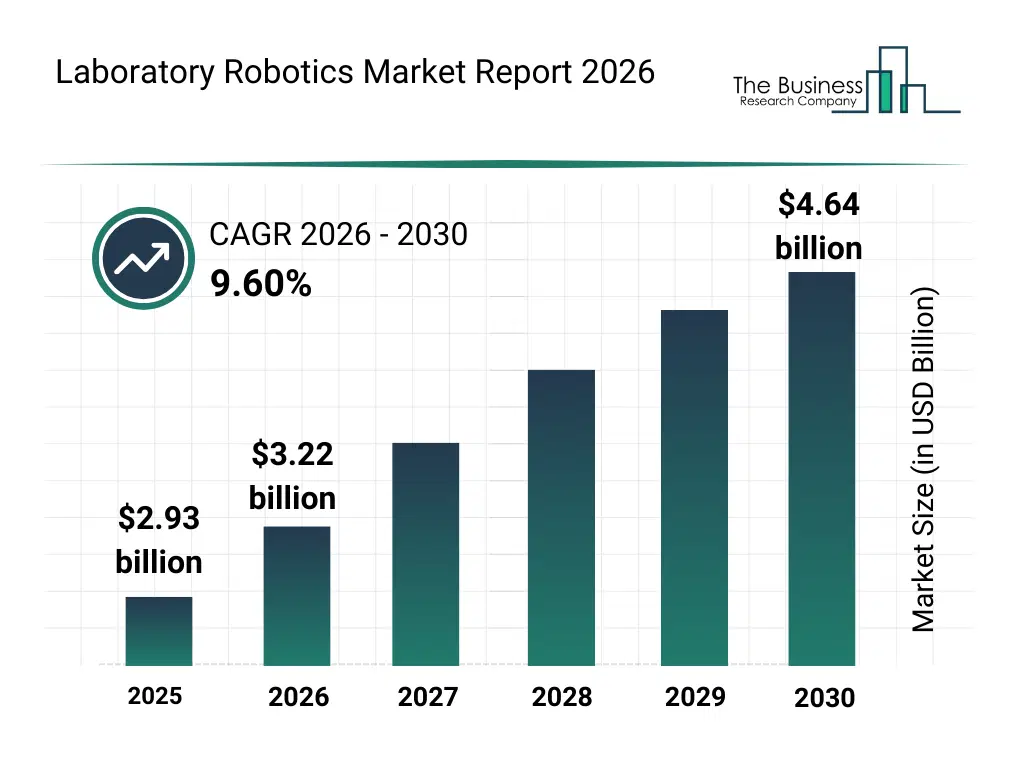
What Is The Laboratory Robotics Market Size and Share 2026?
The laboratory robotics market size has grown strongly in recent years. It will grow from $2.93 billion in 2025 to $3.22 billion in 2026 at a compound annual growth rate (CAGR) of 9.9%. The growth in the historic period can be attributed to manual sample handling practices, limited automation in laboratories, high labor dependency, growing research laboratory infrastructure, increasing demand for precision and reproducibility.What Is The Laboratory Robotics Market Growth Forecast?
The laboratory robotics market size is expected to see strong growth in the next few years. It will grow to $4.64 billion in 2030 at a compound annual growth rate (CAGR) of 9.6%. The growth in the forecast period can be attributed to development of advanced robotic arms and automated workstations, integration of ai-driven workflow optimization, rising investment in genomics and proteomics research, expansion of clinical diagnostics facilities, adoption of cloud-based data analysis and visualization platforms. Major trends in the forecast period include increasing adoption of automated liquid handling systems, rising integration of laboratory information management systems (lims), growth in high-throughput screening and sample processing, expansion of robotics in drug discovery and clinical diagnostics, focus on reducing human error and enhancing workflow efficiency.
Global Laboratory Robotics Market Segmentation
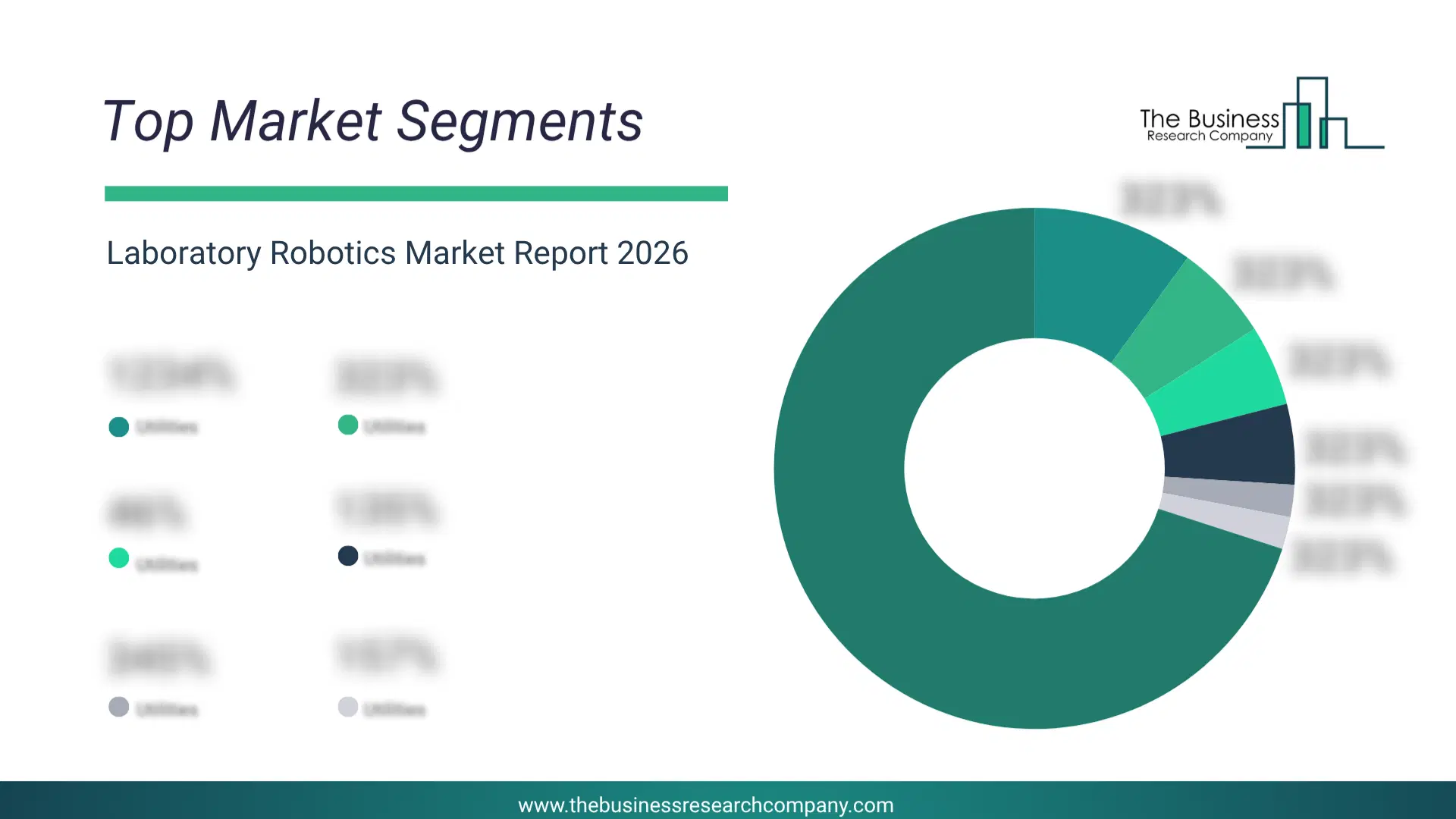
1) By Component: Hardware, Software, Services 2) By Product Type: Automated Liquid Handling Robots, Automated Plate Handlers, Robotic Arms, Lab Automation Workstations, Microplate Readers And Washers 3) By Application: Drug Discovery, Clinical Diagnosis, Microbiology Solutions, Genomics Solutions, Proteomics Solutions 4) By End User: Clinical Laboratory, Research Laboratory Subsegments: 1) By Hardware: Robotic Arms, Automated Liquid Handlers, Microplate Movers, Sample Storage Systems, Sensors And Cameras, Lab-On-A-Chip Devices, Pipetting Robots, Workstations 2) By Software: Workflow Management Software, Data Analysis And Visualization Tools, Robotic Control Software, Laboratory Information Management Systems (LIMS), Scheduling Software, Integration And Interface Software 3) By Services: Installation And Commissioning, Maintenance And Repair, Calibration Services, Training And Support, Software Upgrades And System Integration, Validation And Compliance ServicesWhat Is The Driver Of The Laboratory Robotics Market?
The increase in research and clinical trials is expected to propel the growth of the laboratory robotics market going forward. Research and clinical trials refer to systematic investigations conducted to discover, evaluate, and validate the safety, efficacy, and optimal use of new drugs, therapies, or medical technologies in human subjects. The rise in research and clinical trials is due to the increasing prevalence of complex and chronic diseases, driving demand for new and more effective treatment options. Laboratory robotics enhances research and clinical trials by automating repetitive tasks, increasing efficiency, and reducing human error. They accelerate experimental workflows, improve data accuracy, and support high-throughput screening, advancing the pace and quality of scientific discoveries. For instance, in December 2024, according to the Association of the British Pharmaceutical Industry (ABPI), a UK-based organization, highlighted that the number of pharmaceutical industry trials launched in the UK increased for the second consecutive year, rising from 411 in 2022 to 426 in 2023. Therefore, the increase in research and clinical trials is driving the growth of the laboratory robotics industry.Key Players In The Global Laboratory Robotics Market
Major companies operating in the laboratory robotics market are Thermo Fisher Scientific Inc., Agilent Technologies Inc., Sartorius AG, PerkinElmer Inc., Beckman Coulter Life Sciences, Tecan Group Ltd., Hamilton Company, Hudson Robotics Inc., Peak Analysis & Automation (PAA), Opentrons Labworks Inc., HighRes Biosolutions Inc., Aurora Biomed Inc., AutoGen Inc., Robotic Automation Inc., Staubli Robotics, KUKA AG, FANUC Corporation, DENSO Robotics, Precise Automation Inc., Labman Automation Ltd., Biosero Inc., Chemspeed Technologies AG, Synchron Lab Automation, SPT Labtech Ltd.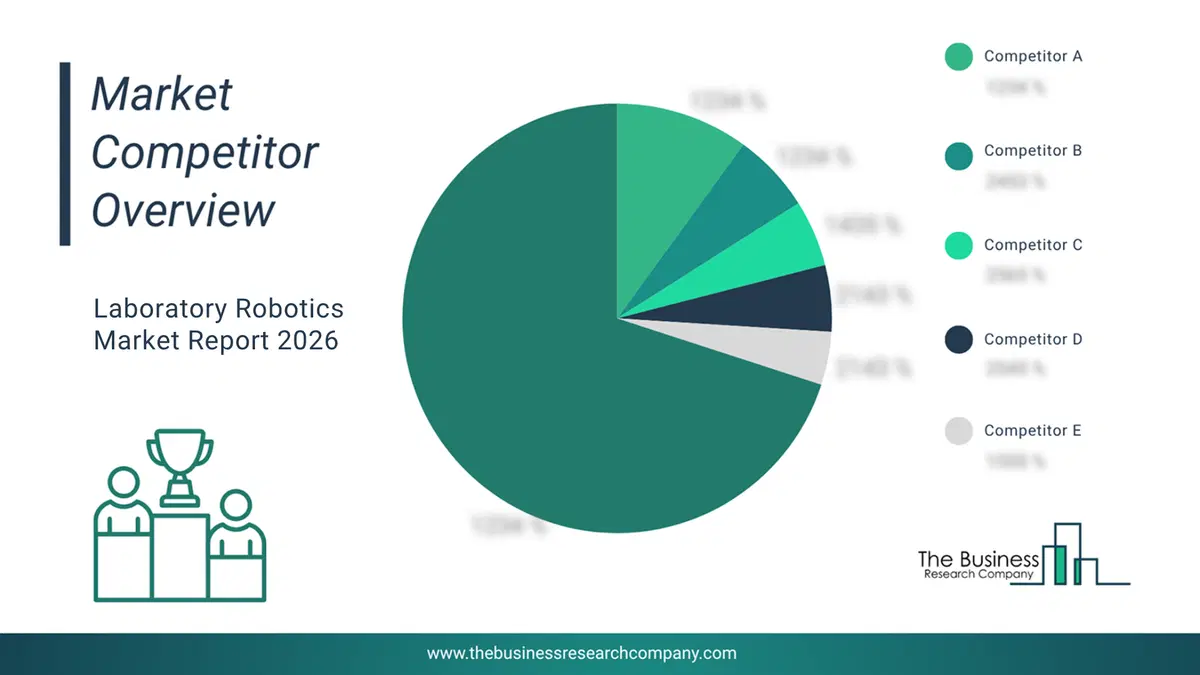
This chart is for illustrative purposes; the full report includes a detailed competitor analysis and comprehensive overview of the top 10 companies in the market.
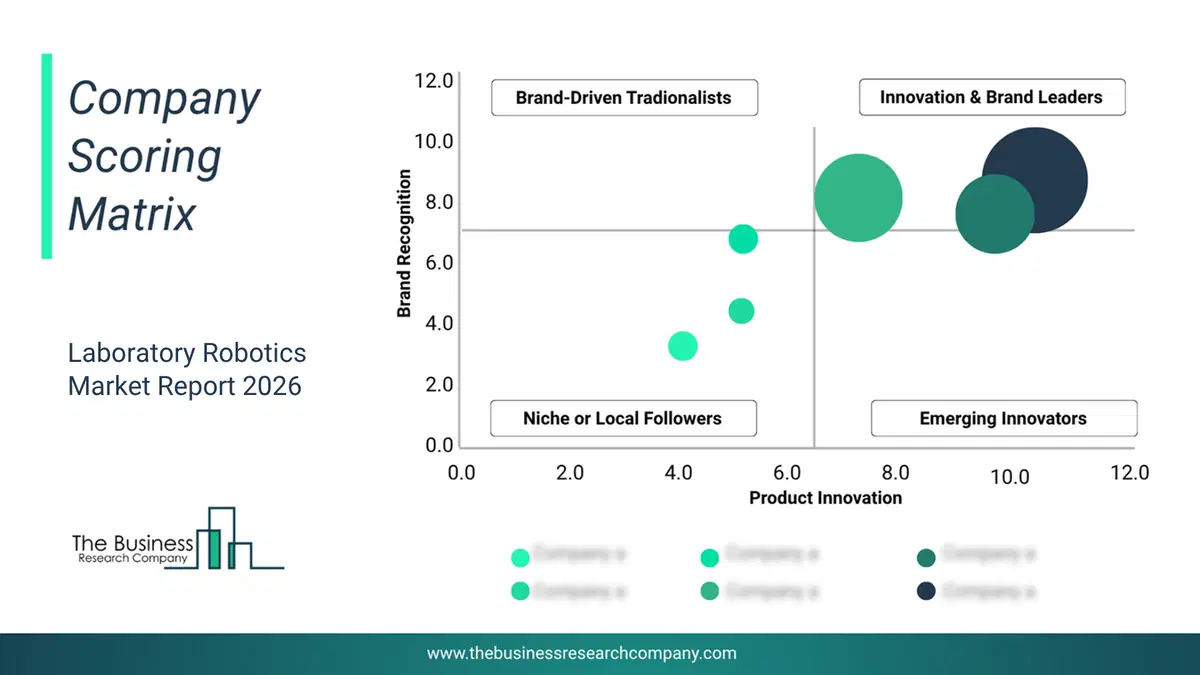
This chart maps companies by product innovation and brand strength, with bubble size indicating relative revenue, helping identify market leaders, challengers, and niche players. This is an illustrative chart; the full report provides a complete and accurate competitive analysis.
Global Laboratory Robotics Market Trends and Insights
Major companies operating in the laboratory robotics market are focusing on developing technologically advanced solutions, such as bipedal humanoid robotic lab assistants, to enhance automation, improve precision, and increase operational efficiency in laboratory workflows. A bipedal humanoid robotic lab assistant refers to a robot designed with two legs and a human-like structure, capable of performing laboratory tasks that typically require human movement and dexterity. For instance, in March 2025, Insilico Medicine, a US-based biotechnology company, launched a bipedal humanoid robot within its fully robotic, AI-powered drug discovery laboratory. This humanoid robot is designed to operate equipment traditionally meant for humans, helping to bridge the gap in automation by handling tasks such as data acquisition, experiment tracking, reagent handling, and lab supervision. The goal is to create a truly autonomous research facility where AI and robotics collaborate seamlessly, reducing the need for human intervention in mundane yet essential lab processes. This development marks a significant advancement toward fully autonomous drug discovery, with the humanoid enhancing efficiency and enabling advanced workflows in both pharmaceutical and broader scientific research.What Are Latest Mergers And Acquisitions In The Laboratory Robotics Market?
In January 2024, Bruker Corporation, a US-based scientific instruments company, acquired Chemspeed Technologies AG for an undisclosed amount. With this acquisition, Bruker aims to strengthen its lab automation by integrating Chemspeed’s modular research and development and quality control solutions, boosting its presence in pharmaceutical, chemical, and materials science markets. Chemspeed Technologies AG is a Switzerland-based lab robotics company specializing in modular automation for research and quality control.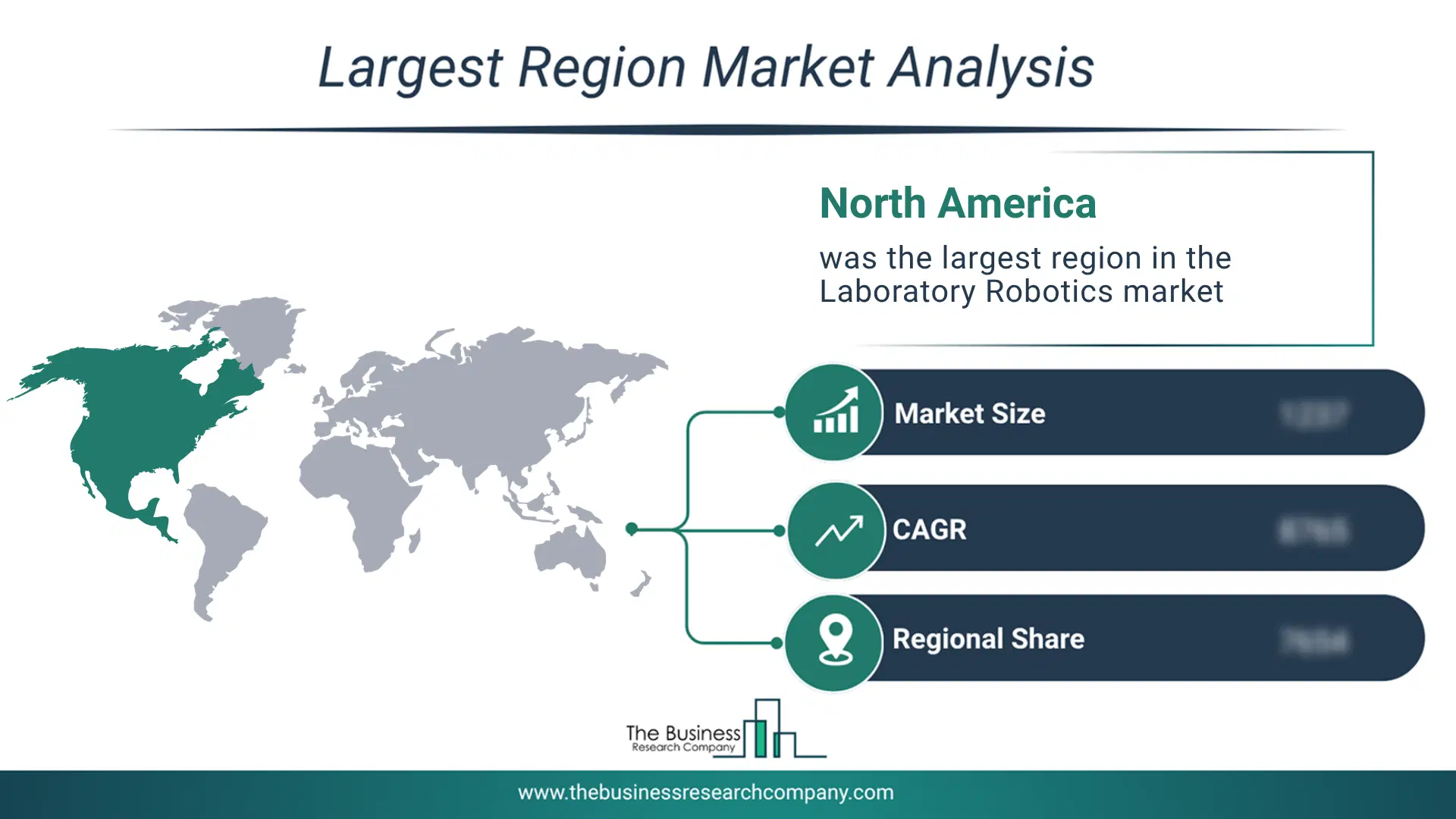
Regional Outlook
North America was the largest region in the laboratory robotics market in 2025. Asia-Pacific is expected to be the fastest-growing region in the forecast period. The regions covered in this market report are Asia-Pacific, South East Asia, Western Europe, Eastern Europe, North America, South America, Middle East, Africa. The countries covered in this market report are Australia, Brazil, China, France, Germany, India, Indonesia, Japan, Taiwan, Russia, South Korea, UK, USA, Canada, Italy, SpainWhat Defines the Laboratory Robotics Market?
The laboratory robotics market consists of revenues earned by entities by providing services such as plate management, labware transportation, data acquisition, system integration, maintenance, and technical support for robotic laboratory systems. The market value includes the value of related goods sold by the service provider or included within the service offering. The laboratory robotics market also includes sales of microplate movers, sample storage and retrieval systems, lab automation software. Values in this market are ‘factory gate’ values, that is, the value of goods sold by the manufacturers or creators of the goods, whether to other entities (including downstream manufacturers, wholesalers, distributors, and retailers) or directly to end customers. The value of goods in this market includes related services sold by the creators of the goods.How is Market Value Defined and Measured?
The market value is defined as the revenues that enterprises gain from the sale of goods and/or services within the specified market and geography through sales, grants, or donations in terms of the currency (in USD unless otherwise specified). The revenues for a specified geography are consumption values that are revenues generated by organizations in the specified geography within the market, irrespective of where they are produced. It does not include revenues from resales along the supply chain, either further along the supply chain or as part of other products.
This chart presents market attractiveness based on a quantitative evaluation of growth, competition, strategic alignment, and risk, offering a clear view of opportunity areas for decision-making. This chart is for illustrative purposes; the full report contains the complete analysis.

This chart highlights the Total Addressable Market (TAM) by estimating the maximum revenue opportunity using an assumption-driven approach, supporting strategic planning and opportunity sizing across markets. The chart is illustrative; the full report provides a more comprehensive analysis.
What Key Data and Analysis Are Included in the Laboratory Robotics Market Report 2026?
The laboratory robotics market research report is one of a series of new reports from The Business Research Company that provides market statistics, including industry global market size, regional shares, competitors with the market share, detailed market segments, market trends and opportunities, and any further data you may need to thrive in the laboratory robotics industry. The market research report delivers a complete perspective of everything you need, with an in-depth analysis of the current and future state of the industry.Laboratory Robotics Market Report Forecast Analysis
| Report Attribute | Details |
|---|---|
| Market Size Value In 2026 | $3.22 billion |
| Revenue Forecast In 2030 | $4.64 billion |
| Growth Rate | CAGR of 9.6% from 2026 to 2030 |
| Base Year For Estimation | 2025 |
| Actual Estimates/Historical Data | 2020-2025 |
| Forecast Period | 2026 - 2030 |
| Market Representation | Revenue in USD Billion and CAGR from 2026 to 2030 |
| Segments Covered | Component, Product Type, Application, End User |
| Regional Scope | Asia-Pacific, Western Europe, Eastern Europe, North America, South America, Middle East, Africa |
| Country Scope | The countries covered in the report are Australia, Brazil, China, France, Germany, India, Indonesia, Japan, Taiwan, Russia, South Korea, UK, USA, Canada, Italy, Spain. |
| Key Companies Profiled | Thermo Fisher Scientific Inc., Agilent Technologies Inc., Sartorius AG, PerkinElmer Inc., Beckman Coulter Life Sciences, Tecan Group Ltd., Hamilton Company, Hudson Robotics Inc., Peak Analysis & Automation (PAA), Opentrons Labworks Inc., HighRes Biosolutions Inc., Aurora Biomed Inc., AutoGen Inc., Robotic Automation Inc., Staubli Robotics, KUKA AG, FANUC Corporation, DENSO Robotics, Precise Automation Inc., Labman Automation Ltd., Biosero Inc., Chemspeed Technologies AG, Synchron Lab Automation, SPT Labtech Ltd. |
| Customization Scope | Request for Customization |
| Pricing And Purchase Options | Explore Purchase Options |