

Life Insurance Rating Systems Market Report 2026
Global Outlook – By Component (Software, Services), By Deployment Mode (On-Premises, Cloud), By Distribution Channel (Direct Sales, Insurance Brokers, Online Platforms, Bancassurance, Independent Agents), By End-User (Insurance Companies, Brokers, Agencies, Other End-Users) – Market Size, Trends, Strategies, and Forecast to 2030
Life Insurance Rating Systems Market Overview
• Life Insurance Rating Systems market size has reached to $3.5 billion in 2025 • Expected to grow to $5.1 billion in 2030 at a compound annual growth rate (CAGR) of 7.8% • Growth Driver: Rise In Cloud Adoption Fuels The Growth Of The Market Due To Cost Efficiency And Real-Time Integration Capabilities • Market Trend: Advancements In AI-Powered Underwriting Tools Transforming Risk Assessment • North America was the largest region in 2025 and Asia-Pacific is the fastest growing region.What Is Covered Under Life Insurance Rating Systems Market?
Life insurance rating systems refer to structured methodologies used by insurance providers to assess and classify the risk level of individuals applying for life insurance coverage. Life insurance rating systems utilize advanced algorithms and data analytics to assess individual risk profiles and determine accurate premium rates for policyholders. The main components of life insurance rating systems include software and services. Software is a suite of tools that automates the calculation of risk, premium, and underwriting decisions for life insurance. They are deployed through different modes, including on-premises and cloud-based solutions, and utilize various distribution channels such as direct sales, insurance brokers, online platforms, bancassurance, and independent agents. The key end-users include insurance companies, brokers, agencies, and others.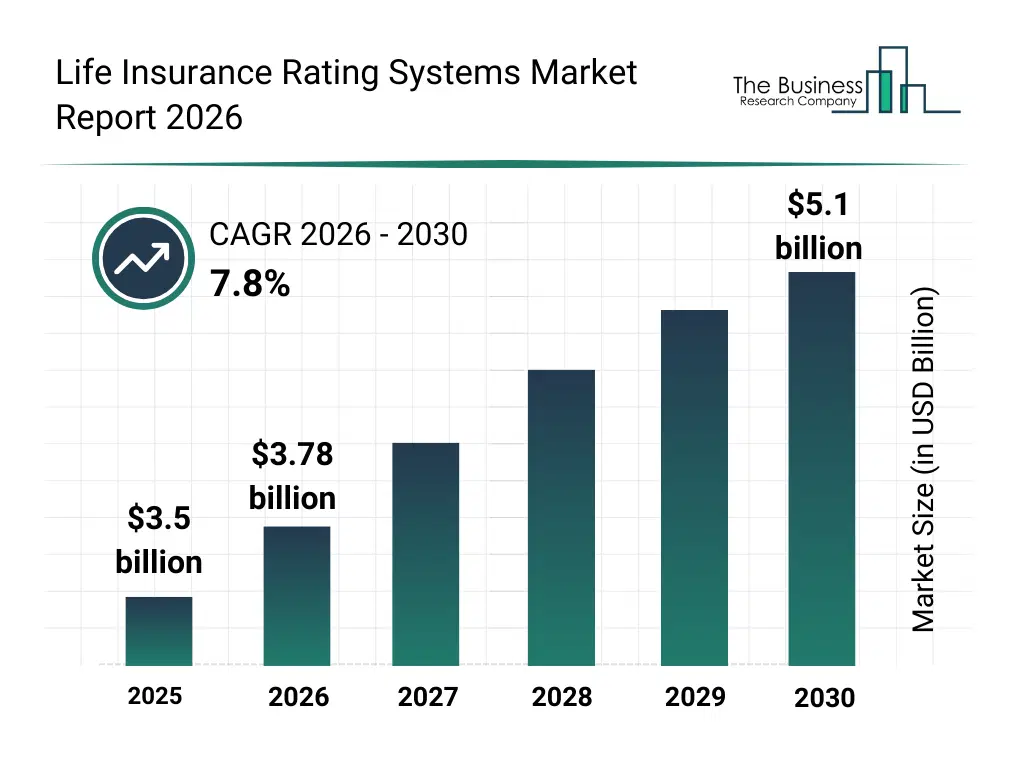
What Is The Life Insurance Rating Systems Market Size and Share 2026?
The life insurance rating systems market size has grown strongly in recent years. It will grow from $3.5 billion in 2025 to $3.78 billion in 2026 at a compound annual growth rate (CAGR) of 8.0%. The growth in the historic period can be attributed to increasing demand for accurate premium pricing, rising policy volumes across life insurance products, expansion of digital underwriting processes, growing reliance on actuarial modeling tools, increased availability of structured consumer data.What Is The Life Insurance Rating Systems Market Growth Forecast?
The life insurance rating systems market size is expected to see strong growth in the next few years. It will grow to $5.1 billion in 2030 at a compound annual growth rate (CAGR) of 7.8%. The growth in the forecast period can be attributed to increasing adoption of real-time risk analytics, rising investments in cloud-native insurance platforms, expansion of personalized premium pricing models, growing regulatory scrutiny on rating transparency, increasing use of alternative data sources. Major trends in the forecast period include increasing adoption of ai-driven risk assessment models, rising use of advanced actuarial analytics platforms, growing integration of cloud-based rating engines, expansion of automated underwriting systems, enhanced focus on predictive risk scoring.
Global Life Insurance Rating Systems Market Segmentation
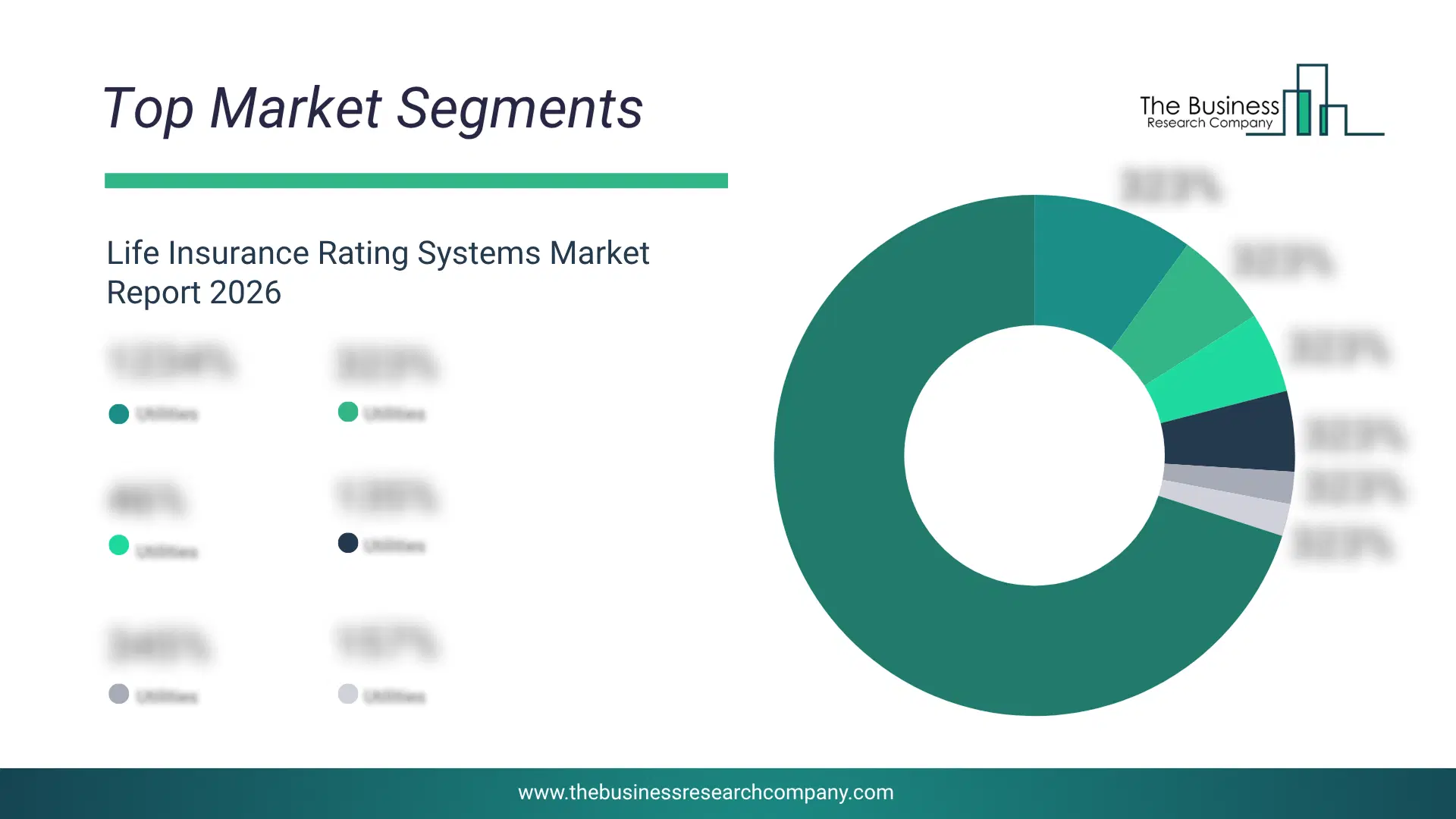
1) By Component: Software, Services 2) By Deployment Mode: On-Premises, Cloud 3) By Distribution Channel: Direct Sales, Insurance Brokers, Online Platforms, Bancassurance, Independent Agents 4) By End-User: Insurance Companies, Brokers, Agencies, Other End-Users Subsegments: 1) By Software: On-Premise Software, Cloud-Based Software, Integrated Policy Administration Systems, Standalone Rating Engines, Actuarial Modeling Tools 2) By Services: Consulting Services, Implementation And Integration Services, Support And Maintenance Services, Training And Education ServicesWhat Is The Driver Of The Life Insurance Rating Systems Market?
The rise in cloud adoption is expected to propel the growth of the life insurance rating systems market going forward. Cloud adoption refers to the process of moving digital assets, services, applications, or IT resources from on-premises infrastructure to cloud-based environments. The growth in cloud adoption is due to cost efficiency, as cloud services eliminate the need for large upfront investments in hardware and allow organizations to pay only for the resources they use. Cloud adoption enhances insurance rating systems by enabling real-time data processing, scalability, and advanced analytics, leading to more accurate and dynamic risk assessments. For instance, in April 2025, according to the American Bar Association, a US-based professional organization, approximately 75% of attorneys reported using cloud computing for work-related tasks, up from 69% in 2023 and about 70% in 2022. Therefore, the rise in cloud adoption is driving the growth of the life insurance rating systems industry.Key Players In The Global Life Insurance Rating Systems Market
Major companies operating in the life insurance rating systems market are Oracle Corporation, CGI Group Inc., LexisNexis Risk Solutions Inc., Milliman Inc., Vertafore Inc., Applied Systems Inc., Majesco Limited, Sapiens International Corporation N.V., Duck Creek Technologies, Insurity Inc., Earnix Ltd, Willis Towers Watson, SAP SE, IBM Corporation, Microsoft Corporation, Salesforce Inc., FINEOS Corporation, Akur8, OneShield Inc., Solartis Inc., Jarus Technologies, Cogitate Technology Solutions Inc., Valuemomentum Inc., Verisk Analytics, EXL Service Holdings Inc., SAS Institute Inc.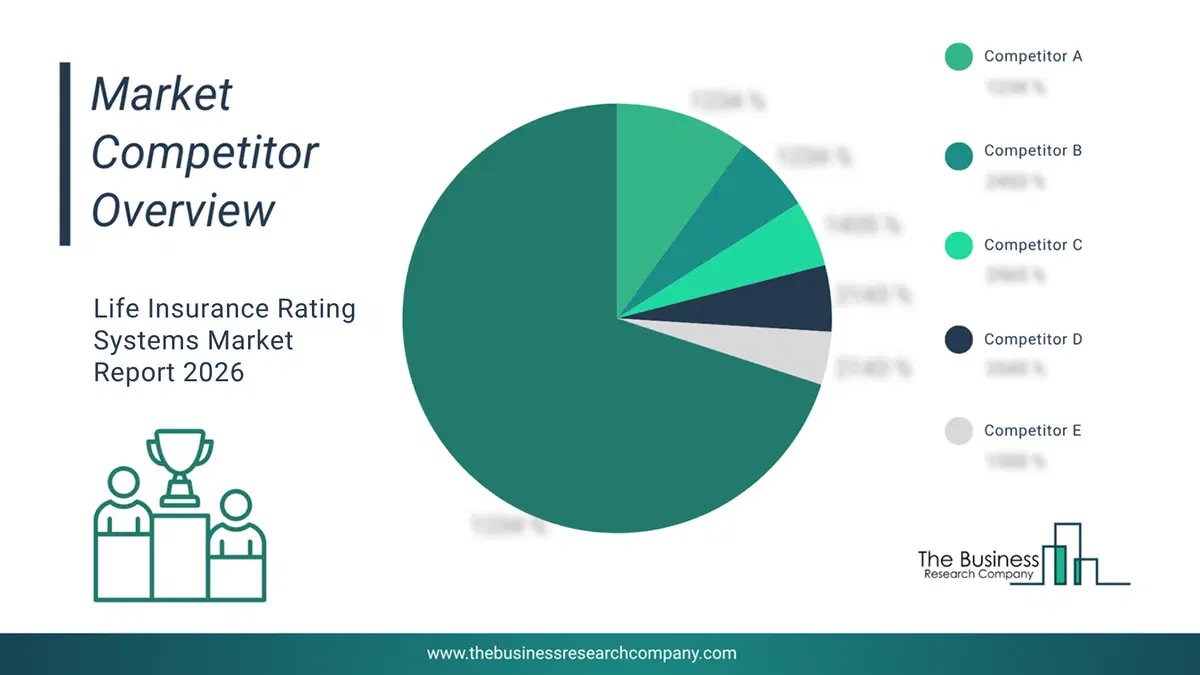
This chart is for illustrative purposes; the full report includes a detailed competitor analysis and comprehensive overview of the top 10 companies in the market.
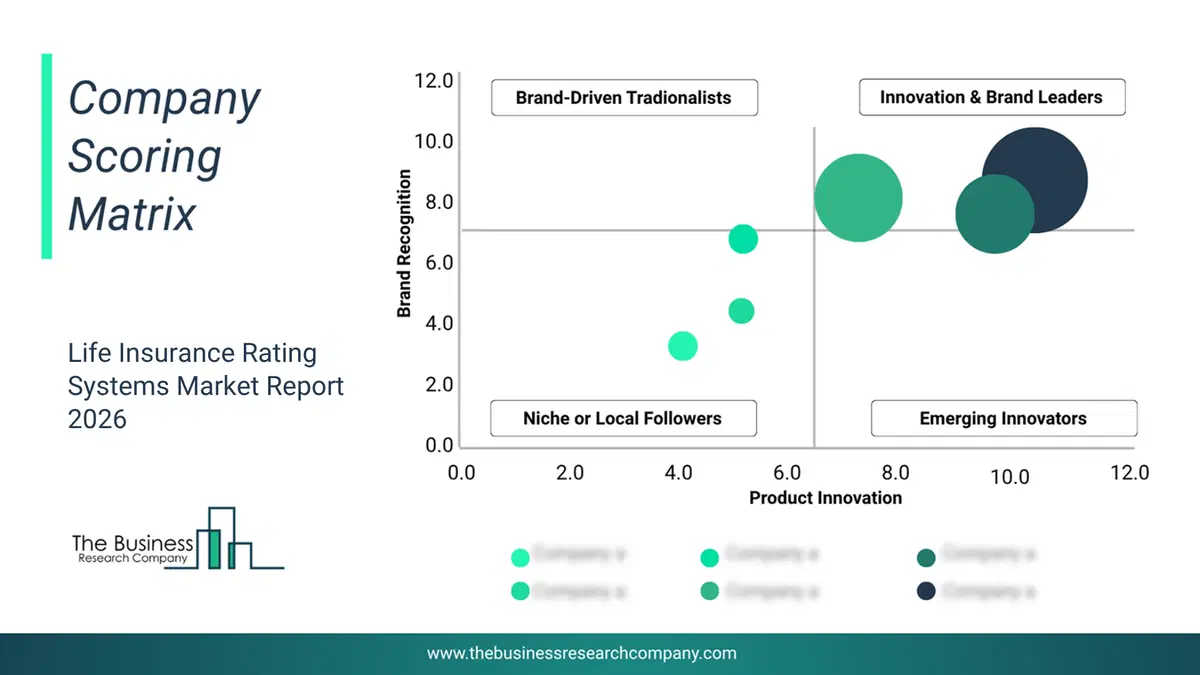
This chart maps companies by product innovation and brand strength, with bubble size indicating relative revenue, helping identify market leaders, challengers, and niche players. This is an illustrative chart; the full report provides a complete and accurate competitive analysis.
Global Life Insurance Rating Systems Market Trends and Insights
Major companies operating in the life insurance rating systems market are focusing on developing innovative solutions, such as artificial intelligence (AI)-powered life insurance underwriting tools, to enhance risk assessment accuracy, streamline policy issuance, and improve customer experience. An AI-powered life insurance underwriting tool refers to a technology solution that uses artificial intelligence and machine learning algorithms to assess applicant risk profiles, analyze medical and behavioral data, and automate underwriting decisions more accurately and efficiently. For instance, in June 2023, Insurance Software Automation, a US-based InsurTech company, launched Best Plan Pro 2.0, an upgraded, AI-powered life insurance underwriting tool designed to make the underwriting process much easier for agents. Leveraging advanced linguistic and pattern-driven AI, the new version instantly compares dozens of insurance products, providing agents with real-time quotes and personalized product recommendations tailored to a client's medical conditions and insurers’ specific requirements. Best Plan Pro 2.0 comes with a more intuitive interface, improved data entry, and automation that allows agents to quickly pre-qualify clients for final expense, term life, or Medicare supplement products, ultimately resulting in faster, more accurate recommendations and a streamlined workflow for life insurance professionals.What Are Latest Mergers And Acquisitions In The Life Insurance Rating Systems Market?
In August 2023, AXA Life & Health Reinsurance Solutions, a Singapore-based provider of reinsurance support to insurance companies, partnered with Verisk to help its insurance partners in Egypt automate health insurance underwriting based on the declared pre-existing medical conditions of their customers. Through this collaboration, AXA aims to enhance its underwriting capabilities by leveraging advanced data analytics to assess health risks more accurately, streamline risk selection processes, and improve pricing strategies in life and health insurance markets. Verisk Analytics is a US-based strategic data analytics company that specializes in life insurance rating systems.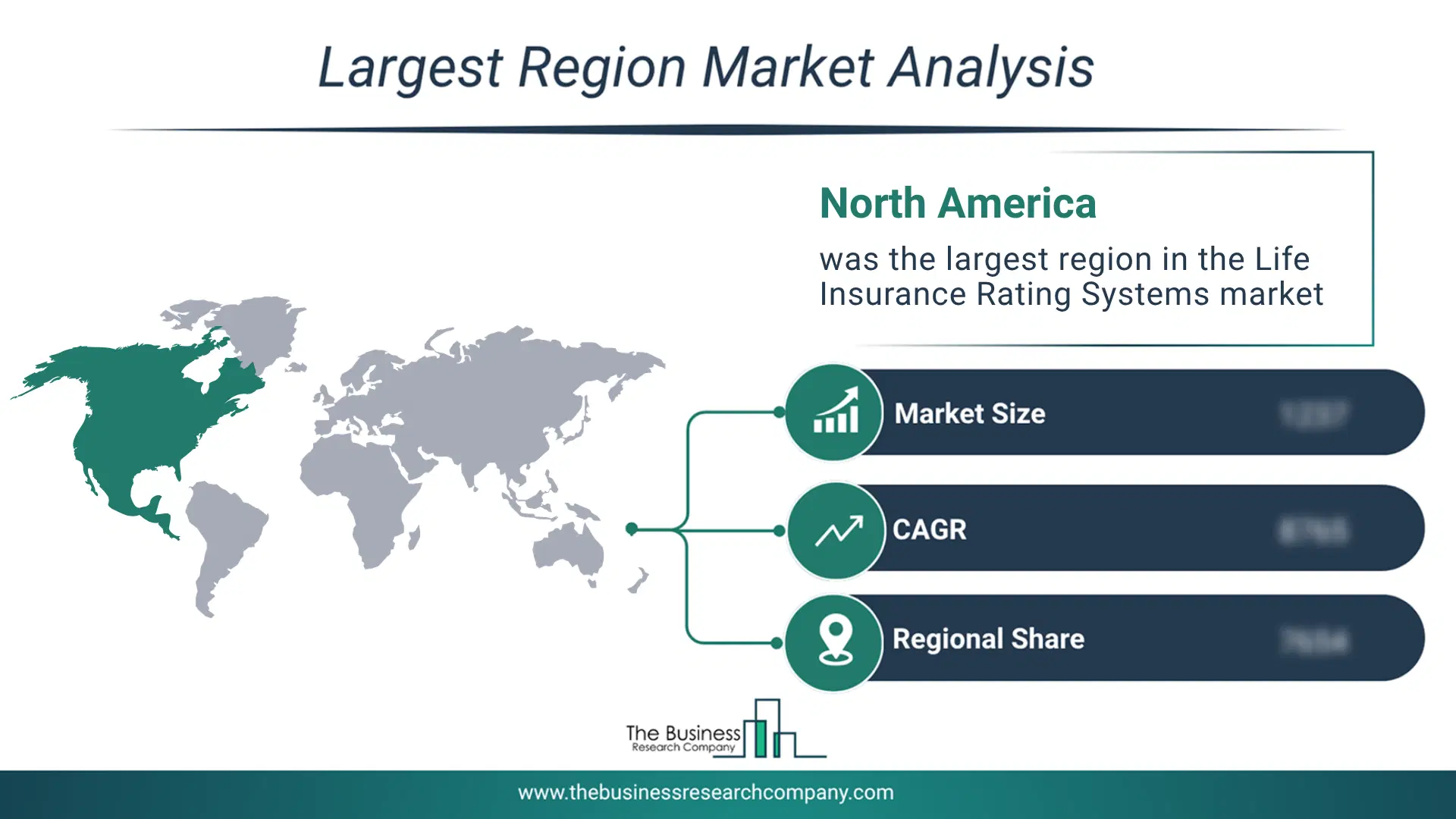
Regional Outlook
North America was the largest region in the life insurance rating systems market in 2025. Asia-Pacific is expected to be the fastest-growing region in the forecast period. The regions covered in this market report are Asia-Pacific, South East Asia, Western Europe, Eastern Europe, North America, South America, Middle East, Africa. The countries covered in this market report are Australia, Brazil, China, France, Germany, India, Indonesia, Japan, Taiwan, Russia, South Korea, UK, USA, Canada, Italy, Spain.What Defines the Life Insurance Rating Systems Market?
The life insurance rating systems market consists of revenues earned by entities by providing services such as automated premium calculation, comparative quoting, multi-carrier integration, and product configuration. The market value includes the value of related goods sold by the service provider or included within the service offering. Only goods and services traded between entities or sold to end consumers are included.How is Market Value Defined and Measured?
The market value is defined as the revenues that enterprises gain from the sale of goods and/or services within the specified market and geography through sales, grants, or donations in terms of the currency (in USD unless otherwise specified). The revenues for a specified geography are consumption values that are revenues generated by organizations in the specified geography within the market, irrespective of where they are produced. It does not include revenues from resales along the supply chain, either further along the supply chain or as part of other products.
This chart presents market attractiveness based on a quantitative evaluation of growth, competition, strategic alignment, and risk, offering a clear view of opportunity areas for decision-making. This chart is for illustrative purposes; the full report contains the complete analysis.

This chart highlights the Total Addressable Market (TAM) by estimating the maximum revenue opportunity using an assumption-driven approach, supporting strategic planning and opportunity sizing across markets. The chart is illustrative; the full report provides a more comprehensive analysis.
What Key Data and Analysis Are Included in the Life Insurance Rating Systems Market Report 2026?
The life insurance rating systems market research report is one of a series of new reports from The Business Research Company that provides market statistics, including Market Report 2026?global market size, regional shares, competitors with the market share, detailed market segments, market trends and opportunities, and any further data you may need to thrive in the life insurance rating systems Market Report 2026? The market research report delivers a complete perspective of everything you need, with an in-depth analysis of the current and future state of the Market Report 2026?Life Insurance Rating Systems Market Report Forecast Analysis
| Report Attribute | Details |
|---|---|
| Market Size Value In 2026 | $3.78 billion |
| Revenue Forecast In 2030 | $5.1 billion |
| Growth Rate | CAGR of 8.0% from 2026 to 2030 |
| Base Year For Estimation | 2025 |
| Actual Estimates/Historical Data | 2020-2025 |
| Forecast Period | 2026 - 2030 |
| Market Representation | Revenue in USD Billion and CAGR from 2026 to 2030 |
| Segments Covered | Component, Deployment Mode, Distribution Channel, End-User |
| Regional Scope | Asia-Pacific, Western Europe, Eastern Europe, North America, South America, Middle East, Africa |
| Country Scope | The countries covered in the report are Australia, Brazil, China, France, Germany, India, Indonesia, Japan, Taiwan, Russia, South Korea, UK, USA, Canada, Italy, Spain. |
| Key Companies Profiled | Oracle Corporation, CGI Group Inc., LexisNexis Risk Solutions Inc., Milliman Inc., Vertafore Inc., Applied Systems Inc., Majesco Limited, Sapiens International Corporation N.V., Duck Creek Technologies, Insurity Inc., Earnix Ltd, Willis Towers Watson, SAP SE, IBM Corporation, Microsoft Corporation, Salesforce Inc., FINEOS Corporation, Akur8, OneShield Inc., Solartis Inc., Jarus Technologies, Cogitate Technology Solutions Inc., Valuemomentum Inc., Verisk Analytics, EXL Service Holdings Inc., SAS Institute Inc. |
| Customization Scope | Request for Customization |
| Pricing And Purchase Options | Explore Purchase Options |