
Lipoid Proteinosis Drug Market Report 2026
Global Outlook – By Drug Type (Retinoids, Anti-inflammatory Agents, Gene Therapy Candidates, Other Drug Types), By Therapy Type (Symptomatic Treatment, Genetic Therapy, Dermatological Care, Other Therapy Types), By Route Of Administration (Oral, Topical, Injectable), By End-Users (Hospitals, Sleep Clinics, Homecare Settings, Other End-Users) – Market Size, Trends, Strategies, and Forecast to 2035
Lipoid Proteinosis Drug Market Overview
• Lipoid Proteinosis Drug market size has reached to $3.45 billion in 2025 • Expected to grow to $5.22 billion in 2030 at a compound annual growth rate (CAGR) of 8.6% • Growth Driver: The Increasing Focus On Rare Disease Diagnosis Driving The Market Growth Through Advancements In Genetic Testing And Early Detection • North America was the largest region in 2025 and Asia-Pacific is the fastest growing region.What Is Covered Under Lipoid Proteinosis Drug Market?
Lipoid proteinosis drugs are therapeutic treatments used to manage and relieve the symptoms of lipoid proteinosis, a rare genetic disorder marked by the buildup of hyaline material in the skin, mucous membranes, and other tissues. These medications help reduce inflammation, improve skin lesions, and support vocal cord function. The main drug types of lipoid proteinosis drug include retinoids, anti-inflammatory agents, gene therapy candidates, and other drug types. Retinoids refer to vitamin A–derived compounds used to manage skin-related symptoms by influencing cellular growth and differentiation in affected tissues. These solutions are based on therapy types such as symptomatic treatment, genetic therapy, dermatological care, and other therapy types. They are administered through oral, topical, and injectable routes and while end users include hospitals, sleep clinics, homecare settings, and other end users.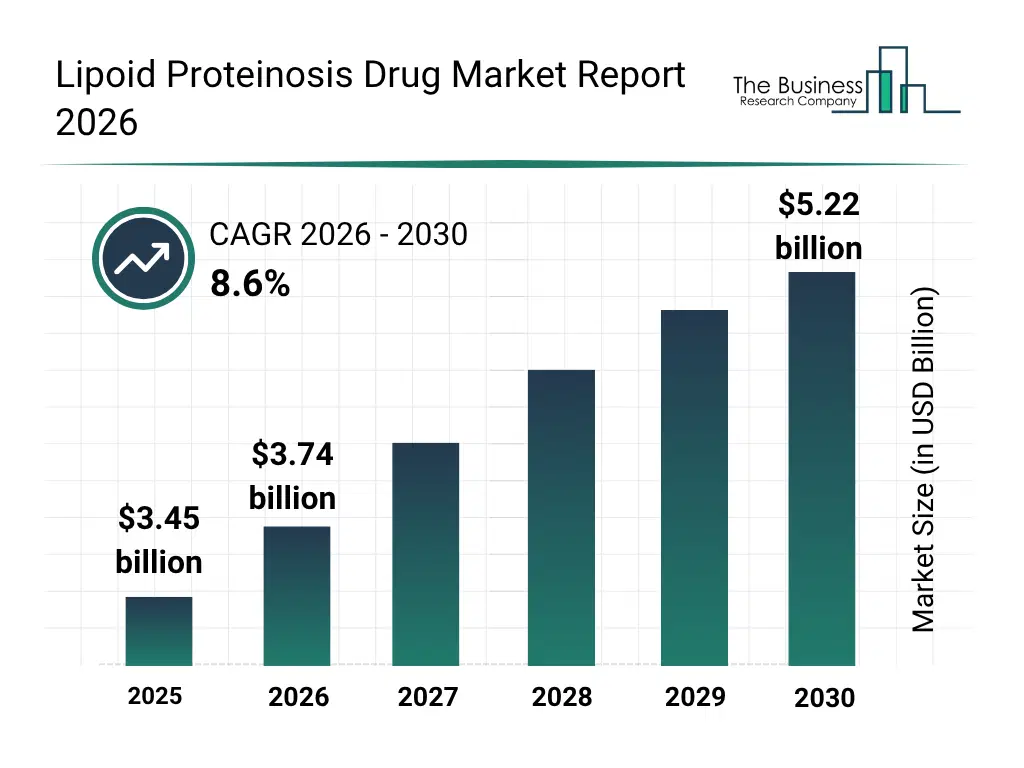
What Is The Lipoid Proteinosis Drug Market Size and Share 2026?
The lipoid proteinosis drug market size has grown strongly in recent years.It will grow from $3.45 billion in 2025 to $3.74 billion in 2026 at a compound annual growth rate (CAGR) of 8.4%. The growth in the historic period can be attributed to limited awareness and delayed diagnosis of rare genetic skin disorders, lack of targeted treatment options for lipoid proteinosis management, reliance on symptomatic and supportive care therapies, slow development of orphan drug pipelines, limited clinical research on hyaline deposition disorders.What Is The Lipoid Proteinosis Drug Market Growth Forecast?
The lipoid proteinosis drug market size is expected to see strong growth in the next few years.It will grow to $5.22 billion by 2030 at a compound annual growth rate (CAGR) of 8.6%. The growth in the forecast period can be attributed to expansion of gene therapy and genome editing research for rare diseases, increasing adoption of precision medicine approaches in dermatology, growth in orphan drug development incentives and regulatory support, rising investment in advanced drug delivery technologies, increasing use of ai based rare disease detection and clinical decision support.Major trends in the forecast period include gene editing based therapeutic approaches for rare dermatological disorders, precision dermatology and personalized drug response profiling, ai driven rare disease diagnosis and treatment optimization, nanotechnology based drug delivery systems for targeted skin repair, regenerative medicine approaches for mucosal and tissue restoration.
Global Lipoid Proteinosis Drug Market Segmentation
1) By Drug Type: Retinoids, Anti-inflammatory Agents, Gene Therapy Candidates, Other Drug Types 2) By Therapy Type: Symptomatic Treatment, Genetic Therapy, Dermatological Care, Other Therapy Types 3) By Route Of Administration: Oral, Topical, Injectable 4) By End-Users: Hospitals, Sleep Clinics, Homecare Settings, Other End-Users Subsegments: 1) By Retinoids: Systemic Retinoids, Topical Retinoids, Synthetic Retinoids 2) By Anti-Inflammatory Agents: Corticosteroids, Non Steroidal Anti Inflammatory Drugs, Immunosuppressive Agents 3) By Gene Therapy Candidates: Viral Vector Based Gene Therapy, Non Viral Gene Delivery Systems, Genome Editing Therapies 4) By Other Drug Types: Antihistamines, Antibiotics, Enzyme Modulating Agents, Supportive Care MedicationsWhat Are The Drivers Of The Lipoid Proteinosis Drug Market?
The increasing focus on rare diseases is expected to propel the growth of the lipoid proteinosis drug industry going forward.Rare diseases are conditions that impact a very small portion of the population and are often long-lasting, severe, and potentially life-threatening.The growing focus on rare diseases is largely driven by expanding regulatory incentives, as government frameworks provide financial benefits, including market exclusivity and tax credits that encourage pharmaceutical companies to invest in developing treatments for previously neglected conditions.The rising attention toward rare diseases accelerates the discovery and clinical development of targeted therapies, directly expanding the pipeline of specialty drugs available for ultra-rare conditions such as lipoid proteinosis.For instance, in October 2024, according to the Cystic Fibrosis Trust, a UK-based national charity, there were 11,148 people living with cystic fibrosis (CF) in the UK in 2022, increasing to 11,318 in 2023.Therefore, the increasing focus on rare diseases is driving the growth of the lipoid proteinosis drug industry. The growing focus on personalized medicine is expected to propel the growth of the lipoid proteinosis drug industry going forward.Personalized medicine is a healthcare approach that customizes treatments and clinical decisions based on an individual’s genetic makeup, lifestyle, and unique disease profile.The rise in focus on personalized medicine is due to increasing efforts by policymakers, clinicians, and research institutions to improve treatment relevance and outcomes while minimizing unnecessary interventions.Lipoid proteinosis drug development supports personalized medicine by targeting disease mechanisms and patient-specific pathological features to improve symptom management and therapeutic efficacy.For instance, in February 2024, according to the Personalized Medicine Coalition, a US-based nonprofit organization, the U.S.Food and Drug Administration approved 16 new personalized treatments for rare disease patients in 2023 compared with 6 in 2022, more than doubling the number of rare disease personalized therapy approvals year-over-year.Therefore, the growing focus on personalized medicine is driving the growth of the lipoid proteinosis drug industry. The rising healthcare expenditure is expected to propel the growth of the lipoid proteinosis drug industry going forward.Healthcare expenditure refers to the total spending by public and private entities on health goods and services, including medicines, treatments, and hospital care, that support overall access to medical innovations and therapies.The rise in healthcare expenditure is due to aging populations and higher demand for advanced medical treatments, which require greater resource allocation.Rising healthcare expenditure enhances the development and accessibility of treatments for rare conditions like lipoid proteinosis by supporting research, improving diagnostics, and enabling advanced therapies and better patient care.For instance, in April 2025, according to the Office for National Statistics, a UK-based independent producer of official statistics, in 2024, the UK’s healthcare spending reached around £317 billion, reflecting a 6.5% nominal increase compared with 2023.Therefore, the rising healthcare expenditure is driving the growth of the lipoid proteinosis drug industry.Key Players In The Global Lipoid Proteinosis Drug Market
Major companies operating in the lipoid proteinosis drug market are Johnson & Johnson Services Inc., F Hoffmann-La Roche Ltd, Merck & Co Inc, Pfizer Inc, AbbVie Inc, Bayer AG, Sanofi SA, Novartis AG, AstraZeneca plc, Bristol-Myers Squibb Company, GlaxoSmithKline plc, Eli Lilly and Company, Takeda Pharmaceutical Company Limited, Teva Pharmaceutical Industries Ltd, CSL Limited, Daiichi Sankyo Company Limited, Grifols SA, Sun Pharmaceutical Industries Ltd, Eisai Co Ltd, Aurobindo Pharma Limited, Chiesi Farmaceutici SpA, Dr Reddys Laboratories Ltd, Amneal Pharmaceuticals Inc, Zydus Lifesciences Limited, Alnylam Pharmaceuticals IncRegional Insights
North America was the largest region in the lipoid proteinosis drugs market in 2025. Asia-Pacific is expected to be the fastest-growing region in the forecast period. The regions covered in this market report are Asia-Pacific, South East Asia, Western Europe, Eastern Europe, North America, South America, Middle East and Africa. The countries covered in this market report are Australia, Brazil, China, France, Germany, India, Indonesia, Japan, Taiwan, Russia, South Korea, UK, USA, Canada, Italy, Spain.What Defines the Lipoid Proteinosis Drug Market?
The lipoid proteinosis drugs market consists of sales of dimethyl sulfoxide, d-penicillamine, hyaluronidase, and chloroquine. Values in this market are ‘factory gate’ values, that is, the value of goods sold by the manufacturers or creators of the goods, whether to other entities (including downstream manufacturers, wholesalers, distributors, and retailers) or directly to end customers. The value of goods in this market includes related services sold by the creators of the goods.What is the Market Assessment and Strategic Outlook for the Lipoid Proteinosis Drug Industry?
The lipoid proteinosis drug market research report is one of a series of new reports from The Business Research Company that provides market statistics, including industry global market size, regional shares, competitors with the market share, detailed market segments, market trends and opportunities, and any further data you may need to thrive in the lipoid proteinosis drug industry. The market research report delivers a complete perspective of everything you need, with an in-depth analysis of the current and future state of the industry.What is the Market Assessment and Strategic Outlook for the Lipoid Proteinosis Drug Market Report 2026?
The lipoid proteinosis drug market research report is one of a series of new reports from The Business Research Company that provides lipoid proteinosis drug market statistics, including lipoid proteinosis drug industry global market size, regional shares, competitors with a lipoid proteinosis drug market share, detailed lipoid proteinosis drug market segments, market trends and opportunities, and any further data you may need to thrive in the lipoid proteinosis drug industry. This lipoid proteinosis drug market research report delivers a complete perspective of everything you need, with an in-depth analysis of the current and future scenario of the industry.Lipoid Proteinosis Drug Market Report Forecast Analysis
| Report Attribute | Details |
|---|---|
| Market Size Value In 2026 | $3.74 billion |
| Revenue Forecast In 2035 | $5.22 billion |
| Growth Rate | CAGR of 8.6% from 2026 to 2035 |
| Base Year For Estimation | 2025 |
| Actual Estimates/Historical Data | 2020-2025 |
| Forecast Period | 2026 - 2030 - 2035 |
| Market Representation | Revenue in USD Billion and CAGR from 2026 to 2035 |
| Segments Covered | Drug Type, Therapy Type, Route Of Administration, End-Users |
| Regional Scope | Asia-Pacific, Western Europe, Eastern Europe, North America, South America, Middle East, Africa |
| Country Scope | The countries covered in the report are Australia, Brazil, China, France, Germany, India, Indonesia, Japan, Taiwan, Russia, South Korea, UK, USA, Canada, Italy, Spain. |
| Key Companies Profiled | Johnson & Johnson Services Inc., F Hoffmann-La Roche Ltd, Merck & Co Inc, Pfizer Inc, AbbVie Inc, Bayer AG, Sanofi SA, Novartis AG, AstraZeneca plc, Bristol-Myers Squibb Company, GlaxoSmithKline plc, Eli Lilly and Company, Takeda Pharmaceutical Company Limited, Teva Pharmaceutical Industries Ltd, CSL Limited, Daiichi Sankyo Company Limited, Grifols SA, Sun Pharmaceutical Industries Ltd, Eisai Co Ltd, Aurobindo Pharma Limited, Chiesi Farmaceutici SpA, Dr Reddys Laboratories Ltd, Amneal Pharmaceuticals Inc, Zydus Lifesciences Limited, Alnylam Pharmaceuticals Inc |
| Customization Scope | Request for Customization |
| Pricing And Purchase Options | Explore Purchase Options |