
Lunar Exploration Market Report 2026
Global Outlook – By Component (Spacecraft, Launch Vehicles, Rovers, Instruments, Other Components), By Mission Type (Manned Missions, Unmanned Missions), By Application (Scientific Research, Commercial, National Defense, Other Applications), By End-User (Government, Commercial, Academic, Other End-Users) – Market Size, Trends, Strategies, and Forecast to 2030
Lunar Exploration Market Overview
• Lunar Exploration market size has reached to $12.52 billion in 2025 • Expected to grow to $19.8 billion in 2030 at a compound annual growth rate (CAGR) of 9.5% • Growth Driver: Rising Space Exploration Fueling The Growth Of The Market Due To Advancements In Technologies And Increasing Government Spending • Market Trend: Advanced GPS Tech Boosts Autonomous Moon Missions • North America was the largest region in 2025.What Is Covered Under Lunar Exploration Market?
Lunar exploration refers to the scientific and technological investigation aimed at studying and understanding the Moon’s physical characteristics, environment, and its broader significance in space research. It encompasses missions and activities directed at gaining deeper insights into the Moon’s origin, geological features, and its role in the history of the solar system. The main components of lunar exploration include spacecraft, launch vehicles, rovers, instruments, and others. Spacecraft are vehicles designed for travel or operation in outer space, including orbiters, landers, and modules that transport equipment, instruments, or crews to the Moon. It offers both manned and unmanned missions and is applied for scientific research, commercial, national defense, and others. It is used by various end-users, including government, commercial, academic, and others.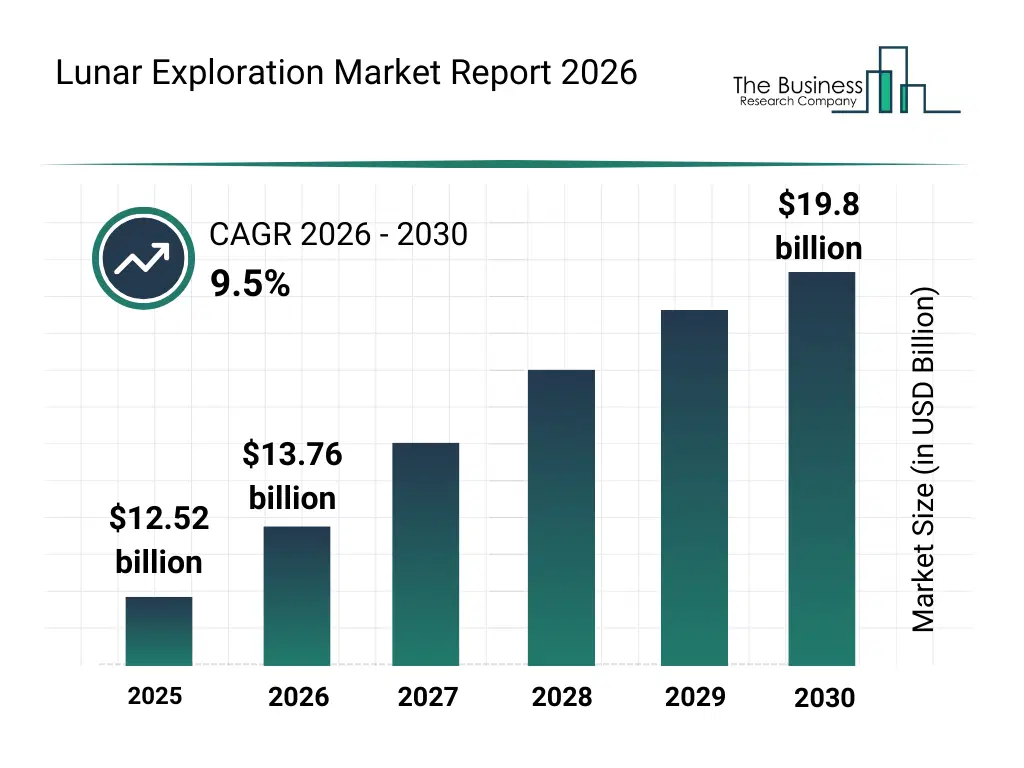
What Is The Lunar Exploration Market Size and Share 2026?
The lunar exploration market size has grown strongly in recent years. It will grow from $12.52 billion in 2025 to $13.76 billion in 2026 at a compound annual growth rate (CAGR) of 9.9%. The growth in the historic period can be attributed to historic government-led lunar missions, development of heavy-lift launch vehicles, advancements in space communication systems, expansion of robotic exploration capabilities, early international space collaborations.What Is The Lunar Exploration Market Growth Forecast?
The lunar exploration market size is expected to see strong growth in the next few years. It will grow to $19.8 billion in 2030 at a compound annual growth rate (CAGR) of 9.5%. The growth in the forecast period can be attributed to increasing investments in lunar infrastructure development, rising interest in lunar resource utilization, expansion of private-sector space missions, growing focus on long-duration lunar habitats, increasing adoption of reusable launch systems. Major trends in the forecast period include increasing deployment of autonomous lunar rovers, rising use of advanced scientific instruments, growing focus on sustainable lunar missions, expansion of commercial lunar programs, enhanced integration of ai-based navigation systems.
Global Lunar Exploration Market Segmentation
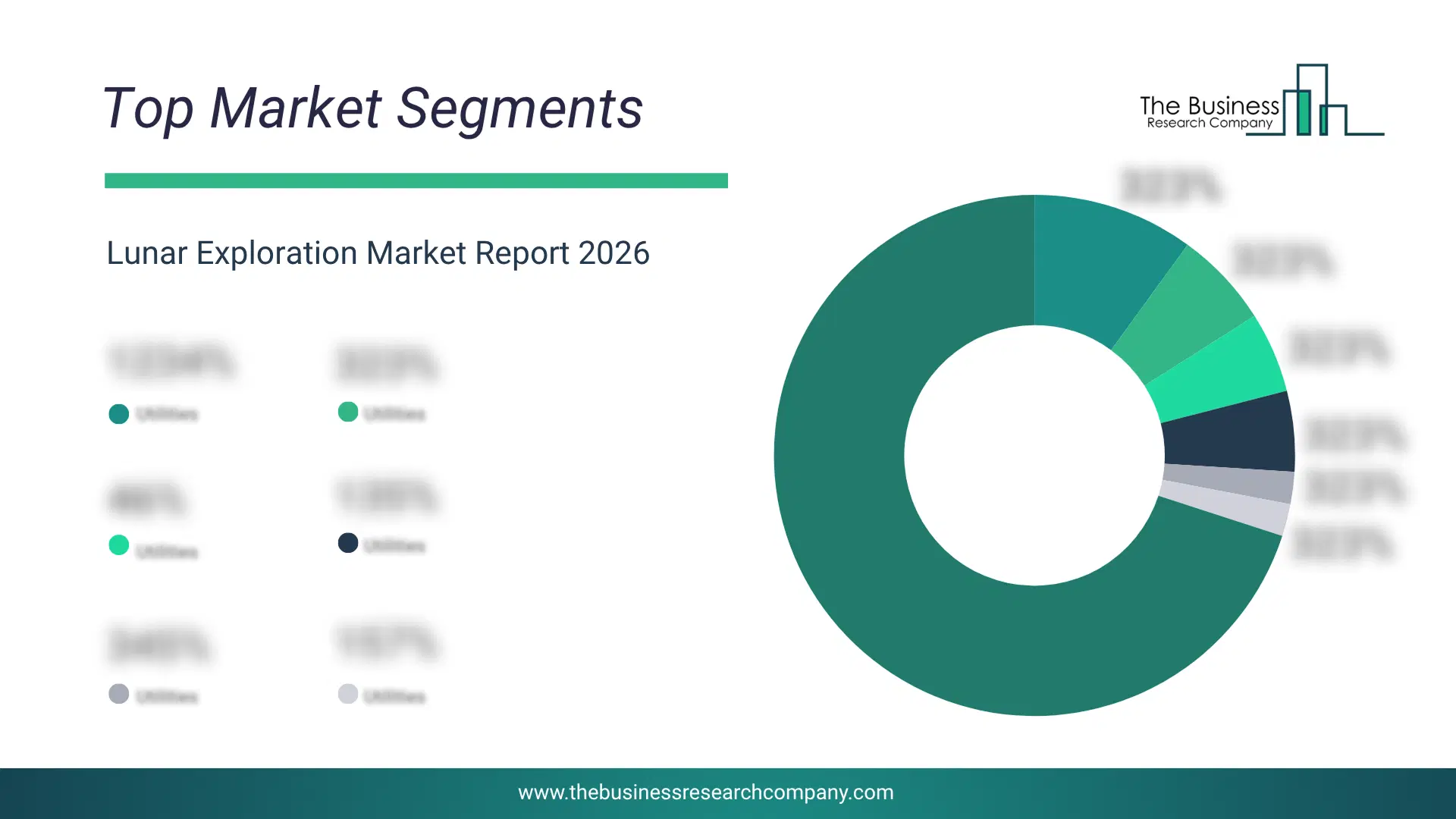
1) By Component: Spacecraft, Launch Vehicles, Rovers, Instruments, Other Components 2) By Mission Type: Manned Missions, Unmanned Missions 3) By Application: Scientific Research, Commercial, National Defense, Other Applications 4) By End-User: Government, Commercial, Academic, Other End-Users Subsegments: 1) By Spacecraft: Orbiter, Lander, Ascent Module, Descent Module, Command Module 2) By Launch Vehicles: Heavy-Lift Launch Vehicles, Medium-Lift Launch Vehicles, Small-Lift Launch Vehicles, Reusable Launch Vehicles, Expendable Launch Vehicles 3) By Rovers: Autonomous Rovers, Remote-Controlled Rovers, Sample Collection Rovers, Exploration Rovers, Communication Rovers 4) By Instruments: Imaging Systems, Spectrometers, Seismometers, Drills And Samplers, Radiation Detectors 5) By Other Components: Power Systems, Navigation Systems, Communication Modules, Thermal Control Systems, Propulsion UnitsWhat Is The Driver Of The Lunar Exploration Market?
The increasing interest in space exploration is expected to propel the growth of the lunar exploration market going forward. Space exploration activities refer to the pursuit of scientific discovery, technological advancement, and commercial opportunities beyond Earth through missions, research, and space-based operations. The space exploration activities are increasing due to the growing demand for advanced communication and Earth observation satellites, as they enable global connectivity, environmental monitoring, and enhanced security. Space exploration aids in lunar exploration by advancing spacecraft technologies, enabling more precise and sustained missions to the Moon. It supports the development of navigation, communication, and landing systems, improving mission efficiency and expanding scientific discovery. For instance, in September 2023, according to Novaspace, a France-based space consulting firm, government spending on space exploration totaled $27 billion in 2024 and is projected to reach nearly $31 billion by 2034. Therefore, the increasing interest in space exploration is driving the growth of the lunar exploration industry.Key Players In The Global Lunar Exploration Market
Major companies operating in the lunar exploration market are SpaceX Corp, Blue Origin LLC, Lockheed Martin Corp, Northrop Grumman Corporation, Airbus SE, Dynetics Inc, Sierra Nevada Corporation, ispace Inc, Astrobotic Technology Inc, Firefly Aerospace, Intuitive Machines, Moon Express Inc, Ceres Robotics Inc, Deep Space Systems, Draper Laboratory, OrbitBeyond Inc, Masten Space Systems Inc, Venturi Astrolab Inc, Lunar Outpost Inc, Rocket Lab USA Inc.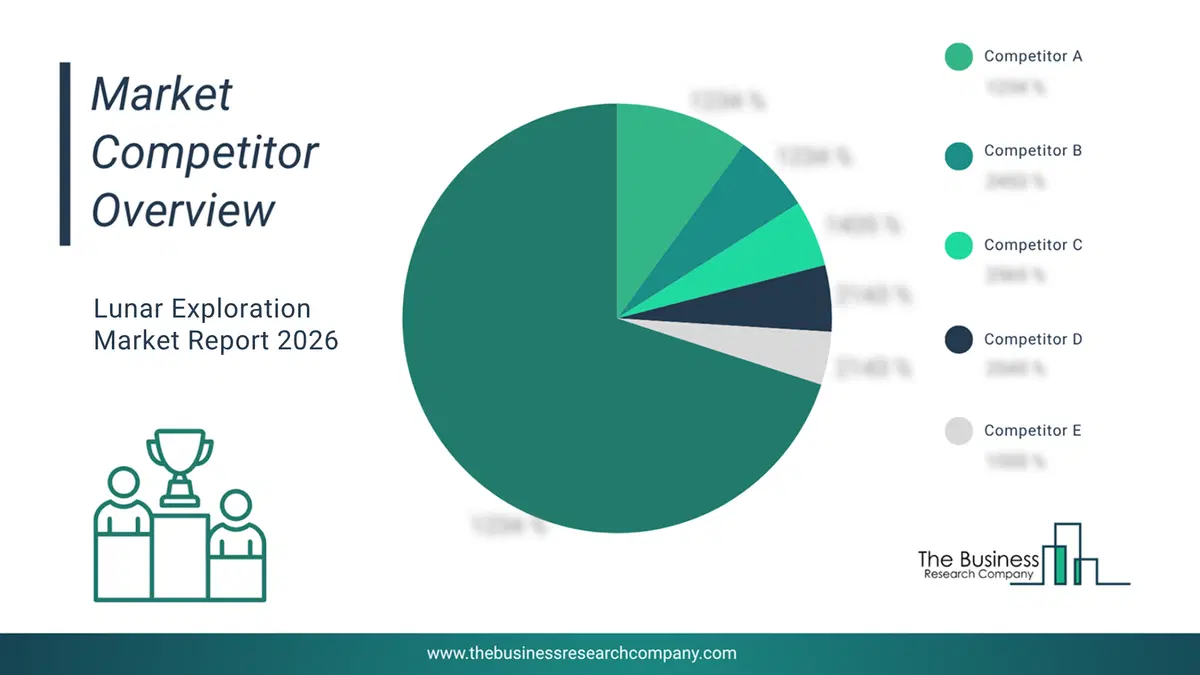
This chart is for illustrative purposes; the full report includes a detailed competitor analysis and comprehensive overview of the top 10 companies in the market.
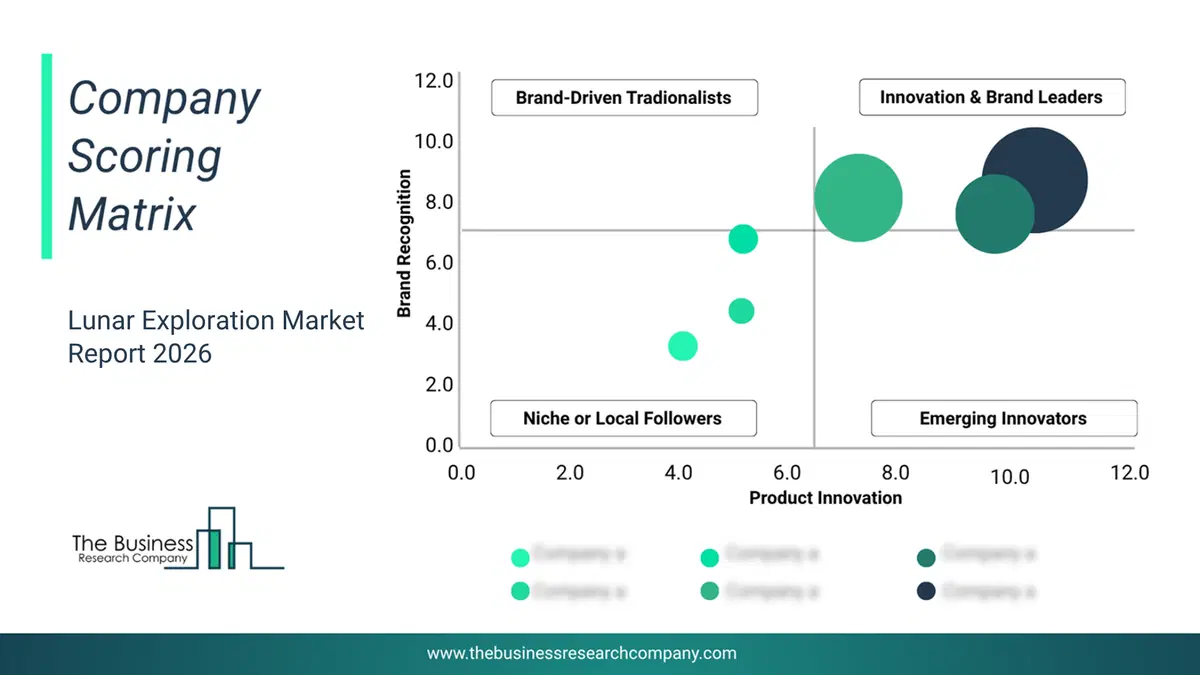
This chart maps companies by product innovation and brand strength, with bubble size indicating relative revenue, helping identify market leaders, challengers, and niche players. This is an illustrative chart; the full report provides a complete and accurate competitive analysis.
Global Lunar Exploration Market Trends and Insights
Major companies operating in the lunar exploration market are focusing on developing advanced solutions, such as global positioning systems (GPS) systems, to support autonomous spacecraft operations. Global positioning system (GPS) systems are navigation technologies that use signals from satellites to determine precise location, movement, and time data for users across the globe. For instance, in June 2025, GMV, a Spain-based technology company, launched the LUPIN GPS system to advance lunar navigation. LUPIN offers a groundbreaking capability by enabling real-time positioning on the Moon without relying on Earth-based navigation, allowing astronauts and rovers to function more independently and efficiently. It ensures uninterrupted navigation even in regions where Earth signals cannot reach, such as deep lunar craters and the far side of the Moon, thereby improving mission safety. The system enhances mapping precision in difficult terrains like the lunar south pole, which is important for future exploration and resource utilization.What Are Latest Mergers And Acquisitions In The Lunar Exploration Market?
In April 2025, Redwire Corporation, a US-based aerospace and defense company, partnered with ispace Technologies U.S. Inc. to introduce commercial lunar missions. This partnership aims to develop and deploy advanced lunar infrastructure, including payload delivery systems and surface operations technologies, to support scientific research, resource utilization, and future human exploration on the Moon. ispace Technologies U.S. Inc. is a US-based lunar exploration company specializing in payload delivery and surface operations on the Moon.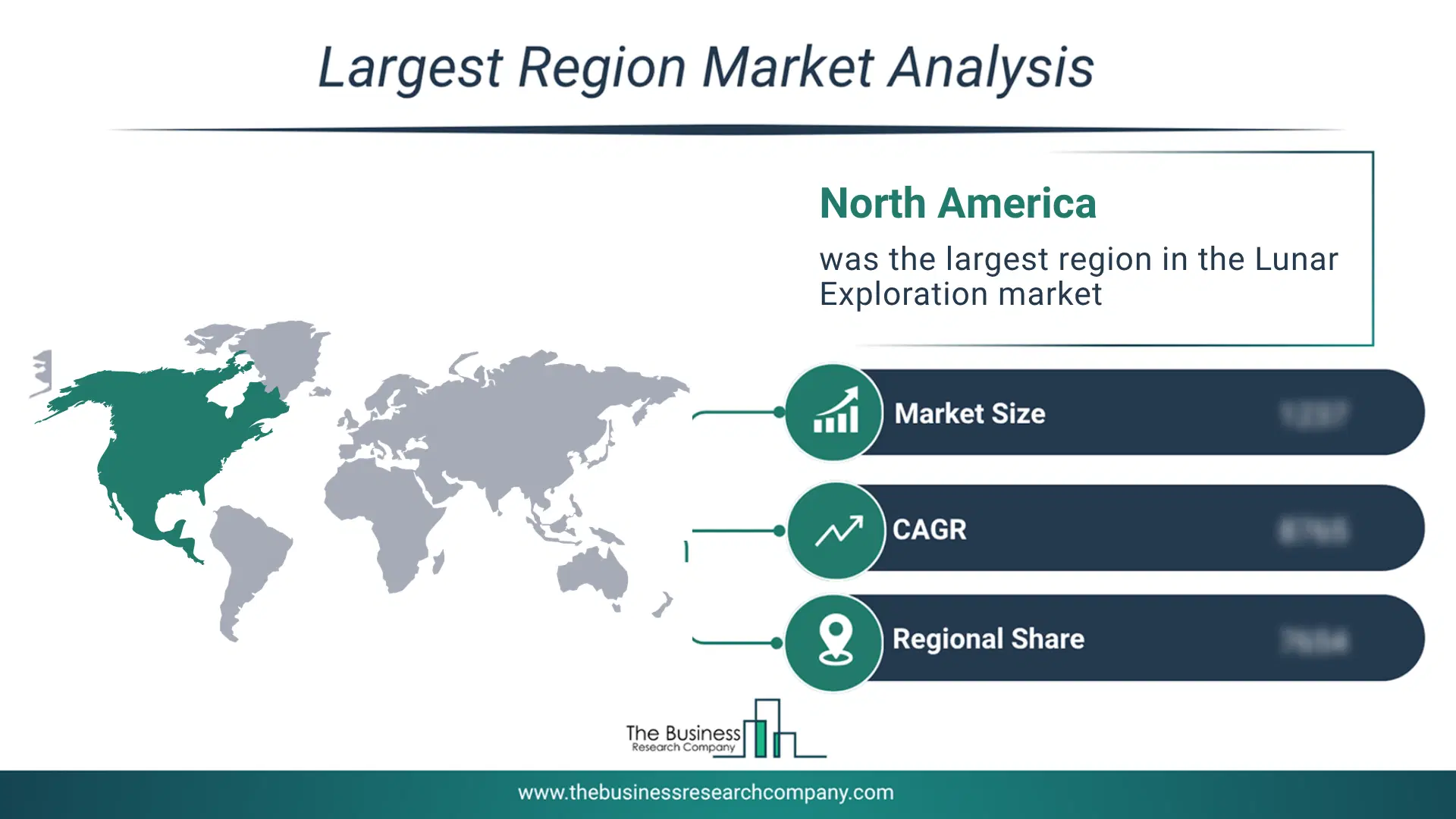
Regional Outlook
North America was the largest region in the lunar exploration market in 2025. The regions covered in this market report are Asia-Pacific, South East Asia, Western Europe, Eastern Europe, North America, South America, Middle East, Africa. The countries covered in this market report are Australia, Brazil, China, France, Germany, India, Indonesia, Japan, Taiwan, Russia, South Korea, UK, USA, Canada, Italy, SpainWhat Defines the Lunar Exploration Market?
The lunar exploration market consists of revenues earned by entities by providing services such as launch services, lunar landing services, payload delivery, and lunar infrastructure development. The market value includes the value of related goods sold by the service provider or included within the service offering. The lunar exploration market also includes sales of lunar landers, orbiters, rovers, propulsion systems, communication modules, navigation instruments, habitat modules, scientific payloads, and related mission-support technologies. Values in this market are ‘factory gate’ values, that is the value of goods sold by the manufacturers or creators of the goods, whether to other entities (including downstream manufacturers, wholesalers, distributors and retailers) or directly to end customers. The value of goods in this market includes related services sold by the creators of the goods.How is Market Value Defined and Measured?
The market value is defined as the revenues that enterprises gain from the sale of goods and/or services within the specified market and geography through sales, grants, or donations in terms of the currency (in USD unless otherwise specified). The revenues for a specified geography are consumption values that are revenues generated by organizations in the specified geography within the market, irrespective of where they are produced. It does not include revenues from resales along the supply chain, either further along the supply chain or as part of other products.
This chart presents market attractiveness based on a quantitative evaluation of growth, competition, strategic alignment, and risk, offering a clear view of opportunity areas for decision-making. This chart is for illustrative purposes; the full report contains the complete analysis.

This chart highlights the Total Addressable Market (TAM) by estimating the maximum revenue opportunity using an assumption-driven approach, supporting strategic planning and opportunity sizing across markets. The chart is illustrative; the full report provides a more comprehensive analysis.
What Key Data and Analysis Are Included in the Lunar Exploration Market Report 2026?
The lunar exploration market research report is one of a series of new reports from The Business Research Company that provides market statistics, including Market Report 2026?global market size, regional shares, competitors with the market share, detailed market segments, market trends and opportunities, and any further data you may need to thrive in the lunar exploration Market Report 2026? The market research report delivers a complete perspective of everything you need, with an in-depth analysis of the current and future state of the Market Report 2026?Lunar Exploration Market Report Forecast Analysis
| Report Attribute | Details |
|---|---|
| Market Size Value In 2026 | $13.76 billion |
| Revenue Forecast In 2030 | $19.8 billion |
| Growth Rate | CAGR of 9.9% from 2026 to 2030 |
| Base Year For Estimation | 2025 |
| Actual Estimates/Historical Data | 2020-2025 |
| Forecast Period | 2026 - 2030 - 2030 |
| Market Representation | Revenue in USD Billion and CAGR from 2026 to 2030 |
| Segments Covered | Component, Mission Type, Application, End-User |
| Regional Scope | Asia-Pacific, Western Europe, Eastern Europe, North America, South America, Middle East, Africa |
| Country Scope | The countries covered in the report are Australia, Brazil, China, France, Germany, India, Indonesia, Japan, Taiwan, Russia, South Korea, UK, USA, Canada, Italy, Spain. |
| Key Companies Profiled | SpaceX Corp, Blue Origin LLC, Lockheed Martin Corp, Northrop Grumman Corporation, Airbus SE, Dynetics Inc, Sierra Nevada Corporation, ispace Inc, Astrobotic Technology Inc, Firefly Aerospace, Intuitive Machines, Moon Express Inc, Ceres Robotics Inc, Deep Space Systems, Draper Laboratory, OrbitBeyond Inc, Masten Space Systems Inc, Venturi Astrolab Inc, Lunar Outpost Inc, Rocket Lab USA Inc. |
| Customization Scope | Request for Customization |
| Pricing And Purchase Options | Explore Purchase Options |