
Marine Interiors Market Report 2026
Global Outlook – By Product (Ceiling And Wall Panels, Lighting, Furniture, Galleys And Pantries, Other Products ), By Ship Type (Commercial, Defense ), By Material (Aluminum, Steel, Joinery, Composites, Other Materials ), By Installation (New, Retrofit ), By Application (Public Area, Passenger Area, Crew Area, Utility Area, Combatant Vessels ) – Market Size, Trends, Strategies, and Forecast to 2030
Marine Interiors Market Overview
• Marine Interiors market size has reached to $4.7 billion in 2025 • Expected to grow to $7.94 billion in 2030 at a compound annual growth rate (CAGR) of 10.8% • Growth Driver: Surging Demand For Cruise Ships Propels Growth In The Marine Interior Market • Market Trend: New Modules To Innovate And Enhancing Client-Participation • Europe was the largest region in 2025.Market Gains By 2030 – Top Opportunities By Segment
Market Gain identifies the most promising market opportunities by highlighting the segments or products expected to generate the highest incremental revenue growth over the next five years.
What Is Covered Under Marine Interiors Market?
Marine interiors refer to the design and outfitting of spaces inside marine vessels. These interiors are crafted with durable, corrosion-resistant, and fire-retardant materials due to the harsh marine environment. Marine interior design combines functionality with comfort and aesthetics. The main products of marine interiors are ceiling and wall panels, lighting, furniture, galleys and pantries and others. Furniture refers to movable articles, such as tables, chairs, desks, or cabinets, required for use or ornament in a house, office. The ship types are commercial and defense, using materials such as aluminum, steel, joinery, composites, and others. The installations used are new, and refit that are fitted in public areas, passenger areas, crew areas, utility areas, and combatant vessels.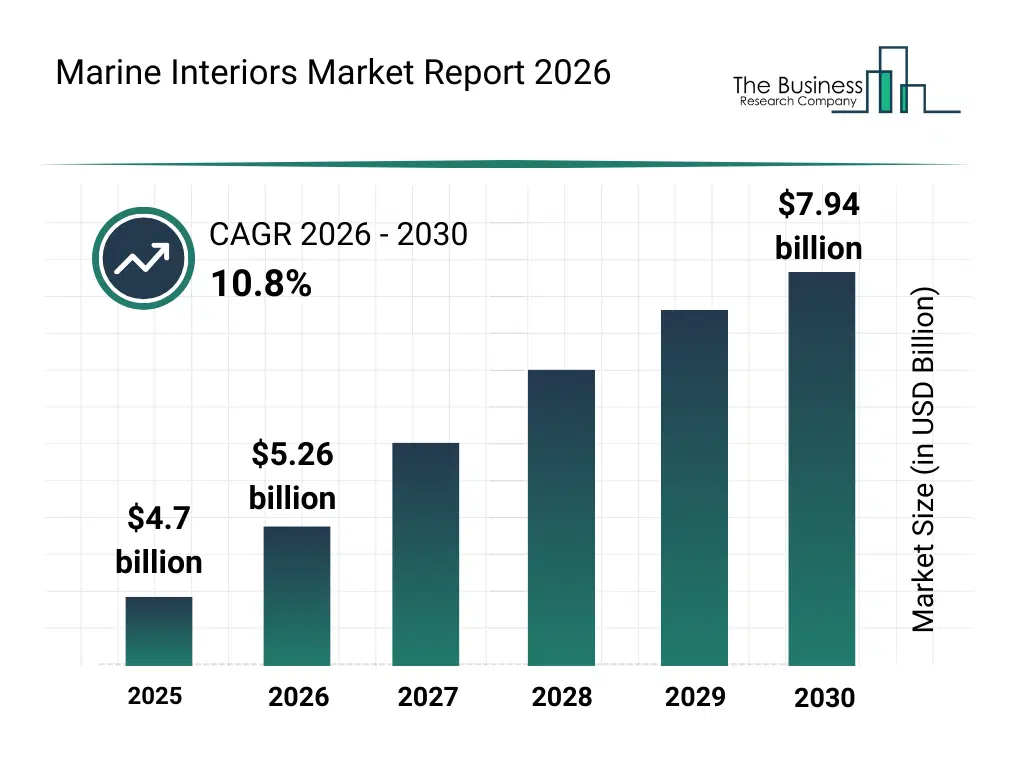
What Is The Marine Interiors Market Size and Share 2026?
The marine interiors market size has grown rapidly in recent years. It will grow from $4.7 billion in 2025 to $5.26 billion in 2026 at a compound annual growth rate (CAGR) of 12.0%. The growth in the historic period can be attributed to growth in commercial shipbuilding increasing demand for durable marine interior components, rising adoption of corrosion-resistant and fire-retardant materials to meet maritime safety standards, expansion of cruise tourism driving upgrades in ship interiors for enhanced passenger comfort, increased deployment of modular interior systems to improve installation efficiency, advancements in marine furniture design improving ergonomics and space utilization.What Is The Marine Interiors Market Growth Forecast?
The marine interiors market size is expected to see rapid growth in the next few years. It will grow to $7.94 billion in 2030 at a compound annual growth rate (CAGR) of 10.8%. The growth in the forecast period can be attributed to growing investment in lightweight and energy-efficient interior materials for fuel-efficient vessel operations, increasing demand for customizable interior solutions across commercial and luxury marine segments, expansion of smart interior technologies integrating climate and occupancy controls, rising focus on sustainable and recyclable materials to meet environmental regulations, development of advanced acoustic and vibration-resistant interior systems enhancing onboard comfort. Major trends in the forecast period include corrosion-resistant and fire-retardant materials, modular interior designs for ships, ergonomic seating and furniture solutions, smart lighting and energy-efficient fixtures, customizable public and passenger areas.
Global Marine Interiors Market Segmentation
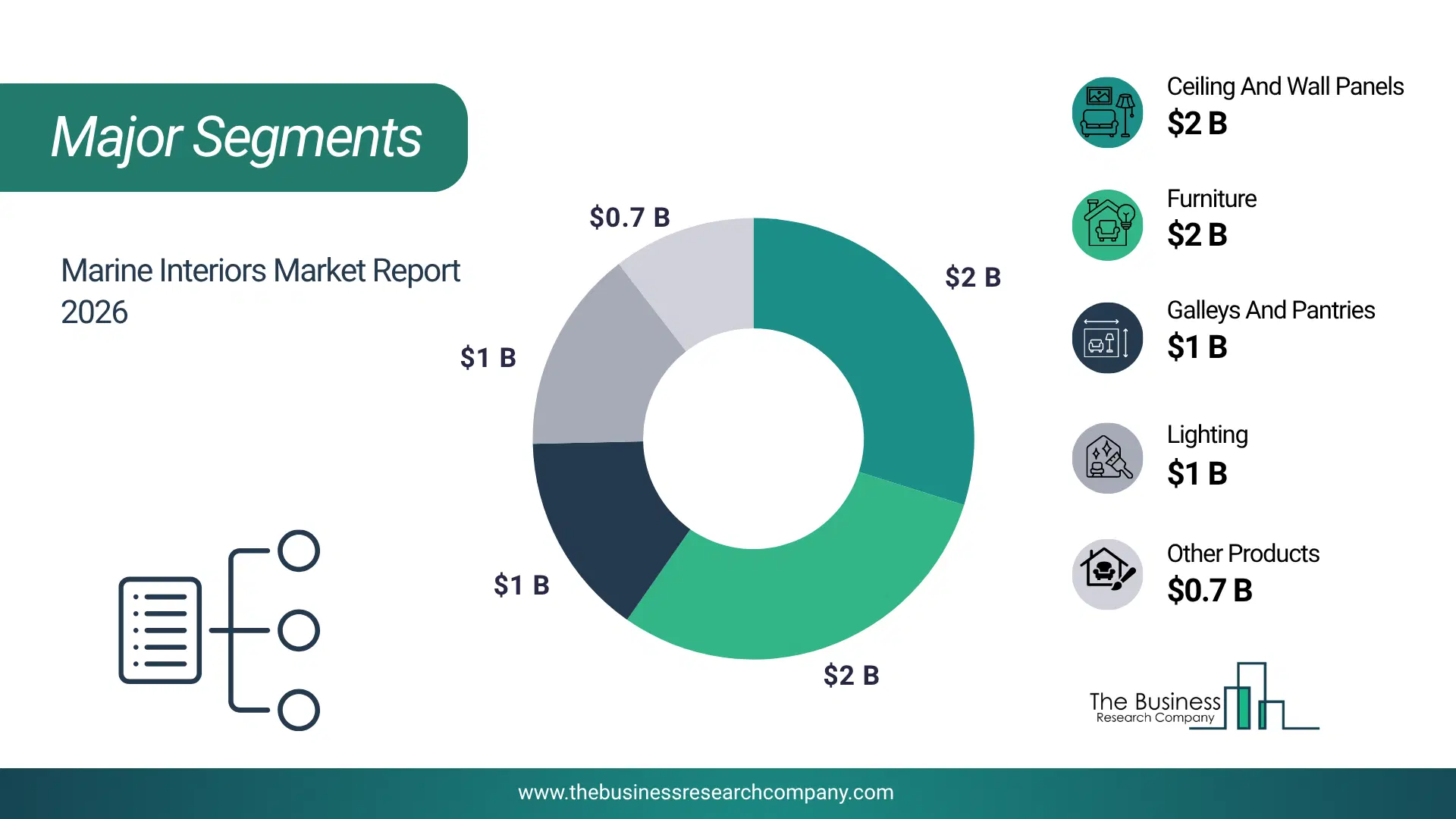
1) By Product: Ceiling And Wall Panels, Lighting, Furniture, Galleys And Pantries, Other Products 2) By Ship Type: Commercial, Defense 3) By Material: Aluminum, Steel, Joinery, Composites, Other Materials 4) By Installation: New, Retrofit 5) By Application: Public Area, Passenger Area, Crew Area, Utility Area, Combatant Vessels Subsegments: 1) By Ceiling And Wall Panels: Acoustic Panels, Decorative Wall Panels, Insulation Panels 2) By Lighting: Ambient Lighting, Task Lighting, Decorative Lighting 3) By Furniture: Seating Solutions, Tables And Desks, Storage Units 4) By Galleys And Pantries: Kitchen Equipment, Storage Solutions, Countertops And Surfaces 5) By Other Products: Flooring Solutions, Window Treatments, Décor And Accessories The top segments in the marine interiors market will be: • Ceiling And Wall Panels will reach $2.44 Billion by 2030. • Furniture will reach $2.18 Billion by 2030. • Galleys And Pantries will reach $1.46 Billion by 2030. • Lighting will reach $1.13 Billion by 2030. • Other Products will reach $0.68 Billion by 2030.What Is Driver Of The Marine Interiors Market?
Increasing demand for cruise ships is expected to propel the growth of the marine interior market going forward. Cruise ships refer to big ships that travels to various ports and brings guests on vacation. Cruise ship interiors help in modifying, renovating, and converting ship galleys, bars, restaurants, pantries, laundries, lounges, restaurants, casinos, spas, fitness centers, as well as cabins and hallways present on the cruise ships. For instance, in September 2023, according to the Cruise Lines International Association (CLIA), a US-based cruise industry trade association, its member cruise lines are set to introduce 44 new ships from 2023 through 2028. Therefore, the increasing demand for cruise ships is driving the growth of the marine interior industry.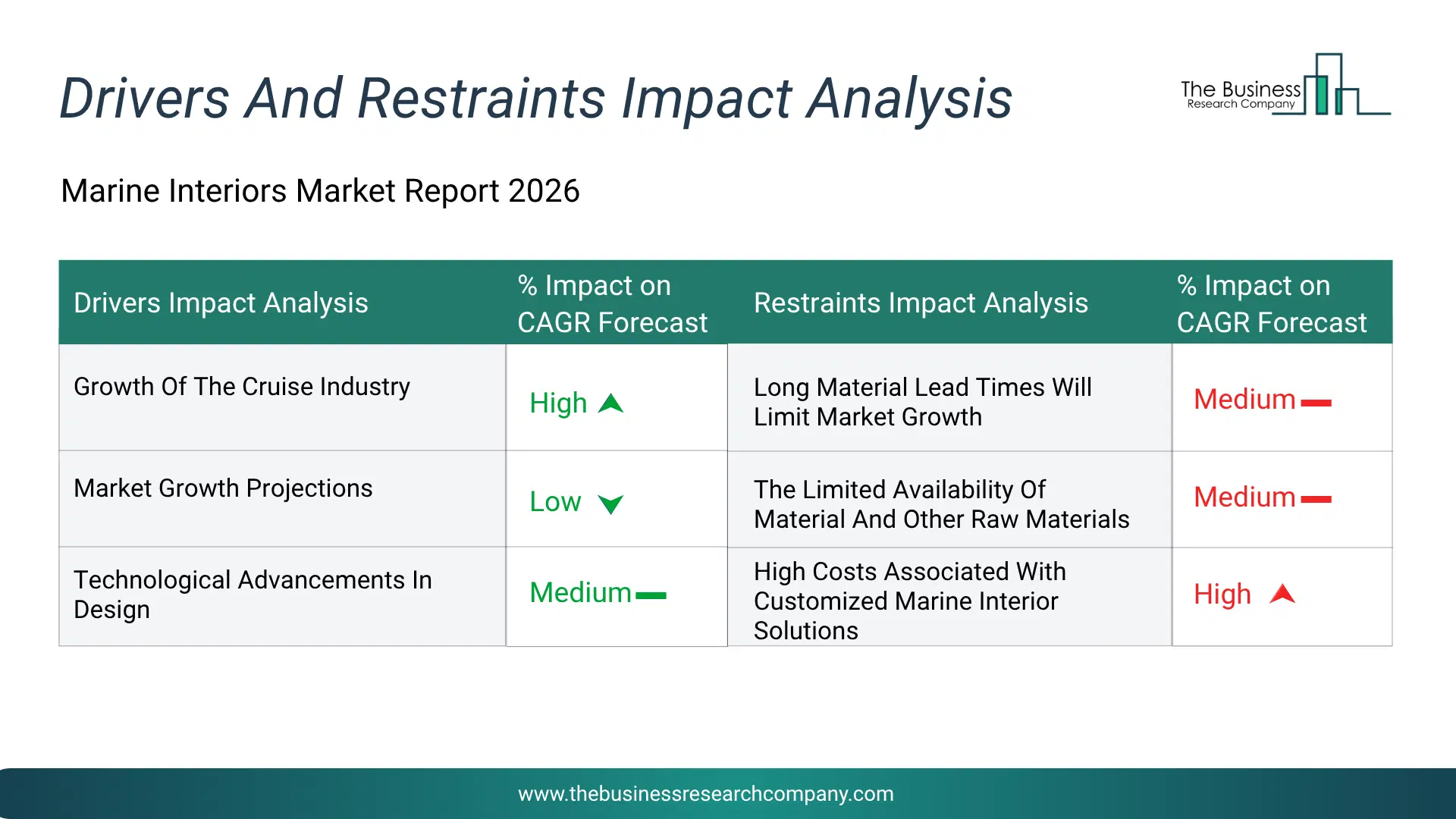
Infographic Chart Showing Key Market Drivers Analysis And Restraints For Marine Interiors Market
The chart presents an impact analysis of key drivers and restraints, quantifying their relative influence on the market's growth rate and helping assess the balance between growth enablers and limiting factors. This chart offers a high-level perspective; the full report contains more detailed insights.
How Will The Drivers Impact Growth In The Global Marine Interiors Market?
• Growth Of The Cruise Industry (High) – During the forecast period, the growth of the cruise industry is expected to become a key growth driver for the marine interiors market by 2030. Rising global demand for leisure travel is encouraging cruise operators to expand fleets and introduce next-generation vessels featuring enhanced interior environments. Shipowners are investing in premium accommodations, entertainment spaces, and aesthetically appealing public areas to attract passengers and improve onboard experiences. The increasing number of cruise ship construction and refurbishment projects is generating sustained demand for advanced interior solutions. • Market Growth Projections (Low) – During the forecast period, the favorable market growth projections are expected to emerge as a major factor driving the expansion of the marine interiors market by 2030. Increasing maritime trade activities, fleet expansion programs, and rising investments in commercial and defense vessels are supporting demand for modern interior systems. Vessel operators are focusing on enhancing operational functionality and onboard comfort through upgraded interior installations. Growing requirements for efficient utilization of onboard spaces are further strengthening adoption across various ship categories. • Technological Advancements In Design (Medium) – During the forecast period, the technological advancements in design are expected to act as a key growth catalyst for the marine interiors market by 2030. Innovations in modular construction techniques, digital design tools, and multifunctional interior concepts are enabling more efficient and customized vessel interiors. Advanced design approaches help improve installation efficiency, optimize available space, and enhance overall vessel performance. The growing integration of smart and adaptable interior solutions is further accelerating modernization efforts across commercial and defense fleets.How Will The Restraints Impact Growth In The Global Marine Interiors Market?
• Long Material Lead Times Will Limit Market Growth (High) – During the forecast period, the long material lead times act as a major restraint in the marine interiors market by delaying the completion and delivery of cruise ships and marine refurbishment projects. Marine interior components such as specialty ceilings, seating systems, luxury furnishings, and customized décor often require complex manufacturing and international sourcing, which increases waiting periods. Delays in receiving these materials disrupt production schedules and increase operational costs for shipbuilders and interior contractors. Extended lead times also create challenges in meeting strict project deadlines, especially in the cruise and hospitality marine sectors where timely vessel deployment is critical. As a result, project postponements and reduced operational efficiency negatively impact the overall growth of the marine interiors market. • The Limited Availability Of Material And Other Raw Materials (Low) – During the forecast period, the limited availability of material and other raw materials restrains the marine interiors market by affecting the continuous production of interior furnishing and construction components. High demand and supply chain disruptions for wood, glass, metals, fabrics, and composite materials create shortages that increase procurement difficulties for manufacturers. These shortages lead to higher material prices, raising the overall cost of marine interior projects and reducing profit margins for companies. Inconsistent supply of raw materials also affects product quality, customization capabilities, and timely installation processes for marine vessels. Consequently, supply limitations slow down market expansion and restrict the ability of manufacturers to fulfill growing demand efficiently. • High Costs Associated With Customized Marine Interior Solutions (Medium) – During the forecast period, the high costs associated with customized marine interior solutions act as a significant restraint by increasing the financial burden on shipbuilders and vessel operators. Luxury cruise ships and premium marine vessels require specialized furniture, advanced décor systems, customized cabins, and high-end finishing materials that involve substantial design and installation expenses. The requirement for compliance with marine safety standards and durability specifications further adds to manufacturing and certification costs. Small and mid-sized operators may hesitate to invest in expensive interior upgrades due to budget constraints and uncertain returns on investment. As a result, high customization costs reduce adoption rates and limit broader market growth within the marine interiors industry.Key Players In The Global Marine Interiors Market
Major companies operating in the marine interiors market are R&M International GmbH, ALMACO Group Inc., Precetti Inc., Kaefer Isoliertechnik GmbH & Co. KG, Marine Interiors S.p.A., Mivan Marine Ltd., Oy Lautex Ab, Bolidt Kunststoftoepassingen B.V., Forbo Flooring Systems GmbH, Tillberg Design of Sweden AB, Aros Marine AS, NORAC AS, Bourne Group Limited, AISTER S.L., YSA Design AS, Trimline Limited, A. Steadman & Son Limited, CDF Industries LLC, Dansk Wilton A/S, Desso Marine B.V., Fincantieri S.p.A., GTF Freese GmbH, H. Henriksen AS, Havelock Europa PLC, Heinen & Hopman Engineering BV, Lufthansa Technik AG, MML Marine Ltd., Ocean Group Inc., P+S Werften GmbH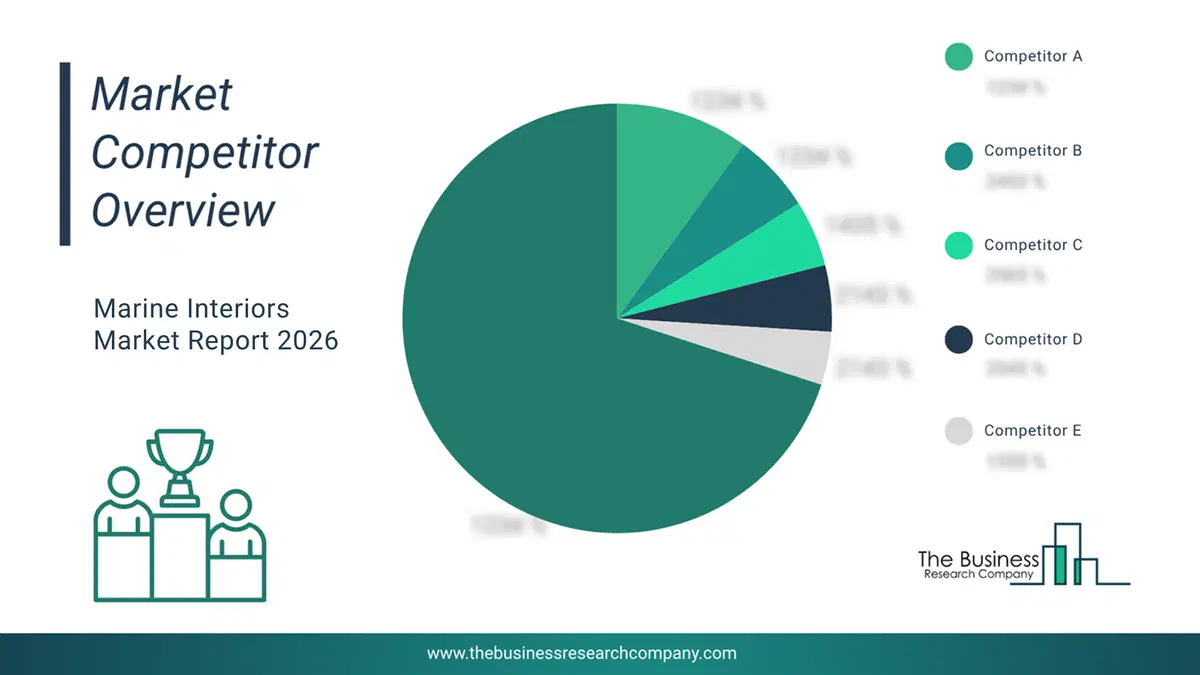
This chart is for illustrative purposes; the full report includes a detailed competitor analysis and comprehensive overview of the top 10 companies in the market.
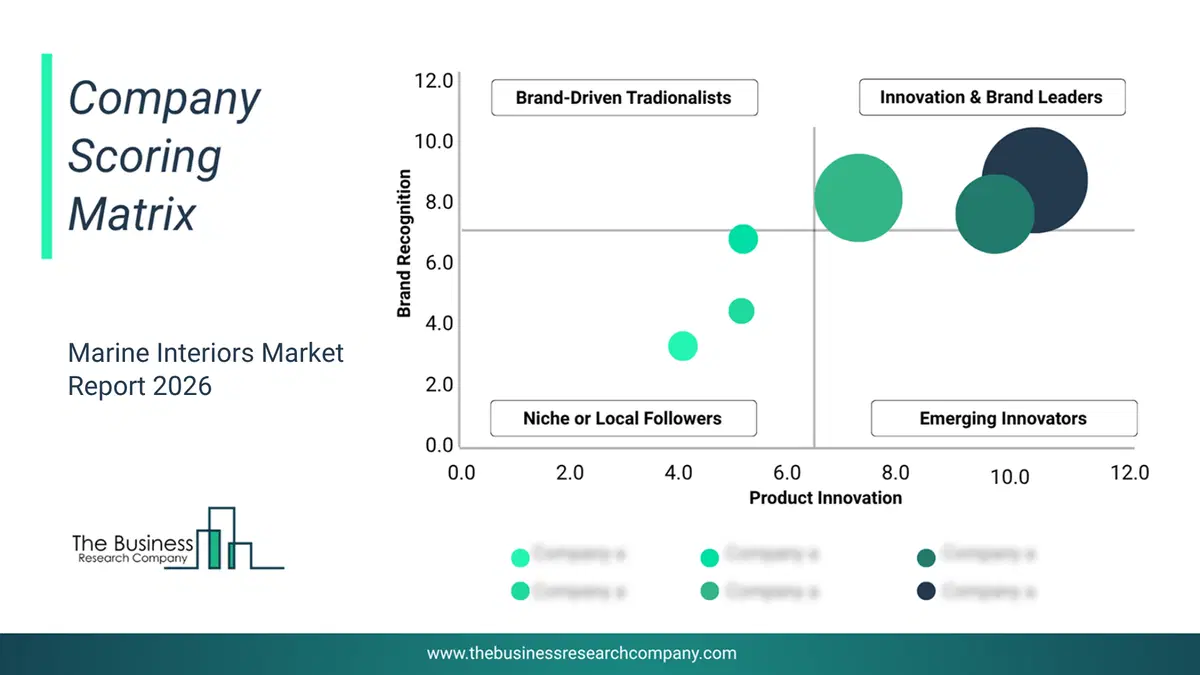
This chart maps companies by product innovation and brand strength, with bubble size indicating relative revenue, helping identify market leaders, challengers, and niche players. This is an illustrative chart; the full report provides a complete and accurate competitive analysis.
Global Marine Interiors Market Trends and Insights
Major companies operating in the marine interiors market are launching new modules, such as the Concept Box, to innovate and enhance client participation. The 'Concept Box' module is a new feature introduced within Trimline's Trimline App (TAPP) software, designed to assist clients in the early stages of marine interior concept and design. For instance, in June 2023, Trimline, a UK-based marine interior outfitter, launched the ‘Concept Box' module in their Trimline App (TAPP) software, featuring AI-powered design capabilities for clients in the early stages of concept and design. Clients can categorize concepts by ship and area on their dashboard, allowing precise exploration of design ideas. The 'Concept Box' enables clients to articulate interior design visions through text input, generating real-time, visually stunning design render ideas. Trimline's commitment to innovation, exemplified by the Concept Box, reinforces its position as a pioneer in the marine interior outfitting industry, enhancing client-designer communication and efficiency.What Are Latest Mergers And Acquisitions In The Marine Interiors Market? Onboard Interiors Acquired Hood Marine Canvas Acquisition
In March 2023, Onboard Interiors, a US-based full-service interior design firm, acquired Hood Marine Canvas for an undisclosed amount. Through this acquisition, Onboard Interiors aimed to combine interior and exterior services, offering a one-stop shop for customers. Hardy Marine is a UK-based marine fabricator, that specializes in high-quality canvas work for boats, particularly excelling in sailboat projects.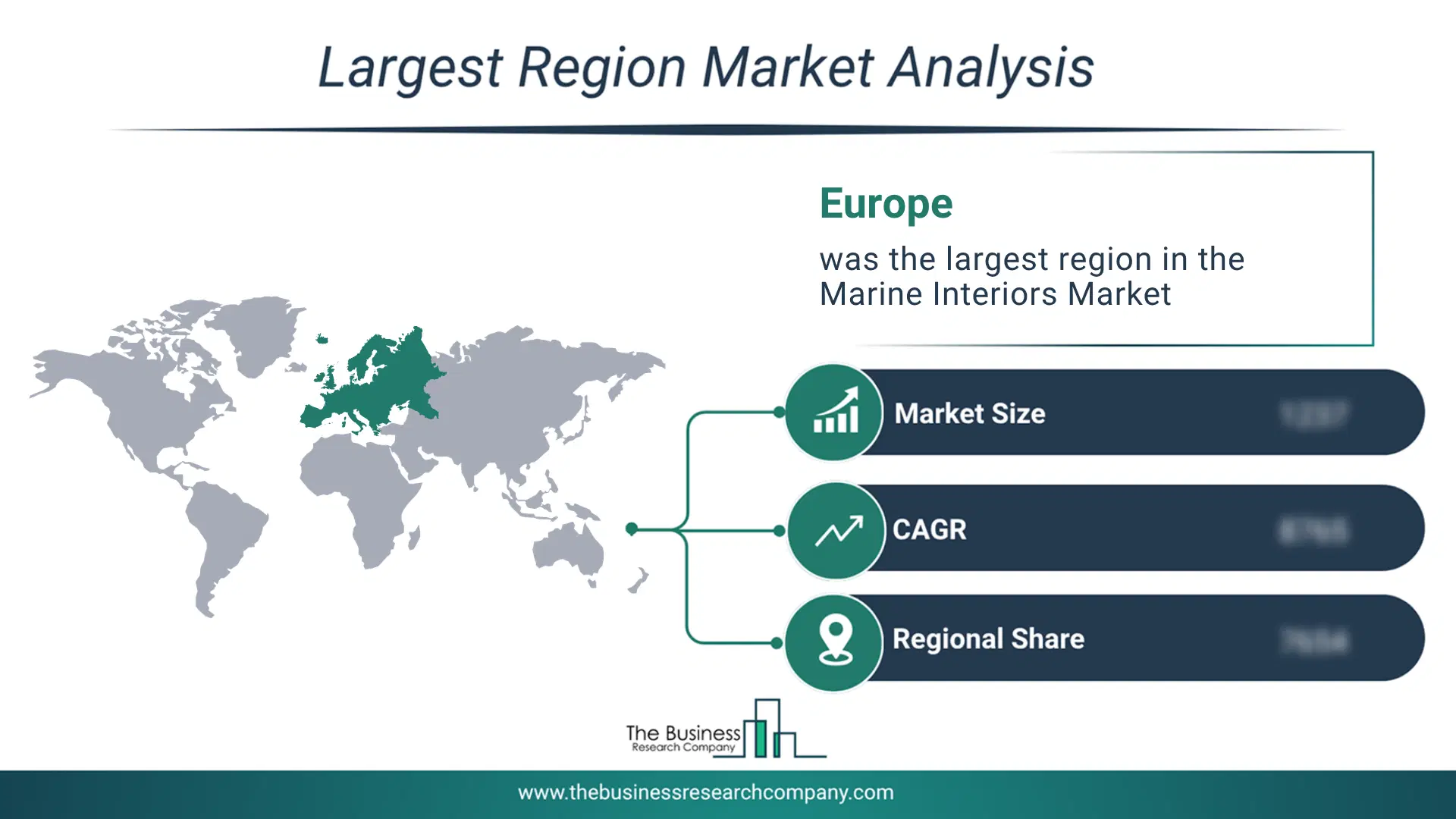
Regional Insights
Europe was the largest region in the marine interiors market in 2025. The regions covered in this market report are Asia-Pacific, South East Asia, Western Europe, Eastern Europe, North America, South America, Middle East, Africa. The countries covered in this market report are Australia, Brazil, China, France, Germany, India, Indonesia, Japan, Taiwan, Russia, South Korea, UK, USA, Canada, Italy, SpainWhat Defines the Marine Interiors Market?
The marine interiors market consists of sales of ship interiors, wood false ceilings, glass false ceilings, fiber false ceilings, Barrel chairs, helm chairs, marine recliners. Values in this market are ‘factory gate’ values, that is the value of goods sold by the manufacturers or creators of the goods, whether to other entities (including downstream manufacturers, wholesalers, distributors, and retailers) or directly to end customers. The value of goods in this market includes related services sold by the creators of the goods.How is Market Value Defined and Measured?
The market value is defined as the revenues that enterprises gain from the sale of goods and/or services within the specified market and geography through sales, grants, or donations in terms of the currency (in USD unless otherwise specified). The revenues for a specified geography are consumption values that are revenues generated by organizations in the specified geography within the market, irrespective of where they are produced. It does not include revenues from resales along the supply chain, either further along the supply chain or as part of other products.
This chart presents market attractiveness based on a quantitative evaluation of growth, competition, strategic alignment, and risk, offering a clear view of opportunity areas for decision-making. This chart is for illustrative purposes; the full report contains the complete analysis.

This chart highlights the Total Addressable Market (TAM) by estimating the maximum revenue opportunity using an assumption-driven approach, supporting strategic planning and opportunity sizing across markets. The chart is illustrative; the full report provides a more comprehensive analysis.
What Key Data and Analysis Are Included in the Marine Interiors Market Report 2026?
The marine interiors market research report is one of a series of new reports from The Business Research Company that provides market statistics, including industry global market size, regional shares, competitors with the market share, detailed market segments, market trends and opportunities, and any further data you may need to thrive in the marine interiors industry. The market research report delivers a complete perspective of everything you need, with an in-depth analysis of the current and future state of the industry.Marine Interiors Market Report Forecast Analysis
| Report Attribute | Details |
|---|---|
| Market Size Value In 2026 | $5.26 billion |
| Revenue Forecast In 2030 | $7.94 billion |
| Growth Rate | CAGR of 12.0% from 2026 to 2030 |
| Base Year For Estimation | 2025 |
| Actual Estimates/Historical Data | 2020-2025 |
| Forecast Period | 2026 - 2030 |
| Market Representation | Revenue in USD Billion and CAGR from 2026 to 2030 |
| Segments Covered | Product, Ship Type, Material, Installation, Application |
| Regional Scope | Asia-Pacific, Western Europe, Eastern Europe, North America, South America, Middle East, Africa |
| Country Scope | The countries covered in the report are Australia, Brazil, China, France, Germany, India, Indonesia, Japan, Taiwan, Russia, South Korea, UK, USA, Canada, Italy, Spain. |
| Key Companies Profiled | R&M International GmbH, ALMACO Group Inc., Precetti Inc., Kaefer Isoliertechnik GmbH & Co. KG, Marine Interiors S.p.A., Mivan Marine Ltd., Oy Lautex Ab, Bolidt Kunststoftoepassingen B.V., Forbo Flooring Systems GmbH, Tillberg Design of Sweden AB, Aros Marine AS, NORAC AS, Bourne Group Limited, AISTER S.L., YSA Design AS, Trimline Limited, A. Steadman & Son Limited, CDF Industries LLC, Dansk Wilton A/S, Desso Marine B.V., Fincantieri S.p.A., GTF Freese GmbH, H. Henriksen AS, Havelock Europa PLC, Heinen & Hopman Engineering BV, Lufthansa Technik AG, MML Marine Ltd., Ocean Group Inc., P+S Werften GmbH |
| Customization Scope | Request for Customization |
| Pricing And Purchase Options | Explore Purchase Options |