

Mobility As A Service Market 2026
By Service Type (Ride Hailing, Car Sharing, Micromobility, Bus Sharing, Train Services, Other Service Types), By Solution Type (Technology Platforms, Payment Engines, Navigation Solutions, Telecom Connectivity Providers, Ticketing Solutions, Insurance Services, Other Solutions Types), By Application (Ios Android, Other Applications), By End Use (Personal, Business, Other End Uses), And By Region, Opportunities And Strategies – Global Forecast To 2035
Mobility-As-A-Service (Maas) Market Definition
Mobility-as-a-Service (MaaS) is a digital platform-based model that integrates various modes of transportation, such as public transit, ride-hailing, car-sharing, bike-sharing and e-scooters, into a single accessible service. The primary purpose of MaaS is to provide seamless, flexible and cost-effective mobility solutions that reduce reliance on private car ownership. The mobility as a service market consists of sales, by entities (organizations, sole traders, or partnerships), of mobility as a service that is used by individual commuters, tourists, people without private vehicles and businesses offering employee transportation solutions. The service is employed for daily commuting, short trips, last-mile connectivity and multi-leg travel routes that may include different modes such as rail, ride-hailing and micromobility. MaaS offerings serve urban, suburban and increasingly semi-rural users where transportation services are aggregated and available in real time.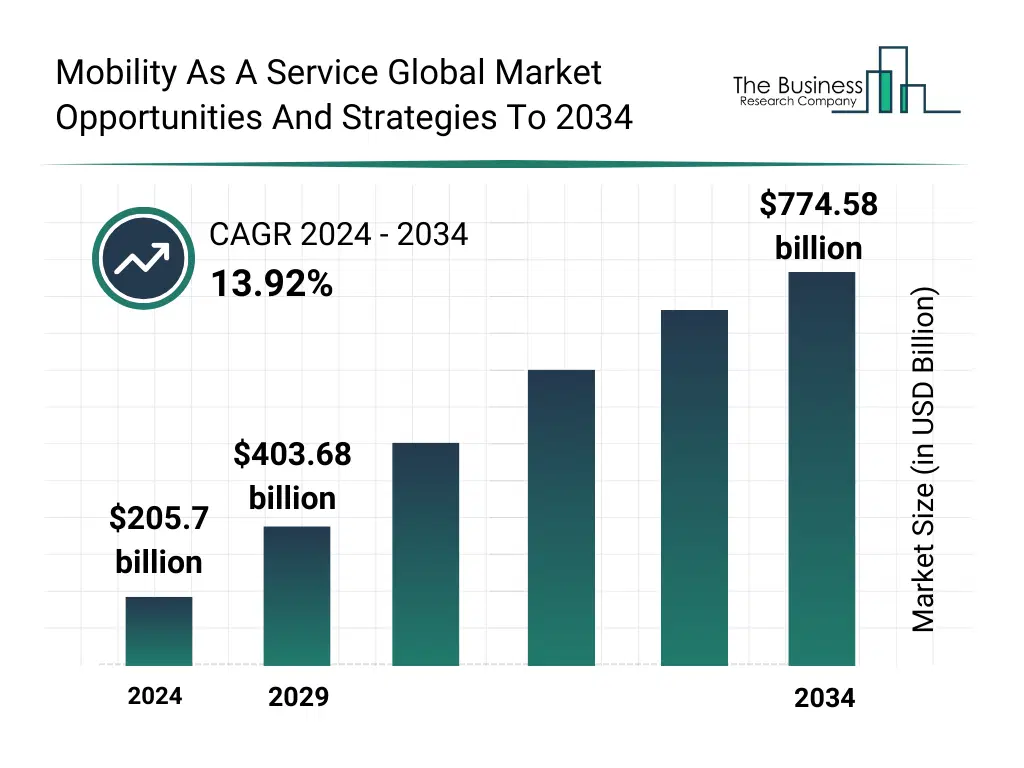
Mobility-As-A-Service (Maas)Market Size
The global mobility as a service market reached a value of nearly $205,701.13 million in 2024, having grown at a compound annual growth rate (CAGR) of 7.63% since 2019. The market is expected to grow from $205,701.13 million in 2024 to $403,681.43 million in 2029 at a rate of 14.44%. The market is then expected to grow at a CAGR of 13.92% from 2029 and reach $774,580.39 million in 2034. Growth in the historic period resulted from the high smartphone adoption, rising fuel prices, rising traffic congestion and smart city initiatives. Factors that negatively affected growth in the historic period were safety concerns and regulatory challenges. Going forward, the government regulations, rising on-demand transportation services, high acceptance of public service shared mobility and growing tourism and travel industry will drive the growth. Factors that could hinder the growth of the mobility as a service market in the future include high initial infrastructure costs, low adoption in rural and semi-urban areas and impact of trade war and tariff.Mobility-As-A-Service (Maas) Market Drivers
The key drivers of the mobility-as-a-service (maas) market include: Government Regulations Government regulations are expected to be a key driver of the growth of the mobility as a service market in the forecast period. They create a framework that encourages the adoption of MaaS (mobility as a service) platforms by ensuring safety, transparency and accountability across mobility services. Clear policies on aggregator operations, data sharing and fare structures foster trust among users and operators, which in turn stimulates investment in MaaS technologies. These regulations also push service providers to upgrade digital platforms and compliance systems, thereby accelerating market growth. Furthermore, governments are increasingly adopting open data policies, mandating transport operators to share real-time service data, which facilitates the development of integrated MaaS solutions. The government regulations contribution during the forecast period in 2024 is 1.50%.Mobility-As-A-Service (Maas) Market Restraints
The key restraints on the mobility-as-a-service (maas)market include: High Initial Infrastructure Costs High initial infrastructure costs are restricting the growth of the mobility as a service market during the forecast period. The implementation of MaaS platforms often requires significant investments in digital infrastructure, including cloud computing, data analytics, payment integration, API (application programming interface) development and backend system upgrades. High upfront costs can deter smaller operators or municipalities from adopting these platforms, limiting market growth. Additionally, costs associated with integrating multiple transport modes, ensuring interoperability and upgrading existing public transport systems contribute to slower adoption of MaaS software solutions. These high costs can also restrict innovation in smaller firms, as funds are diverted toward maintaining existing digital infrastructure rather than enhancing platform capabilities. Moreover, long implementation timelines due to complex integrations can reduce the speed of market expansion. Growth affected by high initial infrastructure costs during the forecast period in 2024 is -2.00%.Mobility-As-A-Service (Maas) Market Trends
Major trends shaping the mobility-as-a-service (maas)market include: 24/7 Micromobility Expands Access To Inclusive And Flexible Urban Travel Major companies in the mobility as a service market are broadening service accessibility and inclusivity by extending operating hours and expanding multimodal options. This shift reflects the growing recognition that urban mobility must serve diverse user groups and operate beyond the constraints of traditional public transport schedules. For instance, in September 2025, Dott, a Netherlands-based micromobility company launched a 24/7 micromobility service in the West of England, operating in Bristol, Bath and South Gloucestershire to provide round-the-clock access to e-scooters and e-bikes. This expansion aims to support residents and visitors, particularly night-time economy workers in sectors like healthcare and hospitality, by offering a safe, flexible and sustainable travel option beyond traditional hours. Dott is also emphasizing safety through in-app messaging, training programs and stricter parking enforcement in collaboration with local councils, reinforcing its commitment to responsible riding across the region. Next-Generation High-Speed Rail Transforms Long-Distance Travel In The U.S Major companies operating in the mobility as a service market are investing in next-generation rail solutions to enhance speed, comfort and capacity in long-distance travel. For instance, in August 2025, Amtrak, a US-based national passenger railroad service, launched its NextGen Acela service. This new generation of high-speed trains operates along the Northeast Corridor between Washington, D.C., New York City and Boston, marking the first major update since the original Acela debuted in 2000. The NextGen Acela trains are America's fastest, reaching speeds up to 160 mph (10 mph faster than the previous fleet) and feature modern amenities such as 5G WiFi, contoured seating, bigger windows, USB ports and a tilt system for smoother curves. The initial launch included five new trains, with 28 NextGen Acela trains expected to be in service by 2027, offering 27% more seating capacity per trip and expanded schedules on weekdays and weekends.Opportunities And Recommendations In The Mobility-As-A-Service (Maas) Market
Opportunities – The top opportunities in the mobility as a service market segmented by service type will arise in the ride hailing segment, which will gain $82,579.28 million of global annual sales by 2029. The top opportunities in the mobility as a service market segmented by solution type will arise in the technology platforms segment, which will gain $56,618.92 million of global annual sales by 2029. The top opportunities in the mobility as a service market segmented by application will arise in the android segment, which will gain $148,186.03 million of global annual sales by 2029. The top opportunities in the mobility as a service market segmented by end use will arise in the personal segment, which will gain $143,356.20 million of global annual sales by 2029. The mobility as a service market size will gain the most in China at $49,324.64 million. Recommendations- To take advantage of the opportunities, The Business Research Company recommends the mobility as a service companies to focus on expanding service accessibility and multimodal coverage, focus on advancing next-generation rail solutions for long-distance efficiency, focus on scaling autonomous and sustainable transport solutions, focus on integrating digital platforms for seamless multimodal connectivity, focus on embedding digital ticketing and real-time tracking in multimodal platforms, focus on advancing sustainable fleet models and ecosystem integration, focus on integrating artificial intelligence to enhance personalization and efficiency, focus on expanding contactless and unified payment systems, focus on the micromobility segment for accelerated growth, focus on payment engines to drive market expansion, expand in emerging markets, focus on strengthening multi-channel distribution networks, focus on building adaptive, value-based pricing structures, optimize digital promotion channels for scalable market reach, leverage localized and strategic partnerships for sustainable promotion, focus on strengthening customer-centric workforce strategies, focus on the android ecosystem to maximize market reach.
Mobility-as-a-Service (MaaS)Market Segmentation
The Mobility-as-a-Service (MaaS)market is segmented segmented by service type, by solution type, by application and by end use.By Service Type –
The Mobility-as-a-Service (MaaS)market is segmented by service type into:
- a) Ride Hailing
- b) Car Sharing
- c) Micromobility
- d) Bus Sharing
- e) Train Services
- f) Other Service Types
By Solution Type –
The Mobility-as-a-Service (MaaS) market is segmented by solution type into:
- a) Technology Platforms
- b) Payment Engines
- c) Navigation Solutions
- d) Telecom Connectivity Providers
- e) Ticketing Solutions
- f) Insurance Services
- g) Other Solutions Types
By Application –
The Mobility-as-a-Service (MaaS) market is segmented > by application into:
- a) IOS Android
- b) Other Applications
By End Use –
The Mobility-as-a-Service (MaaS) market is segmented by end use into:
- a) Personal
- b) Business
- c) Other End Uses
By Geography - The mobility as a service market is segmented by geography into:
- • China
- • India
- • Japan
- • Australia
- • Indonesia
- • South Korea
- • USA
- • Canada
- • Brazil
- • France
- • Germany
- • UK
- • Italy
- • Spain
- • Russia
-
o Asia Pacific
o Africa