
Nanophotonics Market Report 2026
Global Outlook – By Product ( LED, OLED, NFO, Optical Amplifier, Optical Switches, Holographic Data Storage System), By Material ( Quantum Dots, Photonic Crystals, Plasmonic, Nanotubes, Nanoribbons), By Application ( Telecommunications, Entertainment, Consumer Electronics, Indicator And Signs, Lighting, Non-Visual Applications, Other Applications) – Market Size, Trends, Strategies, and Forecast to 2030
Nanophotonics Market Overview
• Nanophotonics market size has reached to $43.69 billion in 2025 • Expected to grow to $149.07 billion in 2030 at a compound annual growth rate (CAGR) of 27.6% • Growth Driver: Increasing Demand For High-Speed Internet Connectivity Fueling The Growth Of The Market Due To Expansion Of Fiber-Optic And 5G Infrastructure • Market Trend: Advancements in Quantum-Accelerated Photonic Vibrometers • Asia-Pacific was the largest region in 2025 and North America is the fastest growing region.What Is Covered Under Nanophotonics Market?
The nanophotonic is focused on behavior of light on nanometer scale and also interaction of with light towards nanometersized objects. Nanophotonics or nano-optics is a part of nanotechnology that investigates the behavior of light on nanometer scales. The main products in nanophotonic market are LED, OLED, NFO, photovoltaic cells, optical amplifier, optical switches, holographic data storage system. LEDs in nanophotonic are used to control and manipulate the light flow. These are of various material such as quantum dots, photonic crystals, plasmonic, nanotubes, nanoribbons. They are used in different applications that include telecommunications, entertainment, consumer electronics, indicator and signs, lighting, non-visual applications, other applications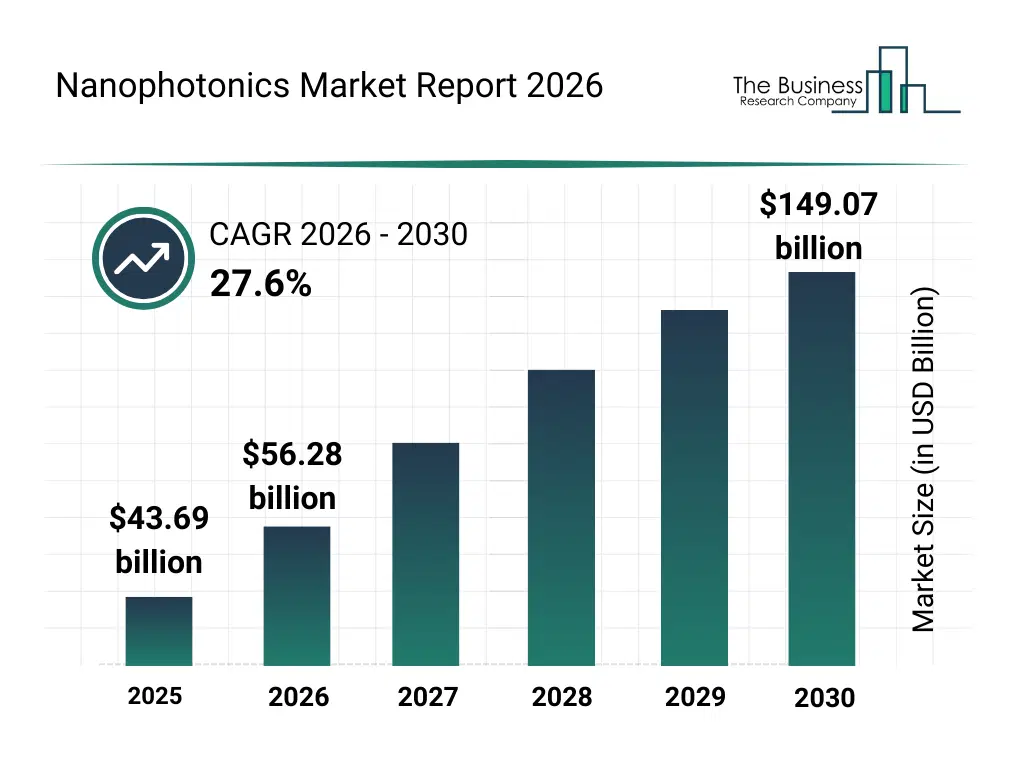
What Is The Nanophotonics Market Size 2026 And Growth Rate?
The nanophotonics market size has grown exponentially in recent years. It will grow from $43.69 billion in 2025 to $56.28 billion in 2026 at a compound annual growth rate (CAGR) of 28.8%. The growth in the historic period can be attributed to early applications in telecommunications, research and development in consumer electronics, adoption in medical imaging, integration in indicator and signage systems, experimental deployment in high-performance computing.What Is The Nanophotonics Market Growth Forecast?
The nanophotonics market size is expected to see exponential growth in the next few years. It will grow to $149.07 billion in 2030 at a compound annual growth rate (CAGR) of 27.6%. The growth in the forecast period can be attributed to research in high-efficiency photonic devices, development in solar photovoltaic applications, scaling up in display technologies, commercialization of optical switches and amplifiers, adoption in holographic storage systems. Major trends in the forecast period include development of nano-optical devices, integration of photonic crystals and quantum dots, deployment of nanophotonic leds and oleds, optimization of plasmonic and nanotube materials, advancements in holographic data storage.
Global Nanophotonics Market Segmentation
1) By Product: LED, OLED, NFO, Optical Amplifier, Optical Switches, Holographic Data Storage System 2) By Material: Quantum Dots, Photonic Crystals, Plasmonic, Nanotubes, Nanoribbons 3) By Application: Telecommunications, Entertainment, Consumer Electronics, Indicator And Signs, Lighting, Non-Visual Applications, Other Applications Subsegments: 1) By Light Emitting Diode (LED): Surface-Mounted Device (SMD) LEDs, Chip On Board (COB) LEDs, Miniature LEDs, High-Power LEDs 2) By Organic Light Emitting Diode (OLED): Active-Matrix OLED (AMOLED), Passive-Matrix OLED (PMOLED), Transparent OLEDs, Flexible OLEDs 3) By Nano-Photonic Film (NFO): Thin-Film NFOs, Metamaterial NFOs, Plasmonic NFOs45) By Optical Amplifier: Erbium-Doped Fiber Amplifier (EDFA), Raman Fiber Amplifier (RFA), Semiconductor Optical Amplifiers (SOA) 5) By Optical Switches: Electro-Optic Switches, Optomechanical Switches, Micro-Electro-Mechanical Systems (MEMS) Switches 6) By Holographic Data Storage System: Volume Holographic Storage, Surface Holographic Storage, Hybrid Holographic Storage SystemsWhat Is The Driver Of The Nanophotonics Market?
The increasing demand for high-speed internet connectivity is expected to propel the growth of the nanophotonic market going forward. High-speed internet connectivity refers to fast and reliable data transmission that enables seamless access to online services, cloud applications, and digital communication through advanced technologies such as fiber optics, 5G, and broadband networks. High-speed internet connectivity is increasing due to the rapid expansion of fiber-optic and 5G network infrastructure worldwide, enabling faster and more reliable data transmission across regions. Nanophotonics helps high-speed internet connectivity by enabling faster and more energy-efficient data transmission through light-based components instead of traditional electronic ones, reducing latency and increasing bandwidth capacity to support growing global data demands. For instance, in November 2024, according to the UK Parliament's House of Commons Library, a UK-based government administration, as of January 2024, 78% of UK premises had access to gigabit broadband, marking significant progress toward the UK government’s target of reaching 85% coverage by 2025 and achieving nationwide availability by 2030. Therefore, the increasing demand for high-speed internet connectivity is driving the growth of the nanophotonic industry.Key Players In The Global Nanophotonics Market
Major companies operating in the nanophotonics market are Cambrios Technologies Corporation, Cnano Technology, Cree Inc., LG Display Co. Ltd., Nanocs Inc., Nanocyl S.A., Nanoco Technologies Ltd., Nanosys Inc., Nanostructured & Amorphous Materials Inc., OSRAM Opto Semiconductors GmbH, Philips Lumileds Lighting Company LLC, QD Vision Inc., Quantum Materials Corp., TCL Display Technology Holdings Limited, Sharp Corporation, Novaled GmbH, Nano Magic LLC, eSpin Technologies, Advanced Nano Products Co. Ltd (ANP), Hamamatsu Photonics K.K., Agiltron Inc., Seoul Semiconductor Co. Ltd., Jenoptik AG, Tech-X Corporation, Nanophase Technologies Corporation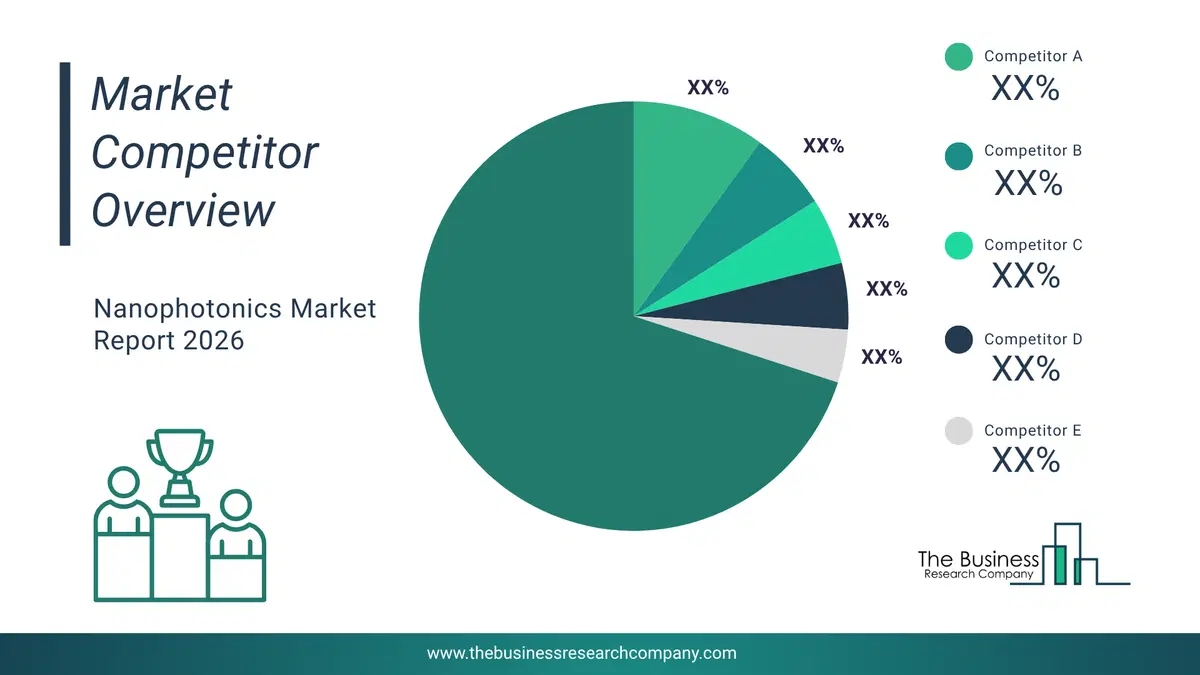
This chart is for illustrative purposes; the full report includes a detailed competitor analysis and comprehensive overview of the top 10 companies in the market.
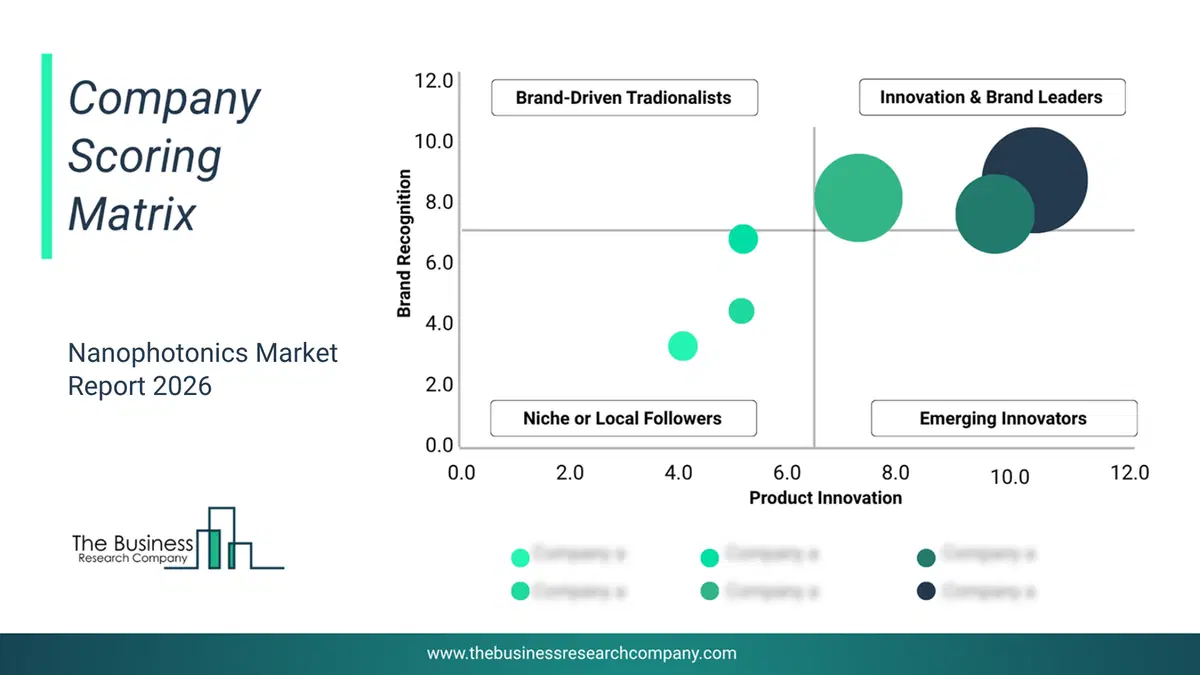
This chart maps companies by product innovation and brand strength, with bubble size indicating relative revenue, helping identify market leaders, challengers, and niche players. This is an illustrative chart; the full report provides a complete and accurate competitive analysis.
Global Nanophotonics Market Trends and Insights
Major players in the nanophotonics market are focusing on developing technologically advanced products, such as the new photonic vibrometer, to provide accurate and detailed vibration analysis. A photonic vibrometer is an advanced optical device that utilizes laser technology to measure and analyze vibrations and displacements in materials or structures with high precision, often used in fields such as engineering, materials science, and structural health monitoring. For instance, in July 2023, Quantum Computing Inc., a US-based photonics company, launched the Quantum Photonic Vibrometer (QPV). This powerful instrument is designed for remote vibration detection, sensing, and inspection. As the first quantum-accelerated photonic vibrometer available on the market, it delivers significant improvements in sensitivity, speed, and resolution, enabling it to identify highly obscured and non-line-of-sight objects for the first time. Its military and commercial applications are extensive, encompassing material recognition, enhanced surveillance, infrastructure integrity monitoring, and preventive industrial maintenance, all achievable from safe distances with minimal energy and optical power requirements.What Are Latest Mergers And Acquisitions In The Nanophotonics Market?
In February 2024, Bruker a US-based scientific instrument manufacturer, acquired Nanophoton Corporation for an undisclosed amount. Bruker's acquisition of Nanophoton Corporation is to enhance its capabilities in the field of analytical instrumentation, particularly in Raman microscopy. Nanophoton Corporation is a Japan-based provider of nanophotonics.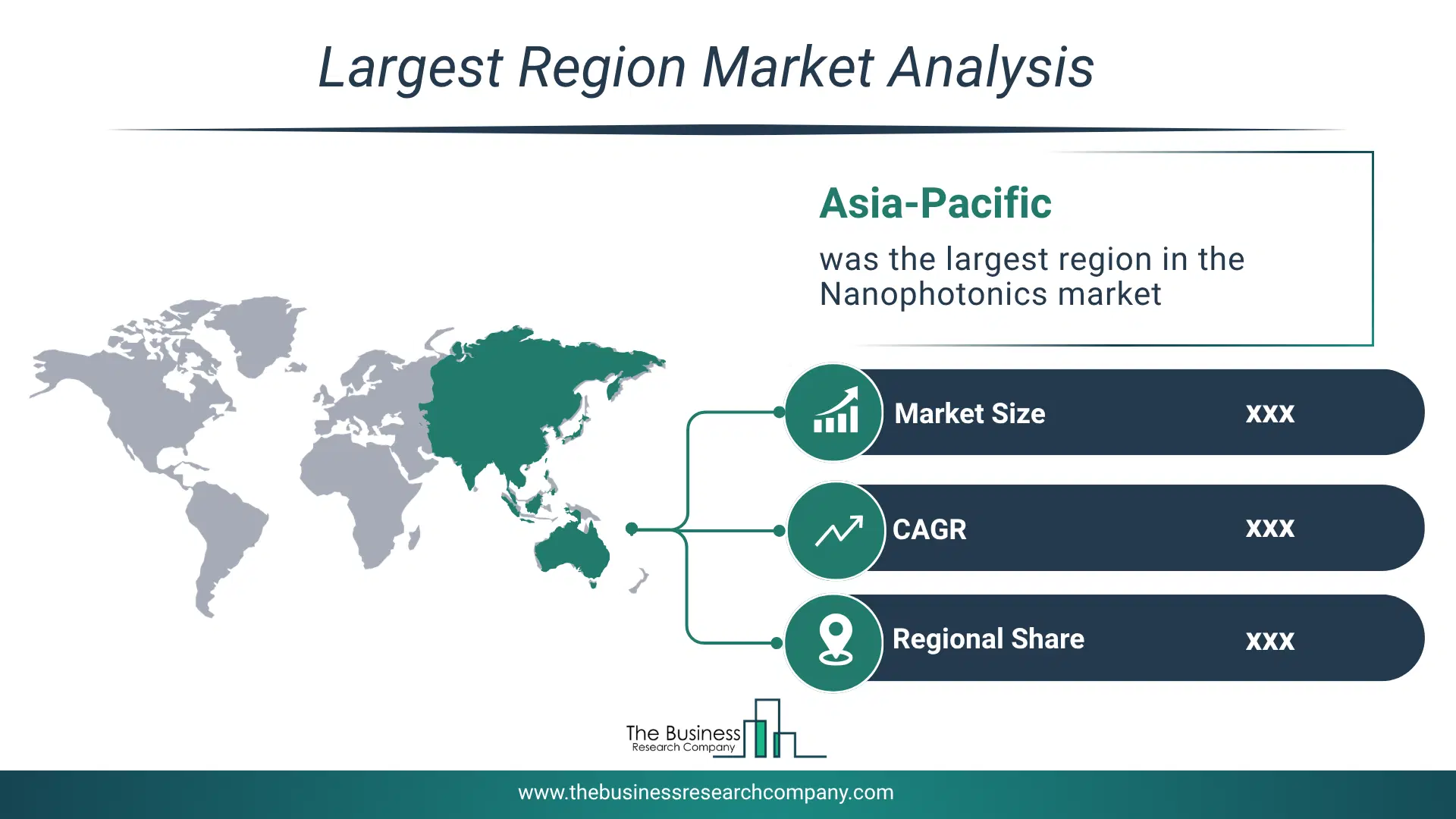
Regional Outlook
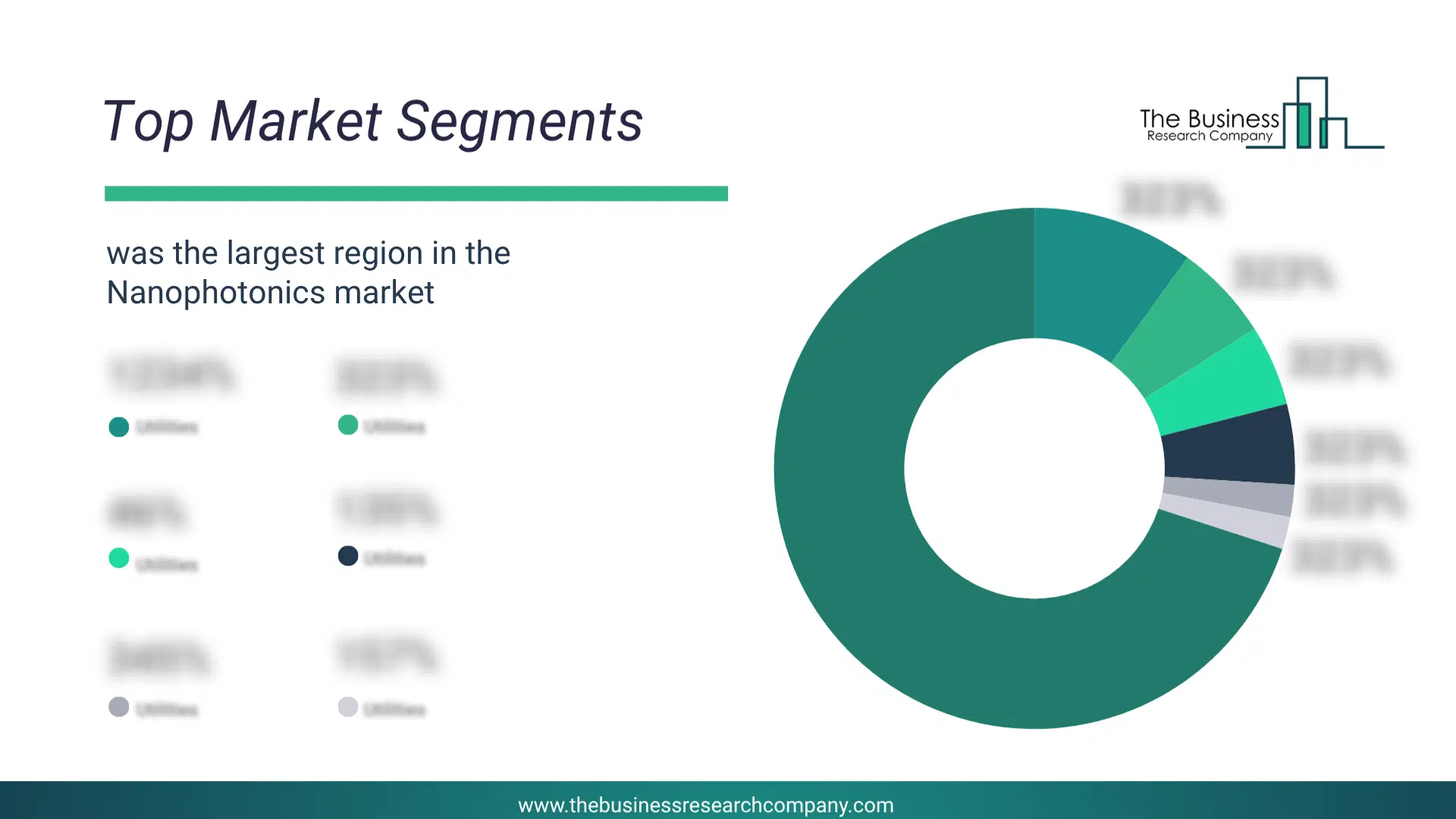
Asia-Pacific was the largest region in the nanophotonic market in 2025. North America is expected to be the fastest-growing region in the forecast period. The regions covered in this market report are Asia-Pacific, South East Asia, Western Europe, Eastern Europe, North America, South America, Middle East, Africa. The countries covered in this market report are Australia, Brazil, China, France, Germany, India, Indonesia, Japan, Taiwan, Russia, South Korea, UK, USA, Canada, Italy, Spain.What Defines the Nanophotonics Market?
The nanophotonic market consists of sales of grating couplers, SOI electro-optical modulators, photonic crystals. Values in this market are ‘factory gate’ values, that is the value of goods sold by the manufacturers or creators of the goods, whether to other entities (including downstream manufacturers, wholesalers, distributors and retailers) or directly to end customers. The value of goods in this market includes related services sold by the creators of the goods.How is Market Value Defined and Measured?
The market value is defined as the revenues that enterprises gain from the sale of goods and/or services within the specified market and geography through sales, grants, or donations in terms of the currency (in USD unless otherwise specified). The revenues for a specified geography are consumption values that are revenues generated by organizations in the specified geography within the market, irrespective of where they are produced. It does not include revenues from resales along the supply chain, either further along the supply chain or as part of other products.
This chart presents market attractiveness based on a quantitative evaluation of growth, competition, strategic alignment, and risk, offering a clear view of opportunity areas for decision-making. This chart is for illustrative purposes; the full report contains the complete analysis.

This chart highlights the Total Addressable Market (TAM) by estimating the maximum revenue opportunity using an assumption-driven approach, supporting strategic planning and opportunity sizing across markets. The chart is illustrative; the full report provides a more comprehensive analysis.
What Key Data and Analysis Are Included in the Nanophotonics Market Report 2026?
The nanophotonics market research report is one of a series of new reports from The Business Research Company that provides market statistics, including industry global market size, regional shares, competitors with the market share, detailed market segments, market trends and opportunities, and any further data you may need to thrive in the nanophotonics industry. The market research report delivers a complete perspective of everything you need, with an in-depth analysis of the current and future state of the industry.Nanophotonics Market Report Forecast Analysis
| Report Attribute | Details |
|---|---|
| Market Size Value In 2026 | $56.28 billion |
| Revenue Forecast In 2030 | $149.07 billion |
| Growth Rate | CAGR of 27.6% from 2026 to 2030 |
| Base Year For Estimation | 2025 |
| Actual Estimates/Historical Data | 2020-2025 |
| Forecast Period | 2026 - 2030 |
| Market Representation | Revenue in USD Billion and CAGR from 2026 to 2030 |
| Segments Covered | Product, Material, Application |
| Regional Scope | Asia-Pacific, Western Europe, Eastern Europe, North America, South America, Middle East, Africa |
| Country Scope | The countries covered in the report are Australia, Brazil, China, France, Germany, India, Indonesia, Japan, Taiwan, Russia, South Korea, UK, USA, Canada, Italy, Spain. |
| Key Companies Profiled | Cambrios Technologies Corporation, Cnano Technology, Cree Inc., LG Display Co. Ltd., Nanocs Inc., Nanocyl S.A., Nanoco Technologies Ltd., Nanosys Inc., Nanostructured & Amorphous Materials Inc., OSRAM Opto Semiconductors GmbH, Philips Lumileds Lighting Company LLC, QD Vision Inc., Quantum Materials Corp., TCL Display Technology Holdings Limited, Sharp Corporation, Novaled GmbH, Nano Magic LLC, eSpin Technologies, Advanced Nano Products Co. Ltd (ANP), Hamamatsu Photonics K.K., Agiltron Inc., Seoul Semiconductor Co. Ltd., Jenoptik AG, Tech-X Corporation, Nanophase Technologies Corporation |
| Customization Scope | Request for Customization |
| Pricing And Purchase Options | Explore Purchase Options |