
Non-Hormonal Contraceptives Market Report 2026
Global Outlook – By Type (Devices, Sterilization, Other Product Types), By Mechanism Of Action (Antagonist, Agonist, Inhibitor, Modulator), By Route of Administration (Intramuscular, Intravaginal, Intravenous, Oral, Subcutaneous, Topical, Transdermal, Other Route Of Administrations), By Purpose Of Therapy (Treatment Of Disease, Management Of Symptoms), By Target Indication (Bacterial Vaginosis, Contraception, Endometriosis, Postmenopausal Osteoporosis, Uterine Fibroids, Vaginitis, Other Target Indications) – Market Size, Trends, Strategies, and Forecast to 2030
Non-Hormonal Contraceptives Market Overview
• Non-Hormonal Contraceptives market size has reached to $25.47 billion in 2025 • Expected to grow to $35.8 billion in 2030 at a compound annual growth rate (CAGR) of 7% • Growth Driver: Increasing Sexually Transmitted Diseases Drive Growth In The Market Due To Reduced Condom Use And Rising Infection Risk • Market Trend: Advancements In Delivery Systems Improve Insertion Efficiency And Patient Comfort • North America was the largest region in 2025 and Asia-Pacific is the fastest growing region.What Is Covered Under Non-Hormonal Contraceptives Market?
Non-hormonal contraceptives refer to methods of preventing pregnancy that do not involve the use of hormones to alter a woman's reproductive system. Non-hormonal contraceptives are utilized by individuals to prevent pregnancy through physical barriers, chemical agents, or natural tracking methods that do not interfere with the body’s hormonal system. The main types of non-hormonal contraceptives are devices, sterilization, and others. Devices refer to physical tools, instruments, or equipment designed to perform specific functions or tasks, often used in medical, industrial, or consumer applications. Their mechanisms of action can involve functioning as antagonists, agonists, inhibitors, or modulators. These products can be administered through various routes, such as intramuscular, intravaginal, intravenous, oral, subcutaneous, topical, transdermal, or others. The purpose of therapy includes both disease treatment and symptom management. Target indications for these contraceptives include bacterial vaginosis, contraception, endometriosis, postmenopausal osteoporosis, uterine fibroids, vaginitis, and others.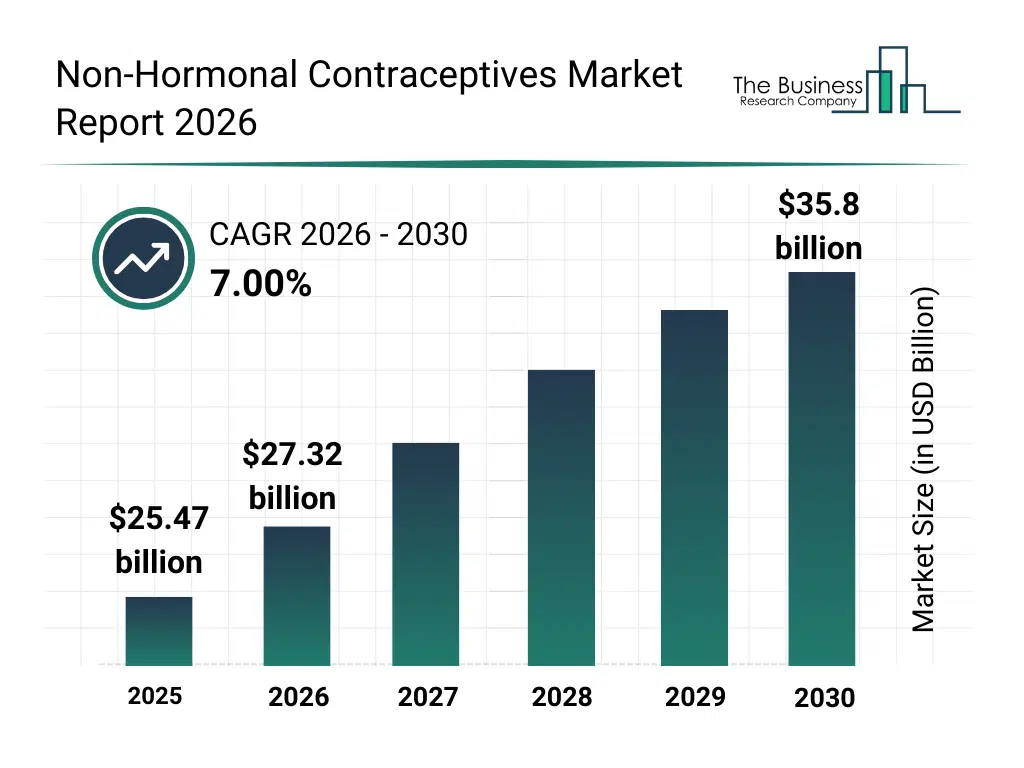
What Is The Non-Hormonal Contraceptives Market Size and Share 2026?
The non-hormonal contraceptives market size has grown strongly in recent years. It will grow from $25.47 billion in 2025 to $27.32 billion in 2026 at a compound annual growth rate (CAGR) of 7.3%. The growth in the historic period can be attributed to limited availability of non-hormonal contraceptive methods, reliance on surgical sterilization, growing awareness of reproductive health, increasing female healthcare initiatives, adoption of barrier devices in clinics.What Is The Non-Hormonal Contraceptives Market Growth Forecast?
The non-hormonal contraceptives market size is expected to see strong growth in the next few years. It will grow to $35.8 billion in 2030 at a compound annual growth rate (CAGR) of 7.0%. The growth in the forecast period can be attributed to development of advanced non-hormonal devices, rising demand for reversible and minimally invasive sterilization, expansion of family planning programs, increasing awareness of safety and compliance standards, integration of smart contraceptive monitoring systems. Major trends in the forecast period include rising preference for non-hormonal contraceptive methods, growing adoption of barrier and mechanical devices, increasing awareness about reversible sterilization options, expansion of minimally invasive contraceptive devices, focus on safety, compliance, and patient-centric design.
Global Non-Hormonal Contraceptives Market Segmentation
1) By Type: Devices, Sterilization, Other Product Types 2) By Mechanism Of Action: Antagonist, Agonist, Inhibitor, Modulator 3) By Route of Administration: Intramuscular, Intravaginal, Intravenous, Oral, Subcutaneous, Topical, Transdermal, Other Route Of Administrations 4) By Purpose Of Therapy: Treatment Of Disease, Management Of Symptoms 5) By Target Indication: Bacterial Vaginosis, Contraception, Endometriosis, Postmenopausal Osteoporosis, Uterine Fibroids, Vaginitis, Other Target Indications Subsegments: 1) By Devices: Surgical Instruments, Ligation Clips, Tubal Rings 2) By Sterilization: Permanent Sterilization, Reversible Sterilization, Mechanical Sterilization Devices 3) By Other Product Types: Non-Surgical Barrier Devices, Implantable Plugs, Intrauterine Permanent DevicesWhat Is The Driver Of The Non-Hormonal Contraceptives Market?
The growing prevalence of sexually transmitted diseases is expected to propel the growth of the non-hormonal contraceptives market going forward. Sexually transmitted diseases (STDs) are infections mainly spread through sexual contact and caused by bacteria, viruses, or parasites. The increase in sexually transmitted diseases is largely attributed to a decline in condom usage, raising the likelihood of infection during unprotected sex. Non-hormonal contraceptives, including male and female condoms, help prevent the transmission of sexually transmitted diseases by serving as a physical barrier that prevents the exchange of bodily fluids during sexual activity. For instance, in April 2025, according to the Minnesota Department of Health (MDH), a US-based state health agency, the proportion of HIV cases among males aged 35 to 39 increased from 10% in 2023 to 17% in 2024. Therefore, the growing prevalence of sexually transmitted diseases is driving the growth of the non-hormonal contraceptives industry.Key Players In The Global Non-Hormonal Contraceptives Market
Major companies operating in the non-hormonal contraceptives market are Church & Dwight Co., Okamoto Industries, CooperSurgical Inc., PSI India Pvt Ltd., Karex Berhad, Fuji Latex Co. Ltd., PREGNA INTERNATIONAL LTD., Cupid Limited, Global Protection Corp., SMB Corporation of India, HLL Lifecare Limited, Contraline Inc.
This chart is for illustrative purposes; the full report includes a detailed competitor analysis and comprehensive overview of the top 10 companies in the market.
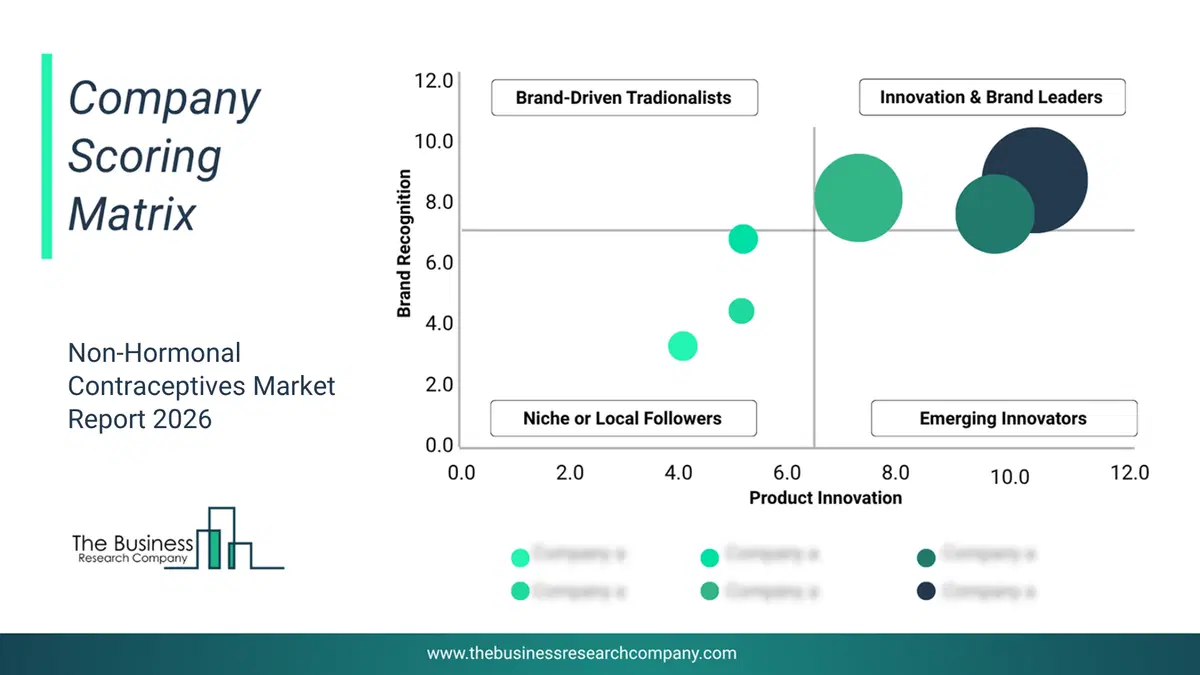
This chart maps companies by product innovation and brand strength, with bubble size indicating relative revenue, helping identify market leaders, challengers, and niche players. This is an illustrative chart; the full report provides a complete and accurate competitive analysis.
Global Non-Hormonal Contraceptives Market Trends and Insights
Major companies operating in the non-hormonal contraceptives market are focusing on developing innovative solutions such as preloaded intrauterine device delivery systems to simplify insertion procedures, enhance user convenience, and improve clinical efficiency. A preloaded intrauterine device (IUD) delivery system refers to a pre-assembled, ready-to-use device that integrates the preloaded intrauterine device and its inserter into a single unit, designed to streamline the insertion process, reduce setup time, and minimize the risk of contamination or handling mistakes. For instance, in September 2024, CooperSurgical Inc., a US-based medical device and fertility company, introduced the Paragard Single-Handed Inserter, aimed at enhancing insertion efficiency and patient comfort during non-hormonal preloaded intrauterine device placement. It offers over 99% effective, long-term birth control for up to 10 years by preventing sperm from fertilizing an egg. Key benefits include immediate and reversible contraception, hormone-free suitability, and low maintenance once inserted.What Are Latest Mergers And Acquisitions In The Non-Hormonal Contraceptives Market?
In November 2023, Daré Bioscience Inc., a US-based biopharmaceutical company, partnered with Premier Research International LLC to extend their strategic collaboration and support the clinical development of Daré’s women’s health programs. With this partnership, Daré Bioscience and Premier Research aim to accelerate clinical development timelines, enhance study execution through expanded operational support, improve efficiency in trial management, and advance the progression of novel women’s health candidates toward regulatory milestones. Premier Research International LLC is a US-based clinical research organization specializing in providing full-service development support for biotechnology and medical technology companies.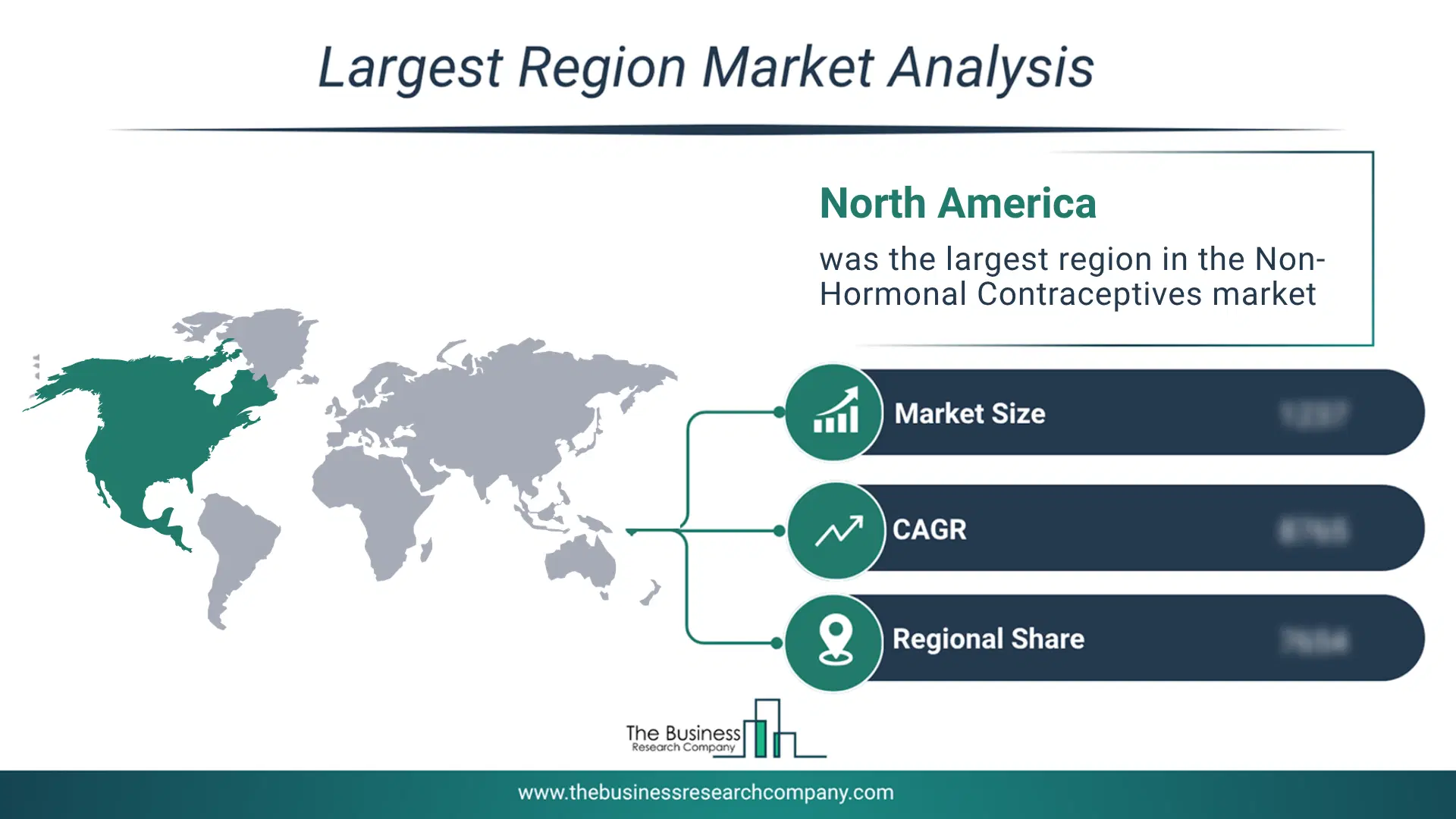
Regional Insights
North America was the largest region in the non-hormonal contraceptives market in 2025. Asia-Pacific is expected to be the fastest-growing region in the forecast period. The regions covered in this market report are Asia-Pacific, South East Asia, Western Europe, Eastern Europe, North America, South America, Middle East, Africa. The countries covered in this market report are Australia, Brazil, China, France, Germany, India, Indonesia, Japan, Taiwan, Russia, South Korea, UK, USA, Canada, Italy, Spain.What Defines the Non-Hormonal Contraceptives Market?
The non-hormonal contraceptives market consists of sales of male condoms, copper intrauterine devices (IUDs), diaphragms, cervical caps, and spermicides. Values in this market are ‘factory gate’ values, that is, the value of goods sold by the manufacturers or creators of the goods, whether to other entities (including downstream manufacturers, wholesalers, distributors, and retailers) or directly to end customers. The value of goods in this market includes related services sold by the creators of the goods.How is Market Value Defined and Measured?
The market value is defined as the revenues that enterprises gain from the sale of goods and/or services within the specified market and geography through sales, grants, or donations in terms of the currency (in USD unless otherwise specified). The revenues for a specified geography are consumption values that are revenues generated by organizations in the specified geography within the market, irrespective of where they are produced. It does not include revenues from resales along the supply chain, either further along the supply chain or as part of other products.
This chart presents market attractiveness based on a quantitative evaluation of growth, competition, strategic alignment, and risk, offering a clear view of opportunity areas for decision-making. This chart is for illustrative purposes; the full report contains the complete analysis.

This chart highlights the Total Addressable Market (TAM) by estimating the maximum revenue opportunity using an assumption-driven approach, supporting strategic planning and opportunity sizing across markets. The chart is illustrative; the full report provides a more comprehensive analysis.
What Key Data and Analysis Are Included in the Non-Hormonal Contraceptives Market Report 2026?
The non-hormonal contraceptives market research report is one of a series of new reports from The Business Research Company that provides market statistics, including industry global market size, regional shares, competitors with the market share, detailed market segments, market trends and opportunities, and any further data you may need to thrive in the non-hormonal contraceptives industry. The market research report delivers a complete perspective of everything you need, with an in-depth analysis of the current and future state of the industry.Non-Hormonal Contraceptives Market Report Forecast Analysis
| Report Attribute | Details |
|---|---|
| Market Size Value In 2026 | $27.32 billion |
| Revenue Forecast In 2030 | $35.8 billion |
| Growth Rate | CAGR of 7.3% from 2026 to 2030 |
| Base Year For Estimation | 2025 |
| Actual Estimates/Historical Data | 2020-2025 |
| Forecast Period | 2026 - 2030 |
| Market Representation | Revenue in USD Billion and CAGR from 2026 to 2030 |
| Segments Covered | Type, Mechanism Of Action, Route of Administration, Purpose Of Therapy, Target Indication |
| Regional Scope | Asia-Pacific, Western Europe, Eastern Europe, North America, South America, Middle East, Africa |
| Country Scope | The countries covered in the report are Australia, Brazil, China, France, Germany, India, Indonesia, Japan, Taiwan, Russia, South Korea, UK, USA, Canada, Italy, Spain. |
| Key Companies Profiled | Church & Dwight Co., Okamoto Industries, CooperSurgical Inc., PSI India Pvt Ltd., Karex Berhad, Fuji Latex Co. Ltd., PREGNA INTERNATIONAL LTD., Cupid Limited, Global Protection Corp., SMB Corporation of India, HLL Lifecare Limited, Contraline Inc. |
| Customization Scope | Request for Customization |
| Pricing And Purchase Options | Explore Purchase Options |