
On-Glass Antenna Market Report 2026
Global Outlook – By Type ( Amplitude Modulation(AM) Or Frequency Modulation (FM) Antenna, Global Positioning System (GPS) Antenna, Cellular Antenna, Wireless Fidelity (Wi-Fi) Antenna), By Frequency Range ( Very High Frequency (VHF), Ultra High Frequency (UHF), Super High Frequency (SHF)), By Vehicle Type ( Passenger Cars, Commercial Vehicles), By Application ( Automotive, Telematics And V2X Communication, In-Vehicle Infotainment And Navigation Systems), By Distribution Channel ( Original Equipment Manufacturer, Aftermarket) – Market Size, Trends, Strategies, and Forecast to 2030
On-Glass Antenna Market Overview
• On-Glass Antenna market size has reached to $1.42 billion in 2025 • Expected to grow to $2.32 billion in 2030 at a compound annual growth rate (CAGR) of 10.2% • Growth Driver: Rising Adoption Of Electric And Hybrid Vehicles Fueling The Growth Of The Market Due To Increasing Need For Advanced Connectivity And Communication Solutions • Market Trend: Window-Integrated On-Glass Antennas Driving Urban 5G Expansion While Preserving Building Aesthetics • North America was the largest region in 2025 and Asia-Pacific is the fastest growing region.What Is Covered Under On-Glass Antenna Market?
An on-glass antenna is a type of antenna that is directly integrated onto the glass surface of a vehicle, typically the windshield or rear window. It is designed to provide wireless connectivity, such as GPS, cellular, or radio signals, without requiring a protruding external antenna. This design enhances the vehicle’s aesthetics and reduces aerodynamic drag while maintaining reliable signal reception. On-glass antennas are commonly used in modern vehicles for both communication and infotainment systems. The main types of on-glass antennas are amplitude modulation (AM) or frequency modulation (FM) antennas, global positioning system (GPS) antennas, cellular antennas, and wireless fidelity (Wi-Fi) antennas. An amplitude modulation (AM) or frequency modulation (FM) antenna is a device designed to transmit or receive radio signals by converting electromagnetic waves into electrical signals for amplitude- or frequency-modulated broadcasting. These antennas operate across frequency ranges such as very high frequency (VHF), ultra high frequency (UHF), and super high frequency (SHF) and are used in vehicle types including passenger cars and commercial vehicles. They are used in applications including automotive, telecommunications, and consumer electronics, with distribution through original equipment manufacturers and aftermarket.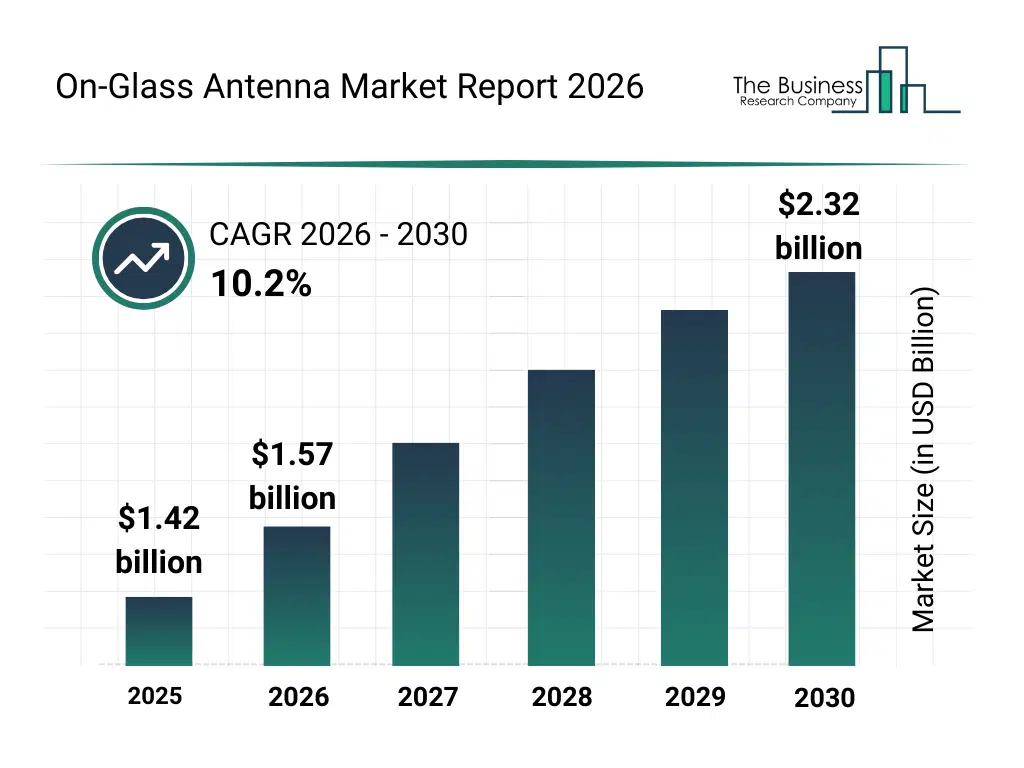
What Is The On-Glass Antenna Market Size 2026 And Growth Rate?
The on-glass antenna market size has grown rapidly in recent years. It will grow from $1.42 billion in 2025 to $1.57 billion in 2026 at a compound annual growth rate (CAGR) of 10.5%. The growth in the historic period can be attributed to increasing adoption of in-vehicle infotainment systems, rising demand for cellular connectivity in vehicles, growth of gps navigation integration, development of aerodynamic and sleek vehicle designs, increasing awareness of wireless technology advantages.What Is The On-Glass Antenna Market Growth Forecast?
The on-glass antenna market size is expected to see rapid growth in the next few years. It will grow to $2.32 billion in 2030 at a compound annual growth rate (CAGR) of 10.2%. The growth in the forecast period can be attributed to advancement in 5g cellular technology, integration of autonomous driving systems, expansion of connected vehicle ecosystems, development of multi-band and multi-frequency antennas, rising demand for electric vehicles with smart connectivity. Major trends in the forecast period include compact and integrated antenna design, multi-band and high-frequency support, enhanced signal reception and reliability, lightweight and aerodynamic vehicle components, vehicle infotainment and connectivity expansion.
Global On-Glass Antenna Market Segmentation
1) By Type: Amplitude Modulation(AM) Or Frequency Modulation (FM) Antenna, Global Positioning System (GPS) Antenna, Cellular Antenna, Wireless Fidelity (Wi-Fi) Antenna 2) By Frequency Range: Very High Frequency (VHF), Ultra High Frequency (UHF), Super High Frequency (SHF) 3) By Vehicle Type: Passenger Cars, Commercial Vehicles 4) By Application: Automotive, Telematics And V2X Communication, In-Vehicle Infotainment And Navigation Systems 5) By Distribution Channel: Original Equipment Manufacturer, Aftermarket Subsegments: 1) By Amplitude Modulation (AM) Or Frequency Modulation (FM) Antenna: Single-Band Amplitude Modulation Antenna, Single-Band Frequency Modulation Antenna, Dual-Band Amplitude Modulation Or Frequency, Modulation Antenna, Multi-Band Radio Antenna 2) By Global Positioning System (GPS) Antenna: Passive Global Positioning System Antenna, Active Global Positioning System Antenna, Multi-Band Global Positioning System Antenna, High-Precision Global Positioning System Antenna 3) By Cellular Antenna: 2G Or 3G Cellular Antenna, 4G LTE Antenna, 5G NR Antenna, Multi-Band Cellular Antenna 4) By Wireless Fidelity (Wi-Fi) Antenna: 2.4 GHz Wi-Fi Antenna, 5 GHz Wi-Fi Antenna, Dual-Band Wi-Fi Antenna (2.4/5 GHz), Multiple Input Multiple Output Wireless Fidelity Antenna 5) By Other Types: Satellite Radio, Bluetooth, TelematicsWhat Is The Driver Of The On-Glass Antenna Market?
The rising demand for electric and hybrid vehicles is expected to propel the growth of the on-glass antenna market going forward. Electric and hybrid vehicles refer to automobiles that use electric motors either solely or in combination with internal combustion engines to reduce or eliminate reliance on fossil fuels. The rising demand for electric and hybrid vehicles is due to the growing global shift toward cleaner, more sustainable transportation solutions, as consumers and industries increasingly prioritize reducing carbon emissions and embracing eco-friendly mobility options. On-glass antennas support the rising trend of electric and hybrid vehicles by enabling compact, efficient, and high-performance connectivity solutions, which are essential for advanced infotainment, telematics, navigation, and vehicle-to-everything (V2X) communication in modern electric and hybrid cars. For instance, in April 2024, according to the International Energy Agency, a France-based intergovernmental autonomous organization, in 2023, global electric car sales reached nearly 14 million, representing 18% of total car sales, compared to 14% in 2022. Therefore, the rising trend of electric and hybrid vehicles is driving the growth of the on-glass antenna industry.Key Players In The Global On-Glass Antenna Market
Major companies operating in the on-glass antenna market are Panasonic Holdings Corporation, Continental AG, TE Connectivity plc, Amphenol Corporation, Murata Manufacturing Co. Ltd., Molex LLC, FUYAO GLASS INDUSTRY GROUP CO. LTD., KYOCERA AVX Components Corporation, Yageo Corporation, Ficosa International S.A., Shenzhen Sunway Communication Co. Ltd., Shenzhen H&T Intelligent Control Co. Ltd., Saint-Gobain Sekurit Ltd., Ace Technologies Corp., Taoglas Group Holdings Limited, SMK Corporation, Ezurio LLC, Hirschmann Car Communication Gmbh, Kathrein Se, Harada Industry Co. Ltd.
This chart is for illustrative purposes; the full report includes a detailed competitor analysis and comprehensive overview of the top 10 companies in the market.
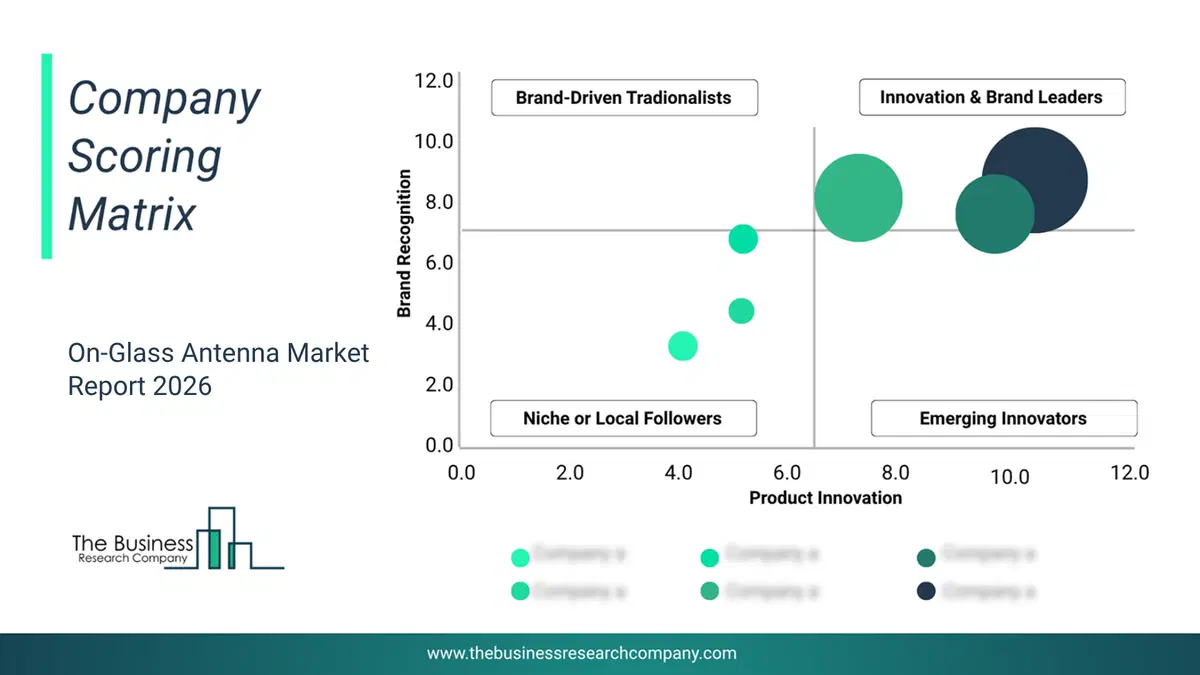
This chart maps companies by product innovation and brand strength, with bubble size indicating relative revenue, helping identify market leaders, challengers, and niche players. This is an illustrative chart; the full report provides a complete and accurate competitive analysis.
Global On-Glass Antenna Market Trends and Insights
Major companies operating in the on-glass antenna market are developing window-Integrated on-glass antenna to enhance urban connectivity, expand 5G coverage cost-effectively, and maintain building aesthetics in densely populated areas. A window-integrated on-glass antenna is a communication antenna seamlessly embedded into building windows, enabling wireless signal transmission and coverage expansion while preserving architectural aesthetics. For instance, in August 2024, JTower, a Japan-based telecommunications infrastructure sharing company, collaborated with NTT Docomo, a Japan-based telecommunications company, to unveil a 5G glass antenna in Tokyo that transforms building windows into 5G base stations. JTower plans to extend this solution beyond the initial deployment at the Shinjuku 3-chome East Building to additional properties already equipped with its shared 5G infrastructure.What Are Latest Mergers And Acquisitions In The On-Glass Antenna Market?
In August 2024, JTower, a Japan-based infrastructure sharing company, partnered with AGC Corporation and NTT Docomo for the commercial deployment of 5G glass antennas at the Shinjuku 3-chome East Building in Tokyo. With this partnership, JTower, AGC, and NTT Docomo aim to leverage their respective advanced technologies, combining JTower's 5G-compatible shared infrastructure platform with AGC's on-glass antenna technology and NTT Docomo's technical expertise in cellular network deployment to provide urban areas with an aesthetically friendly, efficient 5G coverage solution. This collaboration enhances communication in areas where building aesthetics are critical, such as outdoor event spaces and roads near buildings, ultimately promoting efficient 5G expansion and infrastructure sharing adoption. AGC Corporation is a Japan-based company specializing in glass manufacturing and advanced materials, including on-glass antenna solutions, while NTT Docomo is a Japan-based telecommunications provider offering mobile network services and technical cooperation for 5G infrastructure.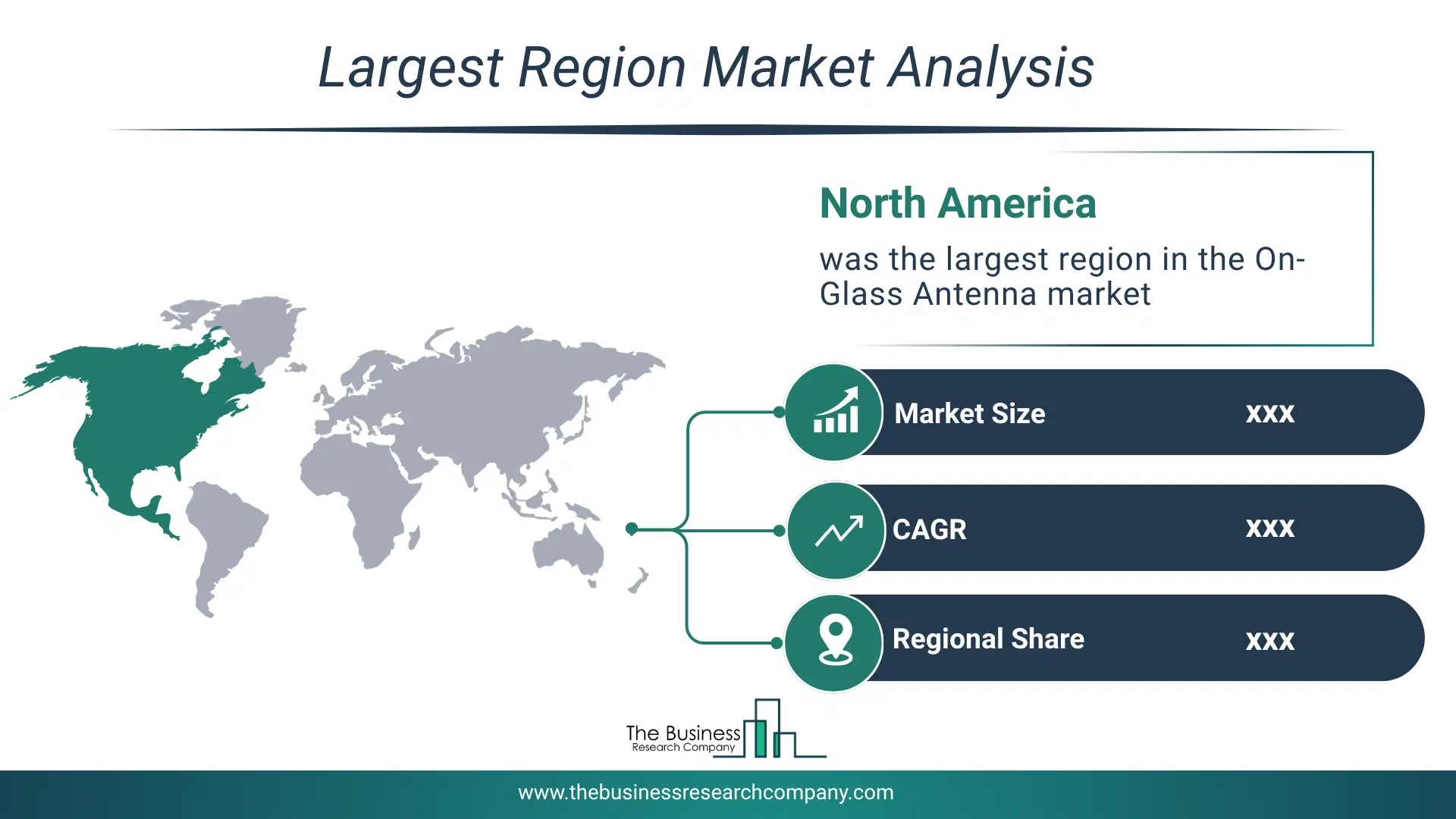
Regional Outlook
North America was the largest region in the on-glass antenna market in 2025. Asia-Pacific is expected to be the fastest-growing region in the forecast period. The regions covered in this market report are Asia-Pacific, South East Asia, Western Europe, Eastern Europe, North America, South America, Middle East, Africa. The countries covered in this market report are Australia, Brazil, China, France, Germany, India, Indonesia, Japan, Taiwan, Russia, South Korea, UK, USA, Canada, Italy, Spain.What Defines the On-Glass Antenna Market?
The on-glass antenna market consists of revenues earned by entities by providing services such as manufacturing and supplying antennas for GPS navigation, AM/FM radio, satellite radio, cellular (4G/5G) connectivity, and vehicle-to-everything (V2X) communication systems, as well as aftermarket installation, customization, and maintenance of these antennas. The market value includes the value of related goods sold by the service provider or included within the service offering. The on-glass antenna market also consists of sales of products including rear-window antennas, windshield-integrated antennas, shark-fin antennas with glass integration, and hybrid on-glass modules that combine GPS, cellular, and radio functionalities. Values in this market are ‘factory gate’ values, that is, the value of goods sold by the manufacturers or creators of the goods, whether to other entities (including downstream manufacturers, wholesalers, distributors, and retailers) or directly to end customers. The value of goods in this market includes related services sold by the creators of the goods.How is Market Value Defined and Measured?
The market value is defined as the revenues that enterprises gain from the sale of goods and/or services within the specified market and geography through sales, grants, or donations in terms of the currency (in USD unless otherwise specified). The revenues for a specified geography are consumption values that are revenues generated by organizations in the specified geography within the market, irrespective of where they are produced. It does not include revenues from resales along the supply chain, either further along the supply chain or as part of other products.
This chart presents market attractiveness based on a quantitative evaluation of growth, competition, strategic alignment, and risk, offering a clear view of opportunity areas for decision-making. This chart is for illustrative purposes; the full report contains the complete analysis.

This chart highlights the Total Addressable Market (TAM) by estimating the maximum revenue opportunity using an assumption-driven approach, supporting strategic planning and opportunity sizing across markets. The chart is illustrative; the full report provides a more comprehensive analysis.
What Key Data and Analysis Are Included in the On-Glass Antenna Market Report 2026?
The on-glass antenna market research report is one of a series of new reports from The Business Research Company that provides market statistics, including industry global market size, regional shares, competitors with the market share, detailed market segments, market trends and opportunities, and any further data you may need to thrive in the on-glass antenna industry. The market research report delivers a complete perspective of everything you need, with an in-depth analysis of the current and future state of the industry.On-Glass Antenna Market Report Forecast Analysis
| Report Attribute | Details |
|---|---|
| Market Size Value In 2026 | $1.57 billion |
| Revenue Forecast In 2030 | $2.32 billion |
| Growth Rate | CAGR of 10.2% from 2026 to 2030 |
| Base Year For Estimation | 2025 |
| Actual Estimates/Historical Data | 2020-2025 |
| Forecast Period | 2026 - 2030 |
| Market Representation | Revenue in USD Billion and CAGR from 2026 to 2030 |
| Segments Covered | Type, Frequency Range, Vehicle Type, Application, Distribution Channel |
| Regional Scope | Asia-Pacific, Western Europe, Eastern Europe, North America, South America, Middle East, Africa |
| Country Scope | The countries covered in the report are Australia, Brazil, China, France, Germany, India, Indonesia, Japan, Taiwan, Russia, South Korea, UK, USA, Canada, Italy, Spain. |
| Key Companies Profiled | Panasonic Holdings Corporation, Continental AG, TE Connectivity plc, Amphenol Corporation, Murata Manufacturing Co. Ltd., Molex LLC, FUYAO GLASS INDUSTRY GROUP CO. LTD., KYOCERA AVX Components Corporation, Yageo Corporation, Ficosa International S.A., Shenzhen Sunway Communication Co. Ltd., Shenzhen H&T Intelligent Control Co. Ltd., Saint-Gobain Sekurit Ltd., Ace Technologies Corp., Taoglas Group Holdings Limited, SMK Corporation, Ezurio LLC, Hirschmann Car Communication Gmbh, Kathrein Se, Harada Industry Co. Ltd. |
| Customization Scope | Request for Customization |
| Pricing And Purchase Options | Explore Purchase Options |