
Open Radio Access Network (RAN) Market Report 2026
Global Outlook – By Type (Open Radio Access Network Radio Unit, Open Virtualized Radio Access Network), By Component (Hardware, Software, Services), By Frequency (Sub-6GHz, mmWave), By Unit (Radio Unit, Distributed Unit, Centralized Unit), By Deployment (Private, Hybrid Cloud, Public Cloud) – Market Size, Trends, Strategies, and Forecast to 2030
Open Radio Access Network (RAN) Market Overview
• Open Radio Access Network (RAN) market size has reached to $5.01 billion in 2025 • Expected to grow to $22.03 billion in 2030 at a compound annual growth rate (CAGR) of 34.4% • Growth Driver: Increasing Smartphone Penetration Propels Market Growth Due To Need For Cost-Effective And Scalable Network Solutions • Market Trend: Strategic Investments Driving Innovation And Adoption • North America was the largest region in 2025 and Asia-Pacific is the fastest growing region.What Is Covered Under Open Radio Access Network (RAN) Market?
Open radio access network (RAN) refers to a framework in telecommunications that promotes the use of open, interoperable interfaces and standards in the radio access network (RAN) infrastructure. Open RAN is used to make mobile networks more flexible, cost-effective, and innovative. It allows operators to combine equipment and software from different companies, improving network performance, enabling faster 4G and 5G rollouts, and reducing reliance on single vendors. The main types in the open radio access network (RAN) include open radio access network radio units and open virtualized radio access networks. An open radio access network (Open RAN) radio unit (RU) refers to a hardware component within the Open RAN architecture responsible for transmitting and receiving radio frequency (RF) signals. The components encompass hardware, software, and services, along with various frequencies such as sub-6GHz and mmWave. The units include radio units, distributed units, and centralized units, which are deployed across private, hybrid, and public cloud environments.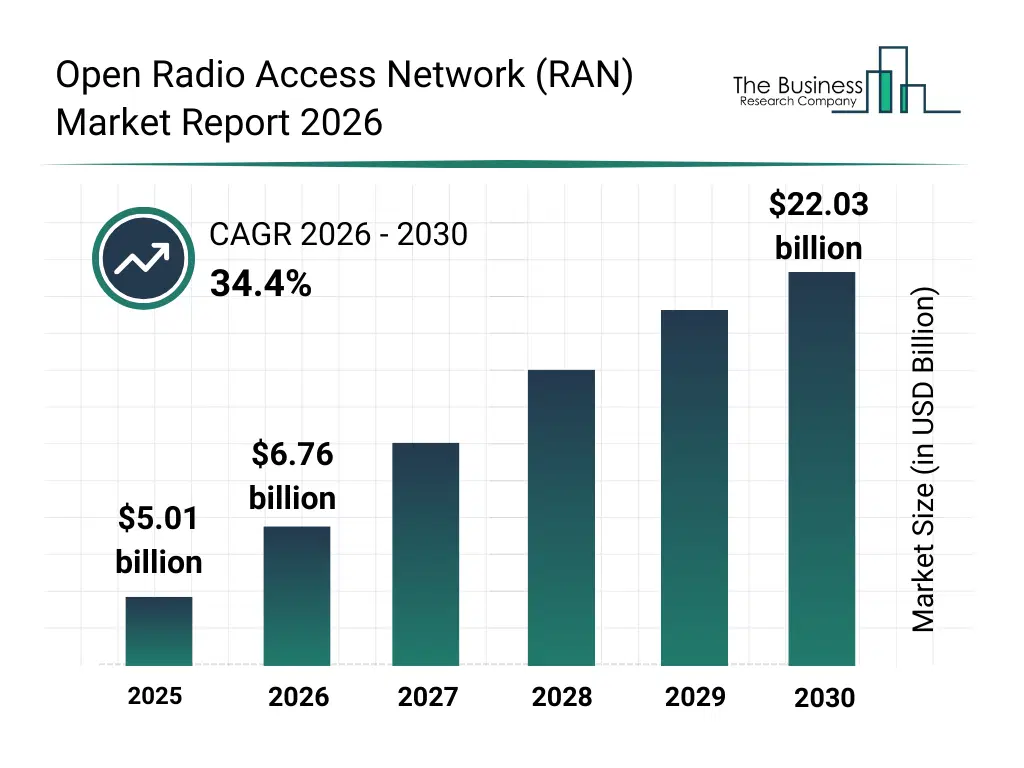
What Is The Open Radio Access Network (RAN) Market Size and Share 2026?
The open radio access network (ran) market size has grown exponentially in recent years. It will grow from $5.01 billion in 2025 to $6.76 billion in 2026 at a compound annual growth rate (CAGR) of 34.9%. The growth in the historic period can be attributed to vendor lock-in challenges, rising mobile data traffic, early virtualization of telecom networks, demand for cost-efficient network rollout, initial 4G network densification.What Is The Open Radio Access Network (RAN) Market Growth Forecast?
The open radio access network (ran) market size is expected to see exponential growth in the next few years. It will grow to $22.03 billion in 2030 at a compound annual growth rate (CAGR) of 34.4%. The growth in the forecast period can be attributed to accelerated 5G network expansion, demand for flexible ran architectures, adoption of cloud-native telecom infrastructure, government support for open ran ecosystems, enterprise private network deployments. Major trends in the forecast period include open and interoperable network architectures, virtualized and cloud-native ran deployments, multi-vendor ecosystem adoption, software-defined radio access networks, private and enterprise open ran networks.
Global Open Radio Access Network (RAN) Market Segmentation
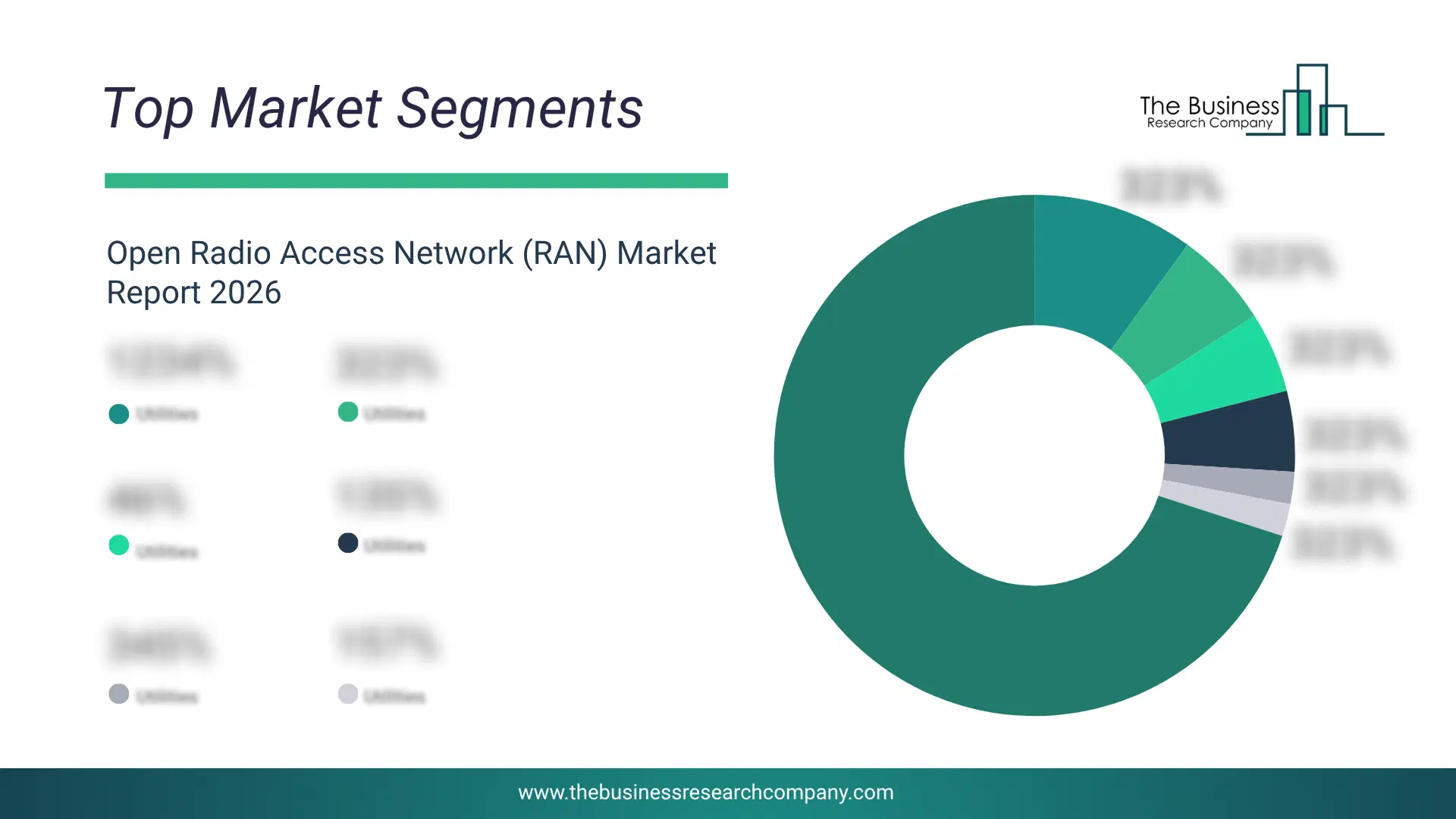
1) By Type: Open Radio Access Network Radio Unit, Open Virtualized Radio Access Network 2) By Component: Hardware, Software, Services 3) By Frequency: Sub-6GHz, mmWave 4) By Unit: Radio Unit, Distributed Unit, Centralized Unit 5) By Deployment: Private, Hybrid Cloud, Public Cloud Subsegments: 1) By Open Radio Access Network Radio Unit: Macrocell Radio Unit, Small Cell Radio Unit, Massive MIMO Radio Unit 2) By Open Virtualized Radio Access Network: Cloud RAN (C-RAN), Edge RAN, Private Network RANWhat Is The Driver Of The Open Radio Access Network (RAN) Market?
The increasing smartphone penetration is expected to propel the growth of the open radio access network (RAN) market going forward. Smartphone penetration is attributed to factors such as the affordability of devices, improved network infrastructure, technological advancements, the globalization of mobile services, increased availability in emerging markets, and higher digital literacy. Open RAN is beneficial for smartphone penetration as it enables cost-effective, flexible, and scalable network solutions, which help expand coverage, especially in underserved areas, thereby making smartphones more accessible to a larger population. For instance, in December 2023, according to Demandsage, a US-based software company, in 2024, the global number of smartphone users is expected to reach 7.10 billion, growing to 7.70 billion by 2027. In the United States, the smartphone penetration rate is projected to rise to 82.20% in 2023, compared to 76.50% in 2022. Therefore, increasing smartphone penetration is driving the growth of the open RAN market.Key Players In The Global Open Radio Access Network (RAN) Market
Major companies operating in the open radio access network (ran) market are Samsung Electronics Co. Ltd., Microsoft Corporation, Verizon Communications Inc., AT&T Inc., Deutsche Telekom AG, Dell Technologies Inc., HuaweiTech, Intel Corporation, International Business Machines Corporation (IBM), Cisco Systems Inc., Qualcomm Incorporated, Telefonica S.A., Broadcom Inc., Google LLC, Hewlett Packard Enterprise (HPE), Fujitsu Limited, Ericsson India Limited, Nokia Corporation, NEC Corporation, Advanced Micro Devices Inc. (AMD), VMware LLC, CommScope, Juniper Networks Inc., NTT Docomo Inc., Orange Group, Mavenir Systems Inc., Spirent Communications plc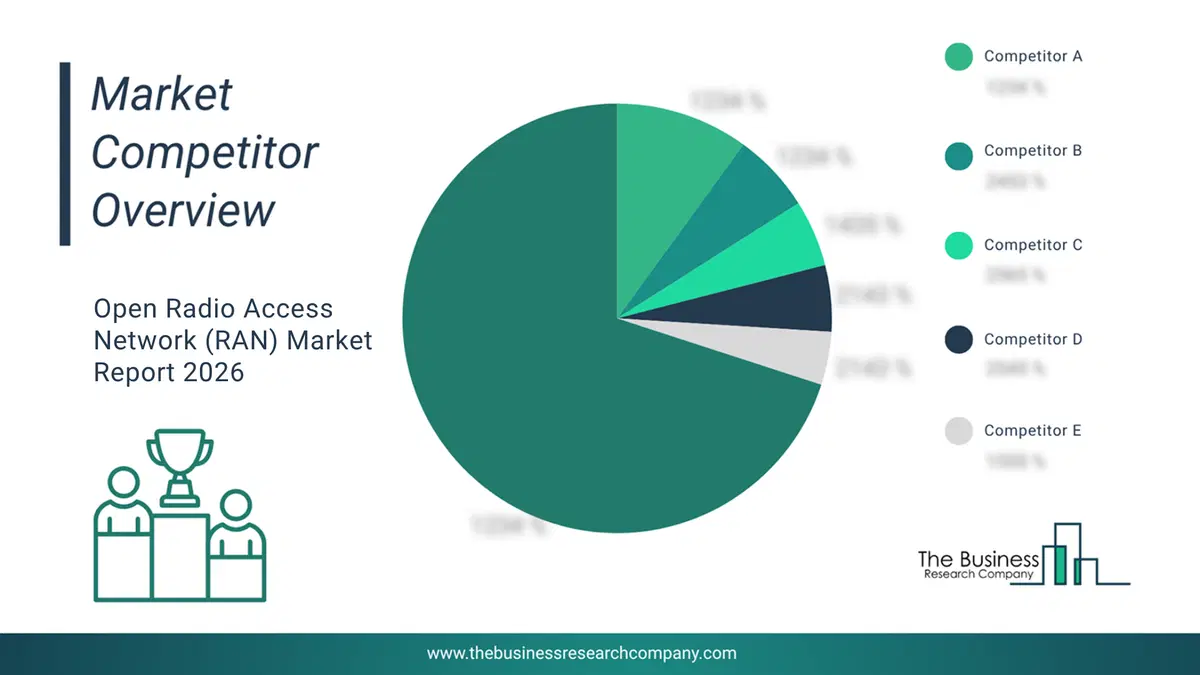
This chart is for illustrative purposes; the full report includes a detailed competitor analysis and comprehensive overview of the top 10 companies in the market.
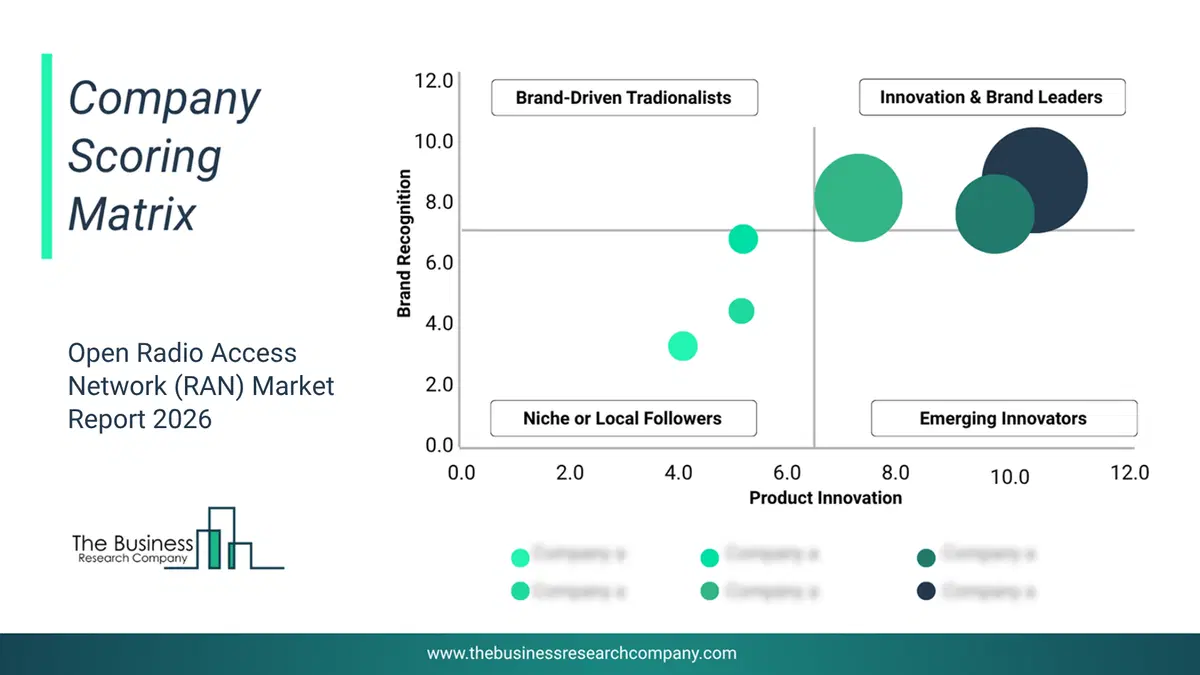
This chart maps companies by product innovation and brand strength, with bubble size indicating relative revenue, helping identify market leaders, challengers, and niche players. This is an illustrative chart; the full report provides a complete and accurate competitive analysis.
Global Open Radio Access Network (RAN) Market Trends and Insights
Major companies operating in the open radio access network (RAN) market are focusing on strategic investments to accelerate the adoption of Open RAN technologies, enhance their product portfolios, and foster partnerships for innovation. Strategic investments help Open RAN by fostering innovation, promoting interoperability, reducing deployment costs, scaling solutions, and building a robust ecosystem to accelerate the adoption of flexible, multi-vendor networks. For instance, in July 2024, EchoStar Corporation, a US-based telecommunications company, launched the Open RAN Center for Integration and Deployment (ORCID). The Open RAN Center for Integration and Deployment (ORCID) is a facility that allows vendors to test and validate O-RAN solutions on EchoStar's live, commercial-grade, cloud-native Open RAN network. The NTIA Public Wireless Supply Chain Innovation Fund supports it with a $50 million grant.What Are Latest Mergers And Acquisitions In The Open Radio Access Network (RAN) Market?
In November 2023, Broadcom Inc., a US based provider of semiconductor solutions and infrastructure hardware, acquired VMware, Inc. for an undisclosed amount. With this acquisition, Broadcom aims to transform VMware into a leading subscription-based, multi-cloud software powerhouse by accelerating investment in core cloud infrastructure, simplifying product offerings, and significantly growing recurring revenue streams. VMware, Inc., is a US based software company that offers open radio access network solutions.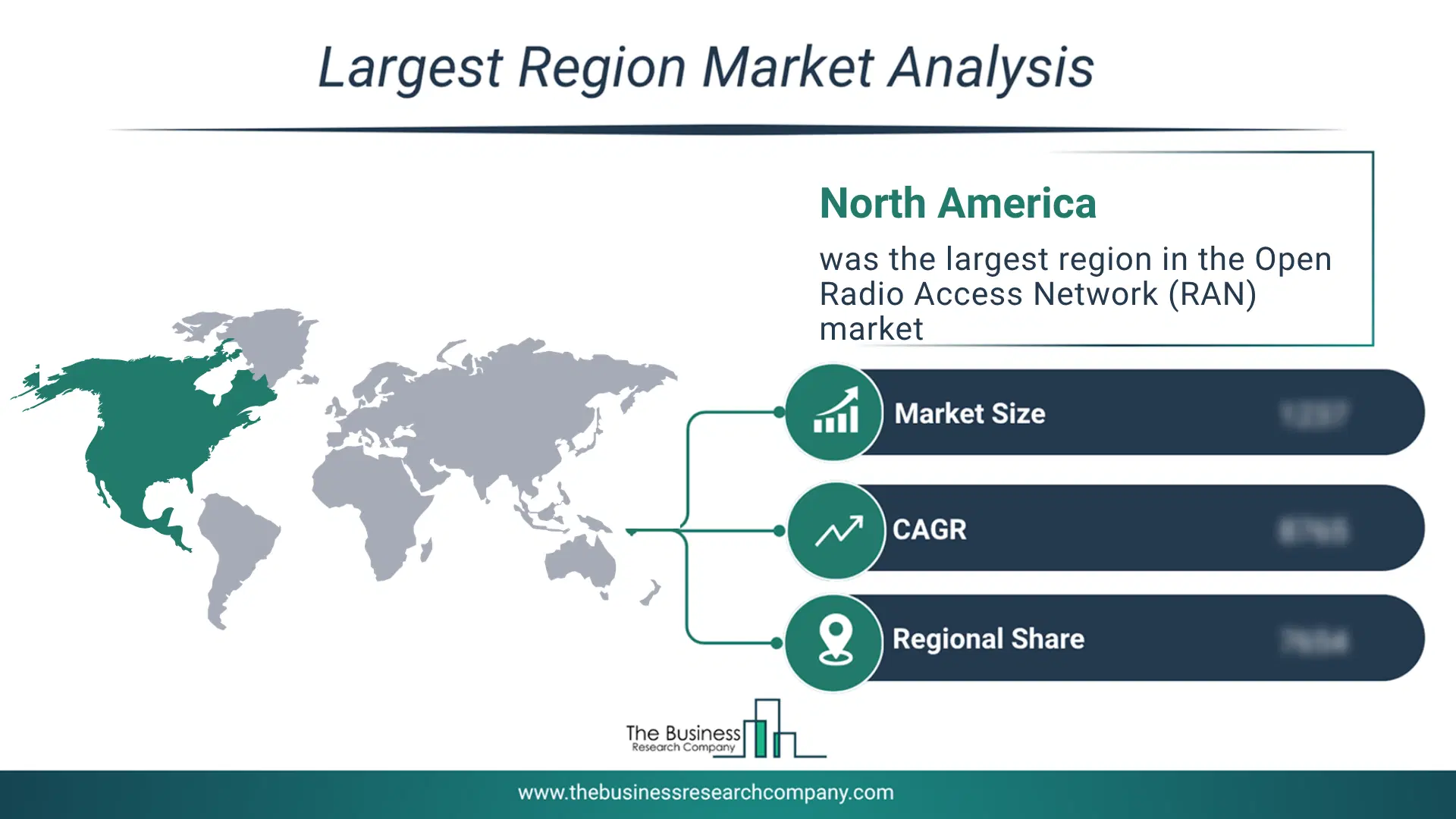
Regional Insights
North America was the largest region in the open radio access network (RAN) market in 2025. Asia-Pacific is expected to be the fastest-growing region in the forecast period. The regions covered in this market report are Asia-Pacific, South East Asia, Western Europe, Eastern Europe, North America, South America, Middle East, Africa. The countries covered in this market report are Australia, Brazil, China, France, Germany, India, Indonesia, Japan, Taiwan, Russia, South Korea, UK, USA, Canada, Italy, Spain.What Defines the Open Radio Access Network (RAN) Market?
The open radio access network (RAN) market consists of revenues earned by entities by providing services such as network integration services, managed network services, and testing and validation services. The market value includes the value of related goods sold by the service provider or included within the service offering. The open RAN market also includes sales of edge computing devices, remote radio units (RRUs), antennas, and radio heads. Values in this market are ‘factory gate’ values, that is the value of goods sold by the manufacturers or creators of the goods, whether to other entities (including downstream manufacturers, wholesalers, distributors and retailers) or directly to end customers. The value of goods in this market includes related services sold by the creators of the goods.How is Market Value Defined and Measured?
The market value is defined as the revenues that enterprises gain from the sale of goods and/or services within the specified market and geography through sales, grants, or donations in terms of the currency (in USD unless otherwise specified). The revenues for a specified geography are consumption values that are revenues generated by organizations in the specified geography within the market, irrespective of where they are produced. It does not include revenues from resales along the supply chain, either further along the supply chain or as part of other products.
This chart presents market attractiveness based on a quantitative evaluation of growth, competition, strategic alignment, and risk, offering a clear view of opportunity areas for decision-making. This chart is for illustrative purposes; the full report contains the complete analysis.

This chart highlights the Total Addressable Market (TAM) by estimating the maximum revenue opportunity using an assumption-driven approach, supporting strategic planning and opportunity sizing across markets. The chart is illustrative; the full report provides a more comprehensive analysis.
What Key Data and Analysis Are Included in the Open Radio Access Network (RAN) Market Report 2026?
The open radio access network (ran) market research report is one of a series of new reports from The Business Research Company that provides market statistics, including industry global market size, regional shares, competitors with the market share, detailed market segments, market trends and opportunities, and any further data you may need to thrive in the open radio access network (ran) industry. The market research report delivers a complete perspective of everything you need, with an in-depth analysis of the current and future state of the industry.Open Radio Access Network (RAN) Market Report Forecast Analysis
| Report Attribute | Details |
|---|---|
| Market Size Value In 2026 | $6.76 billion |
| Revenue Forecast In 2030 | $22.03 billion |
| Growth Rate | CAGR of 34.4% from 2026 to 2030 |
| Base Year For Estimation | 2025 |
| Actual Estimates/Historical Data | 2020-2025 |
| Forecast Period | 2026 - 2030 |
| Market Representation | Revenue in USD Billion and CAGR from 2026 to 2030 |
| Segments Covered | Type, Component, Frequency, Unit, Deployment |
| Regional Scope | Asia-Pacific, Western Europe, Eastern Europe, North America, South America, Middle East, Africa |
| Country Scope | The Countries Covered In This Market Report Are Australia, Brazil, China, France, Germany, India, Indonesia, Japan, Taiwan, Russia, South Korea, Uk, Usa, Canada, Italy, Spain. |
| Key Companies Profiled | Samsung Electronics Co. Ltd., Microsoft Corporation, Verizon Communications Inc., AT&T Inc., Deutsche Telekom AG, Dell Technologies Inc., HuaweiTech, Intel Corporation, International Business Machines Corporation (IBM), Cisco Systems Inc., Qualcomm Incorporated, Telefonica S.A., Broadcom Inc., Google LLC, Hewlett Packard Enterprise (HPE), Fujitsu Limited, Ericsson India Limited, Nokia Corporation, NEC Corporation, Advanced Micro Devices Inc. (AMD), VMware LLC, CommScope, Juniper Networks Inc., NTT Docomo Inc., Orange Group, Mavenir Systems Inc., Spirent Communications plc |
| Customization Scope | Request for Customization |
| Pricing And Purchase Options | Explore Purchase Options |