

Optical Sorter Market Report 2026
Global Outlook – By Type (Camera Sorter, Lasers Sorter, Near Infrared (NIR) Sorter, Hyperspectral Cameras And Combined Sorter, Other Types), By Platform (Hybrid Platform, Lane Platform, Freefall Platform, Belt Platform), By Application (Recycling, Food, Mining), By End-User (Food And Beverages, Waste Recycling, Mining, Pharmaceutical, Other End Users) – Market Size, Trends, Strategies, and Forecast to 2030
Optical Sorter Market Overview
• Optical Sorter market size has reached to $3.45 billion in 2025 • Expected to grow to $6.23 billion in 2030 at a compound annual growth rate (CAGR) of 12.5% • Growth Driver: The Increasing Demand For Automation Drives The Growth Of The Market Due To Improved Efficiency And Cost Reduction • Market Trend: Multi-Commodity Capability Expands Processing Flexibility And Equipment Utilization • North America was the largest region in 2025 and Asia-Pacific is the fastest growing region.What Is Covered Under Optical Sorter Market?
An optical sorter is a machine that uses cameras, lasers, or sensors to automatically identify and separate materials based on visual characteristics such as color, shape, size, or texture. It relies on advanced imaging and processing technologies to detect defects or foreign materials in real time. By automating sorting, it enhances accuracy, efficiency, and consistency compared to manual inspection. The main types of optical sorters are camera sorters, laser sorters, near-infrared (NIR) sorters, hyperspectral cameras, combined sorters, and others. Camera sorters use visible‑light cameras and monochrome and Red Green Blue (RGB) cameras that analyze objects’ size, shape, and color to reject defects or foreign material. The different platforms include the hybrid platform, lane platform, freefall platform, and belt platform. The various applications include recycling, food, and mining and are used by several end users, including food and beverages, waste recycling, mining, pharmaceuticals, and others.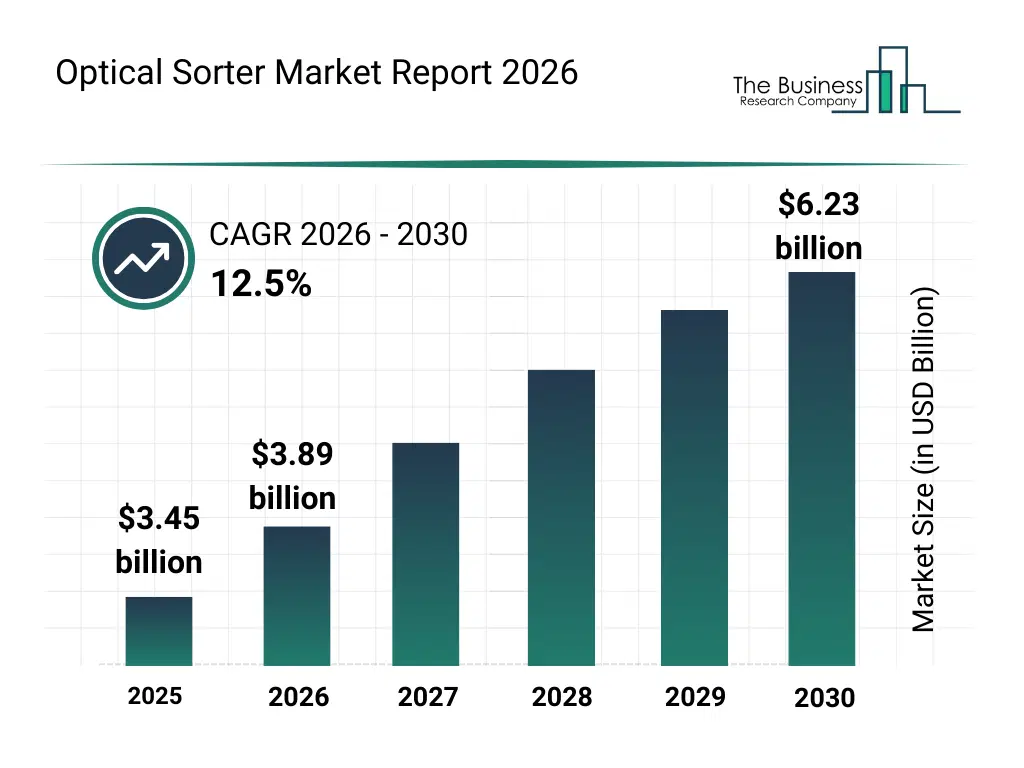
What Is The Optical Sorter Market Size and Share 2026?
The optical sorter market size has grown rapidly in recent years. It will grow from $3.45 billion in 2025 to $3.89 billion in 2026 at a compound annual growth rate (CAGR) of 12.8%. The growth in the historic period can be attributed to manual sorting inefficiencies, growth in recycling initiatives, demand for quality food processing, labor cost pressures, industrial automation adoption.What Is The Optical Sorter Market Growth Forecast?
The optical sorter market size is expected to see rapid growth in the next few years. It will grow to $6.23 billion in 2030 at a compound annual growth rate (CAGR) of 12.5%. The growth in the forecast period can be attributed to circular economy initiatives, stricter waste sorting regulations, AI vision advancements, expansion of smart recycling plants, demand for contamination free products. Major trends in the forecast period include rising automation in material sorting, growing adoption in recycling operations, expansion of optical sorting in food processing, integration of ai based vision systems, increasing demand for high throughput sorting.Tariff Impact On Optical Sorter Market
Tariffs have impacted the optical sorter market by increasing costs of cameras, lasers, and sensor components. Recycling and food processing segments are most affected, particularly in Asia Pacific manufacturing hubs. Equipment pricing has increased moderately. However, tariffs have promoted regional assembly of sorting systems.

Global Optical Sorter Market Segmentation
1) By Type: Camera Sorter, Lasers Sorter, Near Infrared (NIR) Sorter, Hyperspectral Cameras And Combined Sorter, Other Types 2) By Platform: Hybrid Platform, Lane Platform, Freefall Platform, Belt Platform 3) By Application: Recycling, Food, Mining 4) By End-User: Food And Beverages, Waste Recycling, Mining, Pharmaceutical, Other End Users Subsegments: 1) By Camera Sorter: Monochromatic Cameras, Red Green Blue (RGB) Cameras, Line-Scan Cameras, Area-Scan Cameras 2) By Lasers Sorter: Visible Spectrum Lasers, Ultraviolet (UV) Lasers, Infrared (IR) Lasers, Multi-Wavelength Lasers 3) By Near Infrared (NIR) Sorter: Short-Wave Infrared (SWIR), Medium-Wave Infrared (MWIR), Long-Wave Infrared (LWIR) 4) By Hyperspectral Cameras And Combined Sorter: Hyperspectral Imaging Systems, Multispectral Imaging Systems, Combined Laser And Camera Systems, Combined Near Infrared (NIR) And Hyperspectral Systems 5) By Other Types: X-Ray Sorters, Metal Detectors With Optical Integration, Ultraviolet (UV) SortersWhat Is The Driver Of The Optical Sorter Market?
The increasing demand for automation is expected to propel the growth of the optical sorter market going forward. Automation refers to the use of technology, systems, or machines to perform tasks with minimal or no human intervention, aiming to increase efficiency, accuracy, and productivity. Increasing demand for automation is due to its ability to significantly reduce operational costs through improved efficiency, minimized errors, and optimized resource utilization. Optical sorters enhance automation by enabling fast, precise, and consistent sorting processes that reduce manual intervention and improve overall operational efficiency. For instance, in April 2024, the International Federation of Robotics, a Germany-based non-governmental organization, reported 44,303 industrial robot installations in 2023, a rise of 12% from the previous year. Therefore, the increasing demand for automation is driving the growth of the optical sorter industry.Key Players In The Global Optical Sorter Market
Major companies operating in the optical sorter market are Allgaier Werke GmbH, Anzai Manufacturing Co. Ltd., Binder+Co AG, Bühler Group, CP Manufacturing Inc., Daewon GSI Co. Ltd., General Inspection LLC, GREEFA (Greenhouse Equipment Factory), Hefei Meyer Optoelectronic Technology Inc., Cimbria A/S, Hefei Taihe Optoelectronic Technology Co. Ltd., National Recovery Technologies LLC, Orange Sorting Machines (India) Pvt. Ltd., Pellenc Selective Technologies, PETKUS Technologie GmbH, Raytec Vision S.p.A., REDWAVE Solutions US LLC., Satake Corporation, STEINERT GmbH, TOMRA Systems ASA
This chart is for illustrative purposes; the full report includes a detailed competitor analysis and comprehensive overview of the top 10 companies in the market.
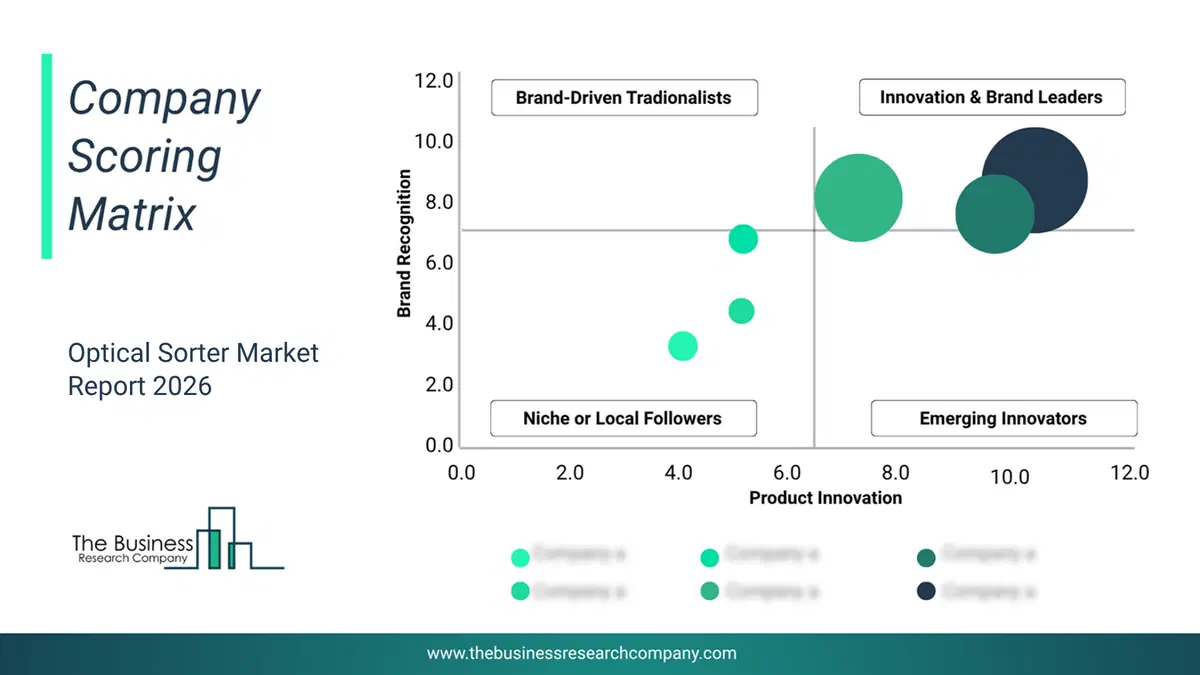
This chart maps companies by product innovation and brand strength, with bubble size indicating relative revenue, helping identify market leaders, challengers, and niche players. This is an illustrative chart; the full report provides a complete and accurate competitive analysis.
Global Optical Sorter Market Trends and Insights
Major companies operating in the optical sorter market are focusing on developing advanced solutions, such as multi-commodity processing, to enable processors to handle diverse product types on a single platform. Multi-commodity processing helps the optical sorter by expanding the addressable customer base, as one machine can sort multiple products such as grains, pulses, nuts, and spices. It also improves return on investment for processors by increasing equipment utilization, reducing the need for multiple dedicated machines, and lowering overall capital and operating costs. For instance, in November 2023, Bühler AG, a Switzerland-based food-technology company, launched the SPARK Pro optical sorter. The system features an easy-operation interface tailored for smaller processors, a non-stop sorting algorithm that prevents production interruptions, and a zero-spillage design that minimizes product waste. It is also available in multiple chute configurations to match varying capacity needs and supports a wide range of commodities such as grains, rice, coffee, pulses, nuts, and spices.What Are Latest Mergers And Acquisitions In The Optical Sorter Market?
In November 2023 IK Investment Partners, a UK-based private equity company, acquired Sesotec GmbH for an undisclosed amount. With this acquisition, IK Investment Partners aims to strengthen Sesotec’s growth, expand its market presence, and accelerate innovation in advanced sorting and detection technologies. Sesotec GmbH is a Germany-based company that designs and manufactures optical sorters.
Regional Outlook
North America was the largest region in the optical sorter market in 2025. Asia-Pacific is expected to be the fastest-growing region in the forecast period. The regions covered in this market report are Asia-Pacific, South East Asia, Western Europe, Eastern Europe, North America, South America, Middle East, Africa The countries covered in this market report are Australia, Brazil, China, France, Germany, India, Indonesia, Japan, Taiwan, Russia, South Korea, UK, USA, Canada, Italy, Spain.What Defines the Optical Sorter Market?
The optical sorter market consists of revenues earned by entities by providing installation and commissioning, maintenance and repair, operator training, calibration and optimization, and remote monitoring and diagnostics. The market value includes the value of related goods sold by the service provider or included within the service offering. The optical sorter market also includes sales of color sorter machines, X-ray sorting machines, shape and size sorters, flake sorters, and vision inspection camera modules. Values in this market are ‘factory gate’ values; that is, the value of goods sold by the manufacturers or creators of the goods, whether to other entities (including downstream manufacturers, wholesalers, distributors, and retailers) or directly to end customers. The value of goods in this market includes related services sold by the creators of the goods.How is Market Value Defined and Measured?
The market value is defined as the revenues that enterprises gain from the sale of goods and/or services within the specified market and geography through sales, grants, or donations in terms of the currency (in USD unless otherwise specified). The revenues for a specified geography are consumption values that are revenues generated by organizations in the specified geography within the market, irrespective of where they are produced. It does not include revenues from resales along the supply chain, either further along the supply chain or as part of other products.
This chart presents market attractiveness based on a quantitative evaluation of growth, competition, strategic alignment, and risk, offering a clear view of opportunity areas for decision-making. This chart is for illustrative purposes; the full report contains the complete analysis.

This chart highlights the Total Addressable Market (TAM) by estimating the maximum revenue opportunity using an assumption-driven approach, supporting strategic planning and opportunity sizing across markets. The chart is illustrative; the full report provides a more comprehensive analysis.
What Key Data and Analysis Are Included in the Optical Sorter Market Report 2026?
The optical sorter market research report is one of a series of new reports from The Business Research Company that provides market statistics, including industry global market size, regional shares, competitors with the market share, detailed market segments, market trends and opportunities, and any further data you may need to thrive in the optical sorter industry. The market research report delivers a complete perspective of everything you need, with an in-depth analysis of the current and future state of the industry.Optical Sorter Market Report Forecast Analysis
| Report Attribute | Details |
|---|---|
| Market Size Value In 2026 | $3.89 billion |
| Revenue Forecast In 2030 | $6.23 billion |
| Growth Rate | CAGR of 12.5% from 2026 to 2030 |
| Base Year For Estimation | 2025 |
| Actual Estimates/Historical Data | 2020-2025 |
| Forecast Period | 2026 - 2030 |
| Market Representation | Revenue in USD Billion and CAGR from 2026 to 2030 |
| Segments Covered | Type, Platform, Application, End-User |
| Regional Scope | Asia-Pacific, Western Europe, Eastern Europe, North America, South America, Middle East, Africa |
| Key Companies Profiled | Allgaier Werke GmbH, Anzai Manufacturing Co. Ltd., Binder+Co AG, Bühler Group, CP Manufacturing Inc., Daewon GSI Co. Ltd., General Inspection LLC, GREEFA (Greenhouse Equipment Factory), Hefei Meyer Optoelectronic Technology Inc., Cimbria A/S, Hefei Taihe Optoelectronic Technology Co. Ltd., National Recovery Technologies LLC, Orange Sorting Machines (India) Pvt. Ltd., Pellenc Selective Technologies, PETKUS Technologie GmbH, Raytec Vision S.p.A., REDWAVE Solutions US LLC., Satake Corporation, STEINERT GmbH, TOMRA Systems ASA |
| Customization Scope | Request for Customization |
| Pricing And Purchase Options | Explore Purchase Options |