
Organic Rankine Cycle (ORC) Waste Heat To Power Market Report 2026
Global Outlook – By Model (Steady-State, Dynamic), By Technology (Organic Rankine Cycle (ORC), Kalina Cycle, Steam Rankine Cycle, Combined Heat And Power (CHP)), By Power Output (≤ 1 Megawatt Electrical, > 1 - 5 Megawatt Electrical, > 5 - 10 Megawatt Electrical, > 10 Megawatt Electrical), By Application (Internal Combustion Engines (ICE) Or Gas Turbine, Waste To Energy, Metal Production, Cement And Lime Industry, Glass Industry, Petroleum Refining, Chemical Industry, Landfill Internal Combustion Engines (ICE)), By End-User Industry (Manufacturing And Industrial Sector, Energy Generation And Utilities, Chemical And Petrochemical, Food And Beverage, Automotive) – Market Size, Trends, Strategies, and Forecast to 2030
Organic Rankine Cycle (ORC) Waste Heat To Power Market Overview
• Organic Rankine Cycle (ORC) Waste Heat To Power market size has reached to $3.64 billion in 2025 • Expected to grow to $7.32 billion in 2030 at a compound annual growth rate (CAGR) of 14.9% • Growth Driver: Surge In Renewable Energy Sources Fueling the Growth Of The Market Due To Rising Demand For Clean And Efficient Power Generation Solutions • Market Trend: Low-Temperature Waste Heat Conversion Enables Cost-Effective Clean Power Generation • North America was the largest region in 2025 and Asia-Pacific is the fastest growing region.Market Gains By 2030 – Top Opportunities By Segment
Market Gain identifies the most promising market opportunities by highlighting the segments or products expected to generate the highest incremental revenue growth over the next five years.
What Is Covered Under Organic Rankine Cycle (ORC) Waste Heat To Power Market?
Organic rankine cycle (ORC) waste heat to power refers to a technology that captures low- to medium-temperature waste heat and converts it into electricity using an organic working fluid. It improves energy efficiency in industrial and renewable energy applications by utilizing heat that would otherwise be lost. The main models in the organic rankine cycle (ORC) waste heat to power are steady-state and dynamic. A steady-state model represents system operation under constant conditions, where variables such as temperature, pressure, and flow remain unchanged over time. The various technologies include organic rankine cycle (ORC), Kalina cycle, steam rankine cycle, and combined heat and power (CHP) systems with multiple power output capacities that are categorized as ≤1 megawatt electrical (MWe), >1–5 MWe, >5–10 MWe, and >10 MWe. The different applications involved are internal combustion engines (ICEs) or gas turbines, waste-to-energy facilities, metal production, the cement and lime industry, the glass industry, petroleum refining, the chemical sector, and landfill ICE, and they are used by several end-use industries such as manufacturing and industrial sectors, energy generation and utilities, chemical and petrochemical industries, food and beverage production, and automotive industry.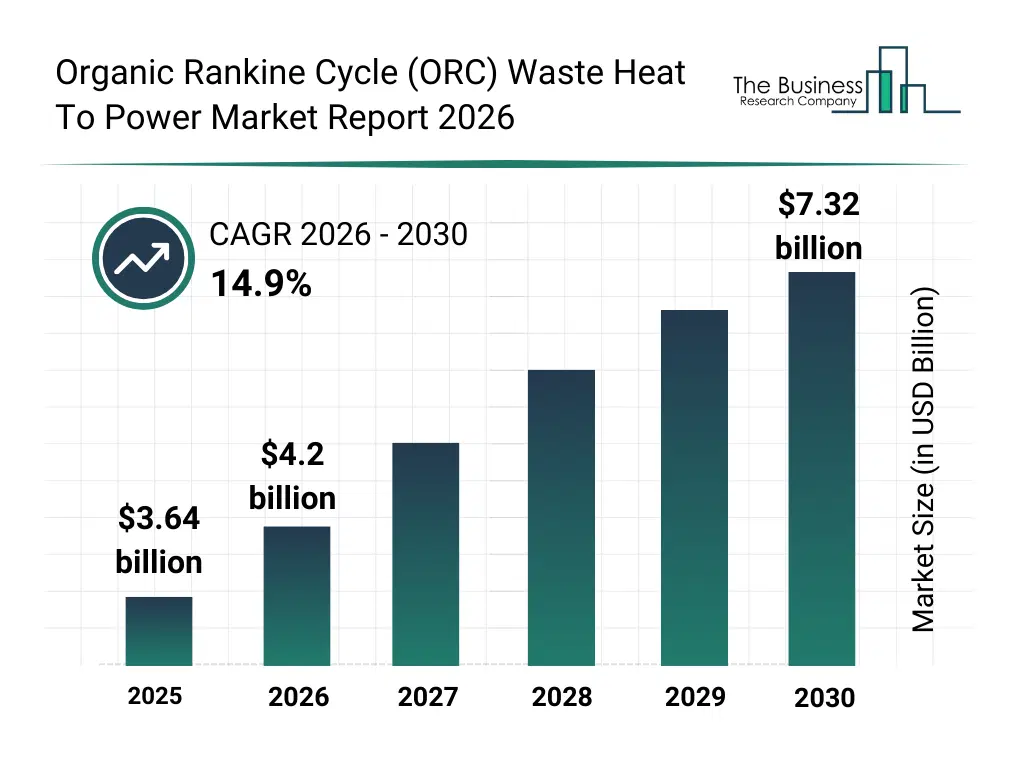
What Is The Organic Rankine Cycle (ORC) Waste Heat To Power Market Size and Share 2026?
The organic rankine cycle (orc) waste heat to power market size has grown rapidly in recent years. It will grow from $3.64 billion in 2025 to $4.2 billion in 2026 at a compound annual growth rate (CAGR) of 15.2%. The growth in the historic period can be attributed to increasing industrial energy consumption, availability of recoverable waste heat streams, early adoption of combined heat and power systems, rising fuel cost pressures, improvements in organic working fluid technologies.What Is The Organic Rankine Cycle (ORC) Waste Heat To Power Market Growth Forecast?
The organic rankine cycle (orc) waste heat to power market size is expected to see rapid growth in the next few years. It will grow to $7.32 billion in 2030 at a compound annual growth rate (CAGR) of 14.9%. The growth in the forecast period can be attributed to increasing demand for energy efficiency optimization, rising investments in decarbonization technologies, expansion of industrial electrification initiatives, growing adoption of distributed power generation, increasing focus on circular energy utilization. Major trends in the forecast period include increasing adoption of waste heat recovery systems, rising deployment of orc units in industrial plants, growing integration of orc with renewable energy sources, expansion of modular and scalable orc solutions, enhanced focus on low-temperature heat utilization.
Global Organic Rankine Cycle (ORC) Waste Heat To Power Market Segmentation
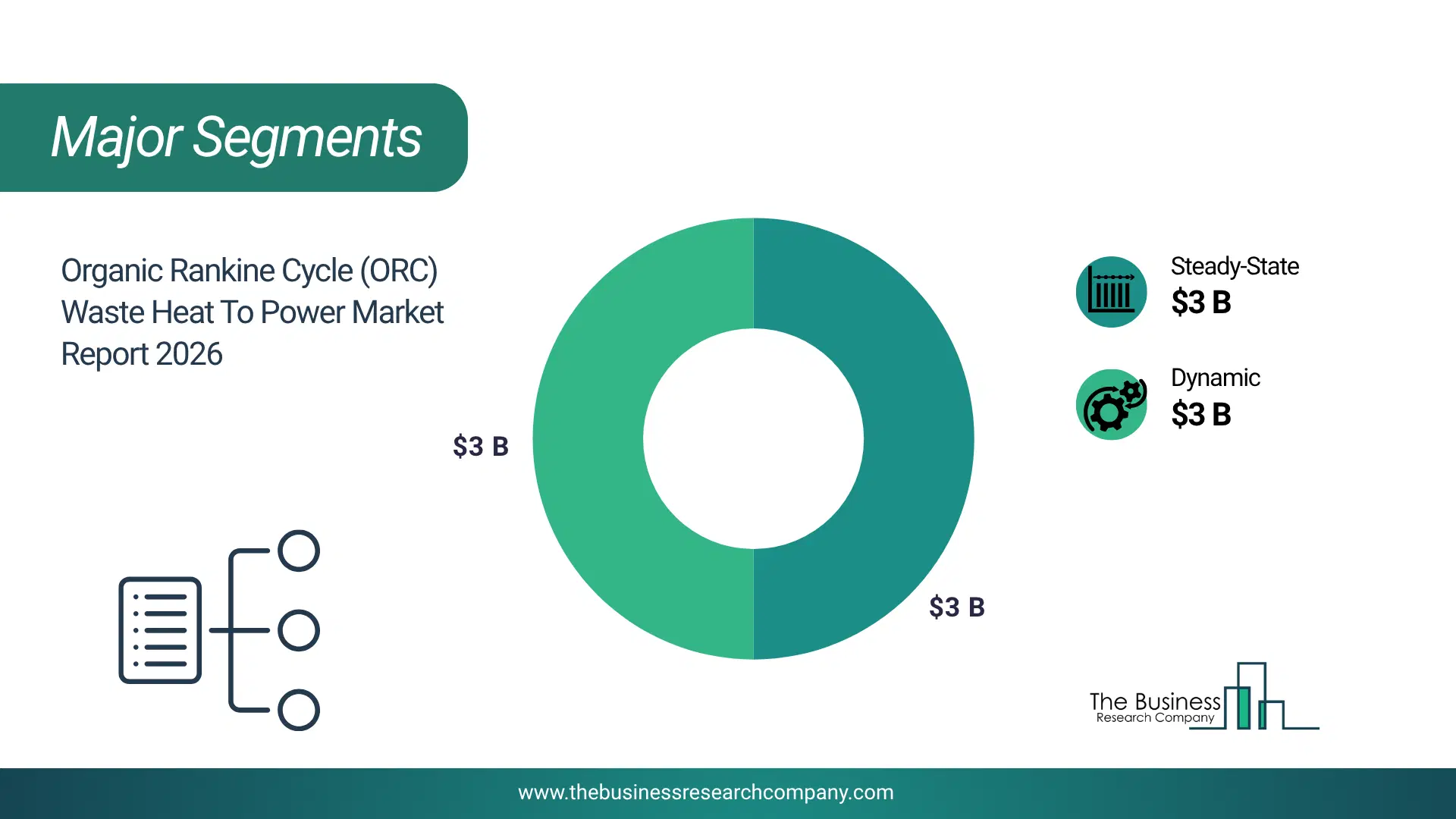
1) By Model: Steady-State, Dynamic 2) By Technology: Organic Rankine Cycle (ORC), Kalina Cycle, Steam Rankine Cycle, Combined Heat And Power (CHP) 3) By Power Output: ≤ 1 Megawatt Electrical, > 1 - 5 Megawatt Electrical, > 5 - 10 Megawatt Electrical, > 10 Megawatt Electrical 4) By Application: Internal Combustion Engines (ICE) Or Gas Turbine, Waste To Energy, Metal Production, Cement And Lime Industry, Glass Industry, Petroleum Refining, Chemical Industry, Landfill Internal Combustion Engines (ICE) 5) By End-User Industry: Manufacturing And Industrial Sector, Energy Generation And Utilities, Chemical And Petrochemical, Food And Beverage, Automotive Subsegments: 1) By Steady-State: Closed Loop Systems, Open Loop Systems, Geothermal Applications, Industrial Process Heat Recovery 2) By Dynamic: Transient Analysis Systems, Real-Time Simulation Systems, Hybrid Systems, Fluctuating Heat Source Applications The top segments in the organic rankine cycle (orc) waste heat to power market will be: • Steady-State will reach $3.34 Billion by 2030. • Dynamic will reach $2.64 Billion by 2030.What Is The Driver Of The Organic Rankine Cycle (ORC) Waste Heat To Power Market?
The rising adoption of renewable energy sources is expected to propel the growth of the organic rankine cycle (ORC) waste heat to power market going forward. Renewable energy sources are naturally replenished resources such as sunlight, wind, and geothermal heat that provide sustainable, clean power without depleting the environment. Renewable energy sources are rising primarily due to increasing global demand for clean, sustainable alternatives to fossil fuels to combat climate change. The organic rankine cycle (ORC) waste heat to power enhances renewable energy sources by efficiently converting low-grade heat from industrial or geothermal processes into electricity, thereby maximizing energy recovery and sustainability. For instance, in February 2025, the World Resources Institute, a US-based non-profit organization, reported that in 2024, solar energy set a new record by adding an estimated 39.6 gigawatts (GW) of capacity, surpassing the 27.4 GW installed in 2023. Therefore, the rising adoption of renewable energy sources is driving the growth of the organic rankine cycle (ORC) waste heat to power industry.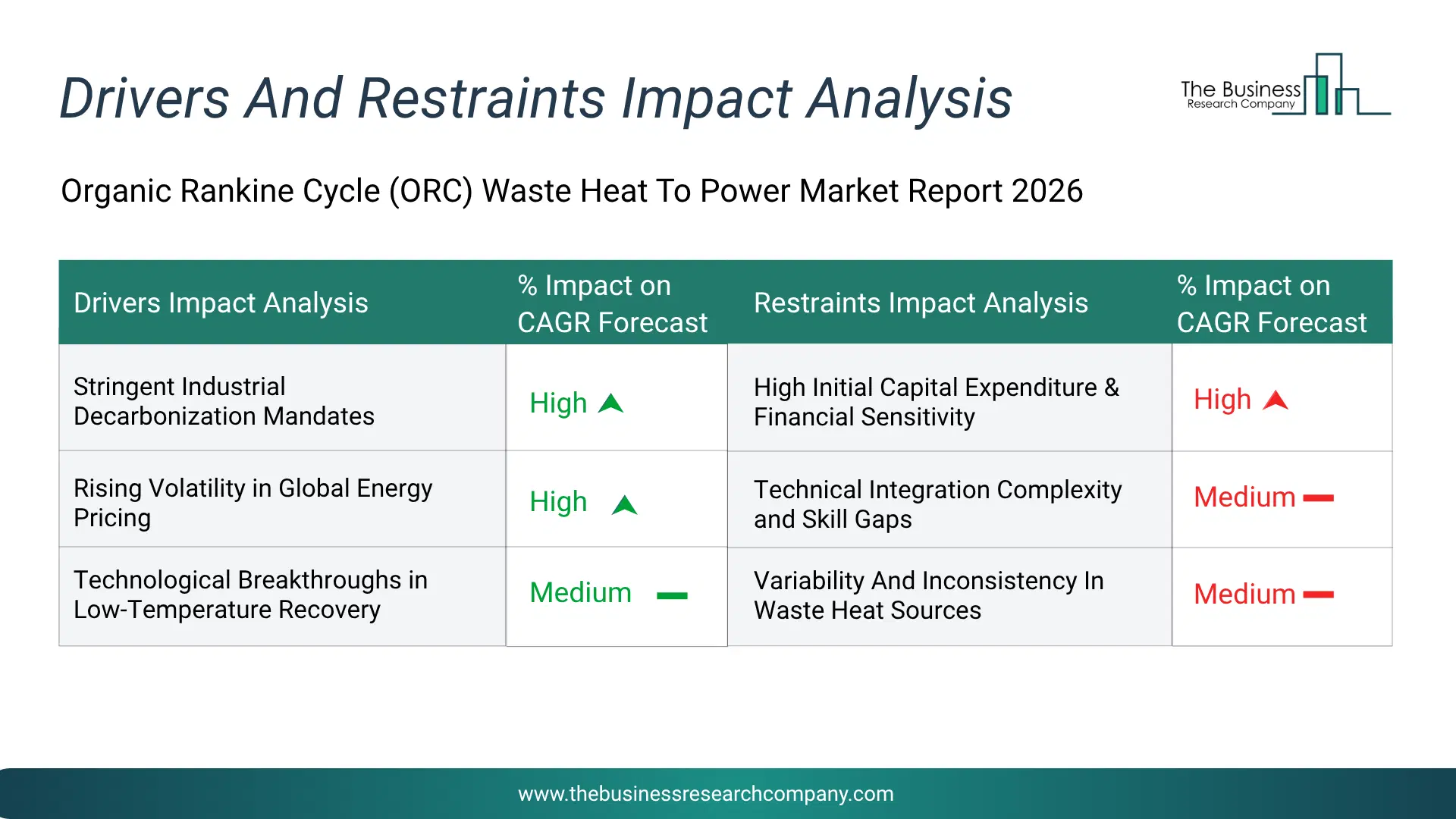
Infographic Chart Showing Key Market Drivers Analysis And Restraints For Organic Rankine Cycle (Orc) Waste Heat To Power Market
The chart presents an impact analysis of key drivers and restraints, quantifying their relative influence on the market's growth rate and helping assess the balance between growth enablers and limiting factors. This chart offers a high-level perspective; the full report contains more detailed insights.
How Will The Drivers Impact Growth In The Global Organic Rankine Cycle (ORC) Waste Heat To Power Market?
• Stringent Industrial Decarbonization Mandates (High) – During the forecast period, stringent industrial decarbonization mandates are expected to become a key growth driver for the organic rankine cycle (ORC) waste heat to power market by 2030. Governments and regulatory bodies across major economies are increasingly enforcing carbon reduction targets for energy-intensive industries, compelling companies to adopt cleaner and more efficient technologies. ORC systems enable industries to convert waste heat into usable electricity, significantly lowering overall carbon intensity without disrupting core operations. This aligns with corporate sustainability goals and environmental compliance requirements across sectors such as cement, metals, and chemicals. The growing pressure to achieve net-zero emissions is accelerating investments in waste heat recovery solutions. • Rising Volatility in Global Energy Pricing (High) – During the forecast period, rising volatility in global energy pricing is expected to emerge as a major factor driving the expansion of the organic rankine cycle (ORC) waste heat to power market by 2030. Fluctuations in electricity and fuel prices are increasing operational uncertainties for industrial facilities, prompting the need for stable and cost-efficient energy alternatives. ORC-based waste heat recovery systems allow industries to generate power internally, reducing dependence on external energy sources and mitigating exposure to price shocks. This enhances long-term cost predictability and improves overall energy security for industrial operations. Increasing awareness of energy cost optimization is further strengthening adoption trends. • Technological Breakthroughs in Low-Temperature Recovery (Medium) – During the forecast period, technological breakthroughs in low-temperature recovery are expected to act as a key growth catalyst for the organic rankine cycle (ORC) waste heat to power market by 2030. Advancements in working fluids, heat exchangers, and turbine efficiency are enabling ORC systems to effectively utilize lower-grade heat sources that were previously uneconomical to recover. This expands the addressable market across a wider range of industries, including food processing, glass manufacturing, and small-scale industrial facilities. Improved system flexibility and modular design are also supporting easier integration into existing operations. As innovation continues to enhance system performance and efficiency, adoption across diverse applications is expected to accelerate.How Will The Restraints Impact Growth In The Global Organic Rankine Cycle (ORC) Waste Heat To Power Market?
• High Initial Capital Expenditure & Financial Sensitivity (High) – During the forecast period, high initial capital expenditure and financial sensitivity are restricting the growth of the organic rankine cycle (ORC) waste heat to power market. Significant upfront investment requirements and sensitivity to project economics are creating financial barriers for industrial players, thereby limiting adoption • Technical Integration Complexity and Skill Gaps (High) – During the forecast period, technical integration complexity and skill gaps are restricting the growth of the organic rankine cycle (ORC) waste heat to power market. Challenges in integrating ORC systems with existing industrial processes along with shortage of skilled professionals are increasing deployment difficulties and slowing implementation • Variability And Inconsistency In Waste Heat Sources (Medium) – During the forecast period, variability and inconsistency in waste heat sources are restricting the growth of the organic rankine cycle (ORC) waste heat to power market. Fluctuations in temperature and availability of waste heat are affecting system efficiency and reliability, thereby limiting optimal performanceKey Players In The Global Organic Rankine Cycle (ORC) Waste Heat To Power Market
Major companies operating in the organic rankine cycle (orc) waste heat to power market are General Electric Power, Siemens Energy AG, Mitsubishi Heavy Industries Ltd., Baker Hughes Company, Atlas Copco AB, GEA Group AG, Alfa Laval AB, Dürr Cyplan GmbH, Ormat Technologies Inc., Exergy S.p.A, GMK Energy Co. Ltd., Turboden S.p.A, ElectraTherm Inc., Calnetix Technologies LLC, Orcan Energy AG, Enogia Société Anonyme, Infinity Turbine LLC, Triogen B.V., Enertime S.A., Zuccato Energia S.r.l., Kaishan ORC Energy Equipment Co. Ltd.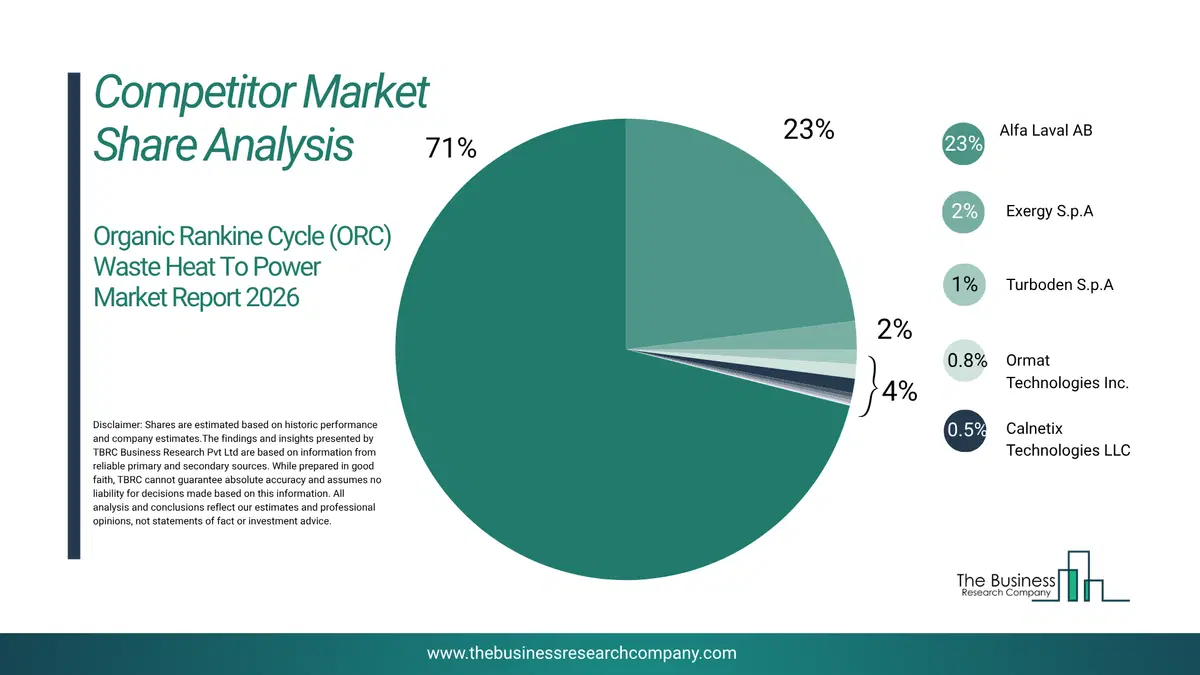
This chart is for illustrative purposes; the full report includes a detailed competitor analysis and comprehensive overview of the top 10 companies in the market.
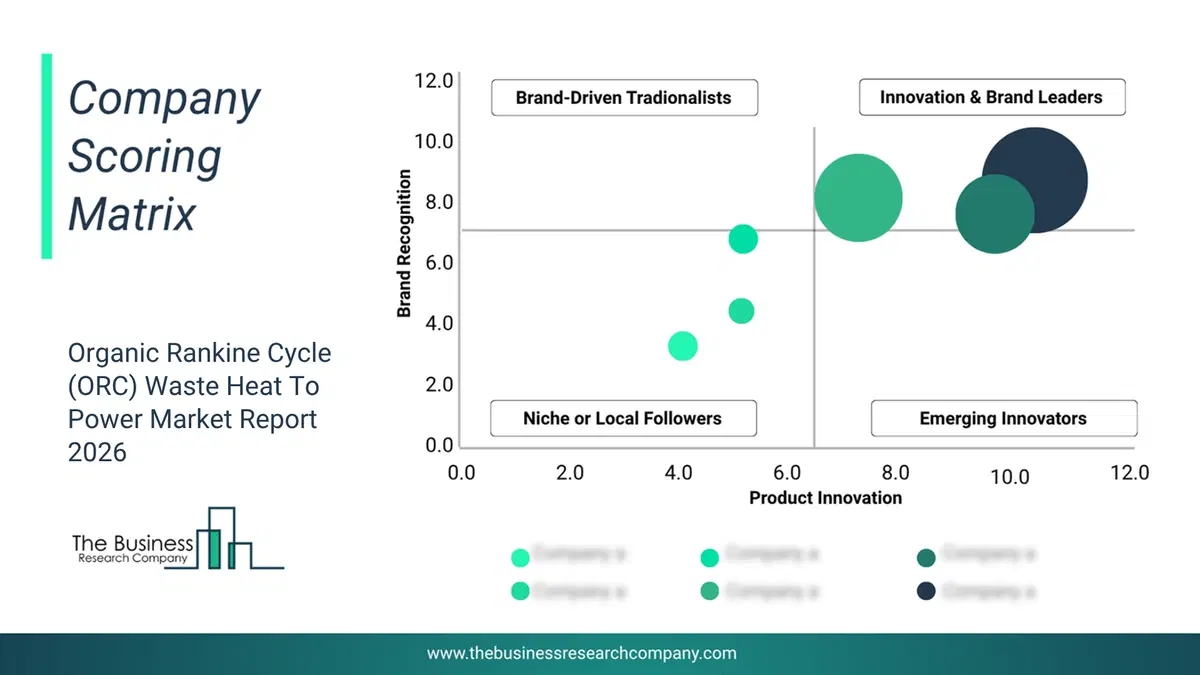
This chart maps companies by product innovation and brand strength, with bubble size indicating relative revenue, helping identify market leaders, challengers, and niche players. This is an illustrative chart; the full report provides a complete and accurate competitive analysis.
Global Organic Rankine Cycle (ORC) Waste Heat To Power Market Trends and Insights
Major companies operating in the organic rankine cycle (orc) waste heat to power market are focusing on developing advanced low-temperature waste heat conversion solutions to enhance cost efficiency and reduce carbon emissions. Low-temperature waste heat conversion refers to technology that enables the generation of clean electricity from thermal energy at lower temperature levels than traditional systems ensuring energy that was previously unused is converted into productive power. For instance, in March 2023, Durr Group, a Germany-based company, launched the Cyplan ORC 70 NT module featuring a proven ORC circuit principle that converts waste heat into clean electricity from temperatures as low as 85 °C making clean power generation economical even at lower heat levels. The system integrates tried-and-tested standard components for fast deployment and provides a plug-and-play solution for seamless integration into customer systems with a maximum gross output of 70 kWe. It works reliably at high outside temperatures and helps lower energy costs while shrinking CO₂ emissions. The first installation at an agricultural machinery manufacturer has improved carbon footprint and stabilized process management by utilizing heat peaks so the combined heat and power unit operates at high efficiency.What Are Latest Mergers And Acquisitions In The Organic Rankine Cycle (ORC) Waste Heat To Power Market?
In October 2023, BITZER SE, a Germany-based manufacturing company, acquired BPOWER for an undisclosed amount. With this acquisition, BITZER aimed to expand its capabilities in waste heat utilization and green energy by integrating Organic Rankine Cycle (ORC) systems into its product portfolio to enhance energy-efficiency solutions and support decarbonization efforts. BPOWER a. s., is a Czech Republic-based engineering company that specializes in providing organic Rankine cycle (ORC) solutions and services for exploiting waste heat, heat recovery, and power generation from biomass, including system planning, project engineering, installation, and customer support.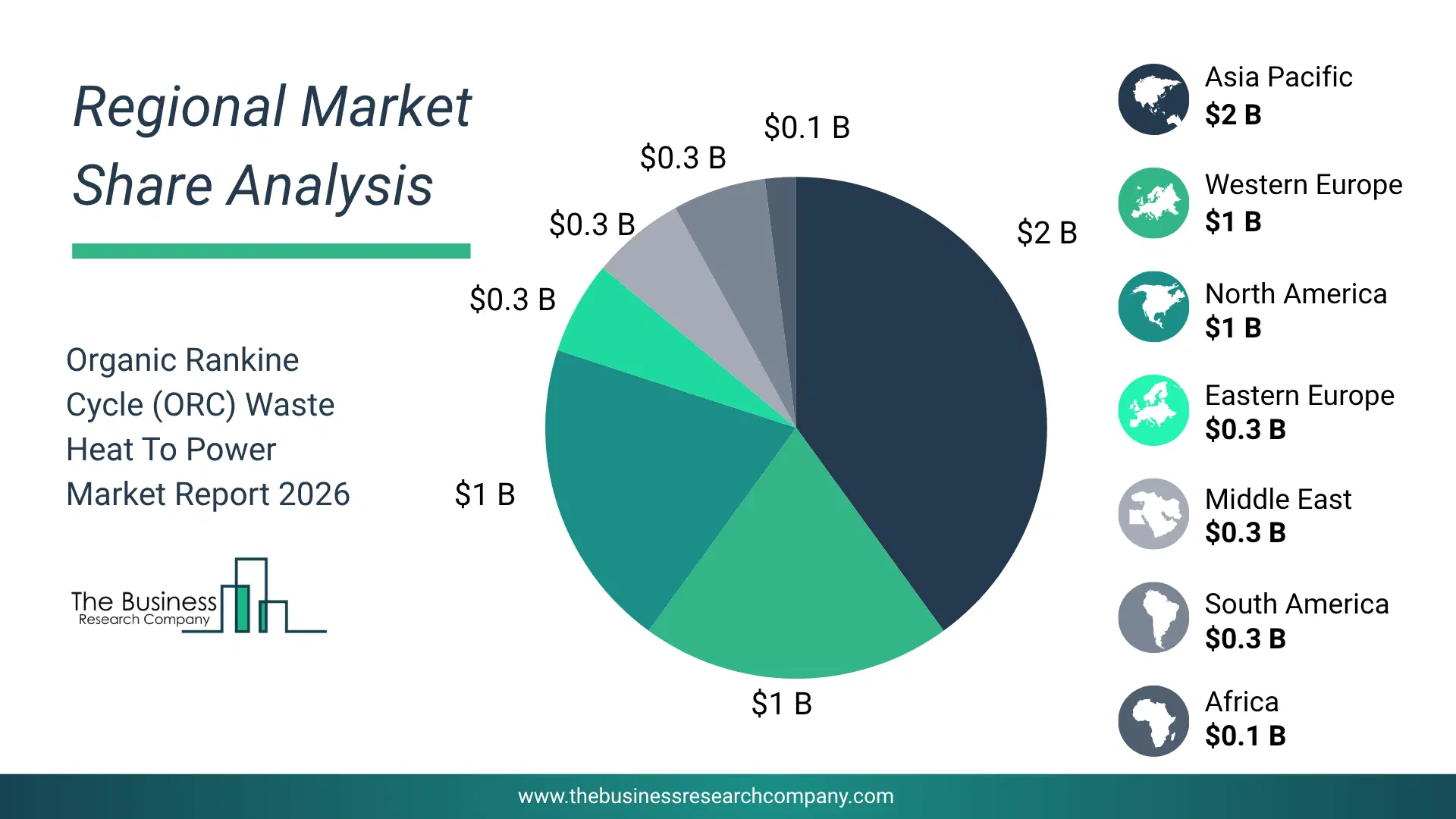
Regional Outlook
North America was the largest region in the organic rankine cycle (ORC) waste heat to power market in 2025. Asia-Pacific is expected to be the fastest-growing region in the forecast period. The regions covered in this market report are Asia-Pacific, South East Asia, Western Europe, Eastern Europe, North America, South America, Middle East, Africa. The countries covered in this market report are Australia, Brazil, China, France, Germany, India, Indonesia, Japan, Taiwan, Russia, South Korea, UK, USA, Canada, Italy, SpainWhat Defines the Organic Rankine Cycle (ORC) Waste Heat To Power Market?
The organic rankine cycle (ORC) waste heat to power market consists of revenues earned by entities by providing services such as system design and engineering, equipment manufacturing, installation, maintenance, and performance optimization. The market value includes the value of related goods sold by the service provider or included within the service offering. The organic rankine cycle (ORC) waste heat to power market also includes sales of pumps and feed systems, condensers, generators, skid-mounted ORC modules, bypass and safety systems, and retrofit kits. Values in this market are ‘factory gate’ values, that is, the value of goods sold by the manufacturers or creators of the goods, whether to other entities (including downstream manufacturers, wholesalers, distributors, and retailers) or directly to end customers. The value of goods in this market includes related services sold by the creators of the goods.How is Market Value Defined and Measured?
The market value is defined as the revenues that enterprises gain from the sale of goods and/or services within the specified market and geography through sales, grants, or donations in terms of the currency (in USD unless otherwise specified). The revenues for a specified geography are consumption values that are revenues generated by organizations in the specified geography within the market, irrespective of where they are produced. It does not include revenues from resales along the supply chain, either further along the supply chain or as part of other products.
This chart presents market attractiveness based on a quantitative evaluation of growth, competition, strategic alignment, and risk, offering a clear view of opportunity areas for decision-making. This chart is for illustrative purposes; the full report contains the complete analysis.

This chart highlights the Total Addressable Market (TAM) by estimating the maximum revenue opportunity using an assumption-driven approach, supporting strategic planning and opportunity sizing across markets. The chart is illustrative; the full report provides a more comprehensive analysis.
What Key Data and Analysis Are Included in the Organic Rankine Cycle (ORC) Waste Heat To Power Market Report 2026?
The organic rankine cycle (orc) waste heat to power market research report is one of a series of new reports from The Business Research Company that provides market statistics, including Market Report 2026?global market size, regional shares, competitors with the market share, detailed market segments, market trends and opportunities, and any further data you may need to thrive in the organic rankine cycle (orc) waste heat to power Market Report 2026? The market research report delivers a complete perspective of everything you need, with an in-depth analysis of the current and future state of the Market Report 2026?Organic Rankine Cycle (ORC) Waste Heat To Power Market Report Forecast Analysis
| Report Attribute | Details |
|---|---|
| Market Size Value In 2026 | $4.2 billion |
| Revenue Forecast In 2030 | $7.32 billion |
| Growth Rate | CAGR of 15.2% from 2026 to 2030 |
| Base Year For Estimation | 2025 |
| Actual Estimates/Historical Data | 2020-2025 |
| Forecast Period | 2026 - 2030 |
| Market Representation | Revenue in USD Billion and CAGR from 2026 to 2030 |
| Segments Covered | Model, Technology, Power Output, Application, End-User Industry |
| Regional Scope | Asia-Pacific, Western Europe, Eastern Europe, North America, South America, Middle East, Africa |
| Country Scope | The countries covered in the report are Australia, Brazil, China, France, Germany, India, Indonesia, Japan, Taiwan, Russia, South Korea, UK, USA, Canada, Italy, Spain. |
| Key Companies Profiled | General Electric Power, Siemens Energy AG, Mitsubishi Heavy Industries Ltd., Baker Hughes Company, Atlas Copco AB, GEA Group AG, Alfa Laval AB, Dürr Cyplan GmbH, Ormat Technologies Inc., Exergy S.p.A, GMK Energy Co. Ltd., Turboden S.p.A, ElectraTherm Inc., Calnetix Technologies LLC, Orcan Energy AG, Enogia Société Anonyme, Infinity Turbine LLC, Triogen B.V., Enertime S.A., Zuccato Energia S.r.l., Kaishan ORC Energy Equipment Co. Ltd. |
| Customization Scope | Request for Customization |
| Pricing And Purchase Options | Explore Purchase Options |