

Personal Care Ingredients Market Report 2026
Global Outlook – By Ingredient Type (Emollients, Surfactants, Emulsifiers, Rheology Modifiers, Conditioning Polymers, Other Ingredients), By Source (Natural Ingredients, Synthetic Ingredients), By Application (Skin Care, Hair Care, Oral Care, Cosmetics, Other Applications) – Market Size, Trends, Strategies, and Forecast to 2030
Personal Care Ingredients Market Overview
• Personal Care Ingredients market size has reached to $17.22 billion in 2025 • Expected to grow to $25.56 billion in 2030 at a compound annual growth rate (CAGR) of 8.1% • Growth Driver: A Rise In E-Commerce Sales Is Anticipated To Fuel The Personal Care Ingredients Market • Market Trend: Sustainable Bio-Based Ingredients Redefine Performance In Personal Care Formulations • North America was the largest region in 2025 and Europe is the fastest growing region.Market Gains By 2030 – Top Opportunities By Segment
Market Gain identifies the most promising market opportunities by highlighting the segments or products expected to generate the highest incremental revenue growth over the next five years.
What Is Covered Under Personal Care Ingredients Market?
The personal care ingredients are used in skincare, haircare, oral care, and make-up products. The ingredients used in the product are usually obtained from synthetic and natural sources. Synthetic materials include parabens, sodium lauryl sulfate, formaldehyde, and propylene glycol; whereas natural ingredients include cocoa butter, coconut oil, soy seeds, and essential oils. The main types of personal care ingredients are emollients, surfactants, emulsifiers, rheology modifiers, conditioning polymers, and others. Emollients are the natural ingredients used in personal care products that help hair and skin to soften and moisturize. Surfactants are compounds that are compatible with water and oil which lower the surface tension between two liquids and are used to clean and foam in shampoos and hair conditioners, shower gels, liquid soaps, and bath additives. Emulsifiers keep unlike ingredients such as oil and water from separating in an emulsion and are used in creams and lotions to mix water with oils. Rheology modifiers are thickeners or viscosity modifiers that give control over the viscosity, suspension, and texture of advanced personal care and home care solutions. Conditioning polymers absorb into the proteins of the skin and hair improving skin feel and hair manageability, making the skin and hair softer and smoother. The types of sources for extracting personal care ingredients include natural and synthetic ingredients. These personal care ingredients are used in skincare, hair care, oral care, cosmetics, and other applications.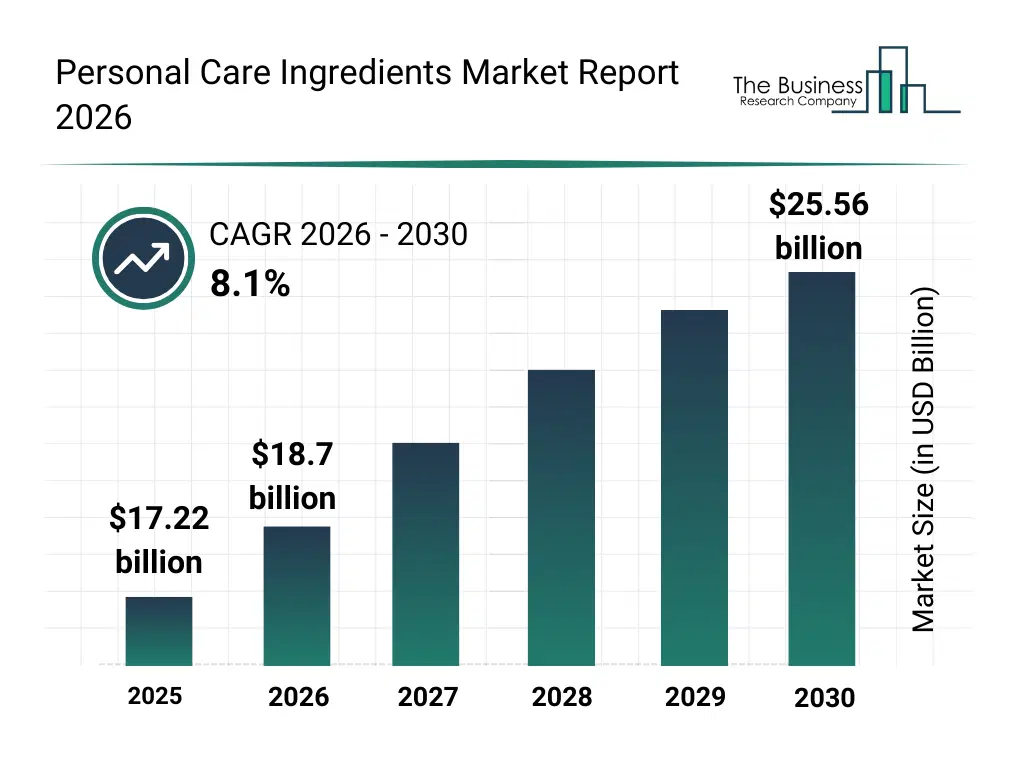
What Is The Personal Care Ingredients Market Size and Share 2026?
The personal care ingredients market size has grown strongly in recent years. It will grow from $17.22 billion in 2025 to $18.7 billion in 2026 at a compound annual growth rate (CAGR) of 8.6%. The growth in the historic period can be attributed to growth of skincare and cosmetics consumption, rising awareness of personal hygiene, expansion of beauty and wellness industries, increasing use of synthetic cosmetic ingredients, availability of diverse ingredient supply chains.What Is The Personal Care Ingredients Market Growth Forecast?
The personal care ingredients market size is expected to see strong growth in the next few years. It will grow to $25.56 billion in 2030 at a compound annual growth rate (CAGR) of 8.1%. The growth in the forecast period can be attributed to increasing demand for sustainable beauty products, rising adoption of bio-based ingredients, expansion of premium personal care segments, growing focus on ingredient transparency, increasing investments in cosmetic ingredient innovation. Major trends in the forecast period include increasing demand for natural and organic ingredients, rising use of plant-based formulations, growing adoption of clean-label ingredients, expansion of multifunctional cosmetic ingredients, enhanced focus on skin-safe formulations.
Global Personal Care Ingredients Market Segmentation
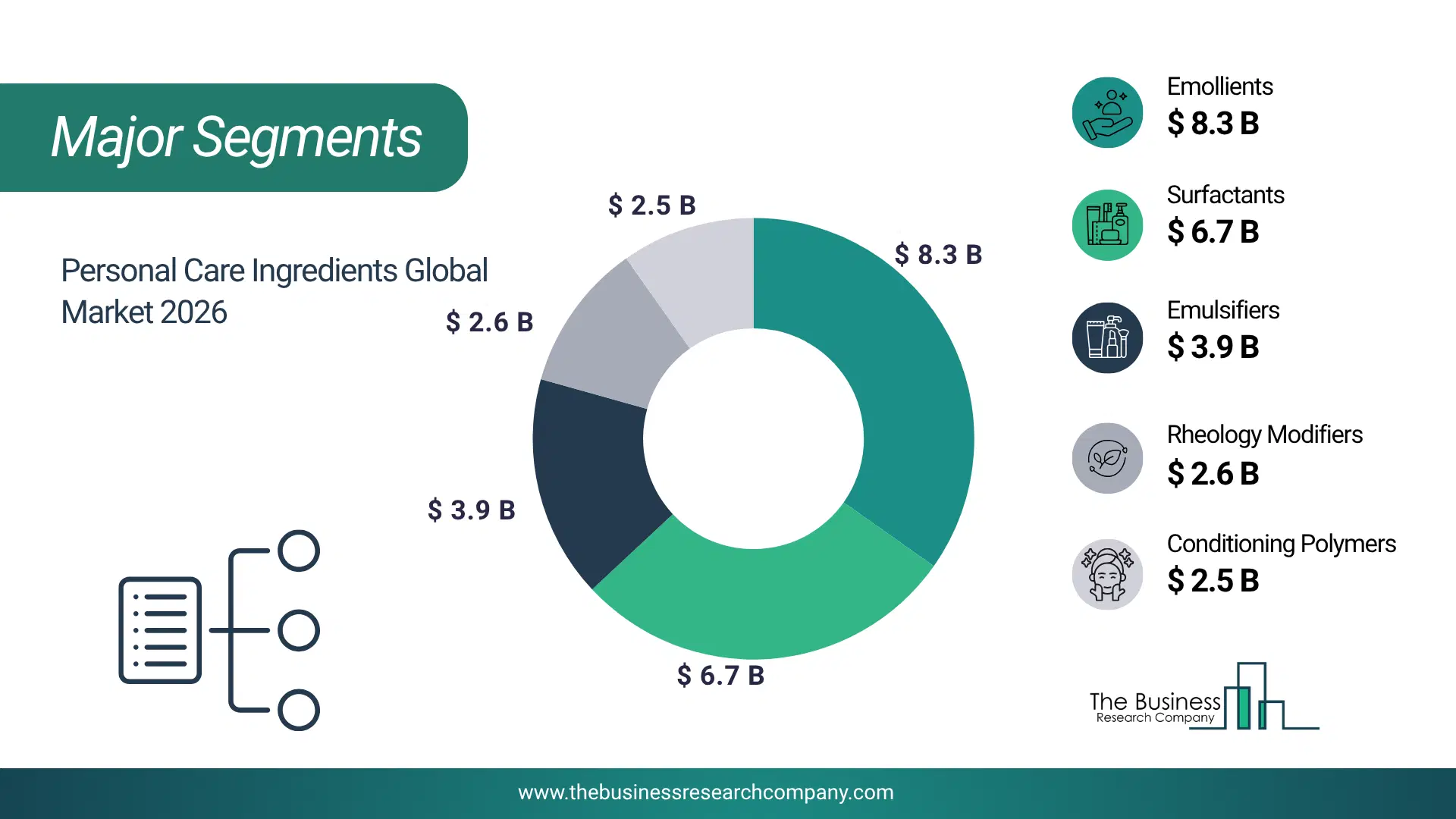
1) By Ingredient Type: Emollients, Surfactants, Emulsifiers, Rheology Modifiers, Conditioning Polymers, Other Ingredients 2) By Source: Natural Ingredients, Synthetic Ingredients 3) By Application: Skin Care, Hair Care, Oral Care, Cosmetics, Other Applications Subsegments: 1) By Emollients: Natural Emollients, Synthetic Emollients, Esters and Fatty Acids 2) By Surfactants: Anionic Surfactants, Cationic Surfactants, Nonionic Surfactants, Amphoteric Surfactants 3) By Emulsifiers: Plant-Based Emulsifiers, Synthetic Emulsifiers, Natural Waxes and Gums 4) By Rheology Modifiers: Thickeners, Gelling Agents, Film-Formers 5) By Conditioning Polymers: Cationic Conditioning Agents, Nonionic Conditioning Agents, Silicone-Based Conditioners 6) By Other Ingredients: Preservatives, Fragrances, Colorants, Active Ingredients The top segments in the personal care ingredients market will be: • Emollients will reach $8.34 billion by 2030. • Surfactants will reach $6.7 billion by 2030. • Emulsifiers will reach $3.88 billion by 2030. • Rheology Modifiers will reach $2.62 billion by 2030. • Conditioning Polymers will reach $2.47 billion by 2030.What Is The Driver Of The Personal Care Ingredients Market?
A rise in e-commerce sales is expected to propel the growth of the personal care ingredients market going forward. E-commerce refers to the online buying and selling of goods and services, encompassing transactions, fund transfers, and data exchange over the Internet. E-commerce provides a platform for consumers to explore and choose products that cater to their specific needs, including those with natural, organic, or innovative ingredients. This shift in consumer behavior not only fosters convenience but also fuels demand for specialized, high-quality ingredients in personal care formulations. For instance, in August 2023, according to the Census Bureau of the Department of Commerce, a US-based Government agency serving as the principal agency for producing vital U.S. statistical data, retail e-commerce sales for Q2 2023, after seasonal adjustments but excluding price changes, stood at $277.6 billion in the US. This reflects a 2.1 percent (±0.9%) rise from Q1 2023. Therefore, the rise in e-commerce sales is driving the growth of the personal care ingredients industry.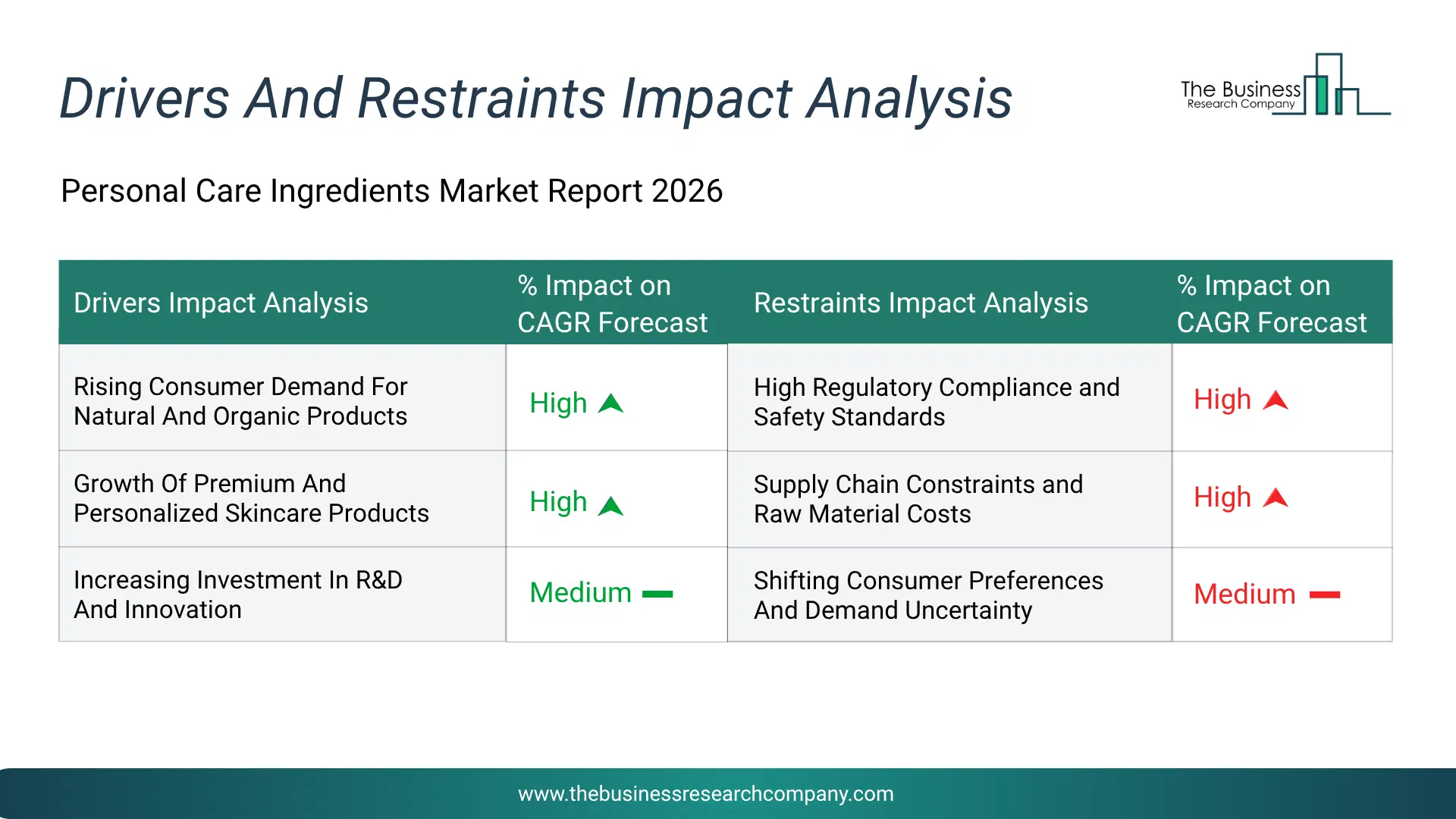
Infographic Chart Showing Key Market Drivers Analysis And Restraints For Personal Care Ingredients Market
The chart presents an impact analysis of key drivers and restraints, quantifying their relative influence on the market's growth rate and helping assess the balance between growth enablers and limiting factors. This chart offers a high-level perspective; the full report contains more detailed insights.
How Will The Drivers Impact Growth In The Global Personal Care Ingredients Market?
• Rising Consumer Demand For Natural And Organic Products (High) – During the forecast period, the rising consumer demand for natural and organic products is expected to become a key growth driver for the personal care ingredients market by 2030. Consumers are increasingly choosing personal care products with natural, plant -based, and organic ingredients due to rising health awareness, skin sensitivity concerns, and eco -friendly preferences. This shift has prompted manufacturers to use high -quality ingredients such as botanical extracts, vitamins, and natural oils in skincare, haircare, and cosmetics. The growing demand for safe, effective, and sustainable formulations is driving the personal care ingredients market, with clean -label and chemical -free products emerging as key differentiators. • Growth Of Premium And Personalized Skincare Products (High) – During the forecast period, the growth of premium and personalized skincare products is expected to emerge as a major factor driving the expansion of the personal care ingredients market by 2030. The surge in demand for premium and customized personal care products is driving the adoption of specialized ingredients. Consumers are increasingly seeking personal care products that address specific skin concerns such as anti-aging, hydration, pigmentation, and sensitivity. Manufacturers are formulating products with active ingredients like hyaluronic acid, peptides, antioxidants, and plant-based actives to meet these requirements. Personalized skincare routines tailored to individual skin types and preferences are further driving demand for high-quality, versatile ingredients, supporting growth in the personal care ingredients market. • Increasing Investment In R&D And Innovation (Medium) – During the forecast period, the increasing investment in r&d and innovation is expected to act as a key growth catalyst for the personal care ingredients market by 2030. Manufacturers are investing heavily in research and development to develop novel personal care ingredients that provide enhanced efficacy, safety, and sensory appeal. Innovations include bioactive compounds, probiotics, sustainable surfactants, and multifunctional ingredients that boost product performance. Focus on ingredient transparency, regulatory compliance, and sustainable sourcing further meets consumer expectations, making continuous innovation a key driver of growth in the personal care ingredients market.How Will The Restraints Impact Growth In The Global Personal Care Ingredients Market?
• High Regulatory Compliance and Safety Standards (High) – During the forecast period, the personal care ingredients are subject to stringent safety regulations and standards set by organizations such as the fda, eu cosmetics regulation, and iso. Manufacturers must ensure proper testing, ingredient safety validation, and adherence to labeling guidelines. Compliance requirements increase product development timelines and costs, particularly for innovative or synthetic ingredients. These regulatory obligations can act as a restraint on market growth, especially for new entrants or smaller suppliers in the industry. • Supply Chain Constraints and Raw Material Costs (High) – During the forecast period, the the personal care ingredients market is affected by fluctuations in raw material availability, sourcing challenges, and rising costs of natural and specialty ingredients. Seasonal variations, geopolitical issues, and sustainability concerns can disrupt supply chains, limiting production capacity. Additionally, the high cost of high-purity or certified organic ingredients increases formulation expenses for manufacturers. These supply chain complexities and cost pressures act as a key restraint on the overall market growth. • Shifting Consumer Preferences And Demand Uncertainty (Medium) – During the forecast period, the consumer preferences in personal care products are evolving rapidly toward natural, organic, vegan, and sustainable formulations. Ingredient suppliers must continuously adapt product portfolios to meet changing expectations. Failure to align with emerging trends can reduce product demand and market relevance. This uncertainty increases business risks and product development costs.Key Players In The Global Personal Care Ingredients Market
Major companies operating in the personal care ingredients market are BASF SE, Croda International Plc, Ashland Global Holdings Inc., Evonik Industries AG, Dow Inc., Clariant AG, Solvay S.A., Lonza Group AG, DSM–Firmenich (DSM Nutritional Products AG), Lubrizol Corporation, Inolex, Nouryon Chemicals B.V., Akzo Nobel N.V., Innospec Inc., Elementis PLC, Merck KGaA, Stepan Company, Eastman Chemical Company, Wacker Chemie AG, Symrise AG, ADEKA Corporation, Galaxy Surfactants Ltd., Gattefossé, Count: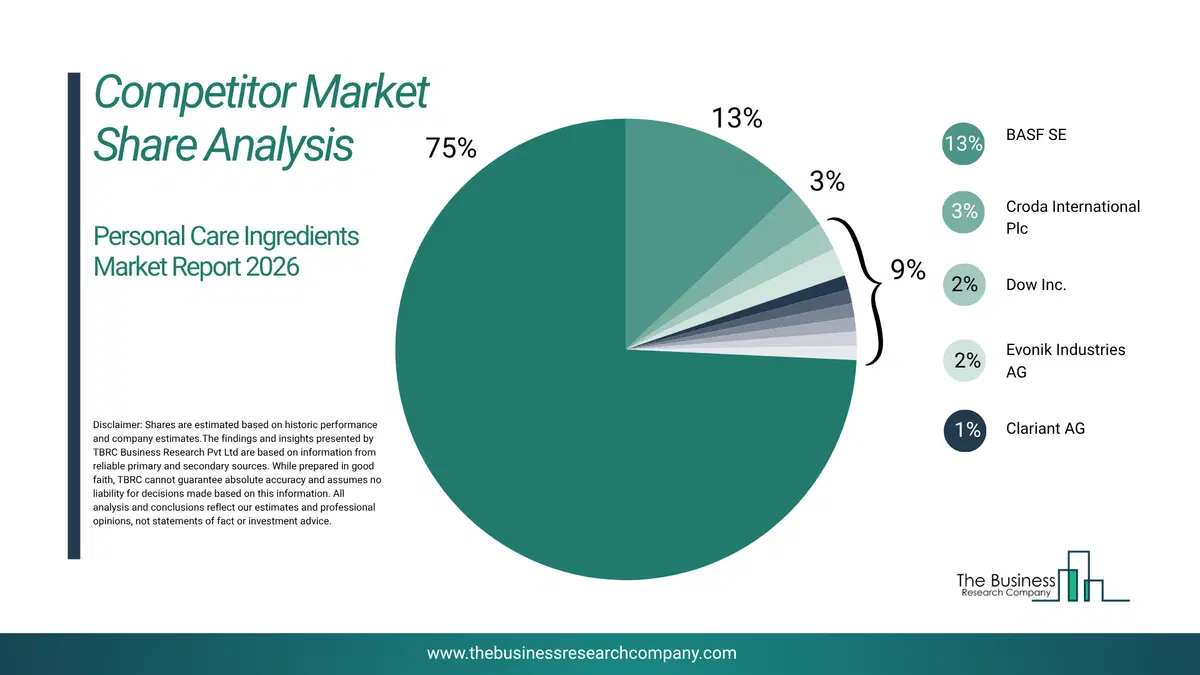
This chart is for illustrative purposes; the full report includes a detailed competitor analysis and comprehensive overview of the top 10 companies in the market.
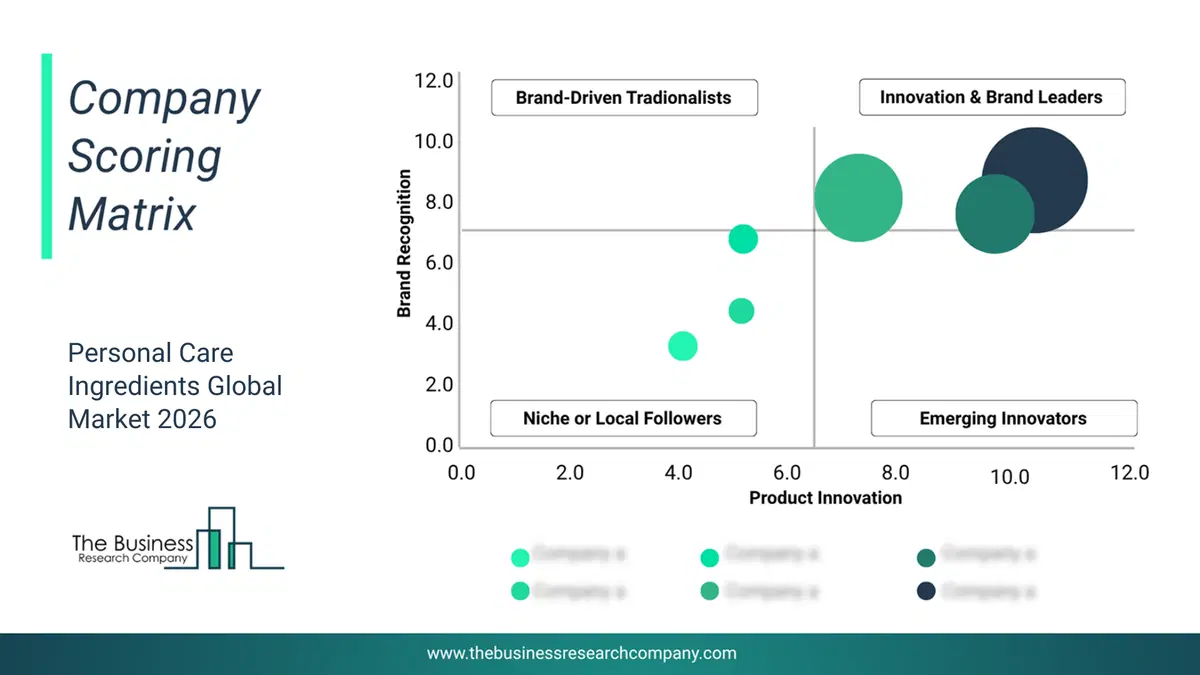
This chart maps companies by product innovation and brand strength, with bubble size indicating relative revenue, helping identify market leaders, challengers, and niche players. This is an illustrative chart; the full report provides a complete and accurate competitive analysis.
Global Personal Care Ingredients Market Trends and Insights
Major companies operating in the personal care ingredients market are focusing on developing advanced solutions such as biodegradable natural-based polymers and surfactants to enhance sustainability and align with consumer demand for eco-friendly products. Biodegradable natural-based polymers and surfactants use renewable feedstocks and natural raw materials to replace conventional synthetic ingredients while still delivering comparable performance. For instance, in April 2025, BASF SE, a Germany-based chemicals company, launched a new set of ingredients at in-cosmetics Global 2025 featuring this approach. The new portfolio includes Verdessence Maize, a plant-based styling polymer derived from hydrolyzed cornstarch and fully renewable feedstocks; Lamesoft OP Plus, a wax-based opacifier dispersion with high natural origin content (92.3–98.5%) designed for rinse-off and other formulations; and Dehyton PK45 GA/RA, a betaine surfactant derived from Rainforest Alliance Certified coconut oil. These ingredients deliver strong styling, opacifying, foaming, and cleansing performance typical of their synthetic counterparts while improving biodegradability, natural origin content, and supporting sustainable and responsible sourcing.What Are Latest Mergers And Acquisitions In The Personal Care Ingredients Market?
In May 2023, Firmenich International SA, Switzerland-based manufacturers of fragrances, flavors, and ingredients, announced a merger with Koninklijke DSM N.V. This merger aims to establish DSM-Firmenich AG as the leading global innovation partner in nutrition, health, and beauty by leveraging Firmenich's expertise in fragrance and taste with DSM's strengths in nutrition, health, and bioscience, aiming to drive growth, sustainability, and innovation across these sectors. Koninklijke DSM N.V. is a Netherlands-based life sciences and materials sciences company.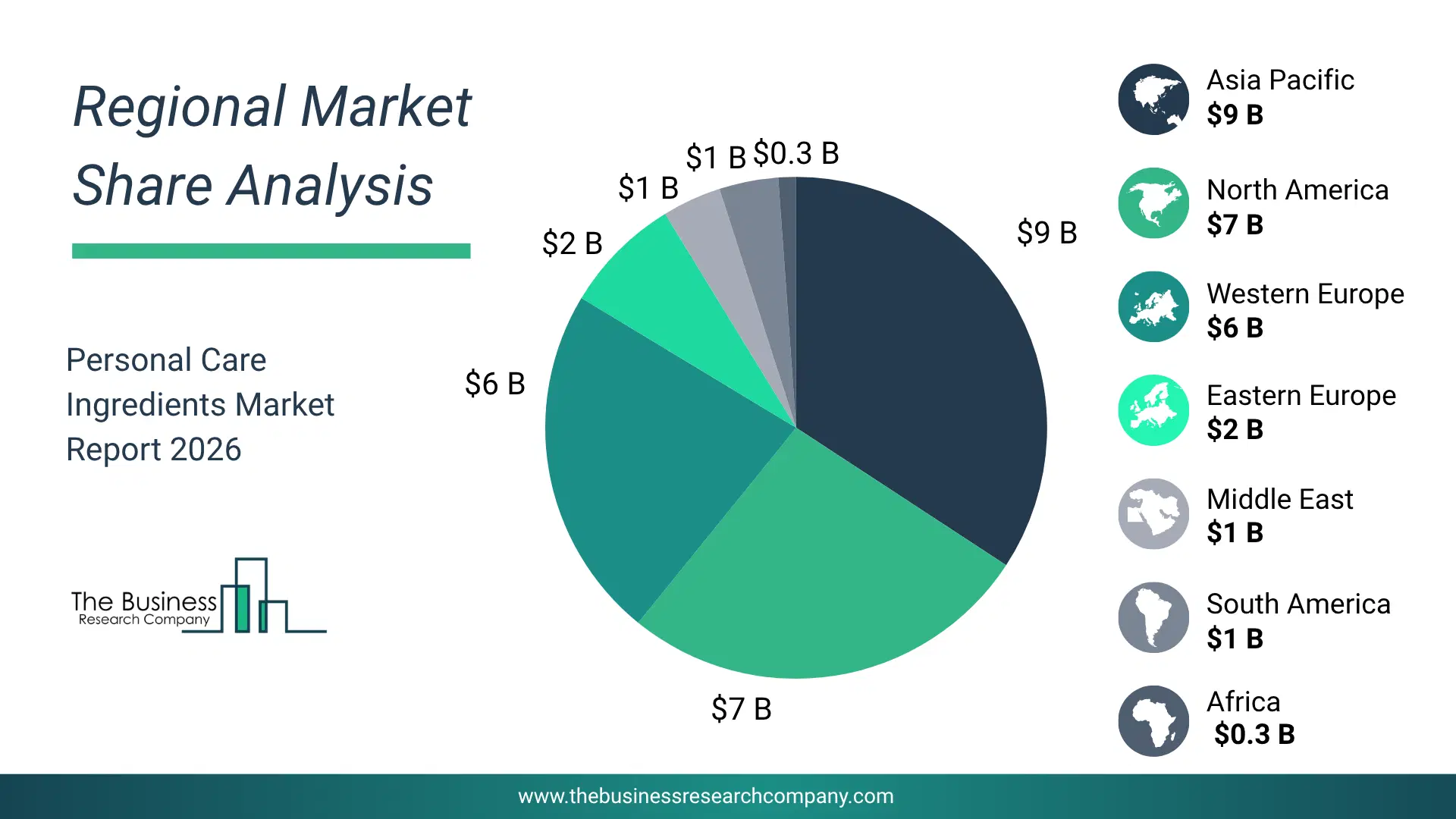
Regional Insights
North America was the largest region in the personal care ingredients market in 2025. Europe was the second largest market in personal care ingredients market share. The regions covered in this market report are Asia-Pacific, South East Asia, Western Europe, Eastern Europe, North America, South America, Middle East, Africa The countries covered in this market report are Australia, Brazil, China, France, Germany, India, Indonesia, Japan, Taiwan, Russia, South Korea, UK, USA, Canada, Italy, SpainWhat Defines the Personal Care Ingredients Market?
The personal care ingredients market consists of sales of preservatives, UV filters and antioxidants. Values in this market are ‘factory gate’ values, that is the value of goods sold by the manufacturers or creators of the goods, whether to other entities (including downstream manufacturers, wholesalers, distributors, and retailers) or directly to end customers. The value of goods in this market includes related services sold by the creators of the goods.How is Market Value Defined and Measured?
The market value is defined as the revenues that enterprises gain from the sale of goods and/or services within the specified market and geography through sales, grants, or donations in terms of the currency (in USD unless otherwise specified). The revenues for a specified geography are consumption values that are revenues generated by organizations in the specified geography within the market, irrespective of where they are produced. It does not include revenues from resales along the supply chain, either further along the supply chain or as part of other products.
This chart presents market attractiveness based on a quantitative evaluation of growth, competition, strategic alignment, and risk, offering a clear view of opportunity areas for decision-making. This chart is for illustrative purposes; the full report contains the complete analysis.

This chart highlights the Total Addressable Market (TAM) by estimating the maximum revenue opportunity using an assumption-driven approach, supporting strategic planning and opportunity sizing across markets. The chart is illustrative; the full report provides a more comprehensive analysis.
What Key Data and Analysis Are Included in the Personal Care Ingredients Market Report 2026?
The personal care ingredients market research report is one of a series of new reports from The Business Research Company that provides market statistics, including industry global market size, regional shares, competitors with the market share, detailed market segments, market trends and opportunities, and any further data you may need to thrive in the personal care ingredients industry. The market research report delivers a complete perspective of everything you need, with an in-depth analysis of the current and future state of the industry.Personal Care Ingredients Market Report Forecast Analysis
| Report Attribute | Details |
|---|---|
| Market Size Value In 2026 | $18.7 billion |
| Revenue Forecast In 2030 | $25.56 billion |
| Growth Rate | CAGR of 8.6% from 2026 to 2030 |
| Base Year For Estimation | 2025 |
| Actual Estimates/Historical Data | 2020-2025 |
| Forecast Period | 2026 - 2030 |
| Market Representation | Revenue in USD Billion and CAGR from 2026 to 2030 |
| Segments Covered | Ingredient Type, Source, Application |
| Regional Scope | Asia-Pacific, Western Europe, Eastern Europe, North America, South America, Middle East, Africa |
| Country Scope | The countries covered in the report are Australia, Brazil, China, France, Germany, India, Indonesia, Japan, Taiwan, Russia, South Korea, UK, USA, Canada, Italy, Spain. |
| Key Companies Profiled | BASF SE, Croda International Plc, Ashland Global Holdings Inc., Evonik Industries AG, Dow Inc., Clariant AG, Solvay S.A., Lonza Group AG, DSM–Firmenich (DSM Nutritional Products AG), Lubrizol Corporation, Inolex, Nouryon Chemicals B.V., Akzo Nobel N.V., Innospec Inc., Elementis PLC, Merck KGaA, Stepan Company, Eastman Chemical Company, Wacker Chemie AG, Symrise AG, ADEKA Corporation, Galaxy Surfactants Ltd., Gattefossé, Count: |
| Customization Scope | Request for Customization |
| Pricing And Purchase Options | Explore Purchase Options |