

Physical Unclonable-Function (PUF) Display Market Report 2026
Global Outlook – By Type (Optical Physical Unclonable Function (PUF) Displays, Electronic Optical Physical Unclonable Function (PUF) Displays, Hybrid Optical Physical Unclonable Function (PUF) Displays), By Technology (Silicon-Based Physical Unclonable Function (PUF), Polymer-Based Physical Unclonable Function (PUF), Photonic Physical Unclonable Function (PUF), Other Technologies), By Application (Authentication, Anti-Counterfeiting, Secure Display Devices, Access Control, Other Applications), By End-User (Banking And Finance, Government, Consumer Electronics, Retail, Healthcare, Other End-Users) – Market Size, Trends, Strategies, and Forecast to 2030
Physical Unclonable-Function (PUF) Display Market Overview
• Physical Unclonable-Function (PUF) Display market size has reached to $1.29 billion in 2025 • Expected to grow to $3.21 billion in 2030 at a compound annual growth rate (CAGR) of 19.9% • Growth Driver: Rising Cybersecurity Threats Driving The Market Due To Growing Need For Hardware-based Device Security • North America was the largest region in 2025 and Asia-Pacific is the fastest growing region.What Is Covered Under Physical Unclonable-Function (PUF) Display Market?
Physical unclonable-function (PUF) display is a type of secure screen that uses unique physical patterns in its materials to protect data and prevent counterfeiting. It ensures that each display is one-of-a-kind and cannot be copied or tampered with. Its main purpose is to enhance security for sensitive devices and digital systems. It also supports authentication, safeguards confidential information, and strengthens overall device reliability. The main types of physical unclonable-function (PUF) displays include optical physical unclonable-function (PUF) displays, electronic optical physical unclonable-function (PUF) displays, and hybrid optical physical unclonable-function (PUF) displays. Optical physical unclonable-function (PUF) displays refer to secure display technologies that leverage unique, unclonable physical patterns to authenticate and protect information, ensuring device integrity and preventing counterfeiting. These displays are built using technologies such as silicon-based physical unclonable-function (PUF), polymer-based physical unclonable-function (PUF), photonic physical unclonable-function (PUF), and others. They are applied in authentication, anti-counterfeiting, secure display devices, access control, and others, serving end-users in banking and finance, government, consumer electronics, retail, healthcare, and others.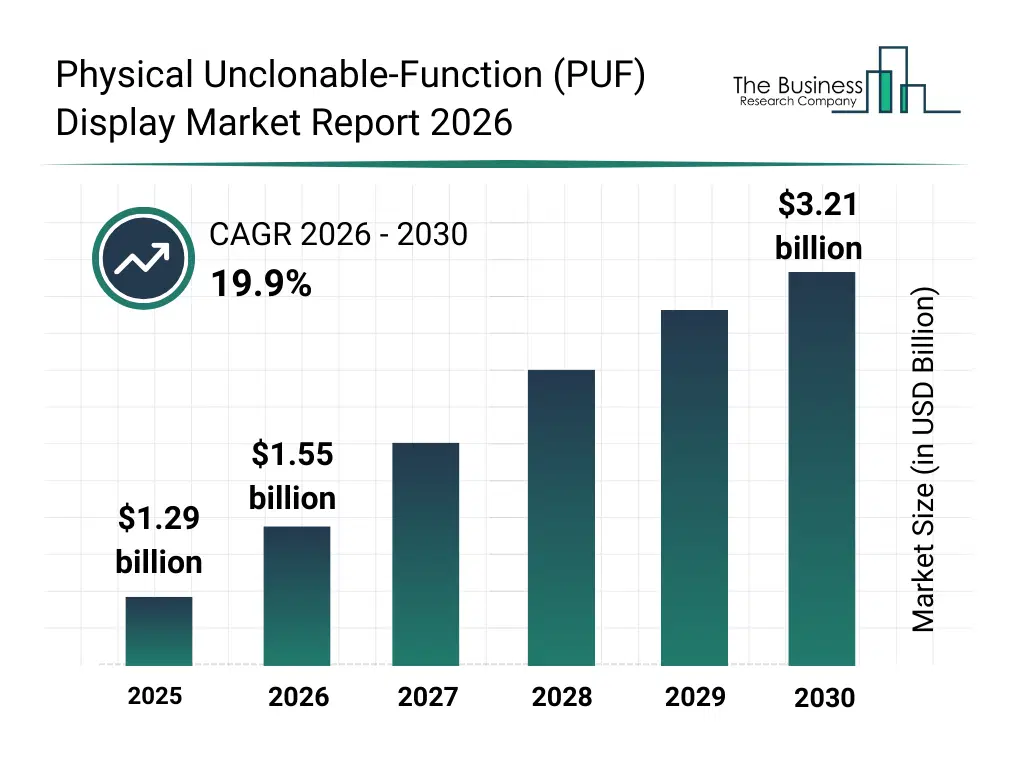
What Is The Physical Unclonable-Function (PUF) Display Market Size and Share 2026?
The physical unclonable-function (puf) display market size has grown exponentially in recent years. It will grow from $1.29 billion in 2025 to $1.55 billion in 2026 at a compound annual growth rate (CAGR) of 20.2%. The growth in the historic period can be attributed to rising incidents of device counterfeiting, growing need for hardware-based security, limitations of software-only authentication, increased adoption of secure consumer electronics, demand for trusted device identification.What Is The Physical Unclonable-Function (PUF) Display Market Growth Forecast?
The physical unclonable-function (puf) display market size is expected to see rapid growth in the next few years. It will grow to $3.21 billion in 2030 at a compound annual growth rate (CAGR) of 19.9%. The growth in the forecast period can be attributed to expansion of secure digital identity systems, adoption of puf-based security in iot devices, growth in secure display demand for financial applications, increasing focus on zero-trust hardware architectures, integration of quantum-resistant security technologies. Major trends in the forecast period include display-level hardware authentication, anti-counterfeiting secure visual interfaces, integration of pufs into advanced display panels, tamper-resistant display architectures, unique device identity through physical randomness.
Global Physical Unclonable-Function (PUF) Display Market Segmentation
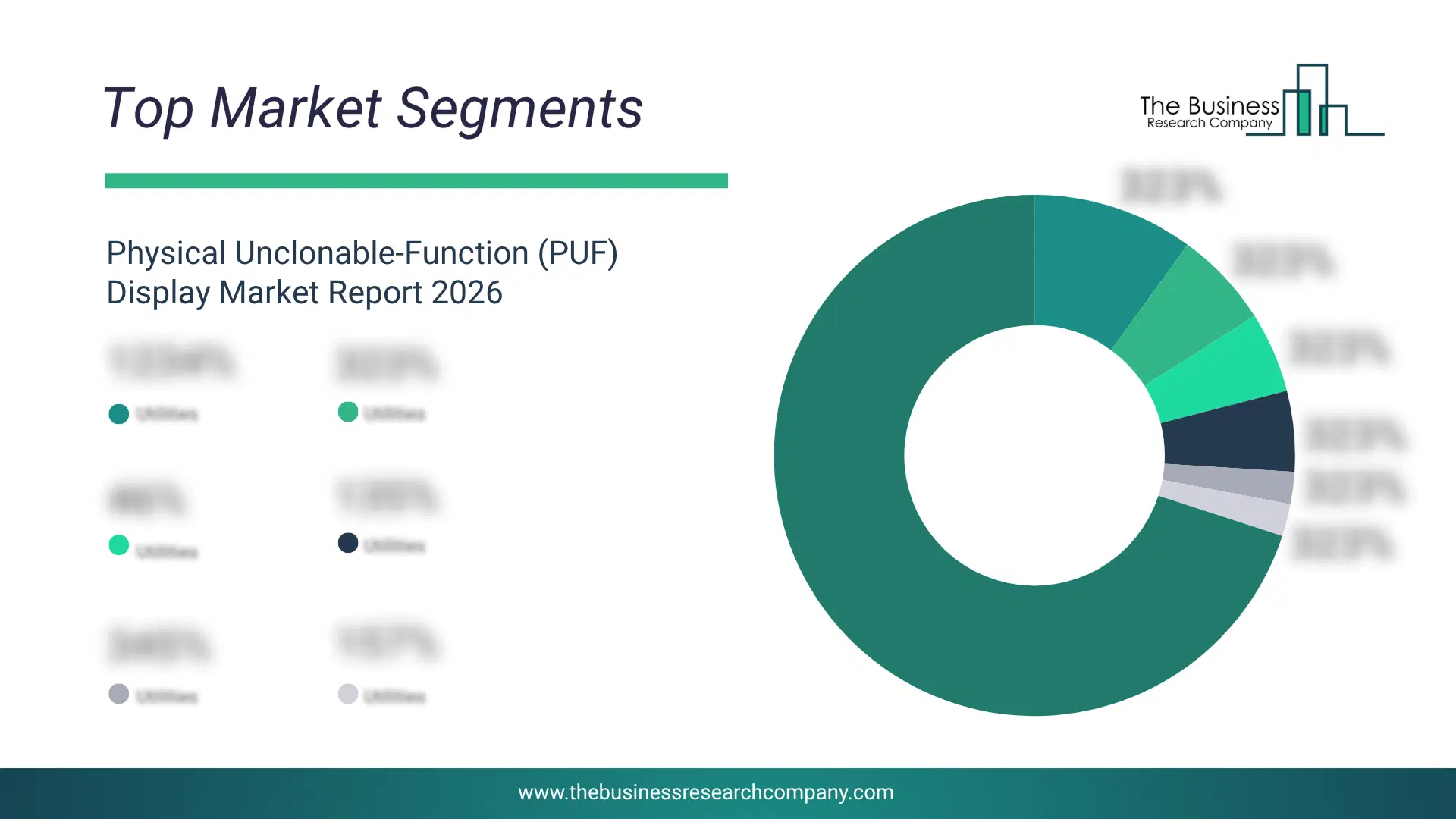
1) By Type: Optical Physical Unclonable Function (PUF) Displays, Electronic Optical Physical Unclonable Function (PUF) Displays, Hybrid Optical Physical Unclonable Function (PUF) Displays 2) By Technology: Silicon-Based Physical Unclonable Function (PUF), Polymer-Based Physical Unclonable Function (PUF), Photonic Physical Unclonable Function (PUF), Other Technologies 3) By Application: Authentication, Anti-Counterfeiting, Secure Display Devices, Access Control, Other Applications 4) By End-User: Banking And Finance, Government, Consumer Electronics, Retail, Healthcare, Other End-Users Subsegments: 1) By Physical Unclonable Function Displays: Reflective Physical Unclonable Function Displays, Transmissive Physical Unclonable Function Displays, Diffractive Physical Unclonable Function Displays 2) By Electronic Optical Physical Unclonable Function Displays: OLED-Based Electronic Optical Physical Unclonable Function Displays, LCD-Based Electronic Optical Physical Unclonable Function Displays, Micro-LED-Based Electronic Optical Physical Unclonable Function Displays 3) By Hybrid Optical Physical Unclonable Function Displays: Optical-Electronic Integrated Hybrid Physical Unclonable Function Displays, Photonic-Electronic Hybrid Physical Unclonable Function Displays, Quantum-Enhanced Hybrid Physical Unclonable Function DisplaysWhat Are The Drivers Of The Physical Unclonable-Function (PUF) Display Market?
The rising cybersecurity threats are expected to propel the growth of the physical unclonable-function (PUF) display market going forward. Cybersecurity threats refer to potential malicious activities or vulnerabilities that can compromise the confidentiality, integrity, or availability of digital systems, networks, or data. Cybersecurity threats are increasing due to the increasing digitization and interconnectedness of devices, which expands the attack surface for cybercriminals. Physical unclonable function (PUF) display enhances cybersecurity by providing a hardware-based unique identity for devices, preventing counterfeiting and unauthorized access. For instance, in January 2025, according to the World Economic Forum, a Switzerland-based non-profit organization, 72% of respondents perceived higher cyber risks over the past year (2024), citing increased cyber-enabled fraud, rising phishing and social engineering attempts, and identity theft emerging as the most significant personal threat. Therefore, the rising cybersecurity threats are driving the physical unclonable-function (PUF) display industry. The growing adoption of smartphones is expected to propel the growth of the physical unclonable-function (PUF) display market going forward. Smartphones refer to mobile devices that combine telecommunication functions with advanced computing capabilities, internet access, and a wide range of applications. The adoption of smartphones is rising due to their increasing affordability and availability, enabling broader access to mobile connectivity and digital services. In smartphones, physical unclonable function (PUF) display is used to secure device authentication and protect sensitive data by providing a unique, tamper-resistant hardware identity. For instance, in February 2023, according to the GSM Association (GSMA), a UK-based industry organization that represents the interests of mobile network operators and companies, smartphone penetration in sub-Saharan Africa is projected to rise significantly, reaching 87% by 2030, up from 51% in 2022. Therefore, the growing adoption of smartphones is driving the physical unclonable-function (PUF) display industry. The expansion of e-commerce is expected to propel the growth of the physical unclonable-function (PUF) display market going forward. E-commerce, or electronic commerce, is the buying and selling of goods and services over the internet. The rise in e-commerce is driven by growing internet penetration and consumer preference for convenient, contactless shopping experiences. In e-commerce, physical unclonable function (PUF) display is used to enhance transaction security by verifying device authenticity and preventing fraud during online payments. For instance, in March 2025, according to the United States Census Bureau, a US-based principal agency for collecting and analyzing population and economic data, in the first quarter of 2025, U.S. e-commerce sales grew by 6.1% year-over-year, outpacing the 4.5% growth in total retail sales over the same period. Therefore, the expansion of e-commerce is driving the growth of the physical unclonable-function (PUF) display industry.Key Players In The Global Physical Unclonable-Function (PUF) Display Market
Major companies operating in the physical unclonable-function (puf) display market are Samsung Electronics Co. Ltd., Intel Corporation, Hewlett Packard Enterprise Company, Fujitsu Limited, Thales Group S.A., LG Display Co. Ltd., Infineon Technologies AG, NXP Semiconductors N.V., Analog Devices Inc., Renesas Electronics Corporation, Toppan Inc., Microchip Technology Inc., Synopsys Inc., Rambus Inc., eMemory Technology Inc., Promwad LLC, Infosecurity Inc., PUFsecurity Inc., Granite Mountain Technologies Inc., Enthentica S.A.S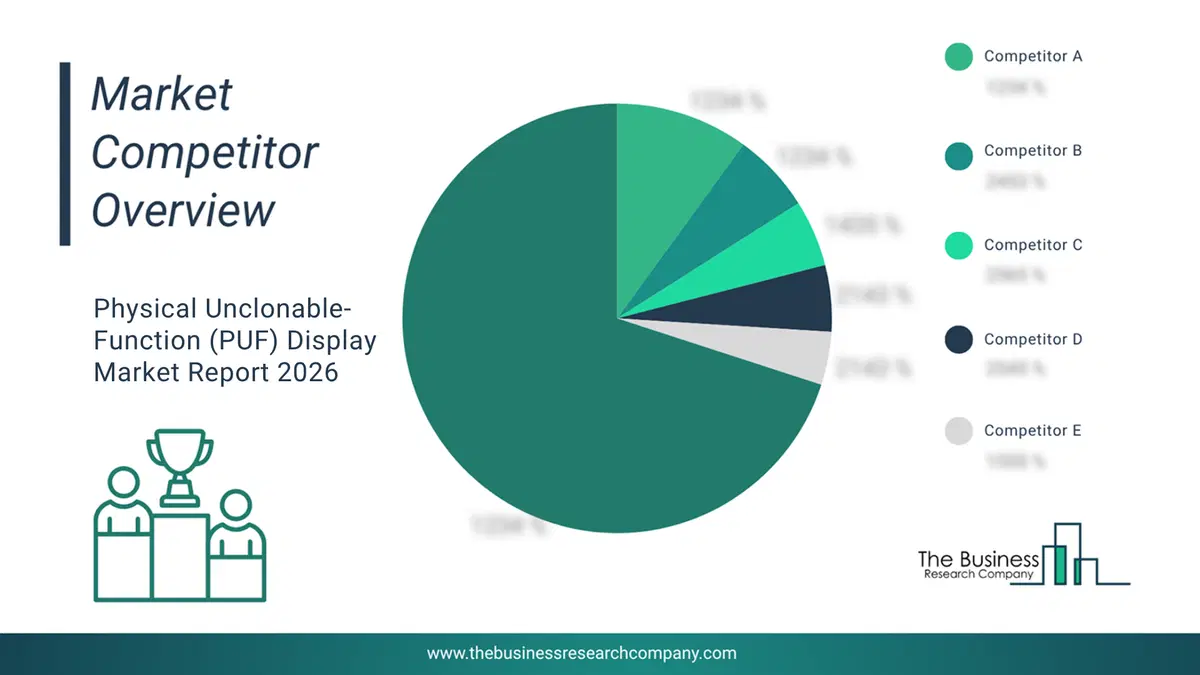
This chart is for illustrative purposes; the full report includes a detailed competitor analysis and comprehensive overview of the top 10 companies in the market.
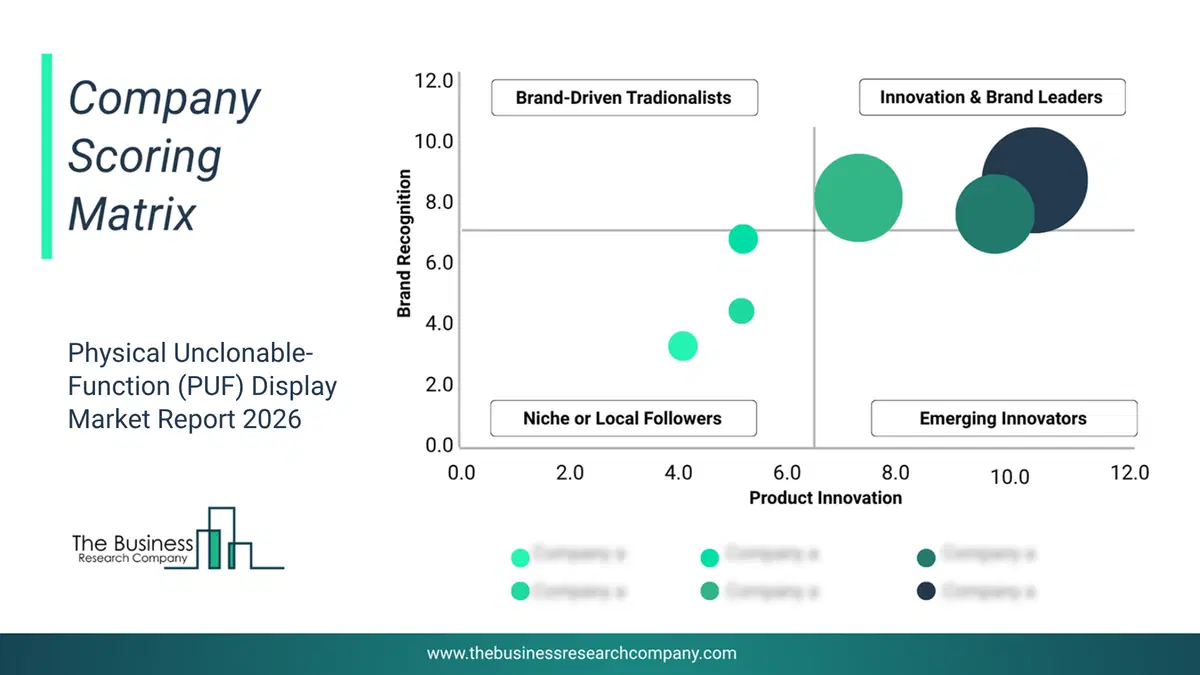
This chart maps companies by product innovation and brand strength, with bubble size indicating relative revenue, helping identify market leaders, challengers, and niche players. This is an illustrative chart; the full report provides a complete and accurate competitive analysis.
Regional Insights
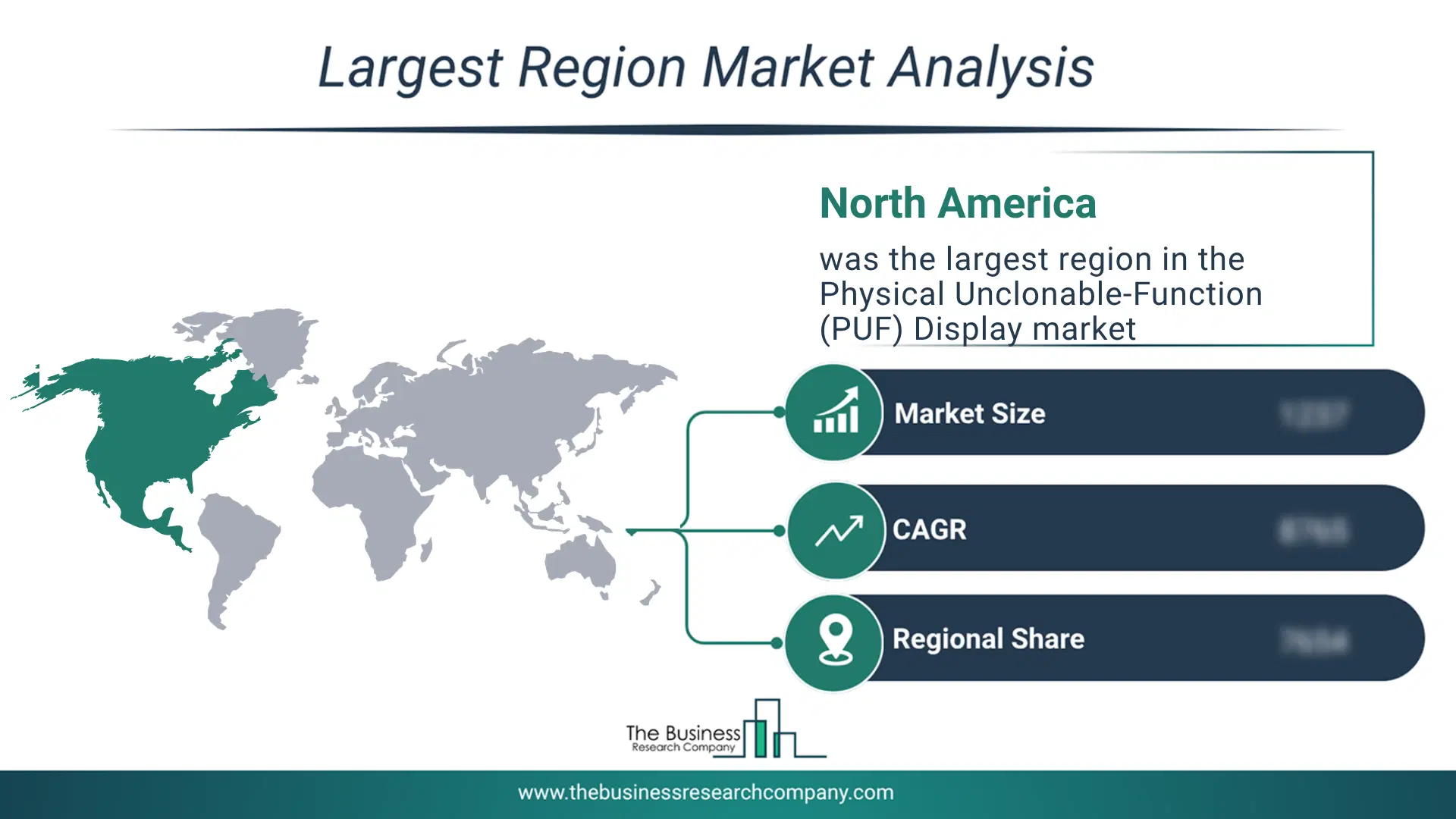
North America was the largest region in the physical unclonable-function (PUF) display market in 2025. Asia-Pacific is expected to be the fastest-growing region in the forecast period. The regions covered in this market report are Asia-Pacific, South East Asia, Western Europe, Eastern Europe, North America, South America, Middle East, Africa. The countries covered in this market report are Australia, Brazil, China, France, Germany, India, Indonesia, Japan, Taiwan, Russia, South Korea, UK, USA, Canada, Italy, Spain.What Defines the Physical Unclonable-Function (PUF) Display Market?
The physical unclonable-function (PUF) display market includes of sales secure display panels, embedded security modules, tamper-proof screen components, authentication-enabled monitors, encrypted touchscreens, and one-of-a-kind device interfaces. Values in this market are ‘factory gate’ values, that is, the value of goods sold by the manufacturers or creators of the goods, whether to other entities (including downstream manufacturers, wholesalers, distributors, and retailers) or directly to end customers. The value of goods in this market includes related services sold by the creators of the goods.How is Market Value Defined and Measured?
The market value is defined as the revenues that enterprises gain from the sale of goods and/or services within the specified market and geography through sales, grants, or donations in terms of the currency (in USD unless otherwise specified). The revenues for a specified geography are consumption values that are revenues generated by organizations in the specified geography within the market, irrespective of where they are produced. It does not include revenues from resales along the supply chain, either further along the supply chain or as part of other products.
This chart presents market attractiveness based on a quantitative evaluation of growth, competition, strategic alignment, and risk, offering a clear view of opportunity areas for decision-making. This chart is for illustrative purposes; the full report contains the complete analysis.

This chart highlights the Total Addressable Market (TAM) by estimating the maximum revenue opportunity using an assumption-driven approach, supporting strategic planning and opportunity sizing across markets. The chart is illustrative; the full report provides a more comprehensive analysis.
What Key Data and Analysis Are Included in the Physical Unclonable-Function (PUF) Display Market Report 2026?
The physical unclonable-function (puf) display market research report is one of a series of new reports from The Business Research Company that provides market statistics, including industry global market size, regional shares, competitors with the market share, detailed market segments, market trends and opportunities, and any further data you may need to thrive in the physical unclonable-function (puf) display industry. The market research report delivers a complete perspective of everything you need, with an in-depth analysis of the current and future state of the industry.Physical Unclonable-Function (PUF) Display Market Report Forecast Analysis
| Report Attribute | Details |
|---|---|
| Market Size Value In 2026 | $1.55 billion |
| Revenue Forecast In 2030 | $3.21 billion |
| Growth Rate | CAGR of 19.9% from 2026 to 2030 |
| Base Year For Estimation | 2025 |
| Actual Estimates/Historical Data | 2020-2025 |
| Forecast Period | 2026 - 2030 |
| Market Representation | Revenue in USD Billion and CAGR from 2026 to 2030 |
| Segments Covered | Type, Technology, Application, End-User |
| Regional Scope | Asia-Pacific, Western Europe, Eastern Europe, North America, South America, Middle East, Africa |
| Country Scope | The Countries Covered In This Market Report Are Australia, Brazil, China, France, Germany, India, Indonesia, Japan, Taiwan, Russia, South Korea, Uk, Usa, Canada, Italy, Spain. |
| Key Companies Profiled | Samsung Electronics Co. Ltd., Intel Corporation, Hewlett Packard Enterprise Company, Fujitsu Limited, Thales Group S.A., LG Display Co. Ltd., Infineon Technologies AG, NXP Semiconductors N.V., Analog Devices Inc., Renesas Electronics Corporation, Toppan Inc., Microchip Technology Inc., Synopsys Inc., Rambus Inc., eMemory Technology Inc., Promwad LLC, Infosecurity Inc., PUFsecurity Inc., Granite Mountain Technologies Inc., Enthentica S.A.S |
| Customization Scope | Request for Customization |
| Pricing And Purchase Options | Explore Purchase Options |