

Private 5G Device Market Report 2026
Global Outlook – By Device Type (Smartphones, Routers, Gateways, Modules, Internet Of Things (IoT) Devices, Other Device Types), By Spectrum (Licensed, Unlicensed, Shared), By Application (Industrial Automation, Remote Monitoring, Asset Tracking, Smart Surveillance, Other Applications), By End-User (Manufacturing, Healthcare, Energy And Utilities, Transportation And Logistics, Government And Public Safety, Mining, Other End Users) – Market Size, Trends, Strategies, and Forecast to 2030
Private 5G Device Market Overview
• Private 5G Device market size has reached to $3.22 billion in 2025 • Expected to grow to $16.7 billion in 2030 at a compound annual growth rate (CAGR) of 39% • Growth Driver: The Growing Demand For High-Speed Connectivity Is Fueling The Growth Of The Market Due To The Need For Ultra-Low-Latency, High-Capacity Transport. • Market Trend: Leveraging Cloud-Native Architectures to Simplify Private 5G Deployment • Asia-Pacific was the largest region and fastest growing region.What Is Covered Under Private 5G Device Market?
A private 5G device is specialized hardware built to operate within a dedicated 5G network owned or controlled by a specific enterprise, facility, or organization. These devices deliver fast, low-latency, and secure wireless connectivity, ensuring reliable data transmission in tightly managed network environments. By enabling advanced functions like industrial internet of things (IoT), automation, and real-time monitoring, private 5G devices boost operational efficiency, enhance data protection, and support seamless integration across digital systems. The main device types of private 5G devices are smartphones, routers, gateways, modules, Internet of Things (IoT) devices, and others. Smartphones are handheld mobile devices that integrate communication functions such as calling and texting with internet connectivity, high-resolution touchscreens, and computing capabilities similar to compact computers. The spectrum types utilized are licensed, unlicensed, and shared. Primary applications encompass industrial automation, remote monitoring, asset tracking, smart surveillance, and others, serving end-users including manufacturing, healthcare, energy and utilities, transportation and logistics, government and public safety, mining, and others.
What Is The Private 5G Device Market Size and Share 2026?
The private 5G device market size has grown exponentially in recent years. It will grow from $3.22 billion in 2025 to $4.48 billion in 2026 at a compound annual growth rate (CAGR) of 39.2%. The growth in the historic period can be attributed to enterprise demand for reliable wireless connectivity, growth of industrial iot deployments, limitations of wi-fi in harsh environments, availability of shared spectrum models, rise of edge computing for real-time operations.What Is The Private 5G Device Market Growth Forecast?
The private 5G device market size is expected to see exponential growth in the next few years. It will grow to $16.7 billion in 2030 at a compound annual growth rate (CAGR) of 39.0%. The growth in the forecast period can be attributed to mass adoption of private 5G in smart factories, integration of AI at the edge over private 5g, private 5G devices for public safety networks, standardization of device certification programs, expansion of private 5G in mining and utilities. Major trends in the forecast period include ruggedized private 5G routers and gateways for industrial sites, private 5G modules embedded in iot and edge devices, multi-spectrum device support for licensed and shared bands, secure device provisioning and sim/esim lifecycle management, low-latency connectivity for mission-critical automation.
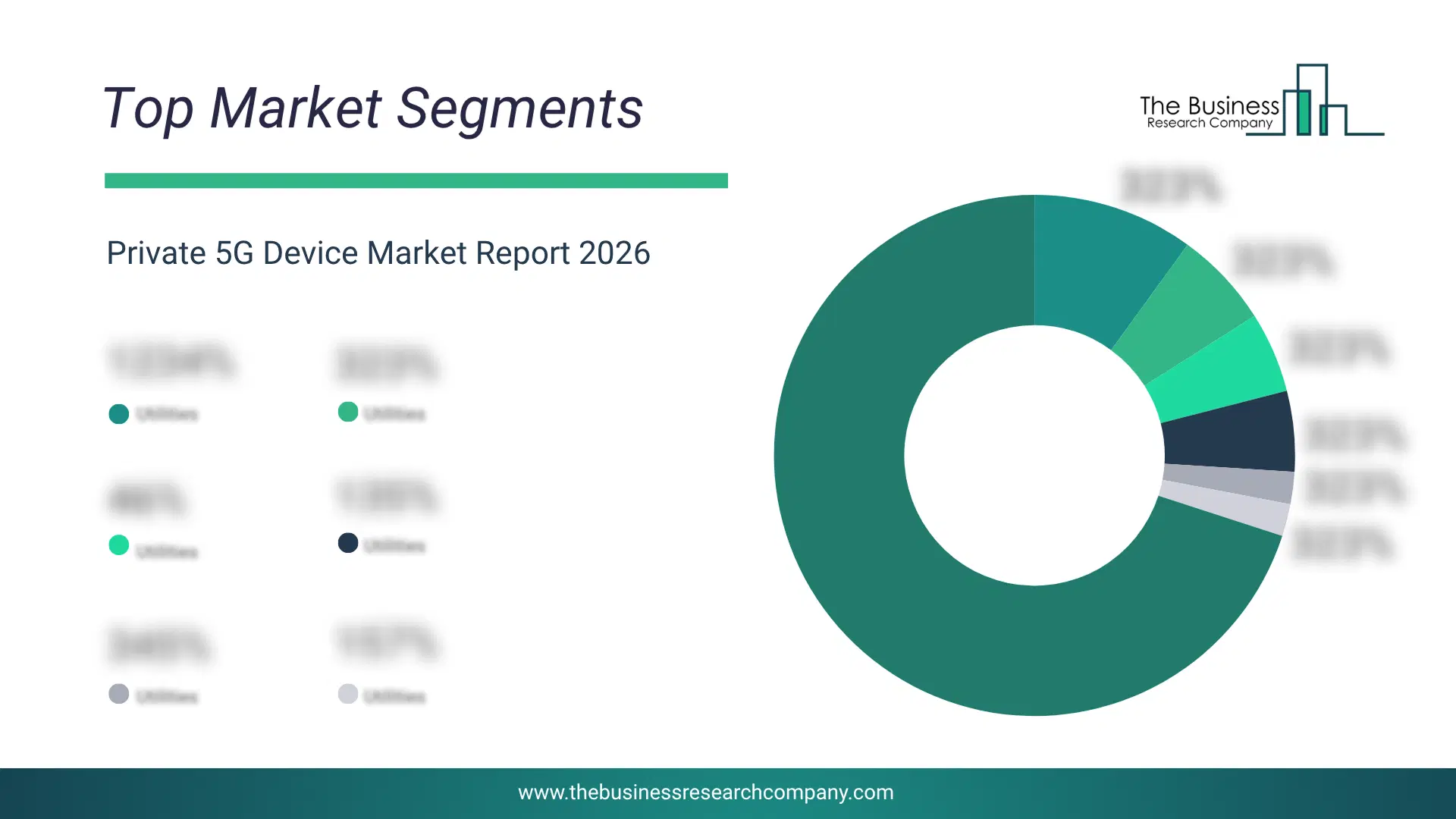
Global Private 5G Device Market Segmentation
1) By Device Type: Smartphones, Routers, Gateways, Modules, Internet Of Things (IoT) Devices, Other Device Types 2) By Spectrum: Licensed, Unlicensed, Shared 3) By Application: Industrial Automation, Remote Monitoring, Asset Tracking, Smart Surveillance, Other Applications 4) By End-User: Manufacturing, Healthcare, Energy And Utilities, Transportation And Logistics, Government And Public Safety, Mining, Other End Users Subsegments: 1) By Smartphones: Business Smartphones, Industrial Smartphones, Rugged Smartphones, Enterprise Grade Smartphones 2) By Routers: Indoor Routers, Outdoor Routers, Industrial Routers, Vehicle Mounted Routers 3) By Gateways: Industrial Gateways, Edge Computing Gateways, Indoor Gateways, Outdoor Gateways 4) By Modules: Communication Modules, Embedded Modules, Enterprise Modules, Industrial Modules 5) By Internet Of Things Devices: Wearable Internet Of Things Devices, Industrial Internet Of Things Sensors, Smart Surveillance Devices, Asset Tracking Devices 6) By Other Device Types: Portable Hotspots, Fixed Wireless Terminals, Remote Monitoring Devices, Machine To Machine DevicesWhat Is The Driver Of The Private 5G Device Market?
The growing demand for high-speed connectivity is expected to propel the growth of the private 5G device market going forward. High-speed connectivity refers to internet or network connections that provide rapid data transfer rates, enabling seamless communication, streaming, and real-time applications. The growing demand for high-speed connectivity is driven by faster data access, as it enables seamless streaming, real-time communication, and efficient online activities. Private 5G devices support high-speed connectivity by providing dedicated, low-latency, and high-bandwidth wireless networks that enable seamless communication between devices, sensors, and applications within enterprise or industrial environments. For instance, In September 2023, according to the Office of Communications, a UK-based regulator for the communications services, the government-approved regulatory and competition authority reported that the median average 24-hour actual download speed recorded across UK residential fixed broadband connections was 69.4 Mbit/s in March 2023, a 10.1 Mbit/s (17%) increase compared to March 2022. Therefore, the growing demand for high-speed connectivity is driving the private 5G device industry.Key Players In The Global Private 5G Device Market
Major companies operating in the private 5G device market are Siemens Aktiengesellschaft, Telefonaktiebolaget LM Ericsson, Nokia Corporation, Zhongxing Telecommunication Equipment Corporation, Phoenix Contact GmbH and Co KG, Advantech Co Ltd, Comba Telecom Systems Holdings Limited, u-blox Holding AG, Fibocom Wireless Inc, Airspan Networks Holdings Inc, Digi International Inc, ShanghAI Quectel Wireless Solutions Co Ltd, Telit Cinterion Limited, Inseego Corp, Teltonika Networks UAB, Baicells Technologies Co Ltd, Peplink International Limited, Guangzhou Robustel Technologies Co Ltd, Celona Inc, SEMPRE Inc.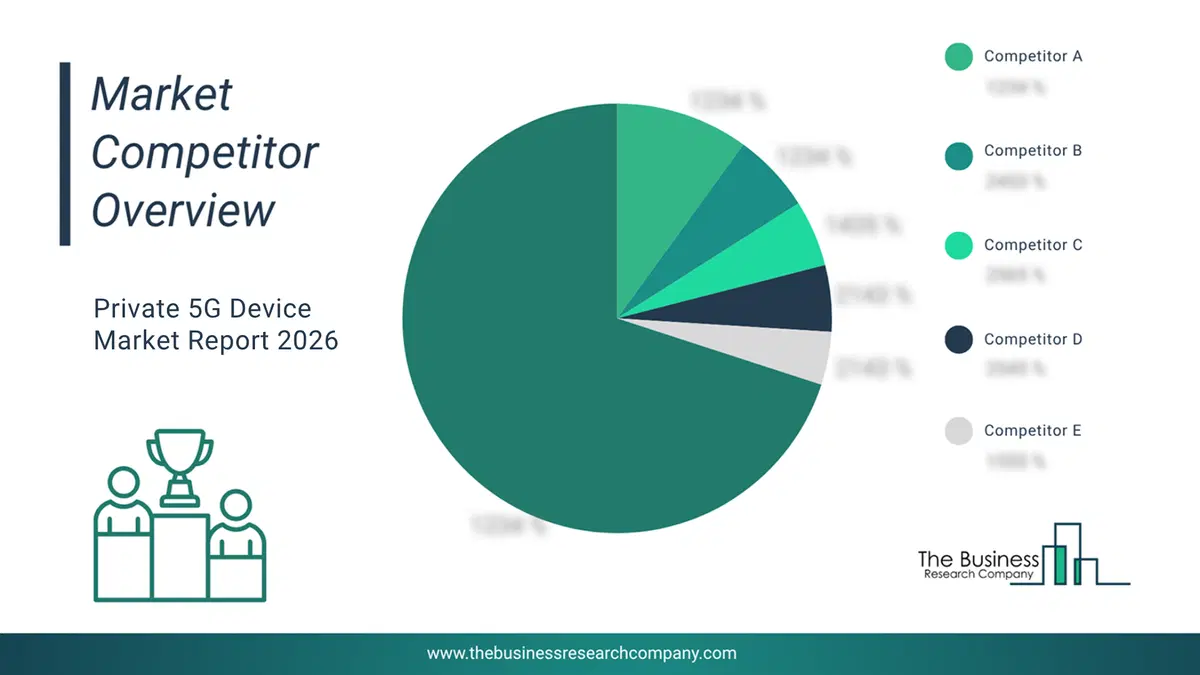
This chart is for illustrative purposes; the full report includes a detailed competitor analysis and comprehensive overview of the top 10 companies in the market.
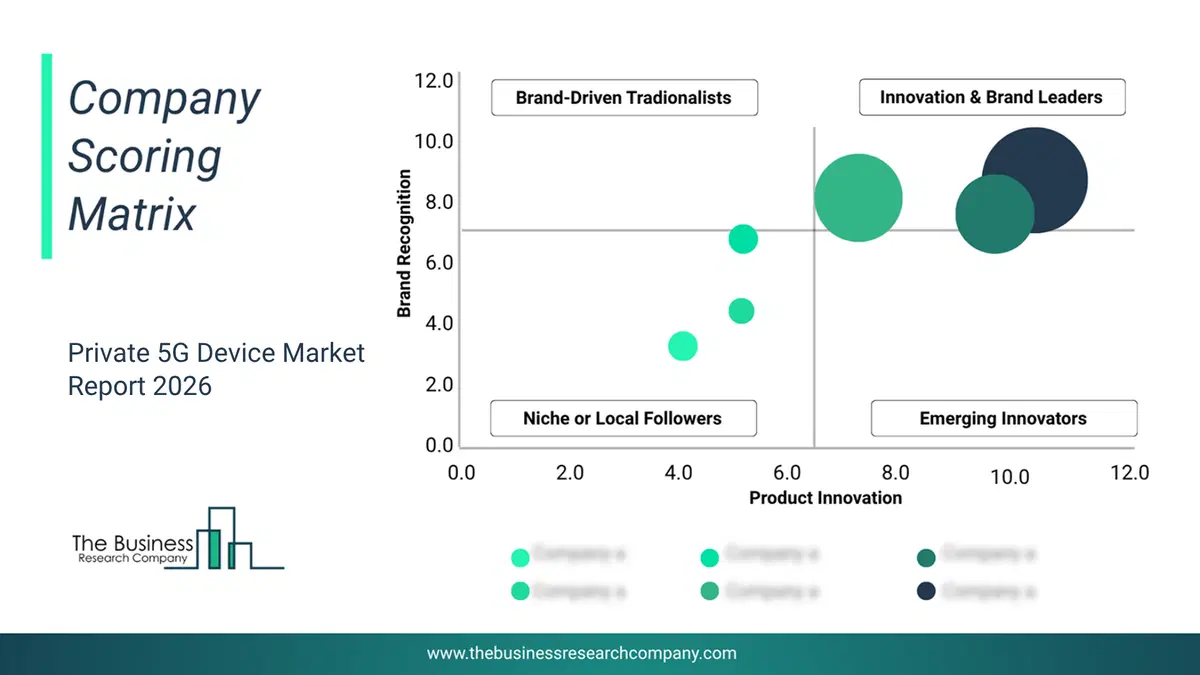
This chart maps companies by product innovation and brand strength, with bubble size indicating relative revenue, helping identify market leaders, challengers, and niche players. This is an illustrative chart; the full report provides a complete and accurate competitive analysis.
Global Private 5G Device Market Trends and Insights
Major companies operating in the private 5G network device market are focusing on incorporating technological advancements such as cloud-native 5G core to enhance network performance, security, and scalability. Cloud-native 5G cores are software-defined mobile core networks built on containerized micro-services, enabling rapid deployment, automation, and flexible scaling across enterprise environments. For instance, in June 2024, Hewlett Packard Enterprise (HPE), a US-based enterprise networking and information technology (IT)-solutions provider, launched HPE Aruba Networking Enterprise Private 5G, a comprehensive solution designed to simplify the deployment and management of private 4G and 5G networks. It features end-to-end automation, zero-touch provisioning, and unified management of radios, SIMs, eSIMs and core network elements. HPE Aruba Networking Enterprise Private 5G improves deployment speed, operational simplicity and enables real-time visibility and control for industrial, campus and mission-critical wireless applications.What Are Latest Mergers And Acquisitions In The Private 5G Device Market?
In January 2023, Semtech Corporation, a US-based provider of analog and mixed-signal semiconductors and internet of things (IoT) solutions, acquired Sierra Wireless for approximately USD 1.2 billion. With this acquisition, Semtech gains access to Sierra Wireless’ 5G modules, gateways, and AirLink routers, along with its device connectivity platform and managed services business, enabling Semtech to expand its position in private long-term evolution (LTE) and 5G devices and IoT connectivity. Sierra Wireless, a Canada-based provider of cellular modules, gateways, and cloud-connected IoT devices, is known for its strong presence in enterprise and industrial wireless hardware, particularly in private LTE and 5G deployments for sectors such as utilities, manufacturing, transportation, and public safety.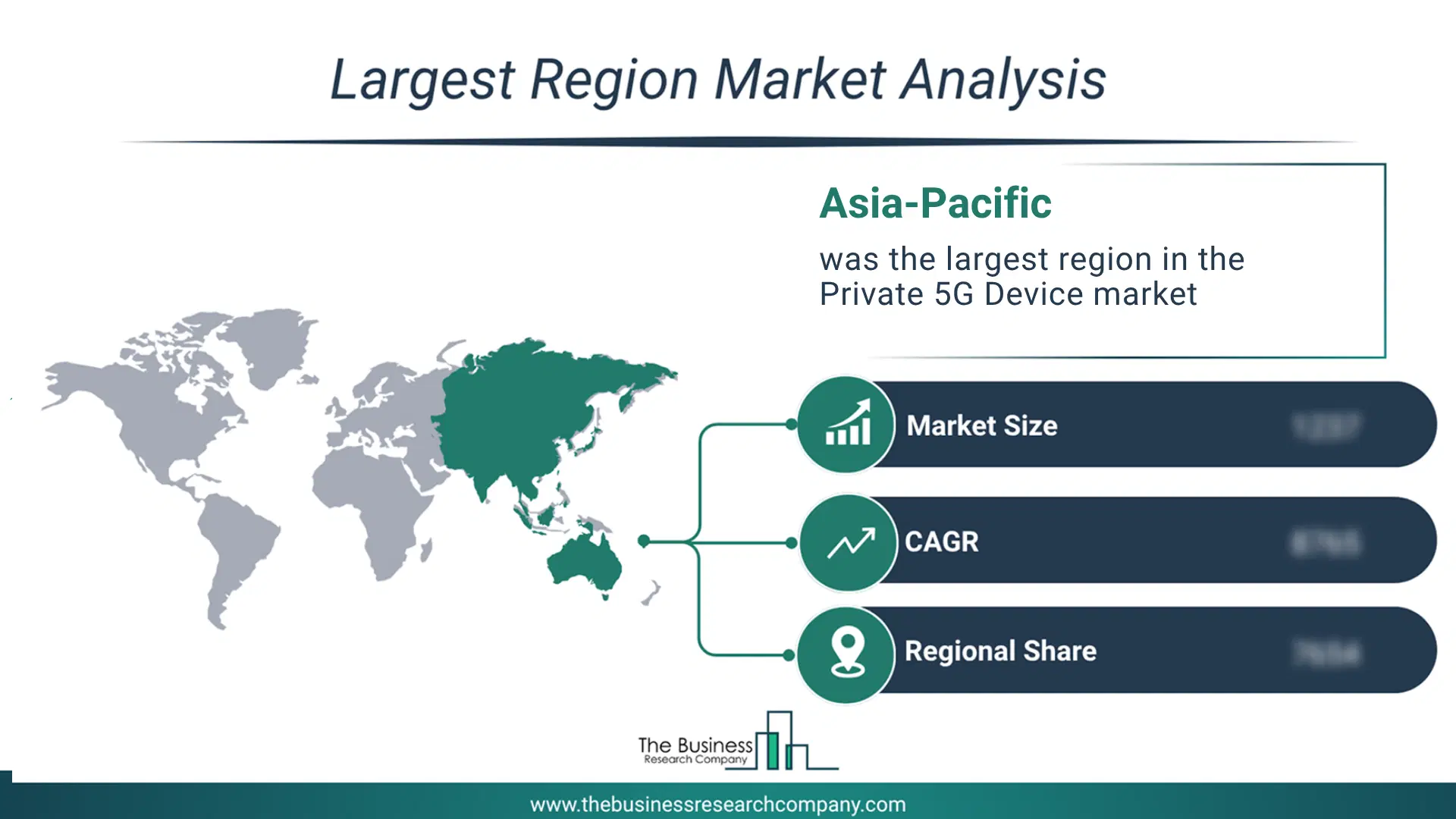
Regional Insights
Asia-Pacific was the largest region in the private 5G device market in 2025. Asia-Pacific is expected to be the fastest-growing region in the forecast period. The regions covered in this market report are Asia-Pacific, South East Asia, Western Europe, Eastern Europe, North America, South America, Middle East, Africa. The countries covered in this market report are Australia, Brazil, China, France, Germany, India, Indonesia, Japan, Taiwan, Russia, South Korea, UK, USA, Canada, Italy, Spain.What Defines the Private 5G Device Market?
The private 5G device market consists of revenues earned by entities by providing services such as network deployment services, integration services, managed network services, maintenance and support services, cybersecurity services, and device management services. The market value includes the value of related goods sold by the service provider or included within the service offering. The private 5G device market also includes sales of signal repeaters, small cells, femtocells, wireless access points, customer premises equipment (CPE) devices, and antennas. Values in this market are ‘factory gate’ values, that is the value of goods sold by the manufacturers or creators of the goods, whether to other entities (including downstream manufacturers, wholesalers, distributors and retailers) or directly to end customers. The value of goods in this market includes related services sold by the creators of the goods.How is Market Value Defined and Measured?
The market value is defined as the revenues that enterprises gain from the sale of goods and/or services within the specified market and geography through sales, grants, or donations in terms of the currency (in USD unless otherwise specified). The revenues for a specified geography are consumption values that are revenues generated by organizations in the specified geography within the market, irrespective of where they are produced. It does not include revenues from resales along the supply chain, either further along the supply chain or as part of other products.
This chart presents market attractiveness based on a quantitative evaluation of growth, competition, strategic alignment, and risk, offering a clear view of opportunity areas for decision-making. This chart is for illustrative purposes; the full report contains the complete analysis.

This chart highlights the Total Addressable Market (TAM) by estimating the maximum revenue opportunity using an assumption-driven approach, supporting strategic planning and opportunity sizing across markets. The chart is illustrative; the full report provides a more comprehensive analysis.
What Key Data and Analysis Are Included in the Private 5G Device Market Report 2026?
The private 5g device market research report is one of a series of new reports from The Business Research Company that provides market statistics, including industry global market size, regional shares, competitors with the market share, detailed market segments, market trends and opportunities, and any further data you may need to thrive in the private 5g device industry. The market research report delivers a complete perspective of everything you need, with an in-depth analysis of the current and future state of the industry.Private 5G Device Market Report Forecast Analysis
| Report Attribute | Details |
|---|---|
| Market Size Value In 2026 | $4.48 billion |
| Revenue Forecast In 2030 | $16.7 billion |
| Growth Rate | CAGR of 39% from 2026 to 2030 |
| Base Year For Estimation | 2025 |
| Actual Estimates/Historical Data | 2020-2025 |
| Forecast Period | 2026 - 2030 |
| Market Representation | Revenue in USD Billion and CAGR from 2026 to 2030 |
| Segments Covered | Device Type, Spectrum, Application, End-User |
| Regional Scope | Asia-Pacific, Western Europe, Eastern Europe, North America, South America, Middle East, Africa |
| Country Scope | The Countries Covered In This Market Report Are Australia, Brazil, China, France, Germany, India, Indonesia, Japan, Taiwan, Russia, South Korea, Uk, Usa, Canada, Italy, Spain. |
| Key Companies Profiled | Siemens Aktiengesellschaft, Telefonaktiebolaget LM Ericsson, Nokia Corporation, Zhongxing Telecommunication Equipment Corporation, Phoenix Contact GmbH and Co KG, Advantech Co Ltd, Comba Telecom Systems Holdings Limited, u-blox Holding AG, Fibocom Wireless Inc, Airspan Networks Holdings Inc, Digi International Inc, ShanghAI Quectel Wireless Solutions Co Ltd, Telit Cinterion Limited, Inseego Corp, Teltonika Networks UAB, Baicells Technologies Co Ltd, Peplink International Limited, Guangzhou Robustel Technologies Co Ltd, Celona Inc, SEMPRE Inc. |
| Customization Scope | Request for Customization |
| Pricing And Purchase Options | Explore Purchase Options |