
Processed Eggs Market Report 2026
Global Outlook – By Product Type (Dried Egg Products, Liquid Egg Products, Frozen Egg Products), By Application (Bakery And Confectionery, Food Processing, Diary Production, Ready To Eat, Soups And Sauces, Other Applications), By End-User (Raw Material Suppliers, Manufacturers And Suppliers, Traders, Distributors And Retailers, Food And Beverage Manufacturers, Other End-Users) – Market Size, Trends, Strategies, and Forecast to 2030
Processed Eggs Market Overview
• Processed Eggs market size has reached to $30.53 billion in 2025 • Expected to grow to $38.59 billion in 2030 at a compound annual growth rate (CAGR) of 5% • Growth Driver: Rising Demand For Processed Eggs To Drive Market Growth • Market Trend: Ethical Sourcing In The Processed Egg Market With A Focus On Premium Quality • North America was the largest region in 2025 and Asia-Pacific is the fastest growing region.Market Gains By 2030 – Top Opportunities By Segment
Market Gain identifies the most promising market opportunities by highlighting the segments or products expected to generate the highest incremental revenue growth over the next five years.
What Is Covered Under Processed Eggs Market?
Processed eggs are shell eggs that have been broken and pasteurized using specific machinery. They are further processed and packaged as liquids, frozen, or dried products. The commercial food sector and the restaurant industry extensively use processed eggs. The main products of processed eggs are dried egg products, liquid egg products, and frozen egg products. Dried egg products refer to egg products that have been dehydrated and reduced to a fine powder with a consistency close to powdered milk. They are used for various applications including bakery and confectionery, food processing, dairy production, ready-to-eat, soups and sauces, and others, which are used by raw material suppliers, manufacturers and suppliers, traders, distributors and retailers, food and beverage manufacturers, and others.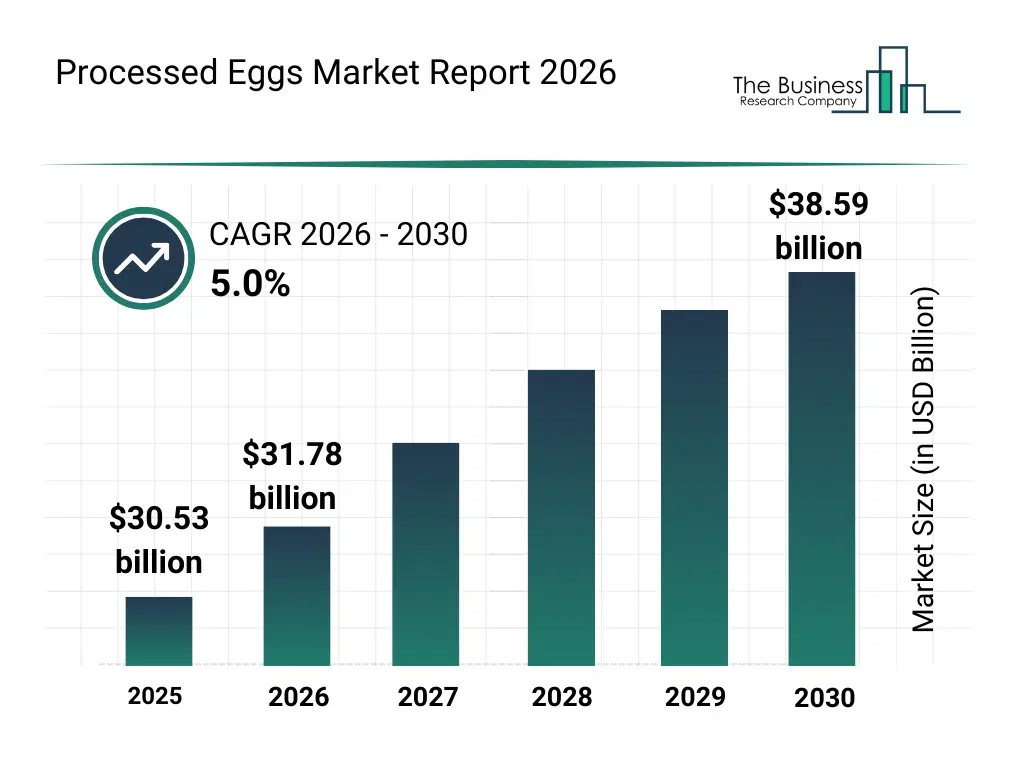
What Is The Processed Eggs Market Size and Share 2026?
The processed eggs market size has grown steadily in recent years. It will grow from $30.53 billion in 2025 to $31.78 billion in 2026 at a compound annual growth rate (CAGR) of 4.1%. The growth in the historic period can be attributed to growth of commercial foodservice industry, expansion of bakery and confectionery production, increased adoption of pasteurized egg products, improvements in egg processing technologies, rising institutional food demand.What Is The Processed Eggs Market Growth Forecast?
The processed eggs market size is expected to see steady growth in the next few years. It will grow to $38.59 billion in 2030 at a compound annual growth rate (CAGR) of 5.0%. The growth in the forecast period can be attributed to increasing demand for convenience foods, rising focus on food safety compliance, expansion of high-protein food products, growing use in meal kits and ready meals, advancements in egg drying and freezing technologies. Major trends in the forecast period include increasing demand for long-shelf-life egg products, rising use in industrial food processing, expansion of liquid egg applications, growing adoption in ready-to-eat foods, enhanced focus on food safety and pasteurization.
Global Processed Eggs Market Segmentation
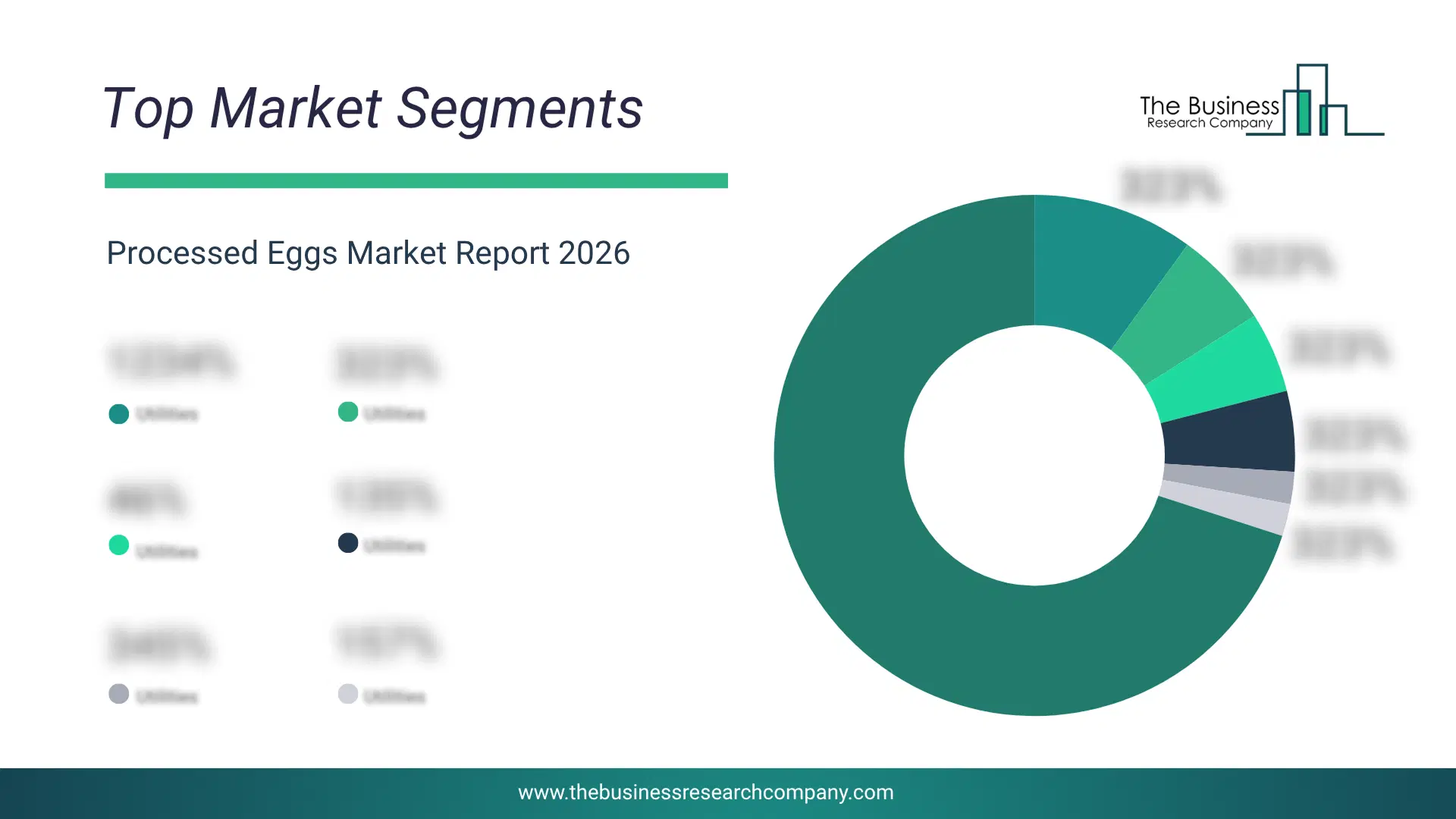
1) By Product Type: Dried Egg Products, Liquid Egg Products, Frozen Egg Products 2) By Application: Bakery And Confectionery, Food Processing, Diary Production, Ready To Eat, Soups And Sauces, Other Applications 3) By End-User: Raw Material Suppliers, Manufacturers And Suppliers, Traders, Distributors And Retailers, Food And Beverage Manufacturers, Other End-Users Subsegments: 1) By Dried Egg Products: Whole Egg Powder, Egg Yolk Powder, Egg White Powder 2) By Liquid Egg Products: Whole Liquid Eggs, Liquid Egg Whites, Liquid Egg Yolks 3) By Frozen Egg Products: Frozen Whole Eggs, Frozen Egg Whites, Frozen Egg Yolks The top segments in the processed eggs market will be: • Liquid Egg Products will reach $23.04 Billion by 2030. • Dried Egg Products will reach $14.89 Billion by 2030. • Frozen Egg Products will reach $6.19 Billion by 2030.What Is The Driver Of The Processed Eggs Market?
The growing demand for processed eggs is expected to boost the growth of the processed eggs market going forward. An egg is a hard-shelled reproductive body produced by a bird or domestic chicken that is used as food in addition to a primary component for baked goods. Processed eggs refer to products made from eggs or egg mixes. These processed egg products are pasteurized to kill salmonella and other pathogens, making them a safer alternative to fresh eggs and providing excellent protein sources. Hence, the growing demand for an egg will boost the need for the processed egg market. For instance, in October 2023, the United States Department of Agriculture (USDA), a US-based government administration, reported that US egg production totaled 9.16 billion in 2023, a 3% increase from 8.89 billion in 2022. This included 7.88 billion table eggs and 1.28 billion hatching eggs, of which 1.19 billion were broiler-type eggs, compared to 7.62 billion table eggs and 1.27 billion hatching eggs in 2022. Therefore, the growing demand for processed eggs is driving the growth of the processed eggs industry.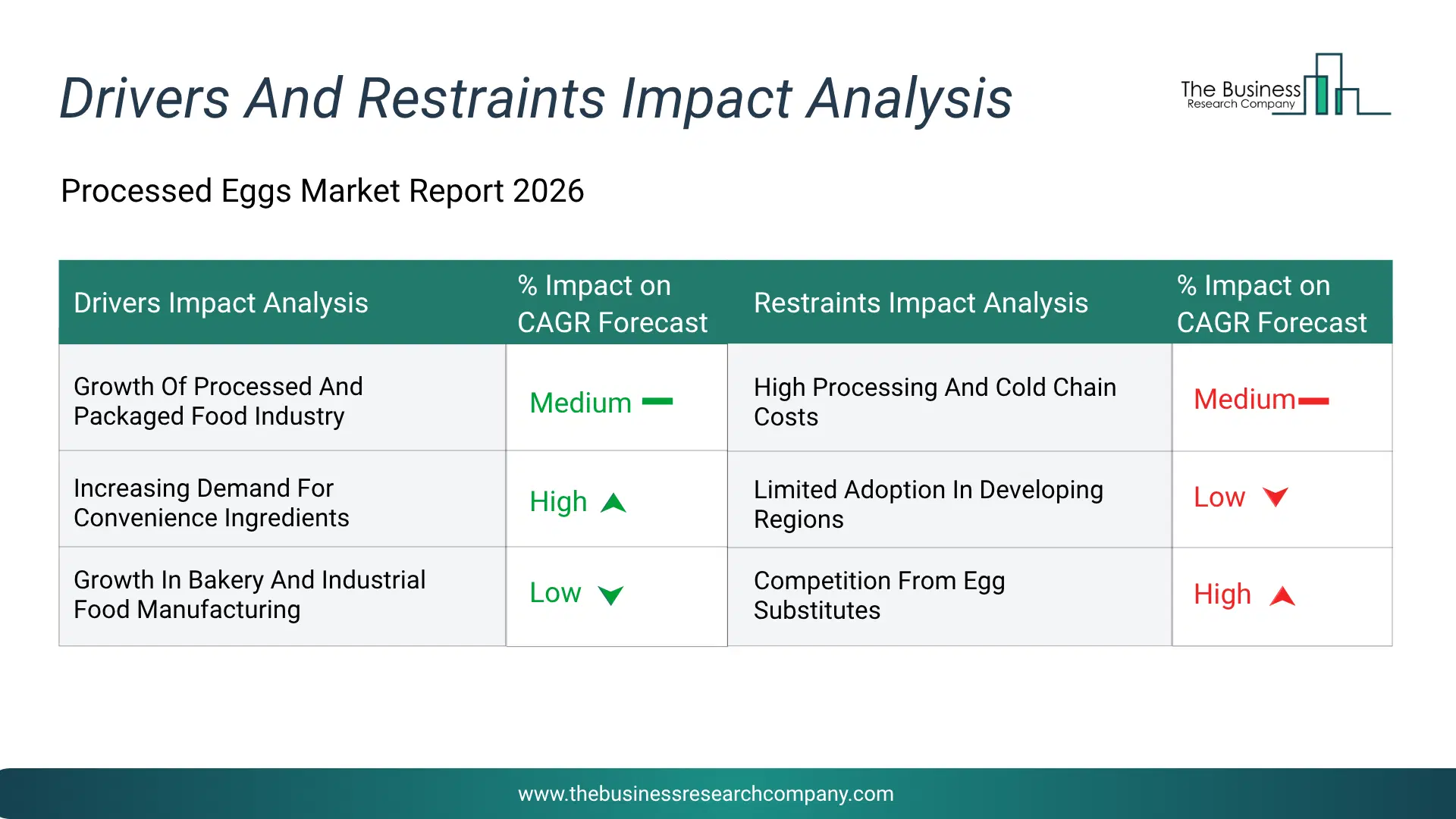
Infographic Chart Showing Key Market Drivers Analysis And Restraints For Processed Eggs Market
The chart presents an impact analysis of key drivers and restraints, quantifying their relative influence on the market's growth rate and helping assess the balance between growth enablers and limiting factors. This chart offers a high-level perspective; the full report contains more detailed insights.
How Will The Drivers Impact Growth In The Global Processed Eggs Market?
• Growth Of Processed And Packaged Food Industry (Medium) – During the forecast period, the growth of processed and packaged food industry is expected to become a key growth driver for the processed eggs market by 2030. The expansion of the processed and packaged food industry directly increases demand for processed eggs because they serve as standardized, functional ingredients in large-scale food manufacturing. Products such as baked goods, sauces, ready meals, and snacks require eggs for emulsification, binding, aeration, and texture, and manufacturers prefer pasteurized liquid or dried eggs for consistency and safety. Since processed eggs are already broken and treated, they integrate easily into automated production lines, reducing variability compared to shell eggs. This aligns with factory-gate demand, as food manufacturers procure processed eggs in bulk directly from producers. As global consumption of packaged foods rises-driven by urbanization, changing lifestyles, and longer shelf-life preferences-the need for reliable, scalable egg inputs increases. Additionally, multinational food companies require uniform quality across geographies, which processed eggs provide better than raw shell eggs. This structural shift toward industrial food production therefore acts as a strong, sustained demand driver for the processed eggs market. • Increasing Demand For Convenience Ingredients (High) – During the forecast period, the increasing demand for convenience ingredients is expected to emerge as a major factor driving the expansion of the processed eggs market by 2030. The growing preference for convenience ingredients significantly drives the processed eggs market, particularly within commercial kitchens and food manufacturing environments. Processed eggs eliminate the need for manual cracking, separation, and handling, saving time and labor while improving operational efficiency. Their pasteurized nature also reduces the risk of contamination, which is critical for maintaining food safety standards in large-scale operations. In restaurants, bakeries, and catering services, using liquid or pre-cooked egg formats simplifies preparation and ensures consistency in taste and texture. From a factory-gate perspective, this translates into higher procurement of ready-to-use egg products directly from manufacturers. Moreover, convenience ingredients support automation and standardization in food production, enabling businesses to scale operations without compromising quality. As labor costs rise and efficiency becomes a priority, especially in urban foodservice sectors, the shift toward ready-to-use processed eggs continues to accelerate, reinforcing their role as a key demand driver. • Growth In Bakery And Industrial Food Manufacturing (Low) – During the forecast period, the growth in bakery and industrial food manufacturing is expected to act as a key growth catalyst for the processed eggs market by 2030. The expansion of bakery and industrial food manufacturing sectors plays a crucial role in driving the processed eggs market because these industries are among the largest consumers of egg-based ingredients. Eggs are essential in bakery applications for providing structure, moisture retention, and volume, making them indispensable in products like cakes, pastries, and bread. Industrial manufacturers prefer processed eggs-particularly dried and liquid forms-because they offer longer shelf life, ease of storage, and precise formulation control. This is especially important in high-volume production environments where consistency and efficiency are critical. As bakery consumption grows globally, supported by rising disposable incomes and evolving dietary habits, the demand for processed eggs increases proportionally. Additionally, industrial food manufacturers rely on bulk procurement at the factory-gate level, which directly aligns with the defined market structure. The scalability and functional reliability of processed eggs make them a preferred choice, thereby reinforcing the strong linkage between bakery industry growth and processed egg market expansion.How Will The Restraints Impact Growth In The Global Processed Eggs Market?
• High Processing And Cold Chain Costs (Medium) – During the forecast period, the processed eggs, as defined, require multiple controlled steps—breaking, pasteurization, homogenization, and then conversion into liquid, dried, or frozen formats. Each of these stages demands specialized machinery, strict hygiene systems, and continuous quality monitoring, all of which raise capital and operating expenses at the factory-gate level. In addition, liquid and frozen egg products depend heavily on refrigerated storage and transportation, which significantly increases logistics costs compared to shell eggs. These higher costs make processed eggs more expensive for commercial buyers such as restaurants and food manufacturers. As a result, price-sensitive customers may prefer cheaper alternatives like fresh shell eggs, especially in cost-competitive markets. The need to maintain uninterrupted cold chains also exposes producers to energy price fluctuations and infrastructure limitations. Any breakdown in temperature control can lead to product spoilage, increasing financial risk for manufacturers. Smaller players often struggle to invest in such infrastructure, limiting market participation and competition. Overall, the high cost structure directly constrains market expansion by affecting pricing, margins, and accessibility. • Limited Adoption In Developing Regions (High) – During the forecast period, the in many developing economies, the consumption pattern still favors fresh shell eggs over processed formats due to cultural preferences, lower cost, and widespread local availability. The processed eggs market, as defined, relies heavily on organized foodservice and industrial food manufacturing sectors, which are still evolving in these regions. Limited awareness about the benefits of pasteurized egg products—such as safety, consistency, and convenience—also slows adoption. Additionally, inadequate cold chain infrastructure and inconsistent electricity supply make storage and distribution of liquid or frozen egg products challenging. Small-scale food businesses and informal restaurants often lack the capacity or incentive to switch from shell eggs to processed alternatives. Regulatory enforcement around food safety and pasteurization may also be weaker, reducing the push toward processed egg usage. This results in a slower transition to factory-processed egg products, directly limiting demand growth. Consequently, despite large population bases, these regions contribute less to market revenues compared to developed markets. • Competition From Egg Substitutes (Low) – During the forecast period, the processed eggs face increasing competition from alternative ingredients used in food manufacturing and foodservice applications. These substitutes include plant-based egg replacers, starch-based binders, and other functional ingredients that can mimic the properties of eggs in baking and processed foods. For manufacturers, substitutes often offer advantages such as longer shelf life, lower price volatility, and easier storage requirements. In certain applications, especially in vegan or allergen-free product lines, substitutes are preferred over traditional egg products. This reduces the dependence on processed eggs as a functional ingredient. Additionally, fluctuations in raw egg prices can make substitutes more economically attractive, prompting food producers to reformulate recipes. Large-scale food manufacturers may adopt these alternatives to stabilize costs and ensure consistent supply. Although substitutes may not fully replicate all functional properties of eggs, continuous innovation is improving their performance. As a result, the growing availability and acceptance of substitutes create competitive pressure, limiting the growth potential of the processed eggs market.Key Players In The Global Processed Eggs Market
Major companies operating in the processed eggs market are Interovo Egg Group B.V., Rose Acre Farms, Ballas Egg Products Corporation, Moba Group, Rembrandt Enterprises, Daybreak Foods Inc., SKM Egg Products, Tyson Foods Inc., Pulviver SPRL, EggSolutions, Shepherd Eggs, OVOBEST egg GmbH u. Co. KG, Griffiths Family Foods, Avril Group, Cal-Maine Foods Inc., EPS S.P.A., Wabash Valley, Michael Foods Inc., Midwest Poultry Services L.P., Weaver Brothers, Hickman's Egg Ranch, Sparboe Farms, Hidden Villa Ranch, Hillandale Farms, Versova Holdings LLP, Center Fresh Group, MPS Egg Farms, Prairie Star Farms, Gemperle Family Farms, Herbruck's Poultry Ranch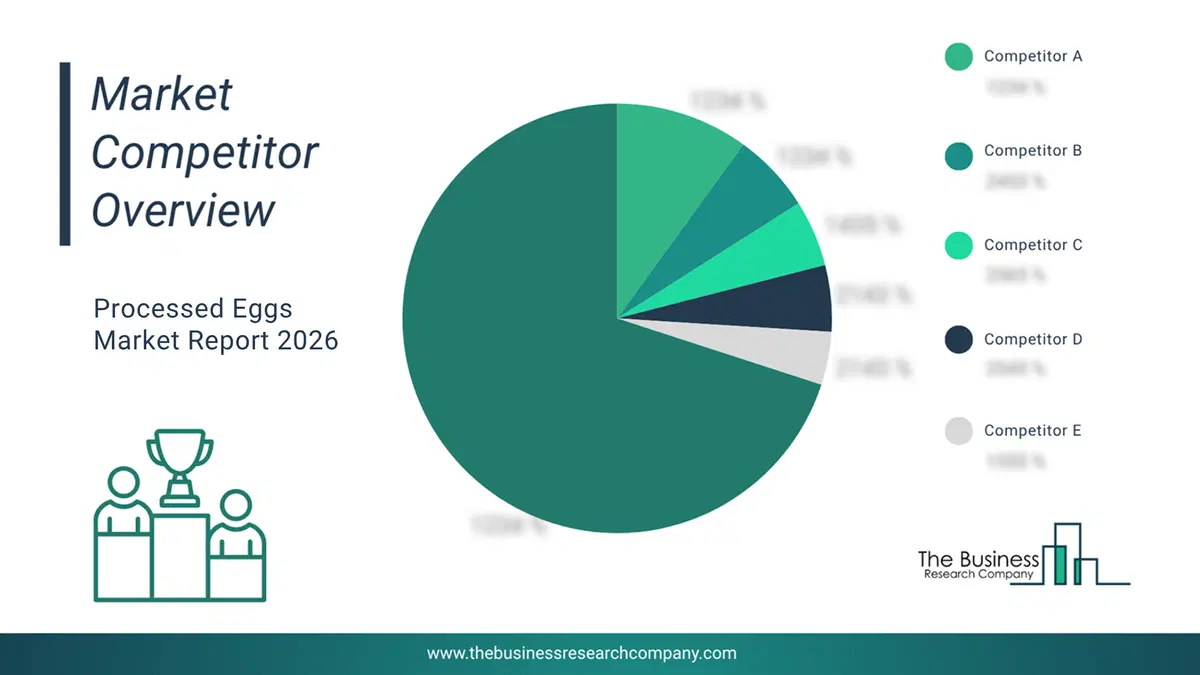
This chart is for illustrative purposes; the full report includes a detailed competitor analysis and comprehensive overview of the top 10 companies in the market.
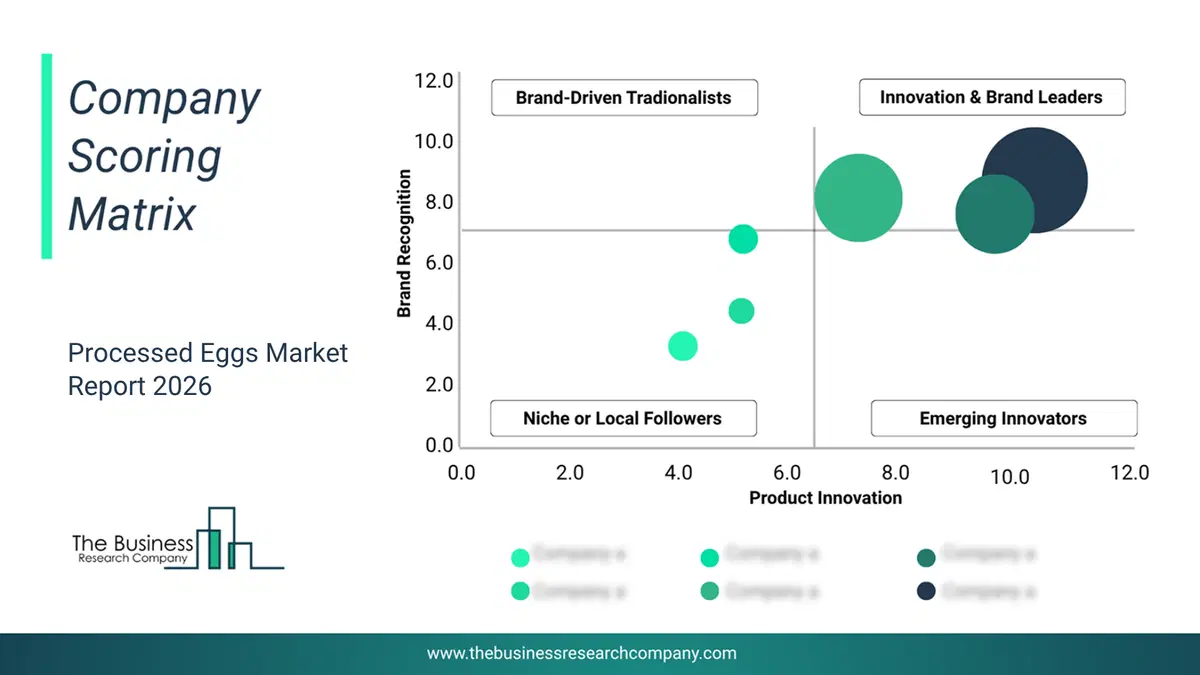
This chart maps companies by product innovation and brand strength, with bubble size indicating relative revenue, helping identify market leaders, challengers, and niche players. This is an illustrative chart; the full report provides a complete and accurate competitive analysis.
Global Processed Eggs Market Trends and Insights
Major companies in the processed egg market are focused on developing innovative products, such as premium lines of barn eggs, to cater to the growing demand for high-quality, ethically sourced options that prioritize animal welfare and sustainability. Premium lines of barn eggs are high-quality eggs sourced from free-range hens raised in humane and sustainable environments, ensuring superior taste and nutritional value. For instance, in October 2024, Bird Bros., a UK-based egg producer and supplier, launched the barn egg brand ‘Roost Eggs’. Roost Eggs represents a premium line of barn eggs that emphasizes ethical sourcing and animal welfare, catering to the increasing consumer demand for quality and transparency. These eggs are produced from free-range hens, ensuring optimal nutrition and superior taste. Positioned within the processed egg market, Roost Eggs aims to meet the preferences of health-conscious consumers seeking reliable and sustainable food options.What Are Latest Mergers And Acquisitions In The Processed Eggs Market?
In January 2024, Rembrandt Foods, a US-based food and beverage manufacturer, acquired Artisan Kitchens for an undisclosed amount. This acquisition supports Rembrandt's strategy to expand its capabilities in the pre-cooked segment by leveraging its expertise in egg processing. Artisan Kitchens, based in California, specializes in producing pre-cooked egg products, with a focus on egg bites and omelets.Regional Outlook
North America was the largest region in the processed eggs market in 2025.Asia-Pacific is expected to be the fastest-growing region in the global processed eggs market report forecast period. The regions covered in this market report are Asia-Pacific, South East Asia, Western Europe, Eastern Europe, North America, South America, Middle East and Africa. The countries covered in this market report are Australia, Brazil, China, France, Germany, India, Indonesia, Japan, Taiwan, Russia, South Korea, UK, USA, Italy, Spain, CanadaWhat Defines the Processed Eggs Market?
The processed eggs market consists of sales of precooked fried eggs, precooked scrambled eggs, omelets, and other related products. Values in this market are ‘factory gate’ values, that is the value of goods sold by the manufacturers or creators of the goods, whether to other entities (including downstream manufacturers, wholesalers, distributors and retailers) or directly to end customers. The value of goods in this market includes related services sold by the creators of the goods.How is Market Value Defined and Measured?
The market value is defined as the revenues that enterprises gain from the sale of goods and/or services within the specified market and geography through sales, grants, or donations in terms of the currency (in USD unless otherwise specified). The revenues for a specified geography are consumption values that are revenues generated by organizations in the specified geography within the market, irrespective of where they are produced. It does not include revenues from resales along the supply chain, either further along the supply chain or as part of other products.
This chart presents market attractiveness based on a quantitative evaluation of growth, competition, strategic alignment, and risk, offering a clear view of opportunity areas for decision-making. This chart is for illustrative purposes; the full report contains the complete analysis.

This chart highlights the Total Addressable Market (TAM) by estimating the maximum revenue opportunity using an assumption-driven approach, supporting strategic planning and opportunity sizing across markets. The chart is illustrative; the full report provides a more comprehensive analysis.
What Key Data and Analysis Are Included in the Processed Eggs Market Report 2026?
The processed eggs market research report is one of a series of new reports from The Business Research Company that provides market statistics, including industry global market size, regional shares, competitors with the market share, detailed market segments, market trends and opportunities, and any further data you may need to thrive in the processed eggs industry. The market research report delivers a complete perspective of everything you need, with an in-depth analysis of the current and future state of the industry.Processed Eggs Market Report Forecast Analysis
| Report Attribute | Details |
|---|---|
| Market Size Value In 2026 | $31.78 billion |
| Revenue Forecast In 2030 | $38.59 billion |
| Growth Rate | CAGR of 4.1% from 2026 to 2030 |
| Base Year For Estimation | 2025 |
| Actual Estimates/Historical Data | 2020-2025 |
| Forecast Period | 2026 - 2030 |
| Market Representation | Revenue in USD Billion and CAGR from 2026 to 2030 |
| Segments Covered | Product Type, Application, End-User |
| Regional Scope | Asia-Pacific, Western Europe, Eastern Europe, North America, South America, Middle East, Africa |
| Country Scope | The countries covered in the report are Australia, Brazil, China, France, Germany, India, Indonesia, Japan, Taiwan, Russia, South Korea, UK, USA, Canada, Italy, Spain. |
| Key Companies Profiled | Interovo Egg Group B.V., Rose Acre Farms, Ballas Egg Products Corporation, Moba Group, Rembrandt Enterprises, Daybreak Foods Inc., SKM Egg Products, Tyson Foods Inc., Pulviver SPRL, EggSolutions, Shepherd Eggs, OVOBEST egg GmbH u. Co. KG, Griffiths Family Foods, Avril Group, Cal-Maine Foods Inc., EPS S.P.A., Wabash Valley, Michael Foods Inc., Midwest Poultry Services L.P., Weaver Brothers, Hickman's Egg Ranch, Sparboe Farms, Hidden Villa Ranch, Hillandale Farms, Versova Holdings LLP, Center Fresh Group, MPS Egg Farms, Prairie Star Farms, Gemperle Family Farms, Herbruck's Poultry Ranch |
| Customization Scope | Request for Customization |
| Pricing And Purchase Options | Explore Purchase Options |