
Production Planning Market Report 2026
Global Outlook – By Product Type (Enterprise Resource Planning (ERP) Production Modules, Manufacturing Software Platforms, Industrial Automation Planning Tools, Supply Chain Planning Systems), By Function Or Use Case (Material Requirement Planning (MRP), Capacity Planning, Production Scheduling, Demand Forecasting And Planning, Shop Floor Management, Inventory Management), By Deployment (On-Premise, Cloud-Based), By Organization Size (Small And Medium-Sized Enterprises (SMEs), Large Enterprises), By Industry (General Manufacturing, Automotive And Aerospace, Pharmaceutical And Life Sciences, Other Industries) – Market Size, Trends, Strategies, and Forecast to 2030
Production Planning Market Overview
• Production Planning market size has reached to $7.79 billion in 2025 • Expected to grow to $8.62 billion in 2030 at a compound annual growth rate (CAGR) of 11% • Growth Driver: Rising Integration Of Iot In Smart Manufacturing Driving The Growth Of The Market Due To Increasing Demand For Real-Time Data, Predictive Insights, And Operational Efficiency • Market Trend: Adoption Of Cloud-Based Manufacturing Operations Management (MOM) Platforms Driving The Market Due To Enhanced Scheduling Efficiency, Flexibility, And Cost Reduction • North America was the largest region in 2025 and Asia-Pacific is the fastest growing region.What Is Covered Under Production Planning Market?
Production planning is a business and industrial management process that determines how manufacturing resources, materials, labor, and production capacity are scheduled and allocated to meet demand efficiently. It enables organizations to optimize production workflows, reduce operational bottlenecks, and ensure timely delivery of goods while minimizing costs and waste. It supports coordinated decision-making across procurement, manufacturing, and supply chain functions to improve overall productivity and operational efficiency. The main product types of the production planning are enterprise resource planning (ERP) production modules, manufacturing software platforms, industrial automation planning tools, and supply chain planning systems. Enterprise resource planning (ERP) production modules refer to integrated software solutions within ERP systems that help manage and coordinate production-related processes such as resource allocation, scheduling, and workflow optimization. These solutions support various functions or use cases, including material requirement planning (MRP), capacity planning, production scheduling, demand forecasting and planning, shop floor management, and inventory management, enabling efficient and optimized manufacturing operations. They are deployed through on-premise and cloud-based models and are used by organizations of different sizes, including small and medium-sized enterprises (SMEs) and large enterprises. These solutions are widely adopted across multiple industries, such as general manufacturing, automotive and aerospace, pharmaceutical and life sciences, and other industries.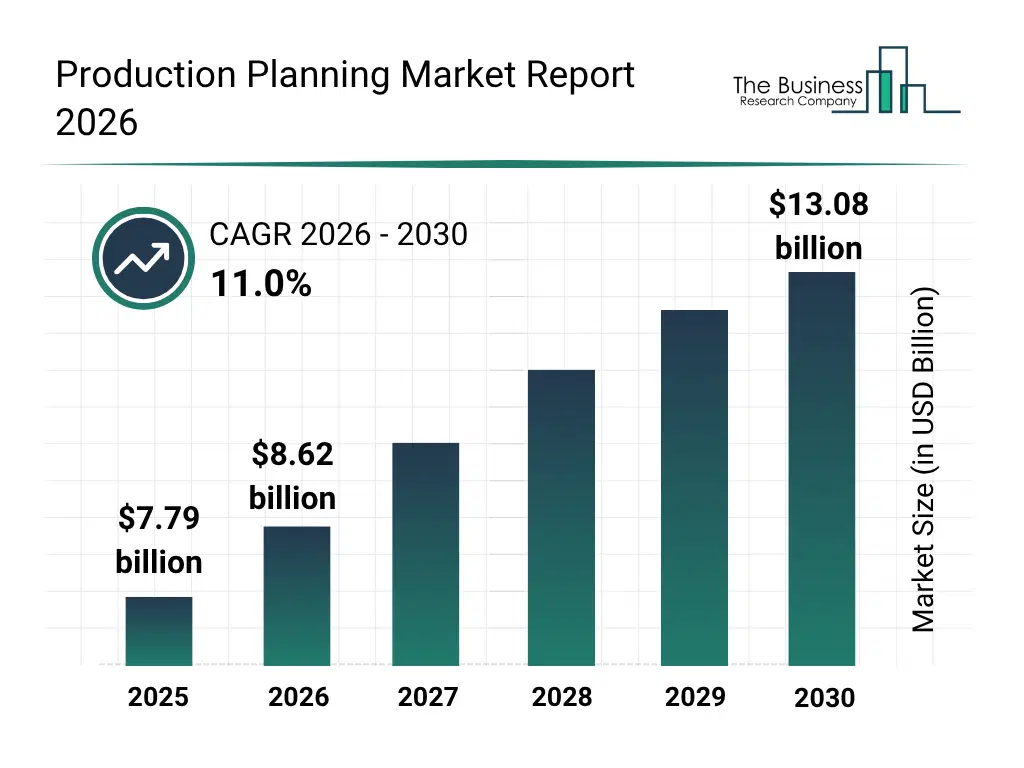
What Is The Production Planning Market Size and Share 2026?
The production planning market size has grown rapidly in recent years. It will grow from $7.79 billion in 2025 to $8.62 billion in 2026 at a compound annual growth rate (CAGR) of 10.7%. The growth in the historic period can be attributed to manual production scheduling dependence, rise of erp adoption in manufacturing, fragmented supply chain coordination, limited shop floor digitization, growing lean manufacturing practices.What Is The Production Planning Market Growth Forecast?
The production planning market size is expected to see rapid growth in the next few years. It will grow to $13.08 billion by 2030 at a compound annual growth rate (CAGR) of 11.0%. The growth in the forecast period can be attributed to AI-enabled production optimization demand, expansion of smart factories, integration of iot-enabled manufacturing systems, increasing need for supply chain resilience, adoption of cloud-based production planning tools. Major trends in the forecast period include AI-driven production scheduling and optimization, digital twin-based production planning systems, cloud-based manufacturing resource planning platforms, predictive demand forecasting and capacity planning, real-time shop floor monitoring and adaptive planning.
Global Production Planning Market Segmentation
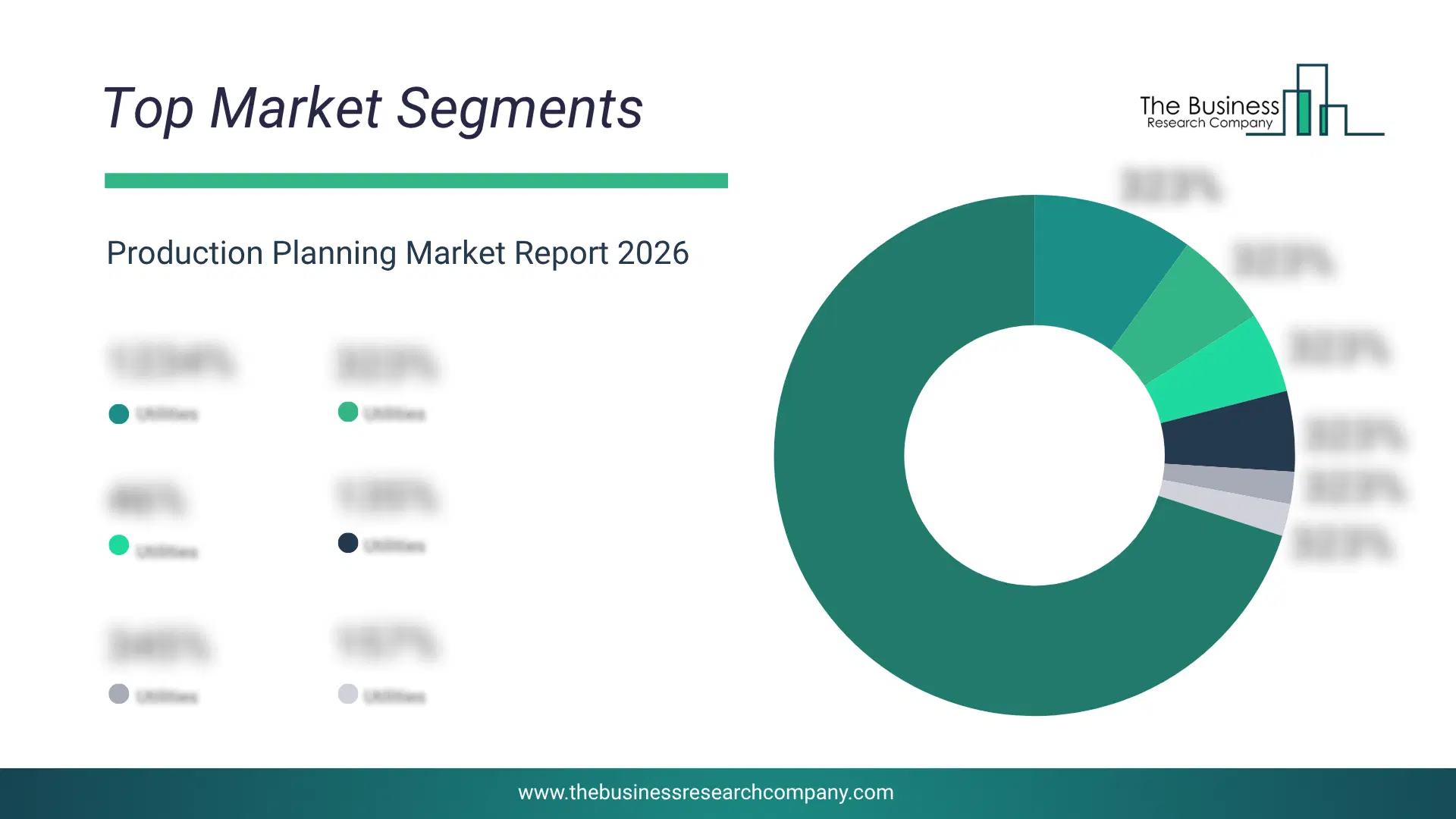
1) By Product Type: Enterprise Resource Planning (ERP) Production Modules, Manufacturing Software Platforms, Industrial Automation Planning Tools, Supply Chain Planning Systems 2) By Function Or Use Case: Material Requirement Planning (MRP), Capacity Planning, Production Scheduling, Demand Forecasting And Planning, Shop Floor Management, Inventory Management 3) By Deployment: On-Premise, Cloud-Based 4) By Organization Size: Small And Medium-Sized Enterprises (SMEs), Large Enterprises 5) By Industry: General Manufacturing, Automotive And Aerospace, Pharmaceutical And Life Sciences, Other Industries Subsegments: 1) By Enterprise Resource Planning (ERP) Production Modules: Material Requirements Planning (MRP), Manufacturing Resource Planning (MRP II), Advanced Planning And Scheduling (APS), Demand Planning, Capacity Planning, Shop Floor Control, Inventory And Production Integration 2) By Manufacturing Software Platforms: Manufacturing Execution Systems (MES), Product Lifecycle Management (PLM), Digital Manufacturing Platforms, Quality Management Systems (QMS), Production Analytics Platforms, Industrial IoT (IIoT) Platforms, Cloud Manufacturing Platforms 3) By Industrial Automation Planning Tools: PLC Programming Tools, SCADA Systems, Robotics Process Planning Software, Simulation And Modeling Tools, HMI Design Tools, Digital Twin Platforms, Automation Workflow Optimization Tools 4) By Supply Chain Planning Systems: Demand Forecasting Systems, Supply Planning Systems, Inventory Optimization Tools, Sales And Operations Planning (SAndOP) Systems, Distribution Requirements Planning (DRP), Transportation Planning Systems, Supply Chain Visibility PlatformsWhat Is The Driver Of The Production Planning Market?
The increasing integration of internet of things (IoT) for smart manufacturing is expected to propel the growth of the production planning market going forward. the internet of things is a network of interconnected devices, machines, and systems that collect and exchange real-time data through embedded sensors and software. The integration of IoT is increasing due to the growing demand for real-time visibility, predictive insights, and operational efficiency in manufacturing environments. Production planning supports smart manufacturing by enabling real-time scheduling, optimizing resource allocation, and improving decision-making based on continuous data flows from connected devices. For instance, in June 2023, according to the GSM Association, a UK-based industry organization, the number of global IoT connections reached 15.1 billion in 2023, increasing from 13.2 billion in 2022. Therefore, the increasing integration of Internet of Things for smart manufacturing is driving the growth of the production planning industry.Key Players In The Global Production Planning Market
Major companies operating in the production planning market are Microsoft Corporation, Oracle Corporation, SAP SE, RELEX Solutions, Dassault Systèmes SE, Infor Inc., Siemens AG, Blue Yonder Group, IFS AB, Odoo S.A., Epicor Software Corporation, Priority Software Ltd, Kinaxis Inc, QAD Inc, Plex Systems Inc, SYSPRO Ltd., Logility Inc., Rootstock Software Inc., PlanetTogether Inc, FlexSim Software Products Inc., Asprova Corporation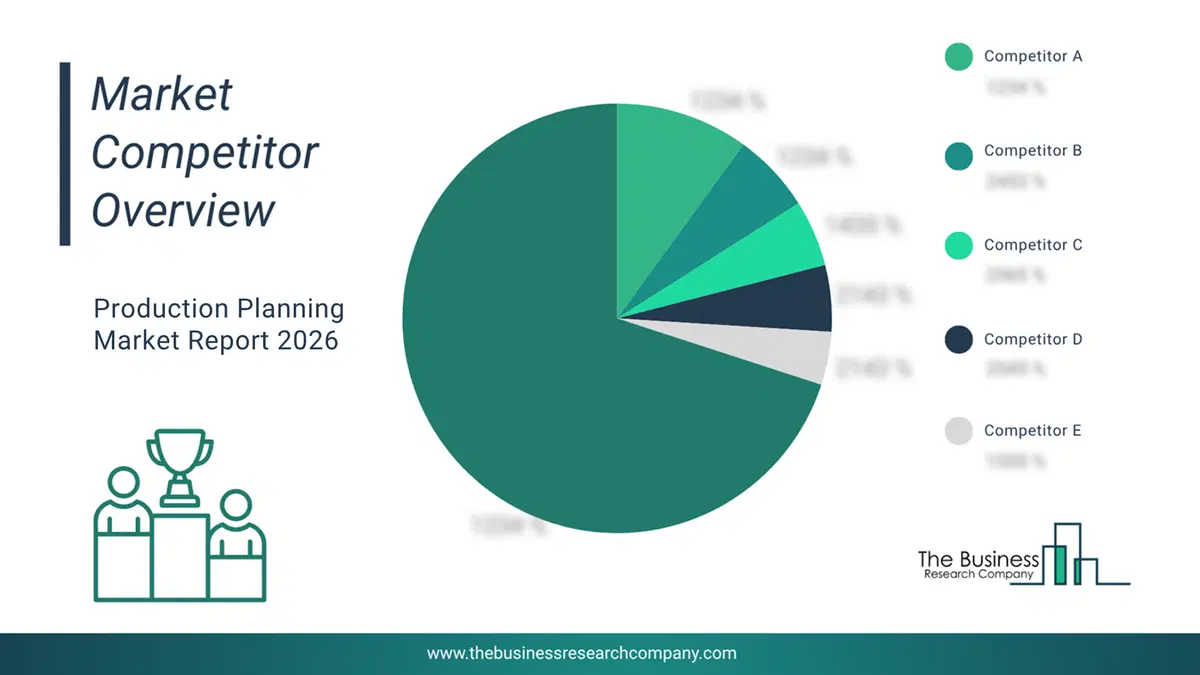
This chart is for illustrative purposes; the full report includes a detailed competitor analysis and comprehensive overview of the top 10 companies in the market.
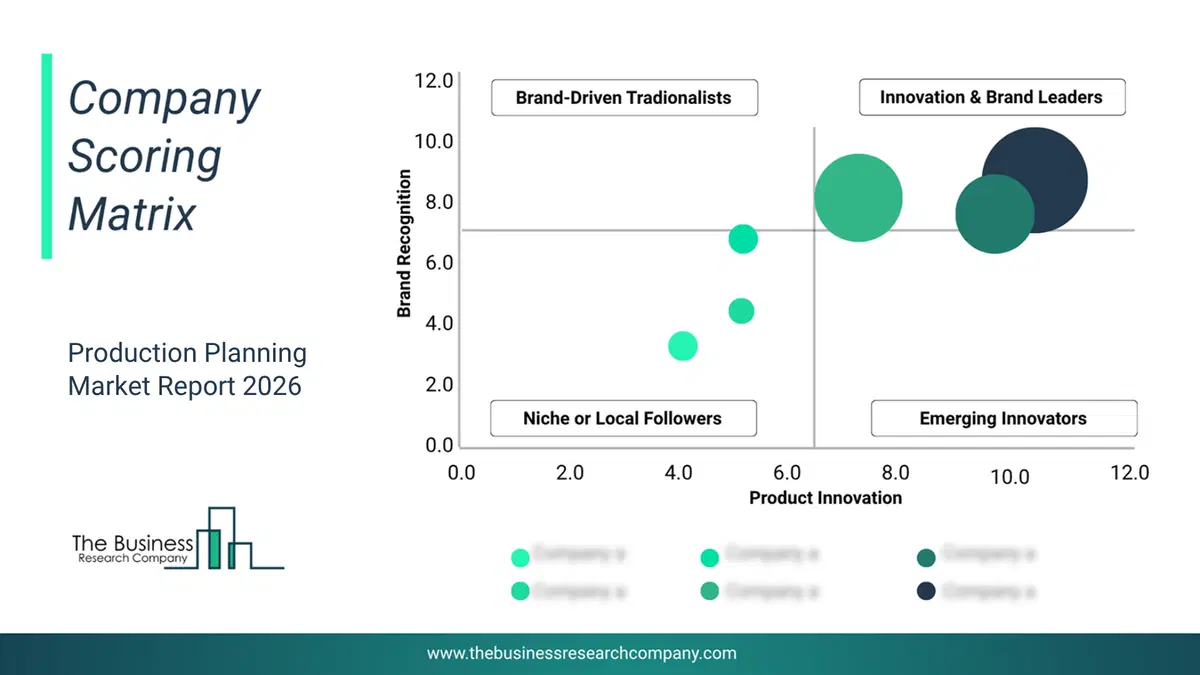
This chart maps companies by product innovation and brand strength, with bubble size indicating relative revenue, helping identify market leaders, challengers, and niche players. This is an illustrative chart; the full report provides a complete and accurate competitive analysis.
Global Production Planning Market Trends and Insights
Major companies operating in the production planning market are focusing on developing innovative solutions, such as cloud-based manufacturing operations management (MOM) platforms, to improve scheduling efficiency, enhance flexibility, and reduce operational costs. Cloud-based MOM platforms refer to software solutions delivered through a SaaS model that integrate production scheduling, execution, quality, and analytics into a unified system, enabling real-time planning and scalable operations without heavy infrastructure investment. For instance, in May 2024, Siemens AG, a Germany-based industrial manufacturing company, introduced Opcenter X, a cloud-native manufacturing operations management solution as part of its Siemens Xcelerator portfolio. Designed to improve production and order scheduling, the platform offers modular capabilities for flexible deployment, enables real-time collaboration across manufacturing processes, and significantly reduces scheduling time, as demonstrated by its ability to cut schedule creation time from 8 hours to 30 minutes in industrial applications.What Are Latest Mergers And Acquisitions In The Production Planning Market?
In September 2023, SAP SE, a Germany-based provider of enterprise resource planning (ERP) software, supply chain management solutions, and manufacturing planning systems, acquired LeanIX GmbH for an undisclosed amount. Through this acquisition, SAP aims to expand its business transformation portfolio by integrating LeanIX’s enterprise architecture management capabilities, enabling AI-driven process optimization and enhanced visibility across IT and production planning environments. LeanIX GmbH is a Germany-based software company that provides enterprise architecture management solutions, enabling organizations to visualize IT landscapes, optimize system architectures, and support digital transformation initiatives.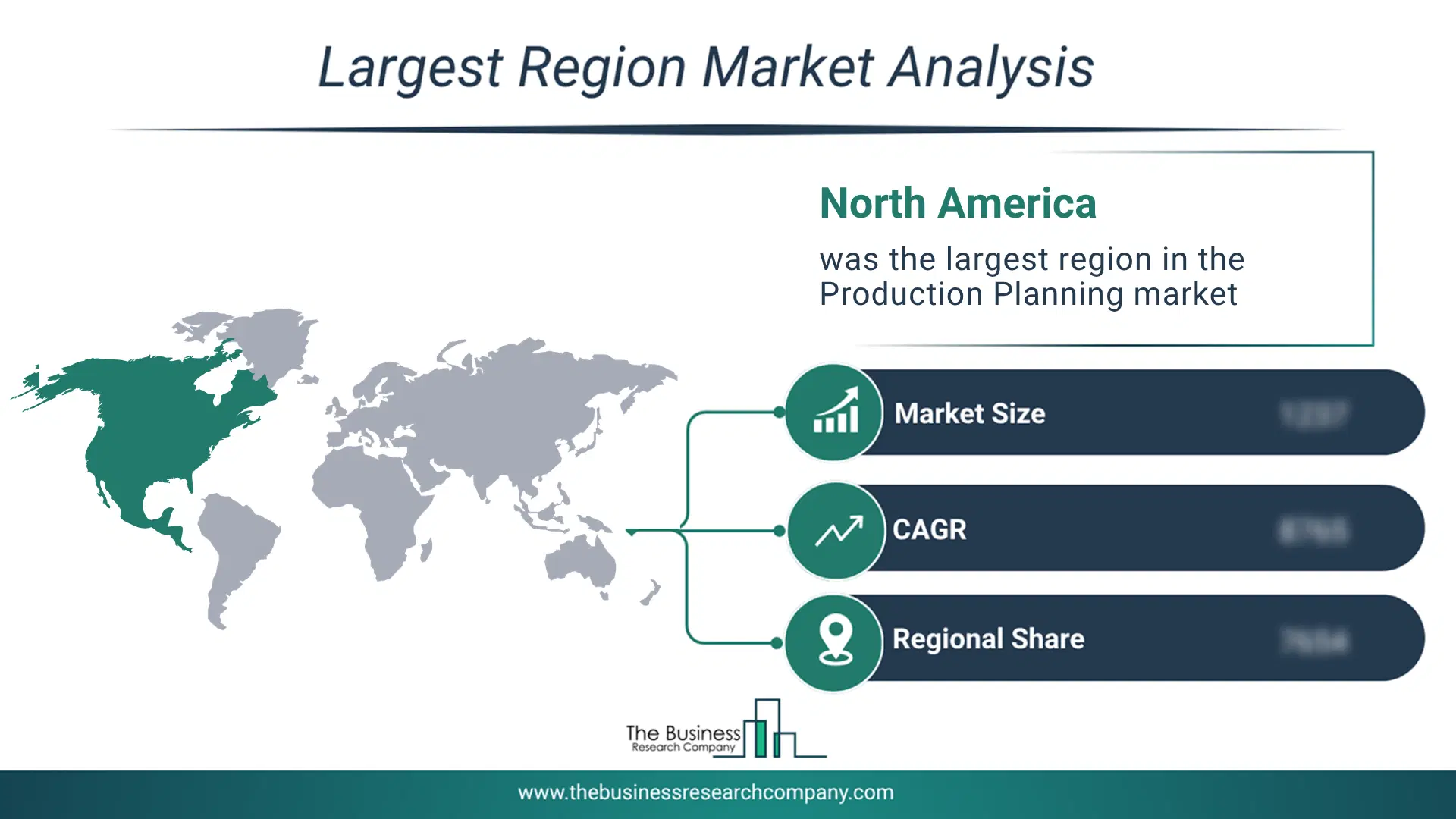
Regional Insights
North America was the largest region in the personalized genomics market in 2025. Asia-Pacific is expected to be the fastest-growing region in the forecast period. The regions covered in this market report are Asia-Pacific, South East Asia, Western Europe, Eastern Europe, North America, South America, Middle East, Africa. The countries covered in this market report are Australia, Brazil, China, France, Germany, India, Indonesia, Japan, Taiwan, Russia, South Korea, UK, USA, Canada, Italy, Spain.What Defines the Production Planning Market?
The production planning market consists of sales of enterprise resource planning (ERP) production modules, manufacturing software platforms, industrial automation planning tools, and supply chain planning systems. Values in this market are ‘factory gate’ values, that is, the value of goods sold by the manufacturers or creators of the goods, whether to other entities (including downstream manufacturers, wholesalers, distributors, and retailers) or directly to end customers. The value of goods in this market includes related services sold by the creators of the goods.How is Market Value Defined and Measured?
The market value is defined as the revenues that enterprises gain from the sale of goods and/or services within the specified market and geography through sales, grants, or donations in terms of the currency (in USD unless otherwise specified). The revenues for a specified geography are consumption values that are revenues generated by organizations in the specified geography within the market, irrespective of where they are produced. It does not include revenues from resales along the supply chain, either further along the supply chain or as part of other products.
This chart presents market attractiveness based on a quantitative evaluation of growth, competition, strategic alignment, and risk, offering a clear view of opportunity areas for decision-making. This chart is for illustrative purposes; the full report contains the complete analysis.

This chart highlights the Total Addressable Market (TAM) by estimating the maximum revenue opportunity using an assumption-driven approach, supporting strategic planning and opportunity sizing across markets. The chart is illustrative; the full report provides a more comprehensive analysis.
What Key Data and Analysis Are Included in the Production Planning Market Report 2026?
The production planning market research report is one of a series of new reports from The Business Research Company that provides market statistics, including industry global market size, regional shares, competitors with the market share, detailed market segments, market trends and opportunities, and any further data you may need to thrive in the production planning industry. The market research report delivers a complete perspective of everything you need, with an in-depth analysis of the current and future state of the industry.Production Planning Market Report Forecast Analysis
| Report Attribute | Details |
|---|---|
| Market Size Value In 2026 | $8.62 billion |
| Revenue Forecast In 2030 | $13.08 billion |
| Growth Rate | CAGR of 11% from 2026 to 2030 |
| Base Year For Estimation | 2025 |
| Actual Estimates/Historical Data | 2020-2025 |
| Forecast Period | 2026 - 2030 |
| Market Representation | Revenue in USD Billion and CAGR from 2026 to 2030 |
| Segments Covered | Product Type, Function Or Use Case, Deployment, Organization Size, Industry |
| Regional Scope | Asia-Pacific, Western Europe, Eastern Europe, North America, South America, Middle East, Africa |
| Country Scope | The Countries Covered In This Market Report Are Australia, Brazil, China, France, Germany, India, Indonesia, Japan, Taiwan, Russia, South Korea, Uk, Usa, Canada, Italy, Spain. |
| Key Companies Profiled | Microsoft Corporation, Oracle Corporation, SAP SE, RELEX Solutions, Dassault Systèmes SE, Infor Inc., Siemens AG, Blue Yonder Group, IFS AB, Odoo S.A., Epicor Software Corporation, Priority Software Ltd, Kinaxis Inc, QAD Inc, Plex Systems Inc, SYSPRO Ltd., Logility Inc., Rootstock Software Inc., PlanetTogether Inc, FlexSim Software Products Inc., Asprova Corporation |
| Customization Scope | Request for Customization |
| Pricing And Purchase Options | Explore Purchase Options |