
Radar Simulators Market Report 2026
Global Outlook – By Component (Hardware, Software), By Type (Marine, Airborne, Ground), By End Use Industry (Military, Commercial) – Market Size, Trends, Strategies, and Forecast to 2030
Radar Simulators Market Overview
• Radar Simulators market size has reached to $2.57 billion in 2025 • Expected to grow to $3.52 billion in 2030 at a compound annual growth rate (CAGR) of 6.5% • Growth Driver: Increasing Orders Of New Aircraft Fueling The Growth Of The Market Due To Rising Demand For Advanced Pilot Training And System Validation • Market Trend: Advanced Simulator Integrates Multi-Modal Sensor Technology • North America was the largest region in 2025 and Asia-Pacific is the fastest growing region.What Is Covered Under Radar Simulators Market?
Radar simulators are specialized systems designed to replicate the behavior and characteristics of radar signals and environments under controlled conditions. They simulate various radar scenarios, including signal characteristics, target movement, and environmental effects. The primary purpose is to evaluate radar system performance, train operators, and support the development of radar-based technologies in a controlled, cost-effective manner. The main components of radar simulators include hardware and software. Radar simulator hardware refers to the physical components used to replicate radar signals and environments for testing, training, or development purposes. These can be marine, airborne, and ground, and are used by different end-use industries, including military and commercial.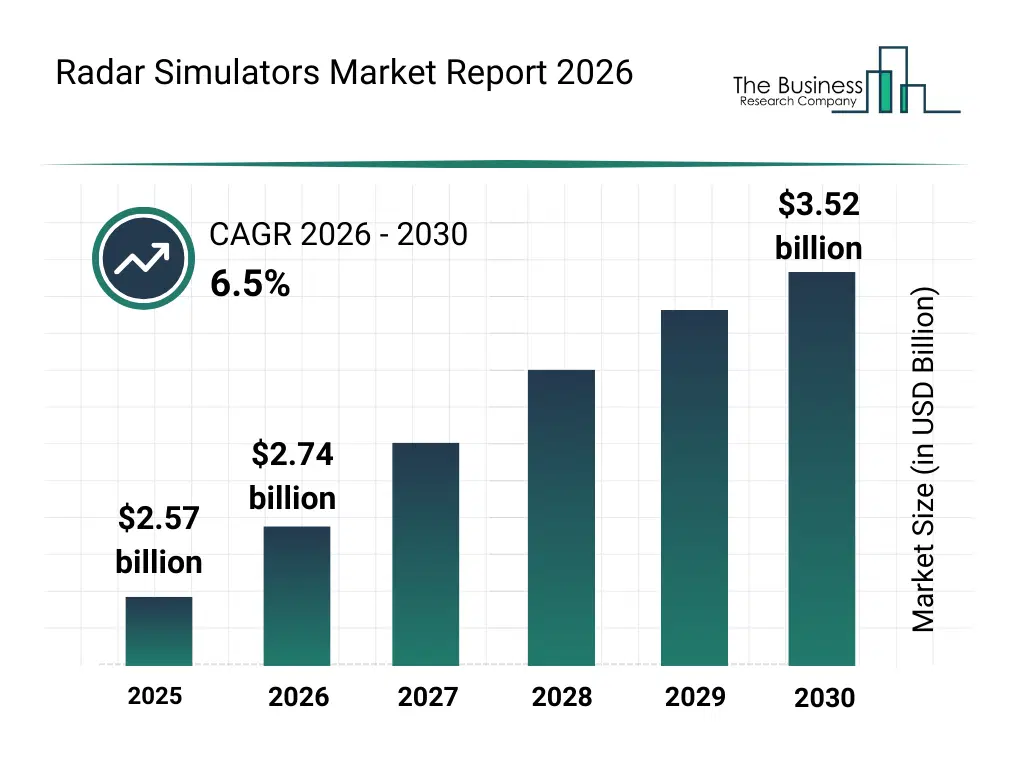
What Is The Radar Simulators Market Size and Share 2026?
The radar simulators market size has grown strongly in recent years. It will grow from $2.57 billion in 2025 to $2.74 billion in 2026 at a compound annual growth rate (CAGR) of 6.6%. The growth in the historic period can be attributed to growing adoption of radar simulators for cost-effective testing of radar systems, increasing demand for radar signal generation tools to support defense and aviation applications, early integration of antenna simulation systems for validating complex array designs, expansion of system integration services as radar technologies became more advanced, rising use of high-speed data acquisition cards for accurate radar scenario replication.What Is The Radar Simulators Market Growth Forecast?
The radar simulators market size is expected to see strong growth in the next few years. It will grow to $3.52 billion in 2030 at a compound annual growth rate (CAGR) of 6.5%. The growth in the forecast period can be attributed to increasing deployment of advanced radar simulators to support next-generation military and aerospace radar development, rising use of ai-driven scenario generation for enhanced operator training and system validation, growing demand for scalable antenna array emulators to test multi-sensor radar platforms, expansion of cloud-based radar simulation services enabling remote testing capabilities, technological advancements improving simulation fidelity for complex environmental and multi-target radar conditions. Major trends in the forecast period include growing adoption of advanced target and threat scenario emulation, increasing demand for cost-effective radar operator training solutions, expansion of multi-domain radar testing capabilities, rising integration of real-time environmental and terrain modeling, development of modular and scalable radar simulation platforms.
Global Radar Simulators Market Segmentation
1) By Component: Hardware, Software 2) By Type: Marine, Airborne, Ground 3) By End Use Industry: Military, Commercial Subsegments: 1) By Hardware: Radar Signal Generators, RF Front-End Modules, Antennas, Power Amplifiers, Signal Processors, Display Units, Control Panels, Data Acquisition Units, Interface Modules, Enclosures And Racks 2) By Software: Radar Signal Processing Software, Scenario Generation Software, Simulation Control Software, Real-Time Operating Systems, Environmental Modeling Software, Target Modeling Software, Threat Emulation Software, Visualization And Analysis Tools, Data Recording And Playback Software, Software Development Kits (SDKs)What Is Driver Of The Radar Simulators Market?
The increasing orders of new aircraft are expected to propel the growth of the radar simulators market going forward. An aircraft is a machine designed to fly through the air by gaining support from the atmosphere. The rise in new aircraft orders is driven by increasing global air travel demand, prompting airlines to expand and modernize their fleets to improve fuel efficiency and meet passenger growth. The rising orders of new aircraft enhance radar simulators by increasing demand for advanced pilot training and system validation tools. They support realistic simulation of modern avionics and radar systems, improving training efficiency and operational readiness. For instance, in December 2023, according to the International Air Transport Association, a Canada-based trade association, the number of aircraft delivered reached 1,372 in 2023, an increase from 1,238 in 2022. Therefore, the increasing orders of new aircraft are driving the growth of the radar simulators industry.Key Players In The Global Radar Simulators Market
Major companies operating in the radar simulators market are Raytheon Technologies Corporation, Lockheed Martin Corporation, Northrop Grumman Corporation, BAE Systems Plc, Thales Group, Leonardo S.p.A., L3Harris Technologies Inc., Elbit Systems Ltd., Keysight Technologies Inc., General Dynamics Corporation, Rohde & Schwarz GmbH & Co. KG, Mercury Systems Inc., Kratos Defense & Security Solutions Inc., Textron Systems, dSPACE India Solutions Private Limited, Plextek Services Limited, Adacel Technologies Limited, SkyRadar, Buffalo Computer Graphics Inc., NI Vehicle Radar Test System, Remcom Inc., Cambridge Pixel Limited, AceWavetech, MVRsimulation Inc.
This chart is for illustrative purposes; the full report includes a detailed competitor analysis and comprehensive overview of the top 10 companies in the market.
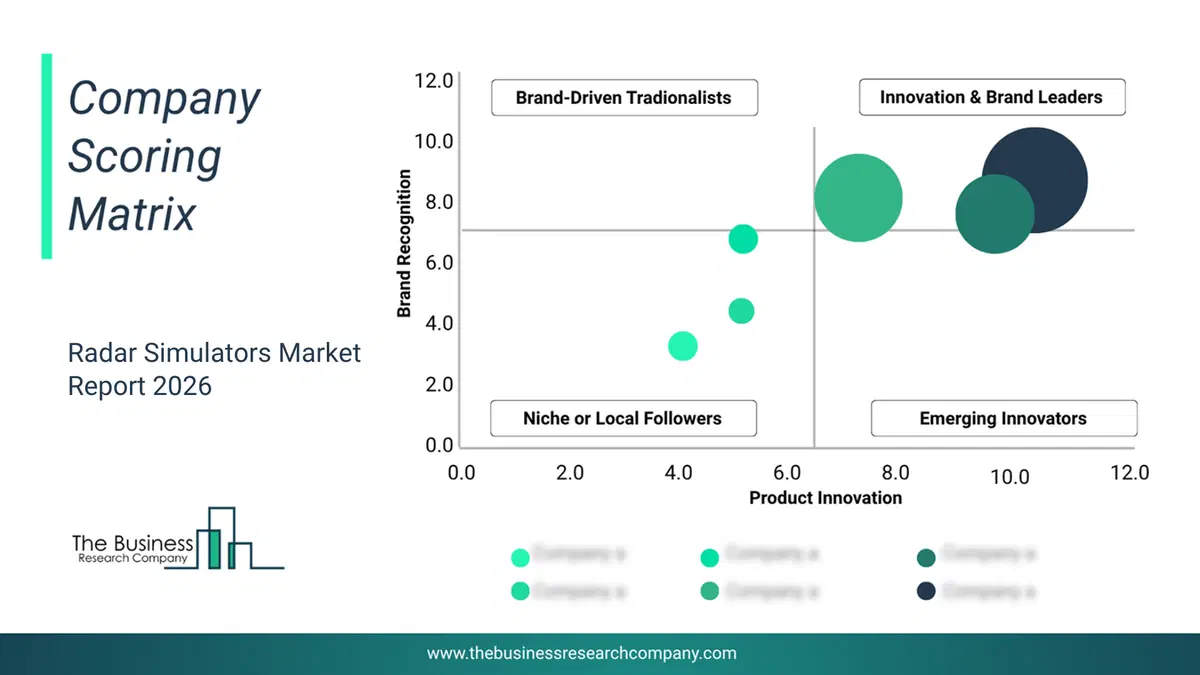
This chart maps companies by product innovation and brand strength, with bubble size indicating relative revenue, helping identify market leaders, challengers, and niche players. This is an illustrative chart; the full report provides a complete and accurate competitive analysis.
Global Radar Simulators Market Trends and Insights
Major companies operating in the radar simulators market are focusing on developing advanced solutions, such as multi-modal sensors, to deliver more realistic training environments. A multi-modal sensor is a device capable of simultaneously detecting and integrating data from different types of physical phenomena or modalities, such as visual, audio, thermal, or radar signals, to provide a more comprehensive and accurate understanding of the environment. For instance, in May 2025, LeddarTech Holdings Inc., a Canada-based technology company, launched LeddarSim, a simulation platform designed to accelerate the development and validation of advanced driver assistance systems and autonomous driving technologies. This advanced radar simulator uses AI-driven scenarios and threat libraries to replicate complex electromagnetic environments, boosting training realism and accelerating radar tech development for defense and aviation. Leddarsim enables flexible, high-fidelity simulation of driving scenarios and sensors, enhancing autonomous vehicle development and testing.What Are Latest Mergers And Acquisitions In The Radar Simulators Market? Aechelon Expands Capabilities With Compro Division Acquisition
In December 2024, Aechelon Technology Inc., a US-based simulation technology company, acquired the radar simulation division from Compro Computer Services for an undisclosed amount. With this acquisition, Aechelon aims to expand its radar simulation capabilities by incorporating additional expertise and resources while preserving the existing team, facilities, and infrastructure to ensure a smooth transition. Compro Computer Services is a US-based software engineering company specializing in radar simulation and real-time systems.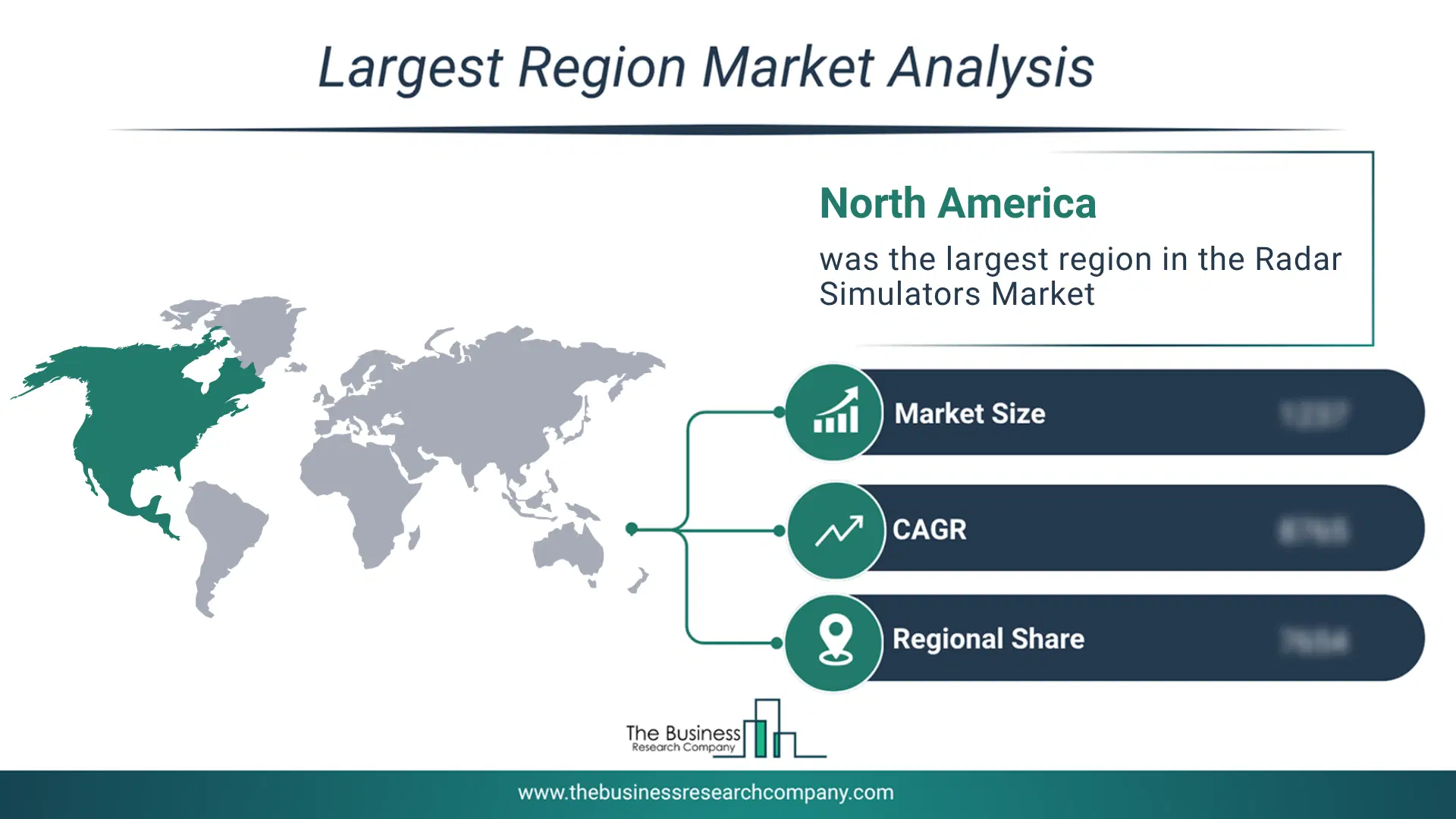
Regional Insights
North America was the largest region in the radar simulators market in 2025. Asia-Pacific is expected to be the fastest-growing region in the forecast period. The regions covered in this market report are Asia-Pacific, South East Asia, Western Europe, Eastern Europe, North America, South America, Middle East, Africa. The countries covered in this market report are Australia, Brazil, China, France, Germany, India, Indonesia, Japan, Taiwan, Russia, South Korea, UK, USA, Canada, Italy, SpainWhat Defines the Radar Simulators Market?
The radar simulators market consists of revenues earned by entities by providing services such as system integration, radar signal generation, support services, and validation services. The market value includes the value of related goods sold by the service provider or included within the service offering. The radar simulators market also includes sales of radar signal generators, antenna simulation systems, antenna array emulators, and high-speed data acquisition cards. Values in this market are ‘factory gate’ values, that is the value of goods sold by the manufacturers or creators of the goods, whether to other entities (including downstream manufacturers, wholesalers, distributors and retailers) or directly to end customers. The value of goods in this market includes related services sold by the creators of the goods.How is Market Value Defined and Measured?
The market value is defined as the revenues that enterprises gain from the sale of goods and/or services within the specified market and geography through sales, grants, or donations in terms of the currency (in USD unless otherwise specified). The revenues for a specified geography are consumption values that are revenues generated by organizations in the specified geography within the market, irrespective of where they are produced. It does not include revenues from resales along the supply chain, either further along the supply chain or as part of other products.
This chart presents market attractiveness based on a quantitative evaluation of growth, competition, strategic alignment, and risk, offering a clear view of opportunity areas for decision-making. This chart is for illustrative purposes; the full report contains the complete analysis.

This chart highlights the Total Addressable Market (TAM) by estimating the maximum revenue opportunity using an assumption-driven approach, supporting strategic planning and opportunity sizing across markets. The chart is illustrative; the full report provides a more comprehensive analysis.
What Key Data and Analysis Are Included in the Radar Simulators Market Report 2026?
The radar simulators market research report is one of a series of new reports from The Business Research Company that provides market statistics, including industry global market size, regional shares, competitors with the market share, detailed market segments, market trends and opportunities, and any further data you may need to thrive in the radar simulators industry. The market research report delivers a complete perspective of everything you need, with an in-depth analysis of the current and future state of the industry.Radar Simulators Market Report Forecast Analysis
| Report Attribute | Details |
|---|---|
| Market Size Value In 2026 | $2.74 billion |
| Revenue Forecast In 2030 | $3.52 billion |
| Growth Rate | CAGR of 6.5% from 2026 to 2030 |
| Base Year For Estimation | 2025 |
| Actual Estimates/Historical Data | 2020-2025 |
| Forecast Period | 2026 - 2030 |
| Market Representation | Revenue in USD Billion and CAGR from 2026 to 2030 |
| Segments Covered | Component, Type, End Use Industry |
| Regional Scope | Asia-Pacific, Western Europe, Eastern Europe, North America, South America, Middle East, Africa |
| Country Scope | The countries covered in the radar simulators market report are Australia, Brazil, China, France, Germany, India, Indonesia, Japan, Taiwan, Russia, South Korea, UK, USA, Canada, Italy, Spain |
| Key Companies Profiled | Raytheon Technologies Corporation, Lockheed Martin Corporation, Northrop Grumman Corporation, BAE Systems Plc, Thales Group, Leonardo S.p.A., L3Harris Technologies Inc., Elbit Systems Ltd., Keysight Technologies Inc., General Dynamics Corporation, Rohde & Schwarz GmbH & Co. KG, Mercury Systems Inc., Kratos Defense & Security Solutions Inc., Textron Systems, dSPACE India Solutions Private Limited, Plextek Services Limited, Adacel Technologies Limited, SkyRadar, Buffalo Computer Graphics Inc., NI Vehicle Radar Test System, Remcom Inc., Cambridge Pixel Limited, AceWavetech, MVRsimulation Inc. |
| Customization Scope | Request for Customization |
| Pricing And Purchase Options | Explore Purchase Options |