

Respiratory Inhaler Devices Market Report 2026
Global Outlook – By Product (Dry Powder Inhalers, Metered Dose Inhalers, Nebulizers), By Technology (Manually Operated Inhaler Devices, Digitally Operated Inhaler Devices), By Disease Indication (Asthma, Chronic Obstructive Pulmonary Disease, Pulmonary Arterial Hypertension, Other Indications), By End User (Hospitals And Clinics, Respiratory Care Centers, Other End Users) – Market Size, Trends, Strategies, and Forecast to 2030
Respiratory Inhaler Devices Market Overview
• Respiratory Inhaler Devices market size has reached to $43.98 billion in 2025 • Expected to grow to $64.74 billion in 2030 at a compound annual growth rate (CAGR) of 8.3% • Growth Driver: Rising Prevalence Of Respiratory Diseases Drives Growth Of Respiratory Inhaler Devices Market • Market Trend: Expanding Connected Respiratory Care Through Smart Sensor-Enabled Inhaler Technologies • North America was the largest region in 2025 and Asia-Pacific is the fastest growing region.What Is Covered Under Respiratory Inhaler Devices Market?
Respiratory inhaler devices refer to small, handheld devices that deliver medication directly to the lungs. They are designed to deliver medication directly to the respiratory system, targeting the lungs and minimizing the systemic effects of the drugs providing quick relief during attacks or exacerbations. The main products of respiratory inhaler devices are dry powder inhalers, metered dose inhalers and nebulizers. Dry powder inhalers (DPIs) are medical devices that deliver powdered medications directly to the lungs for respiratory conditions. The technologies involved include manually operated inhaler devices and digitally operated inhaler devices for the treatment of asthma, chronic obstructive pulmonary disease, pulmonary arterial hypertension and others. The end user are hospitals and clinics, respiratory care centers and others.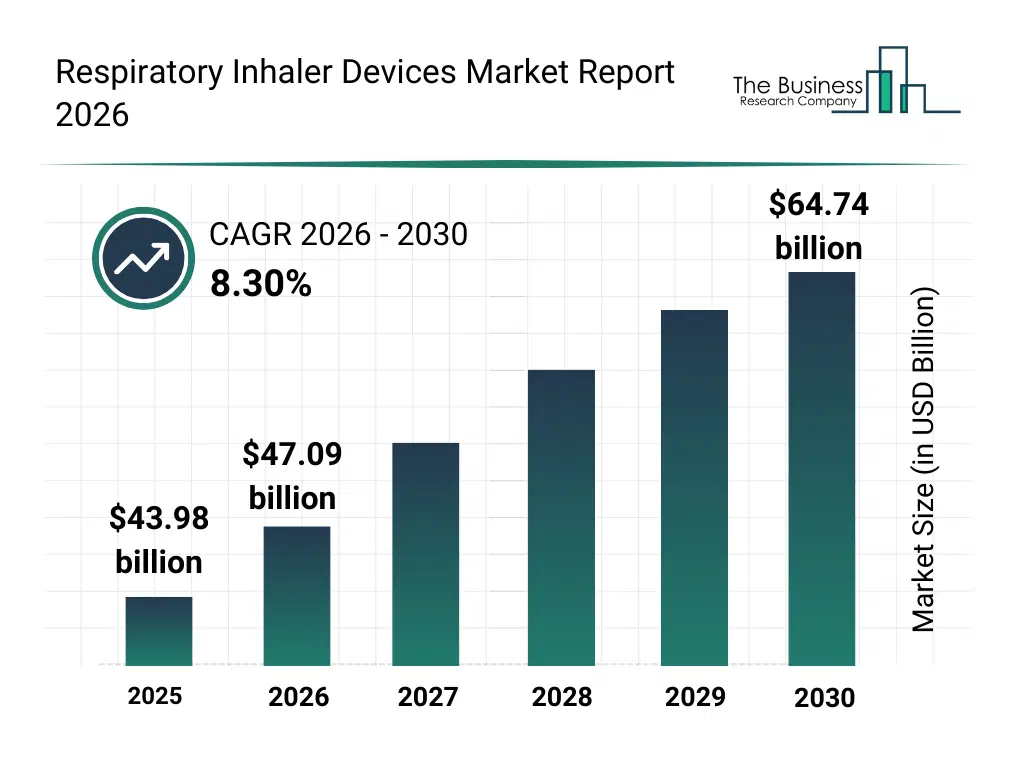
What Is The Respiratory Inhaler Devices Market Size and Share 2026?
The respiratory inhaler devices market size has grown strongly in recent years. It will grow from $43.98 billion in 2025 to $47.09 billion in 2026 at a compound annual growth rate (CAGR) of 7.1%. The growth in the historic period can be attributed to rising prevalence of asthma and copd worldwide, increasing use of inhaler devices for acute symptom relief and maintenance therapy, early availability of cfc-based and hfa-based mdi platforms, expansion of respiratory care services in hospitals and clinics, growing awareness of targeted pulmonary drug delivery.What Is The Respiratory Inhaler Devices Market Growth Forecast?
The respiratory inhaler devices market size is expected to see strong growth in the next few years. It will grow to $64.74 billion in 2030 at a compound annual growth rate (CAGR) of 8.3%. The growth in the forecast period can be attributed to rising demand for digitally operated and smart inhaler devices, increasing utilization of mesh and ultrasonic nebulizers, growing treatment volumes in chronic respiratory disease populations, expanding access to inhaler therapy in emerging healthcare markets, rising focus on improving medication adherence and therapeutic outcomes. Major trends in the forecast period include rising adoption of inhaler devices for rapid drug delivery to the lungs, increasing utilization of metered dose inhalers dry powder inhalers and nebulizers across chronic respiratory disorders, growing preference for portable and patient-friendly respiratory inhaler solutions, expansion of inhaler use in asthma copd and pulmonary arterial hypertension management, increasing deployment of respiratory inhalers across hospitals clinics and respiratory care centers.
Global Respiratory Inhaler Devices Market Segmentation
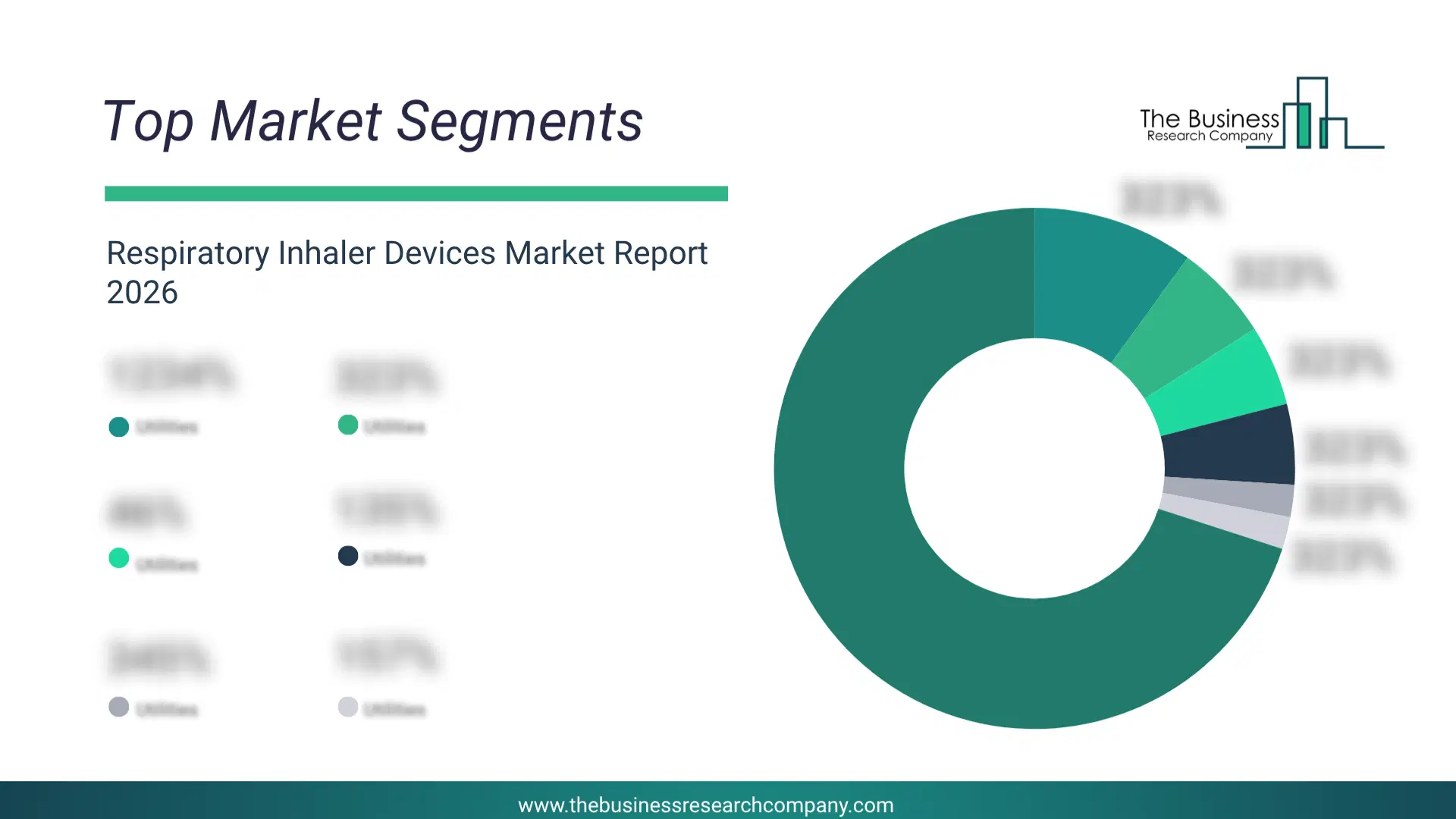
1) By Product: Dry Powder Inhalers, Metered Dose Inhalers, Nebulizers 2) By Technology: Manually Operated Inhaler Devices, Digitally Operated Inhaler Devices 3) By Disease Indication: Asthma, Chronic Obstructive Pulmonary Disease, Pulmonary Arterial Hypertension, Other Indications 4) By End User: Hospitals And Clinics, Respiratory Care Centers, Other End Users Subsegments: 1) By Dry Powder Inhalers: Single-Dose Inhalers, Multi-Dose Inhalers 2) By Metered Dose Inhalers: CFC-Based MDIs, HFA-Based MDIs 3) By Nebulizers: Jet Nebulizers, Ultrasonic Nebulizers, Mesh NebulizersWhat Is The Driver Of The Respiratory Inhaler Devices Market?
The growing prevalence of respiratory diseases is expected to propel the growth of the respiratory inhaler devices market going forward. Respiratory diseases are disorders that affect the lungs and the respiratory system, leading to breathing difficulties and impaired lung function. Respiratory inhaler devices are used to deliver medications directly to the lungs, providing fast and targeted relief for respiratory diseases such as asthma, chronic obstructive pulmonary disease (COPD), respiratory syncytial virus infection and other respiratory conditions. For instance, in November 2024, according to the U.S. Centers for Disease Control and Prevention, a US-based government agency, the prevalence of respiratory diseases has risen to 25 million in 2024, up from 22 million in 2022, reflecting an increasing need for respiratory inhaler devices that deliver medications directly to the lungs for fast and targeted relief. Therefore, the growing prevalence of respiratory diseases propels the growth of the respiratory inhaler devices industry.Key Players In The Global Respiratory Inhaler Devices Market
Major companies operating in the respiratory inhaler devices market are Novartis AG, AstraZeneca plc, Gerresheimer AG, GlaxoSmithKline plc, 3M, Boehringer Ingelheim International GmbH, Koninklijke Philips N.V., Teva Pharmaceutical Industries Ltd., Catalent Inc., AptarGroup Inc., Recipharm AB, Chiesi Farmaceutici S.p.A., Cipla Limited, Hikma Pharmaceuticals plc, Zydus Lifesciences Limited, Lupin Limited, Glenmark Pharmaceuticals Ltd., Hovione Limited, Vectura Group Limited, H&T Presspart Manufacturing Ltd., Pari Medical Holding GmbH, OMRON Healthcare Europe B.V., Medisol Lifescience Pvt. Ltd., Consort Medical plc
This chart is for illustrative purposes; the full report includes a detailed competitor analysis and comprehensive overview of the top 10 companies in the market.
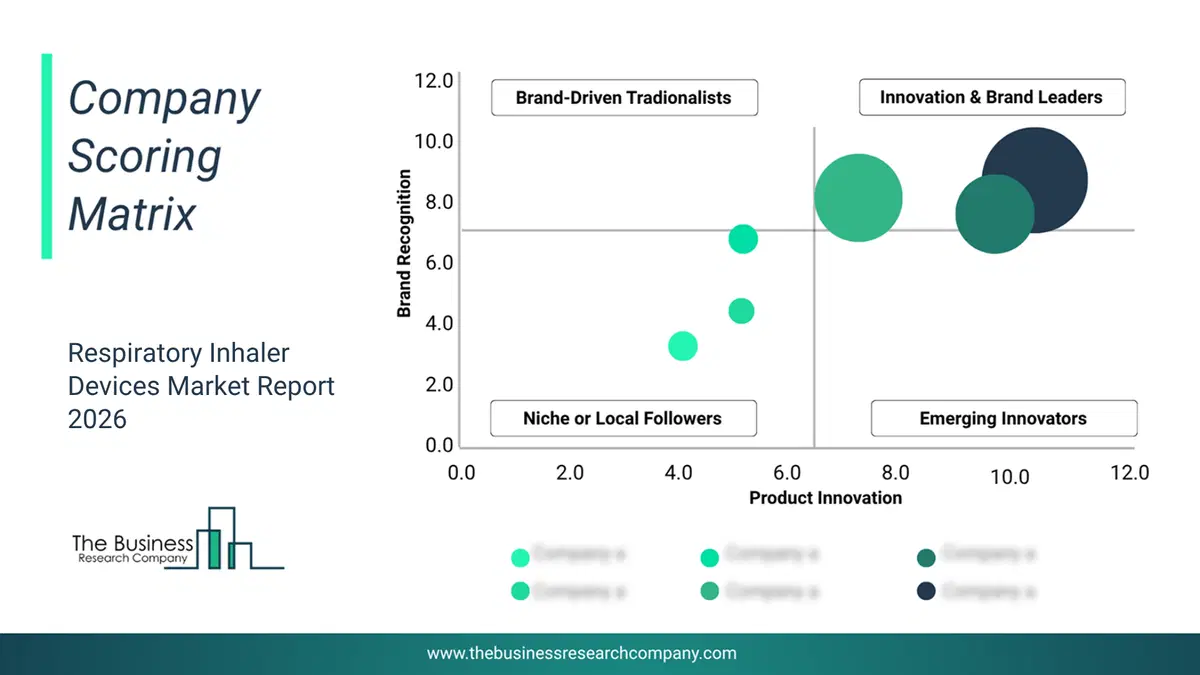
This chart maps companies by product innovation and brand strength, with bubble size indicating relative revenue, helping identify market leaders, challengers, and niche players. This is an illustrative chart; the full report provides a complete and accurate competitive analysis.
Global Respiratory Inhaler Devices Market Trends and Insights
Major companies operating in the respiratory inhaler devices market are adopting new technologies, such as smart sensors and connected inhaler systems, to sustain their position in the market. A smart inhaler sensor system is a device that attaches to a conventional inhaler and uses Bluetooth connectivity and cloud analytics to automatically log dose usage, inhalation technique, and patient adherence, enabling remote monitoring and data-driven therapy optimisation. For instance, in April 2024, Adherium Limited, an Australia-based digital respiratory health technology company, announced that its Hailie Smartinhaler received U.S. FDA clearance for compatibility with AstraZeneca’s Airsupra and Breztri inhalation devices. This regulatory milestone expands Adherium’s smart sensor coverage to key asthma rescue and COPD triple-therapy products in the U.S., enabling healthcare providers to access real-time insights into patient inhaler use patterns and improve adherence-driven outcomes.What Are Latest Mergers And Acquisitions In The Respiratory Inhaler Devices Market?
In October 2024, Aptar Pharma, a US-based drug-delivery systems and device solutions company, acquired select device-technology assets of SipNose for an undisclosed amount. The acquisition aims to strengthen Aptar Pharma’s respiratory and nasal delivery device portfolio by integrating SipNose’s proprietary intranasal delivery technologies and accelerating innovation in inhalation and nasal-device development. SipNose is an Israel-based technology company specializing in advanced nose-to-brain and intranasal drug-delivery devices.
Regional Outlook
North America was the largest region in the respiratory inhaler devices market in 2025. Asia-Pacific is expected to be the fastest-growing region in the forecast period. The regions covered in this market report are Asia-Pacific, South East Asia, Western Europe, Eastern Europe, North America, South America, Middle East, Africa. The countries covered in this market report are Australia, Brazil, China, France, Germany, India, Indonesia, Japan, Taiwan, Russia, South Korea, UK, USA, Canada, Italy, SpainWhat Defines the Respiratory Inhaler Devices Market?
The respiratory inhaler devices market consists of revenues earned by entities by providing services such as the management of chronic lung diseases and minimizing systemic effects of the drugs. The market value includes the value of related goods sold by the service provider or included within the service offering. The respiratory inhaler devices market also includes sales of compressed air nebulizers, ultrasonic nebulizers and mesh nebulizers. Values in this market are ‘factory gate’ values, that is the value of goods sold by the manufacturers or creators of the goods, whether to other entities (including downstream manufacturers, wholesalers, distributors and retailers) or directly to end customers. The value of goods in this market includes related services sold by the creators of the goods.How is Market Value Defined and Measured?
The market value is defined as the revenues that enterprises gain from the sale of goods and/or services within the specified market and geography through sales, grants, or donations in terms of the currency (in USD unless otherwise specified). The revenues for a specified geography are consumption values that are revenues generated by organizations in the specified geography within the market, irrespective of where they are produced. It does not include revenues from resales along the supply chain, either further along the supply chain or as part of other products.
This chart presents market attractiveness based on a quantitative evaluation of growth, competition, strategic alignment, and risk, offering a clear view of opportunity areas for decision-making. This chart is for illustrative purposes; the full report contains the complete analysis.

This chart highlights the Total Addressable Market (TAM) by estimating the maximum revenue opportunity using an assumption-driven approach, supporting strategic planning and opportunity sizing across markets. The chart is illustrative; the full report provides a more comprehensive analysis.
What Key Data and Analysis Are Included in the Respiratory Inhaler Devices Market Report 2026?
The respiratory inhaler devices market research report is one of a series of new reports from The Business Research Company that provides market statistics, including industry global market size, regional shares, competitors with the market share, detailed market segments, market trends and opportunities, and any further data you may need to thrive in the respiratory inhaler devices industry. The market research report delivers a complete perspective of everything you need, with an in-depth analysis of the current and future state of the industry.Respiratory Inhaler Devices Market Report Forecast Analysis
| Report Attribute | Details |
|---|---|
| Market Size Value In 2026 | $47.09 billion |
| Revenue Forecast In 2030 | $64.74 billion |
| Growth Rate | CAGR of 8.3% from 2026 to 2030 |
| Base Year For Estimation | 2025 |
| Actual Estimates/Historical Data | 2020-2025 |
| Forecast Period | 2026 - 2030 |
| Market Representation | Revenue in USD Billion and CAGR from 2026 to 2030 |
| Segments Covered | Product, Technology, Disease Indication, End User |
| Regional Scope | Asia-Pacific, Western Europe, Eastern Europe, North America, South America, Middle East, Africa |
| Country Scope | The countries covered in the report are Australia, Brazil, China, France, Germany, India, Indonesia, Japan, Taiwan, Russia, South Korea, UK, USA, Canada, Italy, Spain. |
| Key Companies Profiled | Novartis AG, AstraZeneca plc, Gerresheimer AG, GlaxoSmithKline plc, 3M, Boehringer Ingelheim International GmbH, Koninklijke Philips N.V., Teva Pharmaceutical Industries Ltd., Catalent Inc., AptarGroup Inc., Recipharm AB, Chiesi Farmaceutici S.p.A., Cipla Limited, Hikma Pharmaceuticals plc, Zydus Lifesciences Limited, Lupin Limited, Glenmark Pharmaceuticals Ltd., Hovione Limited, Vectura Group Limited, H&T Presspart Manufacturing Ltd., Pari Medical Holding GmbH, OMRON Healthcare Europe B.V., Medisol Lifescience Pvt. Ltd., Consort Medical plc |
| Customization Scope | Request for Customization |
| Pricing And Purchase Options | Explore Purchase Options |