
Robot Cars And Trucks Market Report 2026
Global Outlook – By Vehicle Type (Heavy Commercial Vehicles, Light Commercial Vehicles, Passenger Vehicles), By Classification (Level 0, Level 1, Level 2, Level 3, Level 4, Level 5), By Technology (Simultaneous Localization And Mapping, Real-Time Locating System), By Application (Domestic, Commercial, Industrial) – Market Size, Trends, Strategies, and Forecast to 2030
Robot Cars And Trucks Market Overview
• Robot Cars And Trucks market size has reached to $0.97 billion in 2025 • Expected to grow to $1.56 billion in 2030 at a compound annual growth rate (CAGR) of 10.6% • Growth Driver: Impact of Rising Road Accidents on the Robot Cars and Trucks Market • Market Trend: Autonomous Driving Technologies Transforming the Robot Cars and Trucks Market • Asia-Pacific was the largest region in 2025.Market Gains By 2030 – Top Opportunities By Segment
Market Gain identifies the most promising market opportunities by highlighting the segments or products expected to generate the highest incremental revenue growth over the next five years.
What Is Covered Under Robot Cars And Trucks Market?
Robot cars and trucks refer to autonomous or self-driving vehicles, equipped with advanced sensors, cameras, and AI technology to navigate and operate without human intervention. They aim to enhance safety, reduce traffic congestion, and improve fuel efficiency. These vehicles have the potential to transform logistics and public transportation by enabling more efficient and reliable movement of goods and people. The main types of vehicles in the robot cars and trucks are heavy commercial vehicles, light commercial vehicles, and passenger vehicles. Heavy commercial vehicles refer to large trucks and buses designed primarily for transporting goods or passengers over long distances or for heavy-duty applications. They are classified as level 0, level 1, level 2, level 3, level 4, and level 5. The various technologies include simultaneous localization and mapping and real-time locating system. These vehicles find applications across domestic, commercial, and industrial sectors.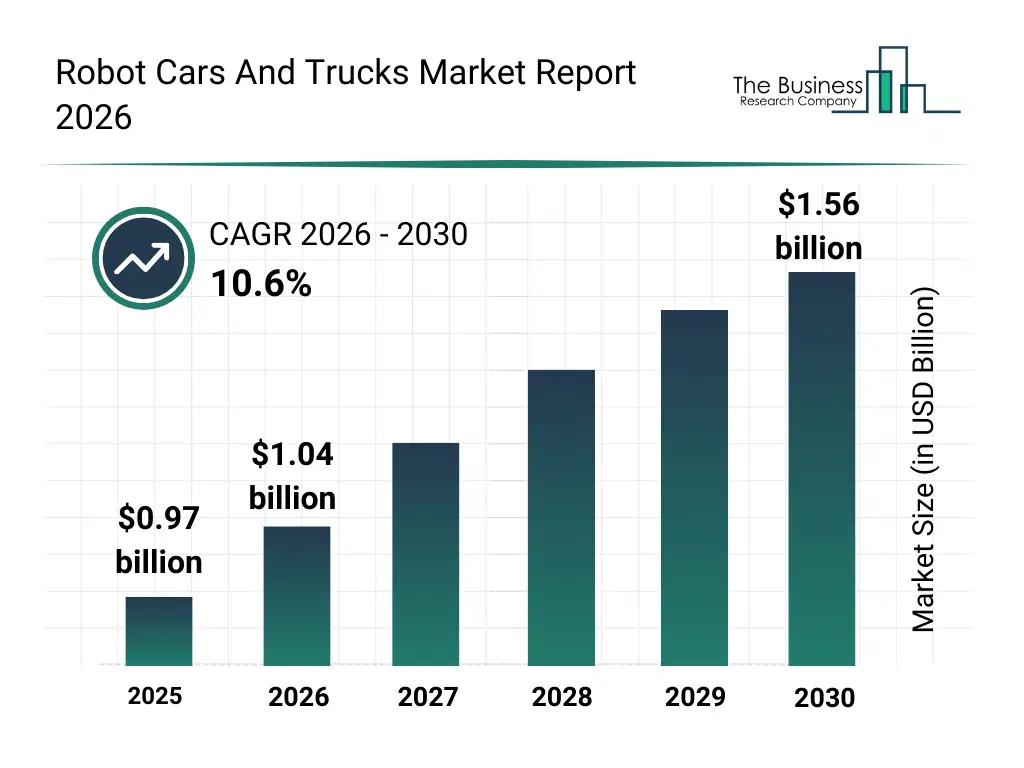
What Is The Robot Cars And Trucks Market Size and Share 2026?
The robot cars and trucks market size has grown strongly in recent years. It will grow from $0.97 billion in 2025 to $1.04 billion in 2026 at a compound annual growth rate (CAGR) of 7.5%. The growth in the historic period can be attributed to advancements in autonomous driving algorithms, expansion of pilot autonomous vehicle programs, increasing investments in smart transportation infrastructure, growth of logistics automation initiatives, availability of advanced sensing technologies.What Is The Robot Cars And Trucks Market Growth Forecast?
The robot cars and trucks market size is expected to see rapid growth in the next few years. It will grow to $1.56 billion in 2030 at a compound annual growth rate (CAGR) of 10.6%. The growth in the forecast period can be attributed to increasing commercialization of level 4 and level 5 vehicles, rising demand for autonomous logistics solutions, expansion of connected road infrastructure, growing focus on zero-emission autonomous fleets, increasing regulatory support for autonomous mobility. Major trends in the forecast period include increasing deployment of fully autonomous freight vehicles, rising adoption of advanced sensor fusion systems, growing integration of ai-based navigation platforms, expansion of autonomous logistics operations, enhanced focus on vehicle safety and redundancy.
Global Robot Cars And Trucks Market Segmentation
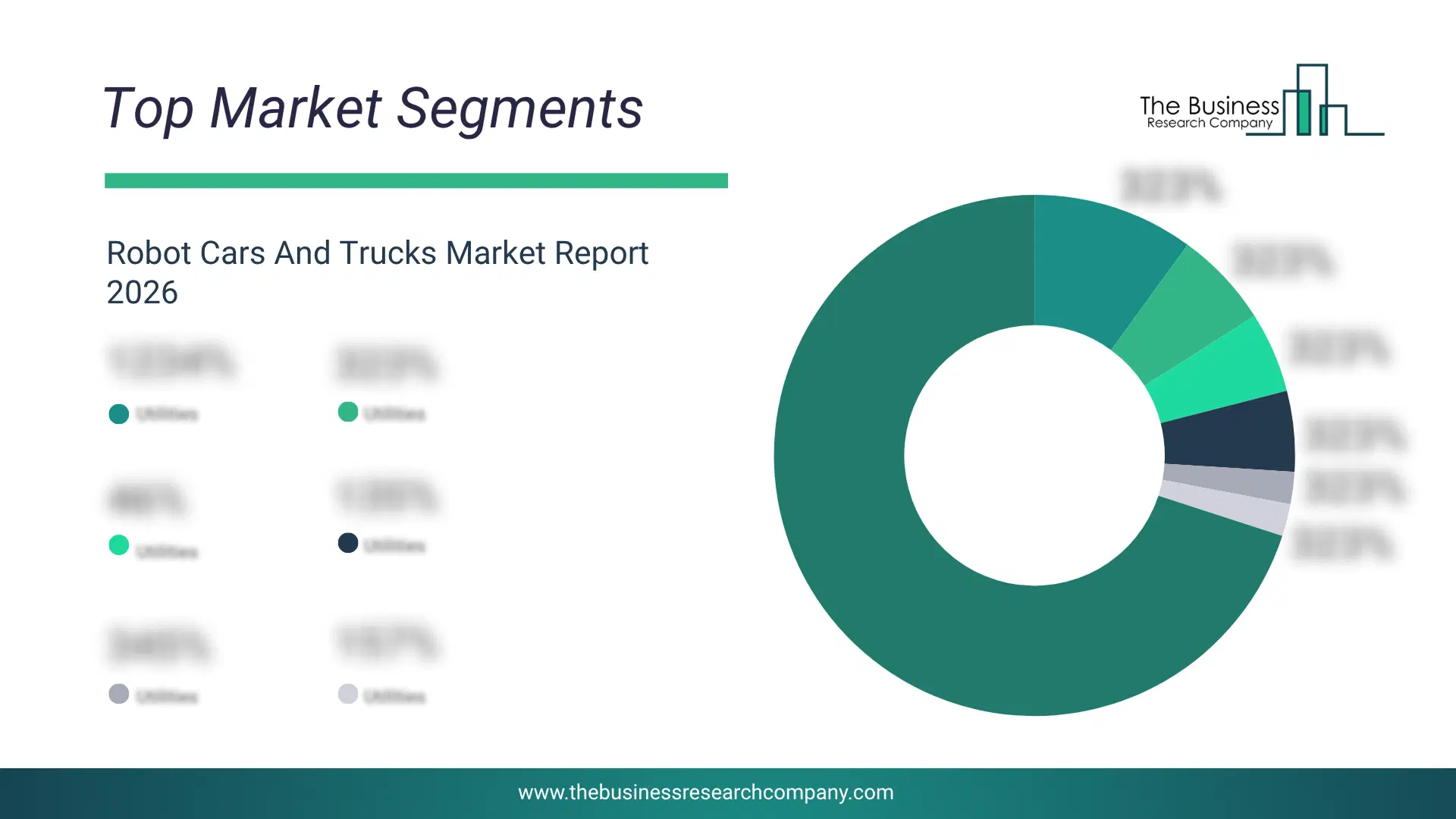
1) By Vehicle Type: Heavy Commercial Vehicles, Light Commercial Vehicles, Passenger Vehicles 2) By Classification: Level 0, Level 1, Level 2, Level 3, Level 4, Level 5 3) By Technology: Simultaneous Localization And Mapping, Real-Time Locating System 4) By Application: Domestic, Commercial, Industrial Subsegments: 1) By Heavy Commercial Vehicles: Autonomous Trucks, Delivery Trucks, Freight Hauling Trucks, Long-Haul Trucks 2) By Light Commercial Vehicles: Autonomous Delivery Vans, Light-Duty Electric Vans, Autonomous Pick-up Trucks 3) By Passenger Vehicles: Autonomous Sedans, Autonomous SUVs, Autonomous Electric Vehicles (EVs), Autonomous Ride-Hailing Cars The top segments in the robot cars and trucks market will be: • Passenger Vehicles will reach $0.73 Billion by 2030. • Heavy Commercial Vehicles will reach $0.46 Billion by 2030. • Light Commercial Vehicles will reach $0.35 Billion by 2030.What Is The Driver Of The Robot Cars And Trucks Market?
The rising number of road accidents is expected to propel the growth of the robot car and truck market going forward. Road accidents occur due to speeding, distracted driving, impaired driving, poor road conditions, and inadequate enforcement of traffic laws. Autonomous cars and trucks help reduce accidents by leveraging advanced sensors and real-time decision-making capabilities and eliminating human error, ultimately enhancing road safety through consistent adherence to traffic laws and predictive analytics. For instance, in July 2025, according to the Italian National Institute of Statistics, an Italy-based public research organization’s platform published that Italy reported 173,364 injury-involved road accidents in 2024, up 4.1% from 2023. Therefore, the rising number of road accidents drives the growth of the robot cars and trucks industry.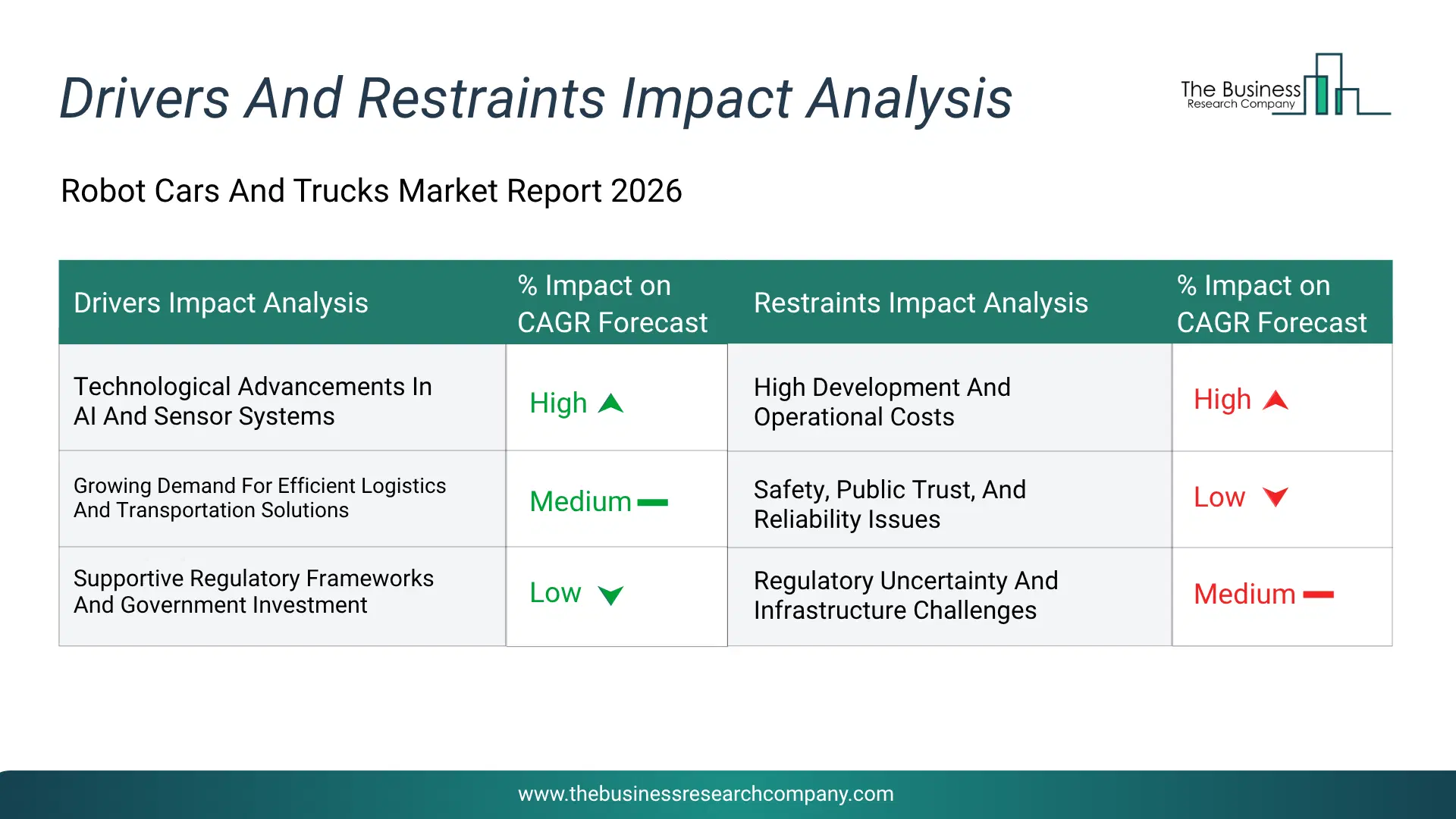
Infographic Chart Showing Key Market Drivers Analysis And Restraints For Robot Cars And Trucks Market
The chart presents an impact analysis of key drivers and restraints, quantifying their relative influence on the market's growth rate and helping assess the balance between growth enablers and limiting factors. This chart offers a high-level perspective; the full report contains more detailed insights.
How Will The Drivers Impact Growth In The Global Robot Cars And Trucks Market?
• Technological Advancements In AI And Sensor Systems (High) – During the forecast period, technological advancements in AI and sensor systems are expected to become a key growth driver for the robot cars and trucks market by 2030. Continuous improvements in machine learning algorithms, computer vision, LiDAR, radar, and sensor fusion technologies are enabling higher levels of driving autonomy and real-time decision-making capabilities. These advancements enhance vehicle perception, object detection accuracy, and navigation efficiency across diverse and complex environments. Automotive and technology companies are increasingly investing in scalable autonomous platforms that can operate reliably under varying road and weather conditions. This ongoing innovation in AI-driven systems is strengthening the technical foundation required for autonomous mobility. • Growing Demand For Efficient Logistics And Transportation Solutions (Medium) – During the forecast period, the growing demand for efficient logistics and transportation solutions is expected to emerge as a major factor driving the expansion of the robot cars and trucks market by 2030. Increasing pressure on supply chains to reduce delivery times, optimize route planning, and lower operational inefficiencies is accelerating the adoption of autonomous trucks and delivery vehicles. Businesses are focusing on improving asset utilization and minimizing human intervention in repetitive transportation tasks, particularly in long-haul and last-mile delivery operations. Autonomous vehicle integration is enabling more predictable and continuous operations, supporting evolving logistics requirements. • Supportive Regulatory Frameworks And Government Investment (Low) – During the forecast period, supportive regulatory frameworks and government investment are expected to act as a key growth catalyst for the robot cars and trucks market by 2030. Governments across major economies are establishing pilot programs, safety standards, and testing corridors to facilitate the controlled deployment of autonomous vehicles. Public investments in smart infrastructure, digital connectivity, and intelligent traffic management systems are creating a conducive environment for autonomous mobility solutions. Additionally, collaborations between regulatory bodies and industry stakeholders are accelerating the development of standardized protocols for autonomous operations. As regulatory clarity improves, industry confidence and adoption rates are expected to strengthen.How Will The Restraints Impact Growth In The Global Robot Cars And Trucks Market?
• High Development And Operational Costs (High) – During the forecast period, high development and operational costs act as a significant restraint on the robot cars and trucks market because the integration of advanced AI systems, sensors, and computing hardware demands substantial investment from manufacturers and fleet operators. These high upfront expenses make autonomous vehicles less affordable, particularly for small and medium‑sized companies and consumers, slowing widespread adoption. The complexity of research, testing, and validation adds further financial pressure, making it difficult for new market entrants and limiting competition. Additionally, costs related to maintenance, insurance, and retrofitting existing fleets with autonomous technologies also burden potential buyers and operators. As a result, cost concerns reduce the willingness of businesses to transition rapidly to self‑driving solutions. This restraint is particularly pronounced in emerging regions where financial resources and infrastructure investments are lower. Consequently, high expenditures on development, deployment, and long‑term operational costs impede the overall growth of the market. • Safety, Public Trust, And Reliability Issues (Medium) – During the forecast period, safety, public trust, and reliability issues act as a major restraint on the robot cars and trucks market because many consumers and stakeholders remain skeptical about the ability of autonomous systems to handle complex, real‑world driving situations safely. Incidents involving self‑driving vehicles, even if rare, receive significant media attention and can erode confidence in the technology’s readiness for widespread deployment. Users worry about system failures, software glitches, and the vehicles’ ability to correctly respond during unpredictable events where human judgment has traditionally been crucial. These concerns make potential buyers hesitant to invest in or rely on autonomous vehicles for passenger and freight transport. Moreover, the need for continuous human oversight in many current autonomous systems highlights ongoing challenges in achieving fully reliable, driverless operation. This lack of trust and perceived safety risk slows consumer adoption and challenges manufacturers in marketing autonomous solutions. • Regulatory Uncertainty And Infrastructure Challenges (Low) – During the forecast period, regulatory uncertainty and infrastructure challenges act as restraints on the robot cars and trucks market because inconsistent laws, fragmented safety standards, and inadequate road infrastructure create barriers for testing and large‑scale deployment. Autonomous vehicles operate best with harmonized regulatory frameworks that clearly define liability, safety requirements, and operational guidelines, yet many regions have not fully established or aligned such regulations. This lack of legal clarity makes it difficult for manufacturers to scale operations across borders and discourages investment. In addition, many existing road networks lack the digital infrastructure—such as vehicle‑to‑infrastructure communication and well‑marked lanes—necessary to support autonomous navigation reliably. Without robust infrastructure and supportive regulatory environments, autonomous vehicles face operational limitations that can slow adoption and inhibit broader integration into transportation systems.Key Players In The Global Robot Cars And Trucks Market
Major companies operating in the robot cars and trucks market report include Volkswagen AG, Ford Motor Company, The Mercedes-Benz Group AG, Bayerische Motoren Werke AG (BMW AG), Tesla Inc., AB Volvo, Continental AG, Paccar Inc., NVIDIA Corporation, Baidu Inc., Aptiv PLC, Mobileye Global Inc., Zoox Inc., Waymo LLC, Aurora Innovation Inc., Nuro Inc., Motional Inc., Torc Robotics LLC, Pony.AI Inc., Embark Trucks Inc., Einride AB, Navya SAS, Udelv Inc., TuSimple Holdings Inc.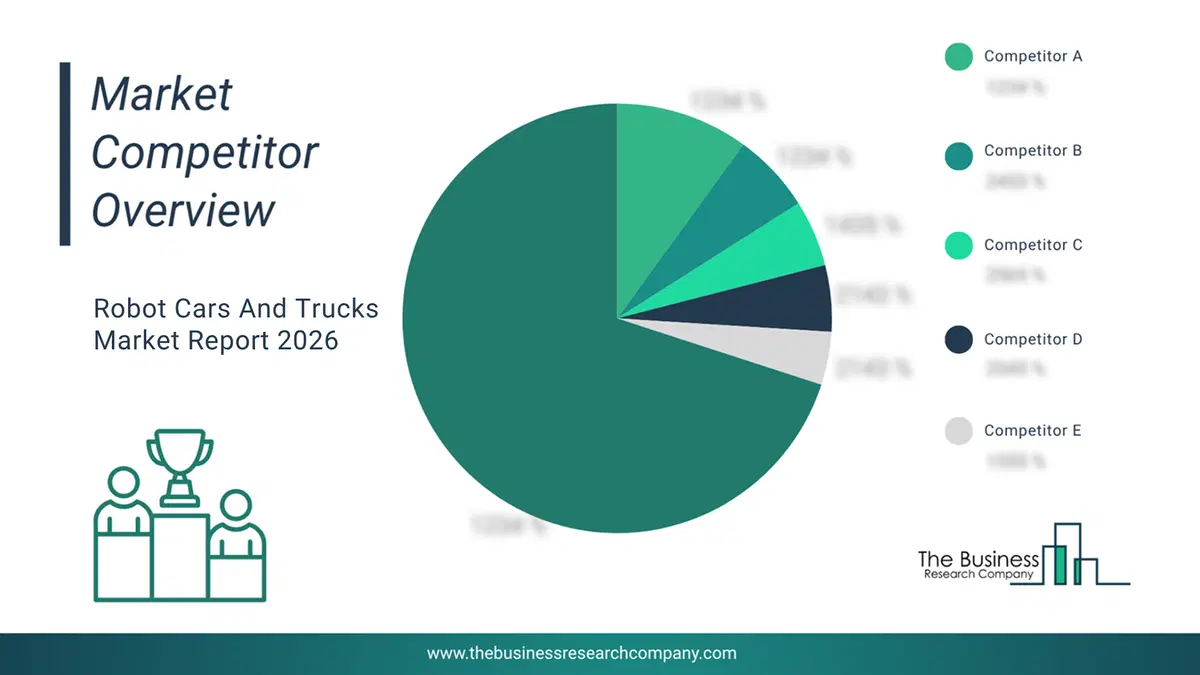
This chart is for illustrative purposes; the full report includes a detailed competitor analysis and comprehensive overview of the top 10 companies in the market.
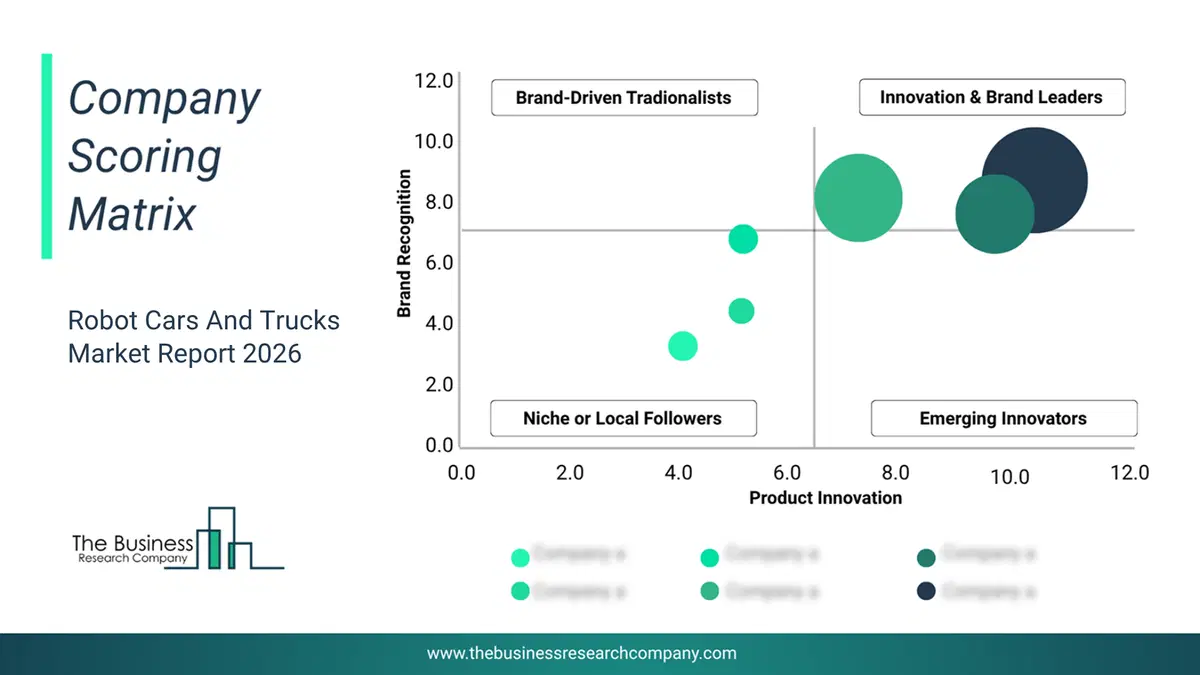
This chart maps companies by product innovation and brand strength, with bubble size indicating relative revenue, helping identify market leaders, challengers, and niche players. This is an illustrative chart; the full report provides a complete and accurate competitive analysis.
Global Robot Cars And Trucks Market Trends and Insights
Major companies operating in the robot cars and trucks market are prioritizing advanced autonomous driving technologies to enhance safety, efficiency, and user experience, aiming to revolutionize transportation with cutting-edge innovations. Autonomous driving technologies refer to systems that enable vehicles to operate without human intervention, using sensors and AI to perceive their environment and navigate autonomously. For instance, in April 2024, Horizon Robotics, a China-based vehicle manufacturing company, launched Horizon SuperDrive, a next-generation autonomous driving solution. It is designed to deliver smooth and human-like driving experiences across urban, highway, and parking scenarios. It integrates advanced ADAS and AD technologies for enhanced safety, comfort, and convenience, accelerating smart driving system adoption in passenger vehicles.What Are Latest Mergers And Acquisitions In The Robot Cars And Trucks Market?
In August 2023, Toyota Motor Corporation, a Japan-based motor vehicle manufacturing company, partnered with Pony.ai for approximately $139.2 million. Toyota's partnership with Pony.ai aims to advance the mass production and deployment of fully autonomous taxis in China, leveraging Pony.ai's seventh-generation autonomous driving kit (ADK) and Toyota's electric bz4x platform to enhance driverless mobility solutions. Pony.ai is a US-based software development Company specializing in autonomous driving technology, including hardware and software solutions for self-driving vehicles.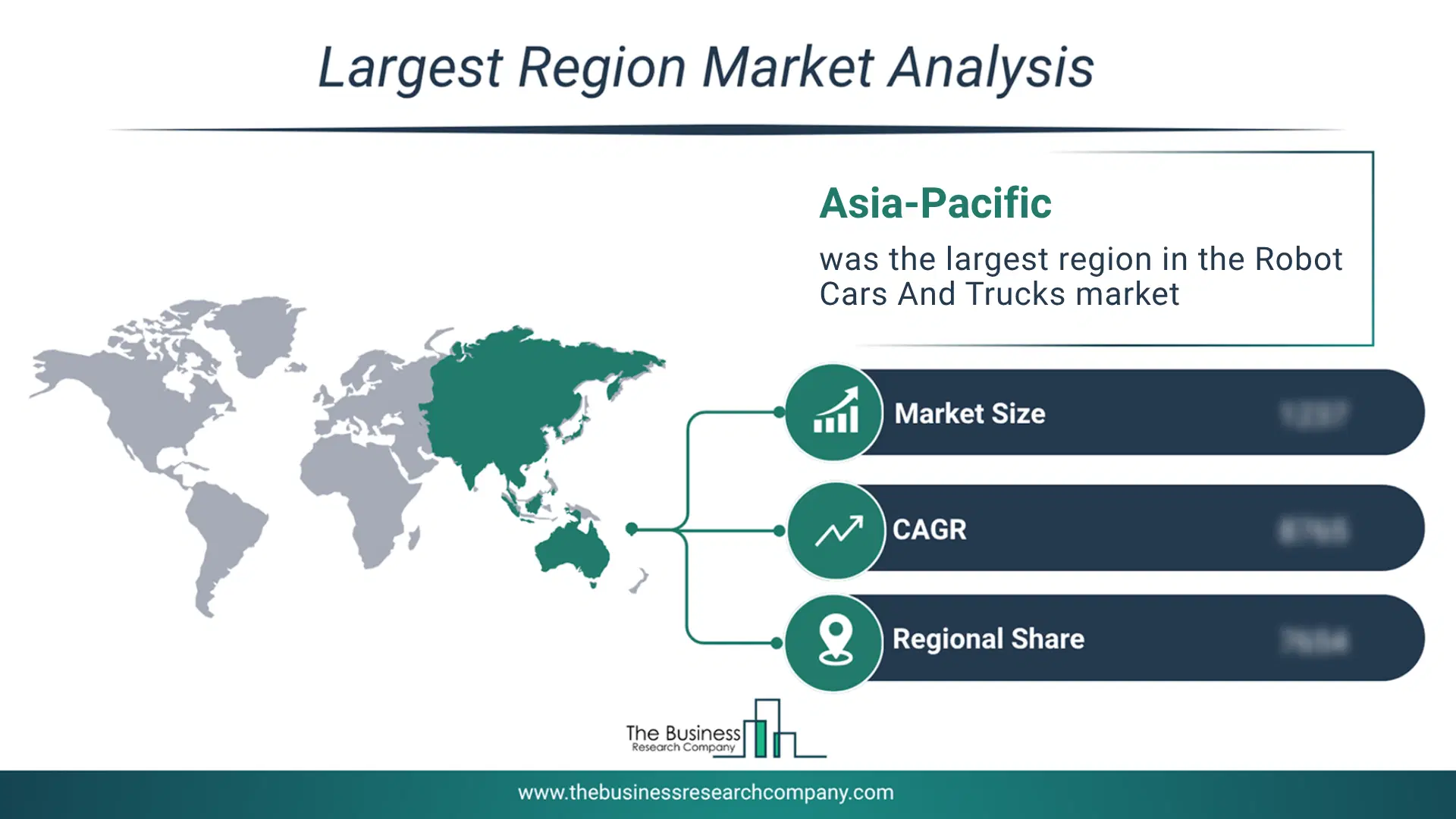
Regional Outlook
Asia-Pacific was the largest region in the robot cars and trucks market in 2025. The regions covered in this market report include Asia-Pacific, South East Asia, Western Europe, Eastern Europe, North America, South America, Middle East, Africa. The countries covered in this market report include Australia, Brazil, China, France, Germany, India, Indonesia, Japan, Taiwan, Russia, South Korea, UK, USA, Canada, Italy, SpainWhat Defines the Robot Cars And Trucks Market?
The robot cars and trucks market consists of revenues earned by entities by providing services such as ride-hailing and ride-sharing, freight and logistics, public transportation, and mobile services. The market value includes the value of related goods sold by the service provider or included within the service offering. The robot cars and trucks market also includes sales of autonomous passenger vehicles and self-driving commercial trucks. Values in this market are ‘factory gate’ values, that is the value of goods sold by the manufacturers or creators of the goods, whether to other entities (including downstream manufacturers, wholesalers, distributors and retailers) or directly to end customers. The value of goods in this market includes related services sold by the creators of the goods.How is Market Value Defined and Measured?
The market value is defined as the revenues that enterprises gain from the sale of goods and/or services within the specified market and geography through sales, grants, or donations in terms of the currency (in USD unless otherwise specified). The revenues for a specified geography are consumption values that are revenues generated by organizations in the specified geography within the market, irrespective of where they are produced. It does not include revenues from resales along the supply chain, either further along the supply chain or as part of other products.
This chart presents market attractiveness based on a quantitative evaluation of growth, competition, strategic alignment, and risk, offering a clear view of opportunity areas for decision-making. This chart is for illustrative purposes; the full report contains the complete analysis.

This chart highlights the Total Addressable Market (TAM) by estimating the maximum revenue opportunity using an assumption-driven approach, supporting strategic planning and opportunity sizing across markets. The chart is illustrative; the full report provides a more comprehensive analysis.
What Key Data and Analysis Are Included in the Robot Cars And Trucks Market Report 2026?
The robot cars and trucks market research report is one of a series of new reports from The Business Research Company that provides market statistics, including industry global market size, regional shares, competitors with the market share, detailed market segments, market trends and opportunities, and any further data you may need to thrive in the robot cars and trucks industry. The market research report delivers a complete perspective of everything you need, with an in-depth analysis of the current and future state of the industry.Robot Cars And Trucks Market Report Forecast Analysis
| Report Attribute | Details |
|---|---|
| Market Size Value In 2026 | $1.04 billion |
| Revenue Forecast In 2030 | $1.56 billion |
| Growth Rate | CAGR of 7.5% from 2026 to 2030 |
| Base Year For Estimation | 2025 |
| Actual Estimates/Historical Data | 2020-2025 |
| Forecast Period | 2026 - 2030 |
| Market Representation | Revenue in USD Billion and CAGR from 2026 to 2030 |
| Segments Covered | Vehicle Type, Classification, Technology, Application |
| Regional Scope | Asia-Pacific, Western Europe, Eastern Europe, North America, South America, Middle East, Africa |
| Country Scope | The countries covered in the report are Australia, Brazil, China, France, Germany, India, Indonesia, Japan, Taiwan, Russia, South Korea, UK, USA, Canada, Italy, Spain. |
| Key Companies Profiled | Volkswagen AG, Ford Motor Company, The Mercedes-Benz Group AG, Bayerische Motoren Werke AG (BMW AG), Tesla Inc., AB Volvo, Continental AG, Paccar Inc., NVIDIA Corporation, Baidu Inc., Aptiv PLC, Mobileye Global Inc., Zoox Inc., Waymo LLC, Aurora Innovation Inc., Nuro Inc., Motional Inc., Torc Robotics LLC, Pony.AI Inc., Embark Trucks Inc., Einride AB, Navya SAS, Udelv Inc., TuSimple Holdings Inc. |
| Customization Scope | Request for Customization |
| Pricing And Purchase Options | Explore Purchase Options |