
Rubber Testing Equipment Market Report 2026
Global Outlook – By Product Type (Rubber Process Analyzer, Moving Die Rheometer, Mooney Viscometer, Other Products), By Type Of Testing (Density Testing, Viscosity Testing, Hardness Testing, Flex Testing, Other Types Of Testing), By Frequency Range (Less Than 1 Hz, 1 To 4 Hz, More Than 4 Hz), By End-User (Tire Manufacturers, Rubber Product Manufacturers, Automotive Suppliers, Research Laboratories, Academic & Testing Institutes) – Market Size, Trends, Strategies, and Forecast to 2030
Rubber Testing Equipment Market Overview
• Rubber Testing Equipment market size has reached to $15.04 billion in 2025 • Expected to grow to $19.31 billion in 2030 at a compound annual growth rate (CAGR) of 5.4% • Growth Driver: Driving Growth In The Rubber Testing Equipment Market With Increasing Demand For Rubber Tires • Market Trend: Next-Generation Rubber Testing Technologies Driving Higher Precision And Integrated Quality Control • Asia-Pacific was the largest region and fastest growing region.What Is Covered Under Rubber Testing Equipment Market?
Rubber testing equipment refers to a variety of tools and devices used to evaluate the properties and characteristics of rubber materials, such as minimum and maximum viscosity, scorch time, conversion time, and curing profiles of rubber compounds under isothermal and non-isothermal test conditions at constant user-defined strain and frequency. These tests are essential to ensure rubber products' quality, durability, and performance. The main product types of rubber testing equipment are rubber process analyzers, moving dye rheometers, mooney viscometers, and others. A rubber process analyzer (RPA) is an advanced testing instrument used to analyze the rheological and dynamic mechanical properties of rubber materials during various stages of processing. It can be used in various types of testing such as density testing, viscosity testing, hardness testing, flex testing, and others at various frequency ranges which are less than 1 Hz, 1 to 4 Hz, and more than 4 Hz. The various end-users are density testing, viscosity testing, hardness testing, flex testing, and others.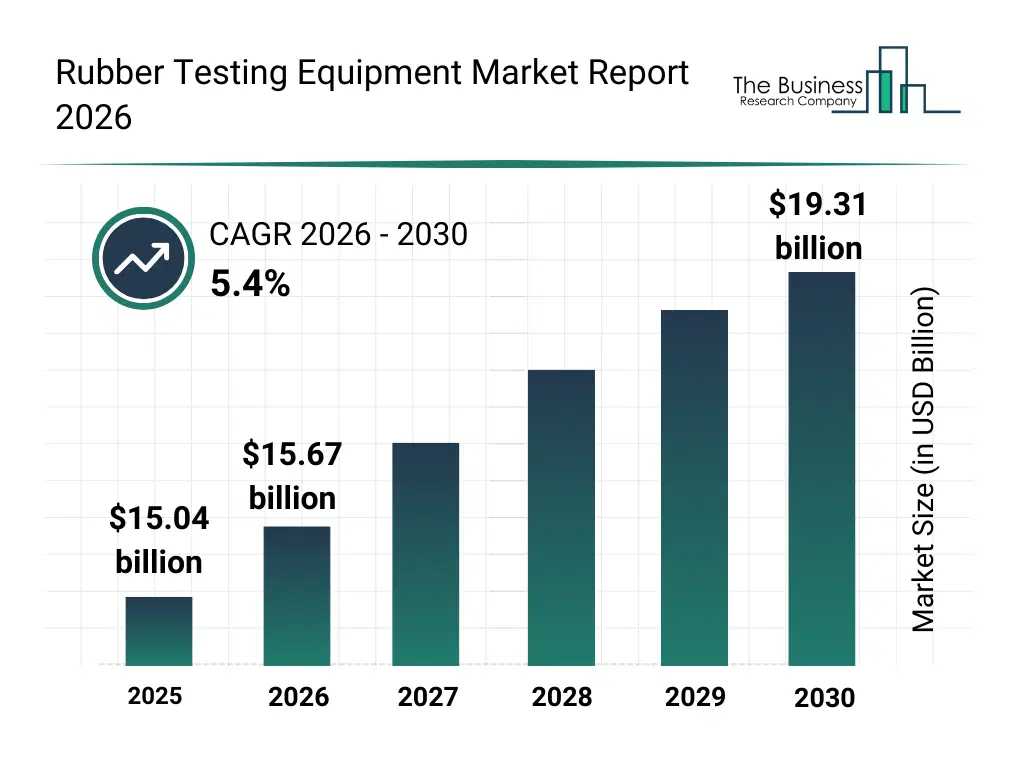
What Is The Rubber Testing Equipment Market Size and Share 2026?
The rubber testing equipment market size has grown steadily in recent years. It will grow from $15.04 billion in 2025 to $15.67 billion in 2026 at a compound annual growth rate (CAGR) of 4.2%. The growth in the historic period can be attributed to growth of automotive tire manufacturing, demand for consistent rubber quality, expansion of industrial rubber products, adoption of laboratory-based material testing, regulatory requirements for rubber performance.What Is The Rubber Testing Equipment Market Growth Forecast?
The rubber testing equipment market size is expected to see strong growth in the next few years. It will grow to $19.31 billion in 2030 at a compound annual growth rate (CAGR) of 5.4%. The growth in the forecast period can be attributed to growth in electric vehicle tire production, increasing use of advanced rubber compounds, demand for real-time quality monitoring, expansion of smart manufacturing practices, rising investments in material testing automation. Major trends in the forecast period include rising adoption of automated rubber testing systems, growing demand for high-precision rheological analysis, increased integration of testing equipment with digital platforms, expansion of in-line quality control in rubber manufacturing, focus on standardization and compliance testing.Tariff Impact On Rubber Testing Equipment Market
Tariffs have influenced the rubber testing equipment market by increasing the cost of imported sensors, precision mechanical components, electronic modules, and calibration systems used in rheometers and analyzers. These impacts are most evident in automotive, industrial rubber, and tire manufacturing sectors, particularly across asia-pacific and europe where equipment sourcing is global. Higher tariffs have raised capital investment requirements and slowed equipment replacement cycles. At the same time, tariffs have encouraged local manufacturing, regional supplier development, and innovation in cost-efficient and digitally enabled rubber testing solutions.
Global Rubber Testing Equipment Market Segmentation
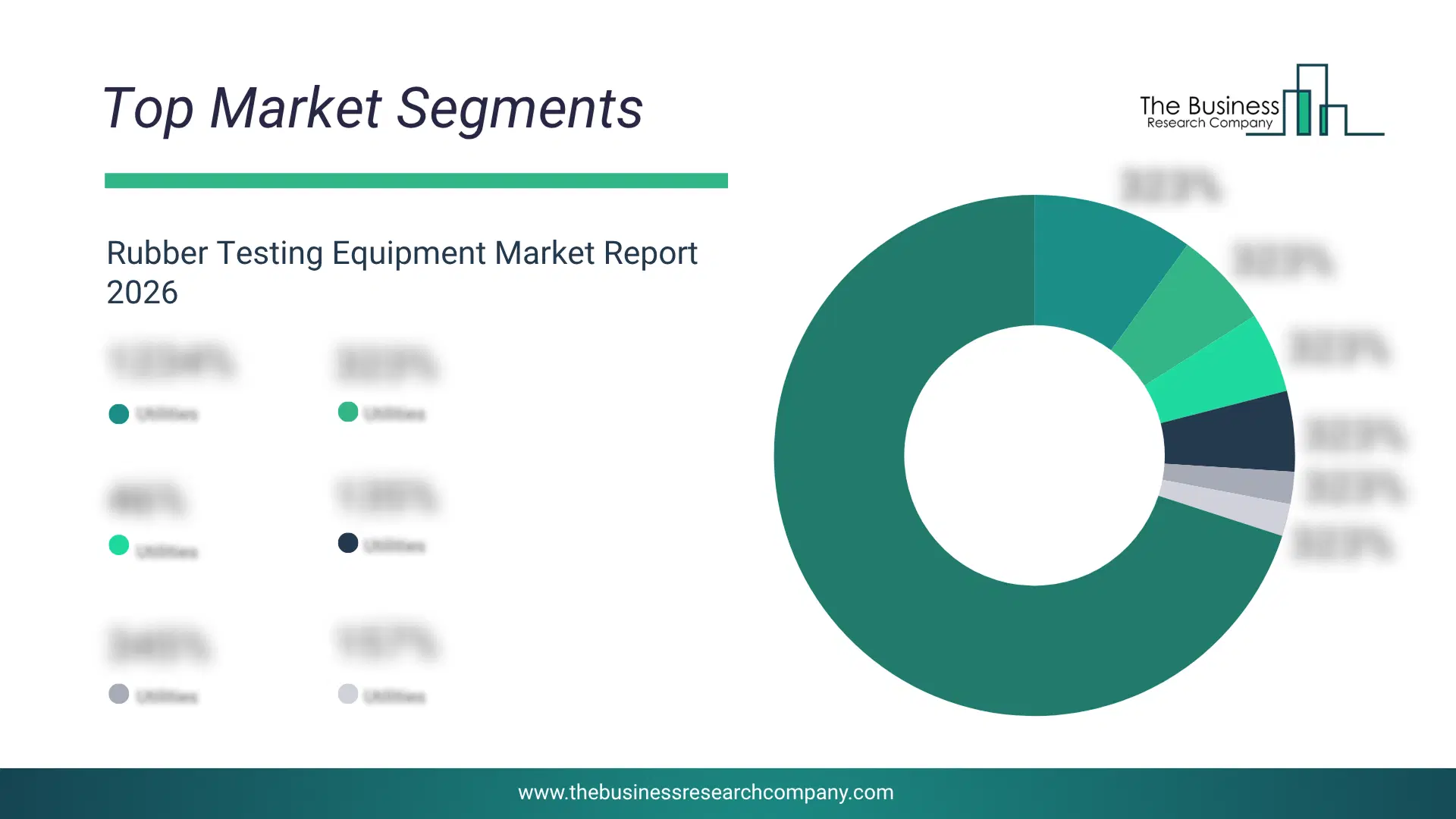
1) By Product Type: Rubber Process Analyzer, Moving Die Rheometer, Mooney Viscometer, Other Products 2) By Type Of Testing: Density Testing, Viscosity Testing, Hardness Testing, Flex Testing, Other Types Of Testing 3) By Frequency Range: Less Than 1 Hz, 1 To 4 Hz, More Than 4 Hz 4) By End-User: Tire Manufacturers, Rubber Product Manufacturers, Automotive Suppliers, Research Laboratories, Academic & Testing Institutes Subsegments: 1) By Rubber Process Analyzer: Dynamic Mechanical Analyzer (DMA), Oscillating Disk Rheometer 2) By Moving Die Rheometer: Capillary Rheometer, Dynamic Rheometer 3) By Mooney Viscometer: Standard Mooney Viscometer, High-Temperature Mooney Viscometer 3) By Other Products: Hardness Testers, Tensile Testers, Compression TestersWhat Is The Driver Of The Rubber Testing Equipment Market?
The increasing demand for rubber tires is expected to propel the growth of the rubber testing equipment market going forward. Rubber tires are components made primarily from rubber compounds that are designed to be mounted onto the wheels of vehicles, machinery, and other equipment. Rubber testing equipment is crucial in rubber tires' development, quality control, and performance evaluation. Tires are essential components of vehicles that require specific properties and performance characteristics to ensure safety, durability, and optimal handling. For instance, in May 2024, according to a report Rubber Tires Trade, Exporters and Importers Statistics, published by The TradeImeX, a India-based global trade data provider, in 2023, global rubber tire exports reached $93 billion, reflecting a $1 billion increase from $92 billion in 2022, with the top exporters being China ($21.3 billion), Thailand ($6.94 billion), Germany ($6.28 billion), Japan ($5.54 billion), and the USA ($5.20 billion), collectively accounting for approximately 45.6% of total exports. Therefore, the increasing demand for rubber tires is driving the growth of the rubber testing equipment industry.Key Players In The Global Rubber Testing Equipment Market
Major companies operating in the rubber testing equipment market are TA Instruments Inc., Waters Corporation, TesTex Inc., Applied Test Systems Ltd., Shimadzu Corporation, Zwick Roell Group, Gotech Testing Machines Inc., Instron, TMI LLC, NDC Technologies Inc., Labtech Engineering Co. Ltd., Haida International Equipment Co. Ltd., Elastocon AB, Testing Machines Inc., Labthink Instruments Co. Ltd., NextGen Material Testing Inc., Montech Rubber Testing Solutions, Tinius Olsen Testing Machine Company, Qualitest International Inc., U-Can Dynatex Inc., ADMET Inc., Prescott Instruments Ltd., Saehan Group, JM Machinery, Alpha Technologies Inc.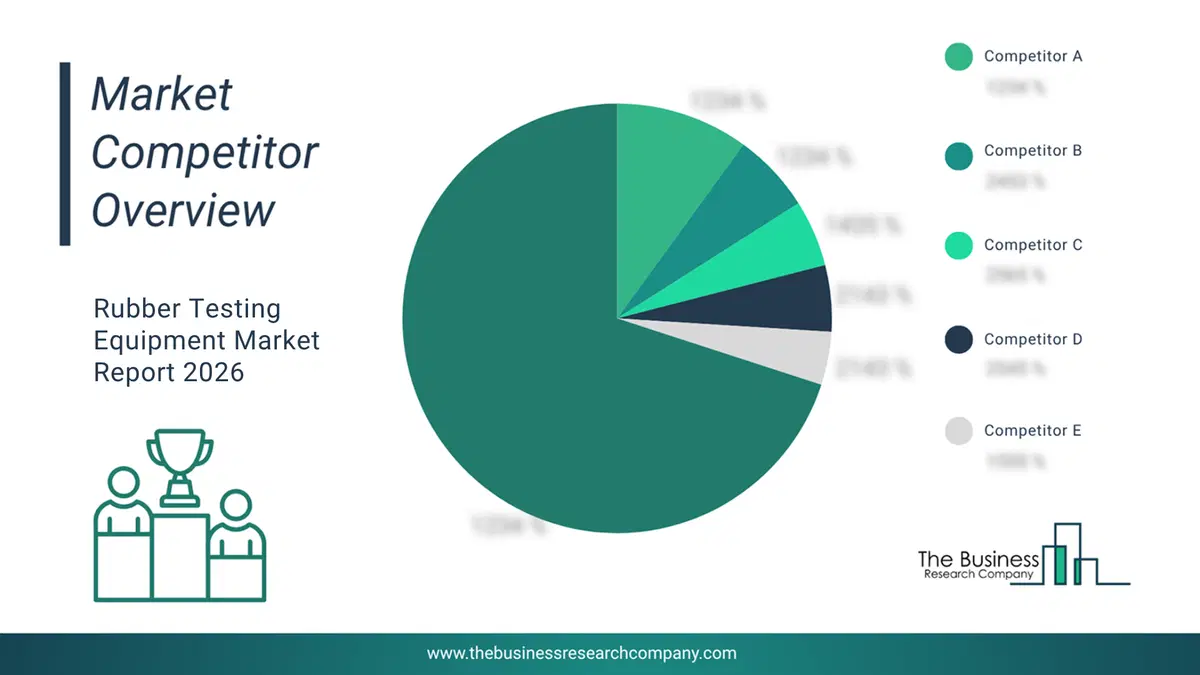
This chart is for illustrative purposes; the full report includes a detailed competitor analysis and comprehensive overview of the top 10 companies in the market.
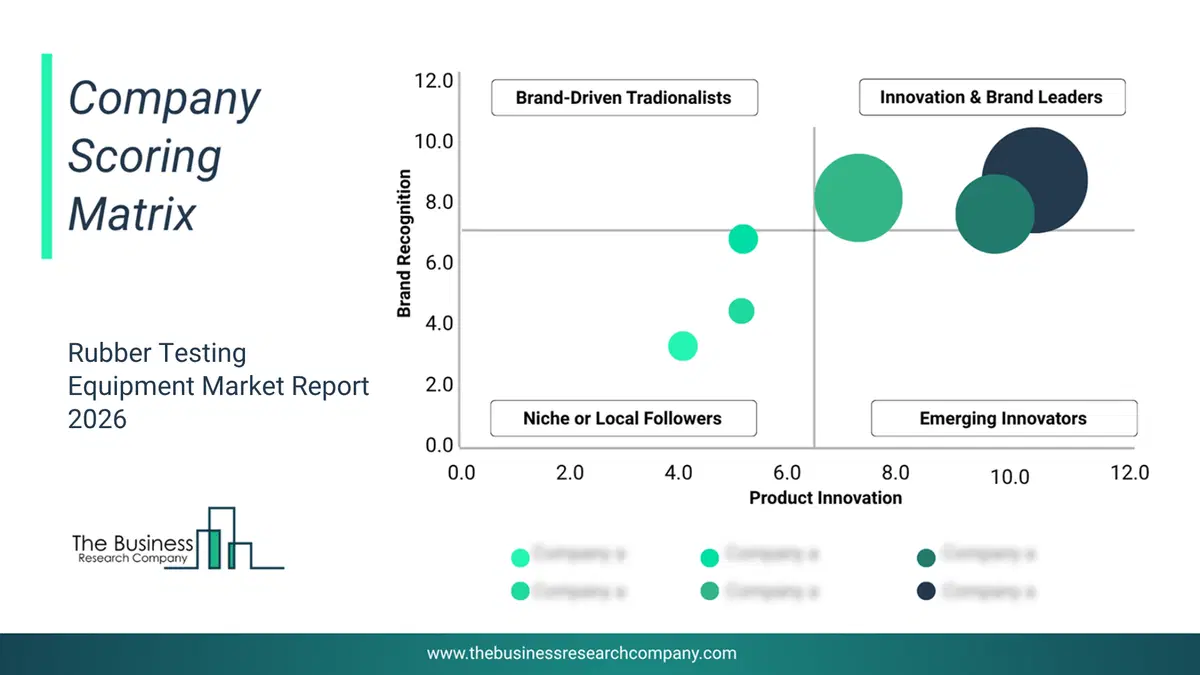
This chart maps companies by product innovation and brand strength, with bubble size indicating relative revenue, helping identify market leaders, challengers, and niche players. This is an illustrative chart; the full report provides a complete and accurate competitive analysis.
Global Rubber Testing Equipment Market Trends and Insights
Major companies operating in the rubber testing equipment market are focusing on technological advancements, such as next-generation tensile testers and automated rheometers, to meet the rising demand for enhanced quality control, accelerated compound development cycles, and compliance with stricter regulatory and safety standards driven by growth in automotive, industrial rubber goods, tire production, and elastomer innovations globally. For instance, in May 2024, Alpha Technologies, a US-based testing-equipment manufacturer, launched the AlphaFlex10 Tensile Tester, a state-of-the-art tensile testing system that adds destructive physical-property testing to its established rheology instrument lineup. The AlphaFlex10 is a modular, high-elongation tensile tester designed for rubber materials (elastomers and non-rigid plastics); it uses precision load frames, configurable grips, and optical encoders to measure elongation, tensile strength, modulus, and failure properties under controlled conditions. Its key features including a low-tracking force for sensitive materials, robust construction for high release energies, and seamless integration with the company’s Enterprise software and existing rheometers enable more comprehensive material characterization compared to traditional tensile testers. This makes it possible for labs to consolidate rheology and tensile testing workflows, thereby improving efficiency, repeatability, and data management, especially valuable for compound development and QC in industries like automotive and footwear.What Are Latest Mergers And Acquisitions In The Rubber Testing Equipment Market?
In September 2025, Alpha Technologies, a US-based automation machinery manufacturing company, acquired Metravib Material Testing for an undisclosed amount. With this acquisition, it aims to expand its global materials-testing offerings combining its rubber rheology expertise with Metravib’s dynamic mechanical analysis (DMA) and fatigue-testing capabilities to provide a more comprehensive, end-to-end testing solution for research and industrial labs. Metravib Material Testing is a France-based provider of dynamic mechanical analysis, fatigue testing and advanced viscoelastic / failure-analysis instrumentation for polymer, elastomer and composite materials.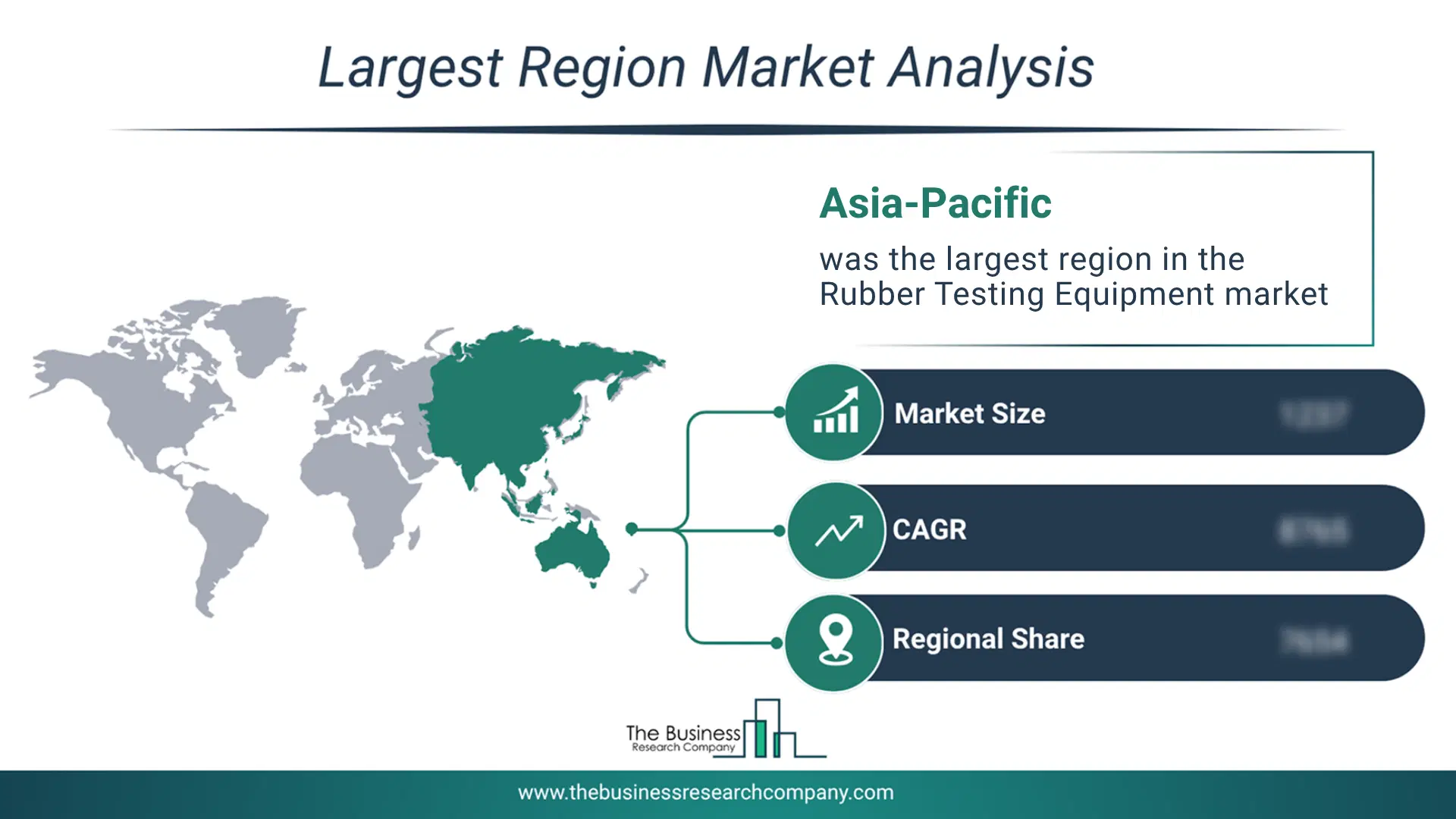
Regional Outlook
Asia-Pacific was the largest region in the rubber testing equipment market in 2025, and is expected to be the fastest-growing region in the forecast period. The regions covered in this market report are Asia-Pacific, South East Asia, Western Europe, Eastern Europe, North America, South America, Middle East, Africa The countries covered in this market report are Australia, Brazil, China, France, Germany, India, Indonesia, Japan, Taiwan, Russia, South Korea, UK, USA, Canada, Italy, Spain.What Defines the Rubber Testing Equipment Market?
The rubber testing equipment market consists of sales of tensile testing machines, hardness testers, flexometers, abrasion testers, heat aging ovens, rheometers, and chemical resistance testers. Values in this market are ‘factory gate’ values, that is the value of goods sold by the manufacturers or creators of the goods, whether to other entities (including downstream manufacturers, wholesalers, distributors and retailers) or directly to end customers. The value of goods in this market includes related services sold by the creators of the goods.How is Market Value Defined and Measured?
The market value is defined as the revenues that enterprises gain from the sale of goods and/or services within the specified market and geography through sales, grants, or donations in terms of the currency (in USD unless otherwise specified). The revenues for a specified geography are consumption values that are revenues generated by organizations in the specified geography within the market, irrespective of where they are produced. It does not include revenues from resales along the supply chain, either further along the supply chain or as part of other products.
This chart presents market attractiveness based on a quantitative evaluation of growth, competition, strategic alignment, and risk, offering a clear view of opportunity areas for decision-making. This chart is for illustrative purposes; the full report contains the complete analysis.

This chart highlights the Total Addressable Market (TAM) by estimating the maximum revenue opportunity using an assumption-driven approach, supporting strategic planning and opportunity sizing across markets. The chart is illustrative; the full report provides a more comprehensive analysis.
What Key Data and Analysis Are Included in the Rubber Testing Equipment Market Report 2026?
The rubber testing equipment market research report is one of a series of new reports from The Business Research Company that provides market statistics, including industry global market size, regional shares, competitors with the market share, detailed market segments, market trends and opportunities, and any further data you may need to thrive in the rubber testing equipment industry. The market research report delivers a complete perspective of everything you need, with an in-depth analysis of the current and future state of the industry.Rubber Testing Equipment Market Report Forecast Analysis
| Report Attribute | Details |
|---|---|
| Market Size Value In 2026 | $15.67 billion |
| Revenue Forecast In 2030 | $19.31 billion |
| Growth Rate | CAGR of 5.4% from 2026 to 2030 |
| Base Year For Estimation | 2025 |
| Actual Estimates/Historical Data | 2020-2025 |
| Forecast Period | 2026 - 2030 |
| Market Representation | Revenue in USD Billion and CAGR from 2026 to 2030 |
| Segments Covered | Product Type, Type Of Testing, Frequency Range, End-User |
| Regional Scope | Asia-Pacific, Western Europe, Eastern Europe, North America, South America, Middle East, Africa |
| Key Companies Profiled | TA Instruments Inc., Waters Corporation, TesTex Inc., Applied Test Systems Ltd., Shimadzu Corporation, Zwick Roell Group, Gotech Testing Machines Inc., Instron, TMI LLC, NDC Technologies Inc., Labtech Engineering Co. Ltd., Haida International Equipment Co. Ltd., Elastocon AB, Testing Machines Inc., Labthink Instruments Co. Ltd., NextGen Material Testing Inc., Montech Rubber Testing Solutions, Tinius Olsen Testing Machine Company, Qualitest International Inc., U-Can Dynatex Inc., ADMET Inc., Prescott Instruments Ltd., Saehan Group, JM Machinery, Alpha Technologies Inc. |
| Customization Scope | Request for Customization |
| Pricing And Purchase Options | Explore Purchase Options |