

Smart Construction Materials Market Report 2026
Global Outlook – By Material (Coatings, Concrete, Glass), By Function (Chromoactive Materials, Electrochromic Materials, Electrorheological Fluids, Magnetostrictive Materials, Piezoelectric Materials), By Application (Structural Health Monitoring, Energy Efficiency, Durability Enhancement, Safety And Fire Resistance, Smart Facades, Acoustic And Vibration Control, Environmental Sensing), By End Use Industry (Residential, Commercial, Industrial, Infrastructure) – Market Size, Trends, Strategies, and Forecast to 2030
Smart Construction Materials Market Overview
• Smart Construction Materials market size has reached to $43.76 billion in 2025 • Expected to grow to $141.65 billion in 2030 at a compound annual growth rate (CAGR) of 26.5% • Growth Driver: Increasing Focus On Green Building Practices Driving The Growth Of The Market Due To Rising Demand For Energy Efficiency, Sustainability, And Reduced Carbon Emissions In Construction • Market Trend: IoT-Enabled Smart Concrete Sensors Transforming Construction Efficiency • North America was the largest region in 2025 and Asia-Pacific is the fastest growing region.What Is Covered Under Smart Construction Materials Market?
Smart construction materials are advanced building materials designed to respond dynamically to environmental changes such as temperature, pressure, moisture, or stress. These materials incorporate functional properties such as self-healing, energy efficiency, adaptive insulation, and structural monitoring to enhance building performance, safety, and sustainability. The main materials of smart construction materials are coatings, concrete, and glass. Coatings are engineered surface layers designed to enhance functionality by providing properties such as self-healing, thermal regulation, or corrosion resistance. These materials incorporate advanced functions such as chromoactive, electrochromic, electrorheological, magneto strictive, and piezoelectric technologies. Their applications span structural health monitoring, energy efficiency, durability enhancement, safety and fire resistance, smart facades, acoustic and vibration control, and environmental sensing, and they are widely utilized across residential, commercial, industrial, and infrastructure sectors.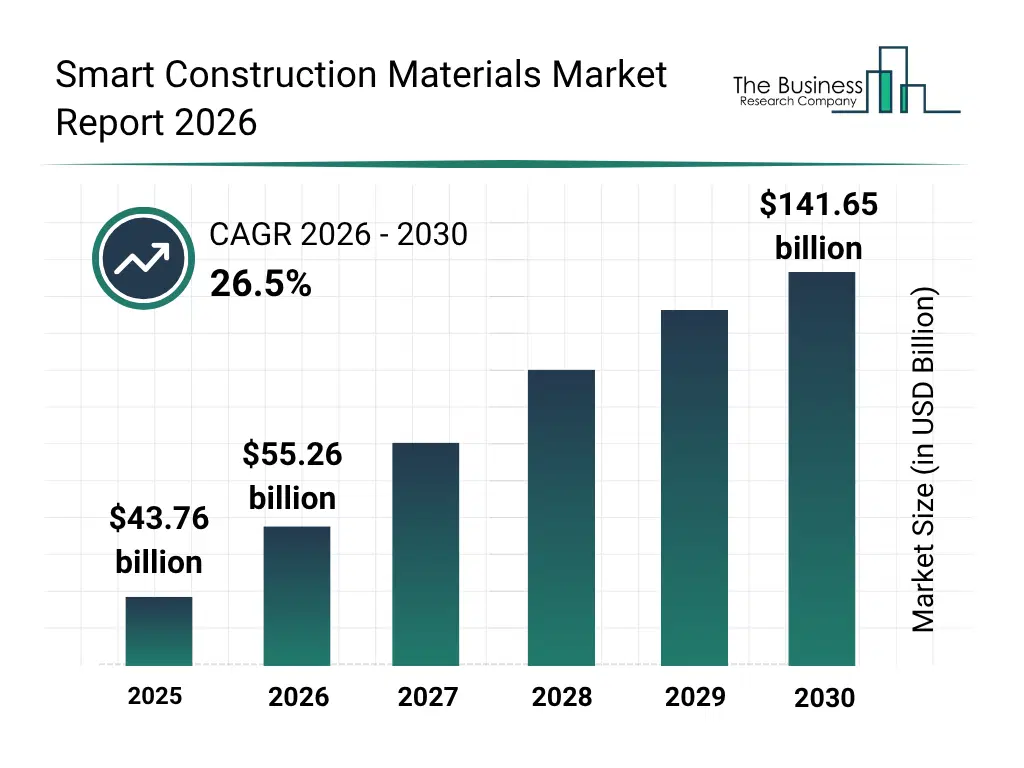
What Is The Smart Construction Materials Market Size and Share 2026?
The smart construction materials market size has grown exponentially in recent years. It will grow from $43.76 billion in 2025 to $55.26 billion in 2026 at a compound annual growth rate (CAGR) of 26.3%. The growth in the historic period can be attributed to growing demand for sustainable building solutions, adoption of conventional high-performance concrete, expansion of residential and commercial construction, rising awareness of energy efficiency, introduction of functional coatings in building materials.What Is The Smart Construction Materials Market Growth Forecast?
The smart construction materials market size is expected to see exponential growth in the next few years. It will grow to $141.65 billion by 2030 at a compound annual growth rate (CAGR) of 26.5%. The growth in the forecast period can be attributed to increasing adoption of electrochromic and photochromic glass, rising demand for self-sensing and light-emitting concrete, expansion of smart infrastructure projects, growing focus on carbon-sequestering and eco-friendly materials, rising integration of IoT-enabled environmental sensing systems. Major trends in the forecast period include increasing adoption of self-healing and self-cleaning materials, rising demand for energy-efficient smart facades, growing integration of structural health monitoring systems, expansion of acoustic and vibration control solutions, rising focus on safety, fire resistance, and durability enhancement.
Global Smart Construction Materials Market Segmentation
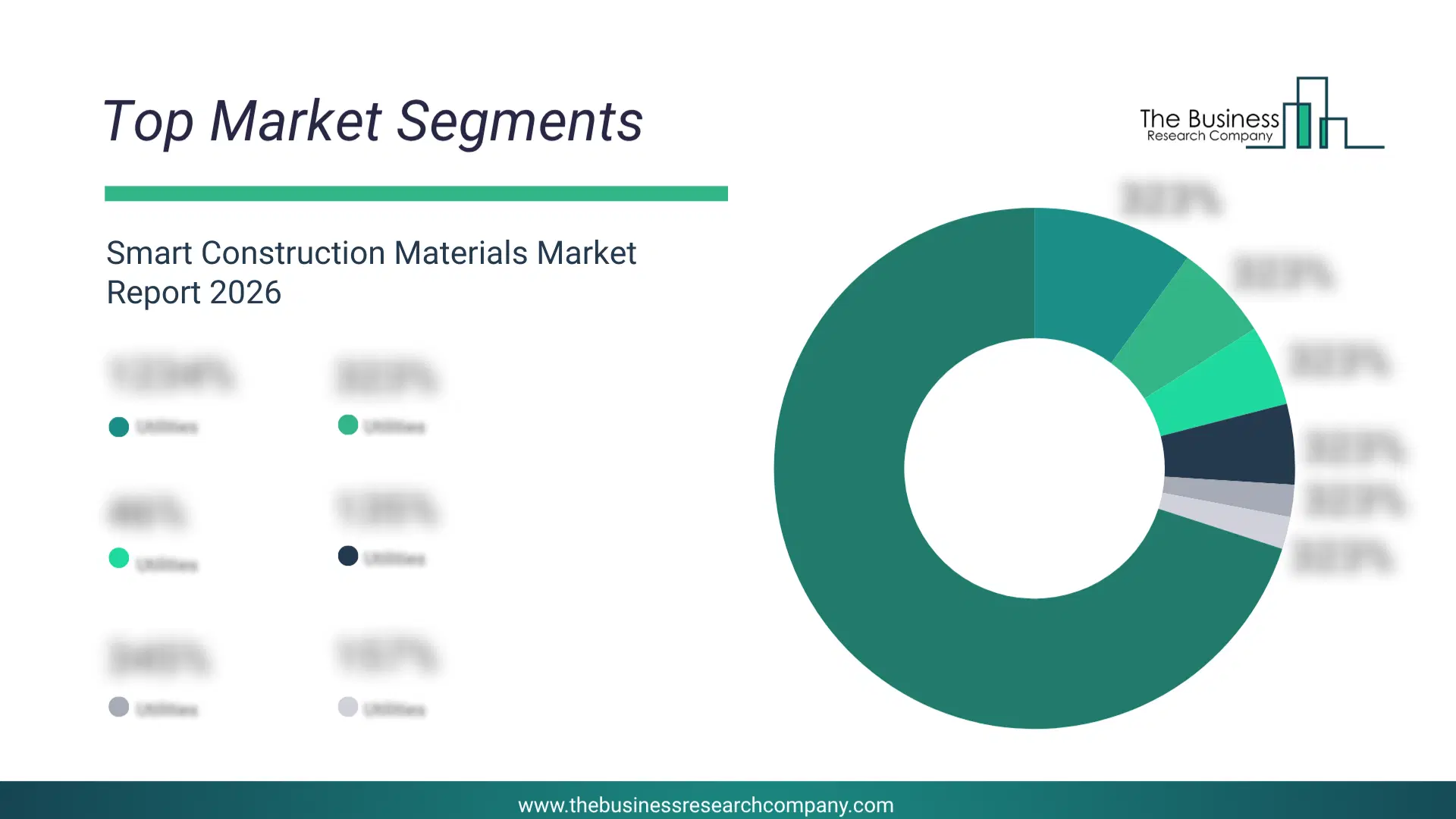
1) By Material: Coatings, Concrete, Glass 2) By Function: Chromoactive Materials, Electrochromic Materials, Electrorheological Fluids, Magnetostrictive Materials, Piezoelectric Materials 3) By Application: Structural Health Monitoring, Energy Efficiency, Durability Enhancement, Safety And Fire Resistance, Smart Facades, Acoustic And Vibration Control, Environmental Sensing 4) By End Use Industry: Residential, Commercial, Industrial, Infrastructure Subsegments: 1) By Coatings: Self-Healing Coatings, Self-Cleaning Coatings, Thermal Insulating Coatings, Anti-Corrosion Coatings, Photochromic Coatings 2) By Concrete: Self-Healing Concrete, Self-Sensing Concrete, Light-Emitting Concrete, High-Performance Concrete, Carbon-Sequestering Concrete 3) By Glass: Electrochromic Glass, Thermochromic Glass, Photochromic Glass, Self-Cleaning Glass, Low-Emissivity GlassWhat Is The Driver Of The Smart Construction Materials Market?
The increasing focus on green building practices is expected to propel the growth of the smart construction materials market going forward. Green building practices encompass approaches to designing and constructing buildings that minimize environmental impact, enhance energy efficiency, and promote the sustainable use of resources throughout a building’s lifecycle. The rise in green building practices is driven by growing environmental concerns and the need to reduce carbon emissions and energy consumption within the construction sector. Smart construction materials support green building practices by enabling energy efficiency, self-healing capabilities, thermal regulation, and reduced material waste, thereby improving overall building performance and sustainability. For instance, in February 2024, according to the US Green Building Council, a US-based non-profit organization that promotes eco-friendly building and developed the Leadership in Energy and Environmental Design (LEED) certification system, in 2023, LEED certifications increased by 9% compared to the previous year, along with 21 additional certifications for single-family homes. Additionally, new LEED project registrations rose by 51%, indicating substantial growth. Therefore, the increasing focus on green building practices is driving the growth of the smart construction materials industry.Key Players In The Global Smart Construction Materials Market
Major companies operating in the smart construction materials market are BASF SE, Saint-Gobain S.A., Dow Inc., LafargeHolcim Ltd., 3M Company, Johnson Controls International, The Sherwin-Williams Company, PPG Industries Inc., Evonik Industries AG, Skanska AB, Covestro AG, Sika AG, DuPont de Nemours Inc., Kingspan Group, RPM International Inc., Huntsman Corporation, Nippon Sheet Glass Co. Ltd., Rockwool A/S, USG Corporation, GCP Applied Technologies, Aerogel Technologies LLC.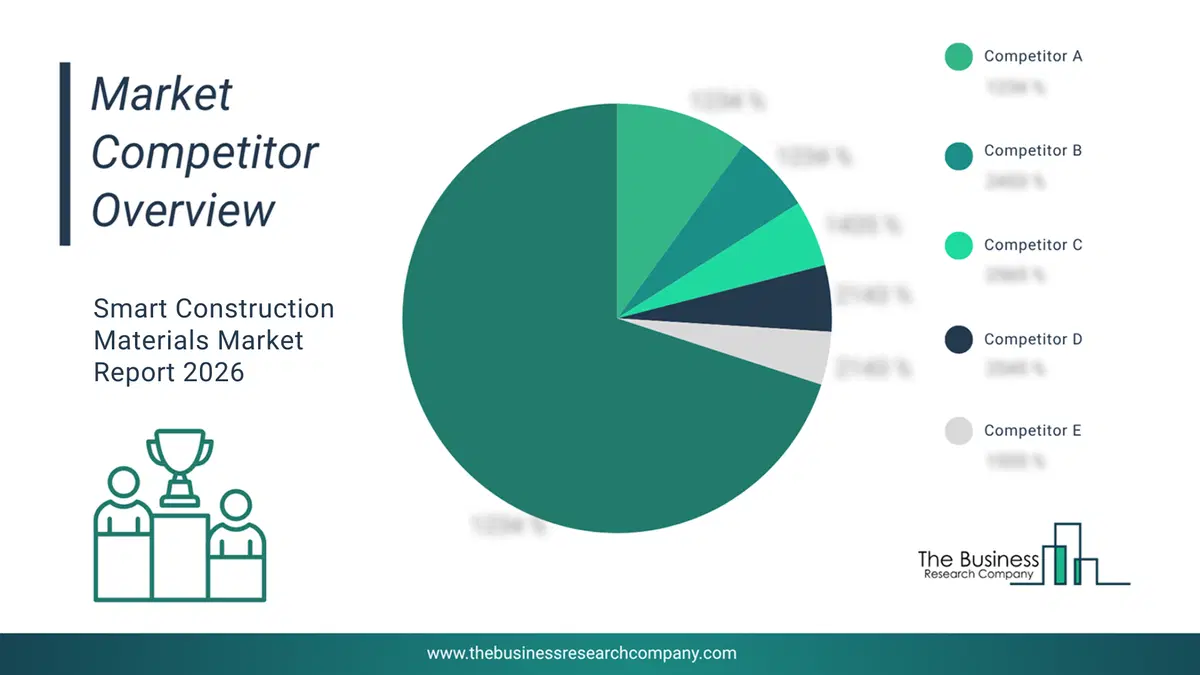
This chart is for illustrative purposes; the full report includes a detailed competitor analysis and comprehensive overview of the top 10 companies in the market.
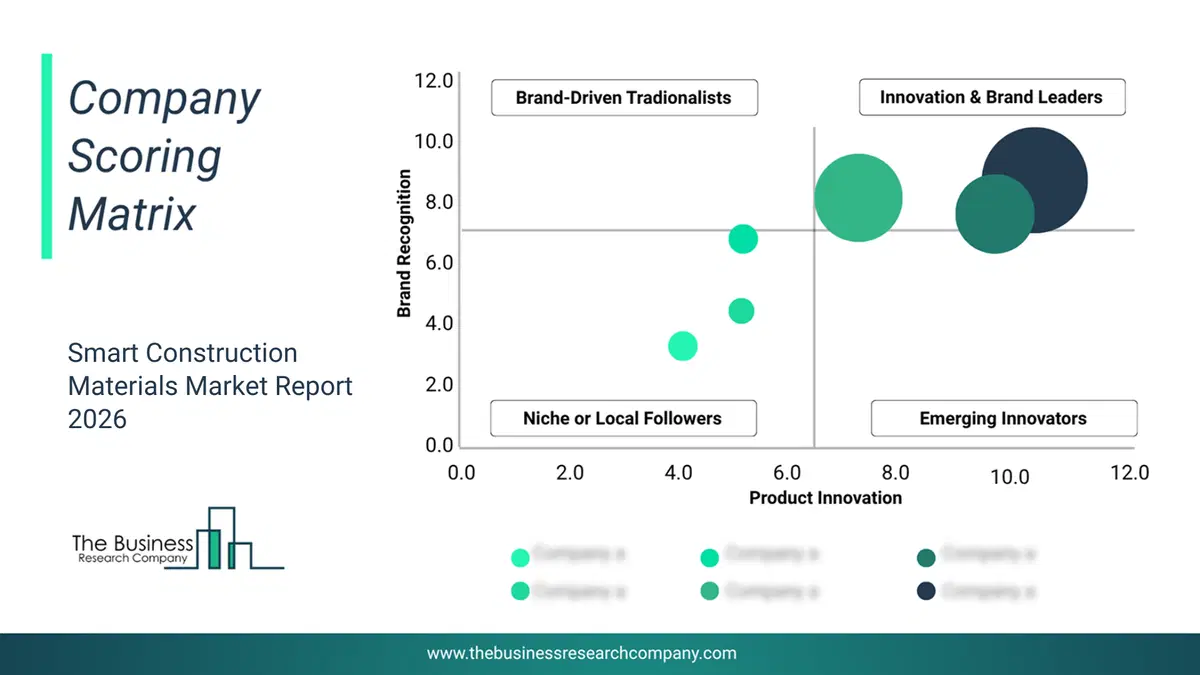
This chart maps companies by product innovation and brand strength, with bubble size indicating relative revenue, helping identify market leaders, challengers, and niche players. This is an illustrative chart; the full report provides a complete and accurate competitive analysis.
Global Smart Construction Materials Market Trends and Insights
Major companies operating in the smart construction materials market are focusing on the integration of Internet of Things (IoT) technologies in building materials, such as IoT-enabled smart concrete sensors, to meet the rising demand for real-time construction monitoring, improved structural safety, and data-driven project management. IoT-enabled smart concrete sensors are embedded wireless devices placed within concrete or attached to reinforcement bars that continuously measure parameters such as temperature, humidity, and strength development during the curing process. For instance, in January 2023, Giatec Scientific Inc., a Canada-based developer of construction testing technologies, launched SmartRock Pro, an advanced self-calibrating wireless concrete sensor designed for real-time strength monitoring in construction projects. The sensor is embedded directly into concrete and attached to reinforcement bars, where it automatically measures temperature and maturity to estimate compressive strength without requiring manual calibration. It uses advanced sensing techniques and wireless connectivity to transmit real-time data to mobile and cloud platforms, allowing contractors to monitor curing progress remotely and reduce delays caused by traditional break tests. The technology helps save construction time, lower material waste, and improve project efficiency by providing accurate data throughout the concrete lifecycle.What Are Latest Mergers And Acquisitions In The Smart Construction Materials Market?
In October 2025, Holcim Ltd., a Switzerland-based manufacturer of building materials and sustainable construction solutions, acquired Xella Group for approximately $2.1 billion (€1.85 billion). This acquisition enables Holcim to strengthen its position in energy-efficient building solutions and expand its portfolio of advanced walling systems, supporting the growing demand for sustainable and smart construction materials. Xella Group is a Germany-based manufacturer of autoclaved aerated concrete (AAC), insulation materials, and lightweight building solutions.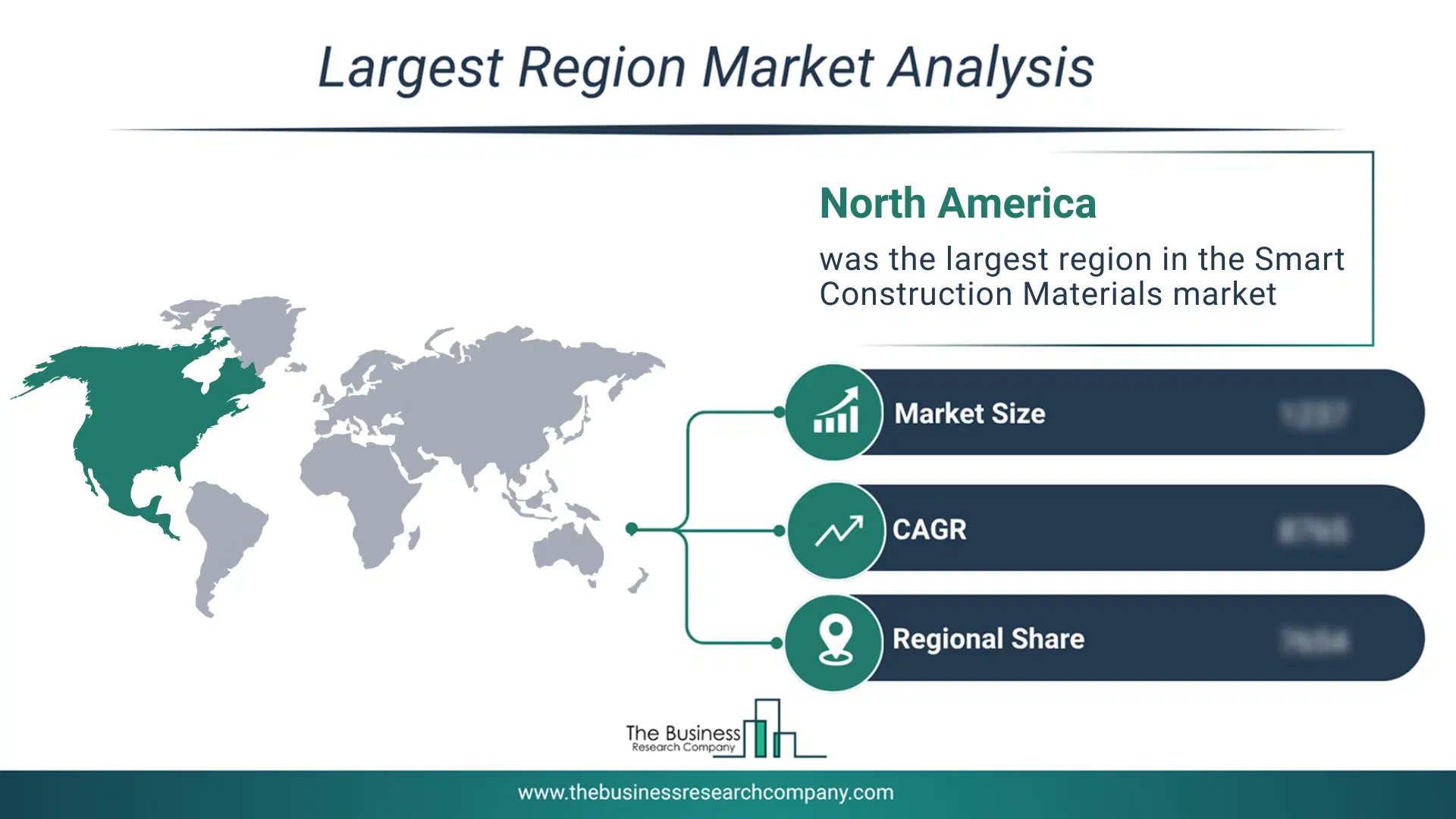
Regional Insights
North America was the largest region in the smart construction materials market in 2025. Asia-Pacific is expected to be the fastest-growing region in the forecast period. The regions covered in this market report are Asia-Pacific, South East Asia, Western Europe, Eastern Europe, North America, South America, Middle East, Africa. The countries covered in this market report are Australia, Brazil, China, France, Germany, India, Indonesia, Japan, Taiwan, Russia, South Korea, UK, USA, Canada, Italy, Spain.What Defines the Smart Construction Materials Market?
The smart construction materials market consists of sales of self healing concrete, phase change materials, energy efficient glass, electrochromic glass, fiber reinforced smart composites, shape memory alloys, smart coatings, conductive concrete, piezoelectric materials, and insulation materials. Values in this market are ‘factory gate’ values, that is the value of goods sold by the manufacturers or creators of the goods, whether to other entities (including downstream manufacturers, wholesalers, distributors and retailers) or directly to end customers. The value of goods in this market includes related services sold by the creators of the goods.How is Market Value Defined and Measured?
The market value is defined as the revenues that enterprises gain from the sale of goods and/or services within the specified market and geography through sales, grants, or donations in terms of the currency (in USD unless otherwise specified). The revenues for a specified geography are consumption values that are revenues generated by organizations in the specified geography within the market, irrespective of where they are produced. It does not include revenues from resales along the supply chain, either further along the supply chain or as part of other products.
This chart presents market attractiveness based on a quantitative evaluation of growth, competition, strategic alignment, and risk, offering a clear view of opportunity areas for decision-making. This chart is for illustrative purposes; the full report contains the complete analysis.

This chart highlights the Total Addressable Market (TAM) by estimating the maximum revenue opportunity using an assumption-driven approach, supporting strategic planning and opportunity sizing across markets. The chart is illustrative; the full report provides a more comprehensive analysis.
What Key Data and Analysis Are Included in the Smart Construction Materials Market Report 2026?
The smart construction materials market research report is one of a series of new reports from The Business Research Company that provides market statistics, including industry global market size, regional shares, competitors with the market share, detailed market segments, market trends and opportunities, and any further data you may need to thrive in the smart construction materials industry. The market research report delivers a complete perspective of everything you need, with an in-depth analysis of the current and future state of the industry.Smart Construction Materials Market Report Forecast Analysis
| Report Attribute | Details |
|---|---|
| Market Size Value In 2026 | $55.26 billion |
| Revenue Forecast In 2030 | $141.65 billion |
| Growth Rate | CAGR of 26.3% from 2026 to 2030 |
| Base Year For Estimation | 2025 |
| Actual Estimates/Historical Data | 2020-2025 |
| Forecast Period | 2026 - 2030 |
| Market Representation | Revenue in USD Billion and CAGR from 2026 to 2030 |
| Segments Covered | Material, Function, Application, End Use Industry |
| Regional Scope | Asia-Pacific, Western Europe, Eastern Europe, North America, South America, Middle East, Africa |
| Country Scope | The countries covered in this market report are Australia, Brazil, China, France, Germany, India, Indonesia, Japan, Taiwan, Russia, South Korea, UK, USA, Canada, Italy, Spain |
| Key Companies Profiled | BASF SE, Saint-Gobain S.A., Dow Inc., LafargeHolcim Ltd., 3M Company, Johnson Controls International, The Sherwin-Williams Company, PPG Industries Inc., Evonik Industries AG, Skanska AB, Covestro AG, Sika AG, DuPont de Nemours Inc., Kingspan Group, RPM International Inc., Huntsman Corporation, Nippon Sheet Glass Co. Ltd., Rockwool A/S, USG Corporation, GCP Applied Technologies, Aerogel Technologies LLC. |
| Customization Scope | Request for Customization |
| Pricing And Purchase Options | Explore Purchase Options |