

Contact Us
  Search
The Business Research Company Logo
Smart Homes Market 2025
Buy Now
Smart Homes Market 2025
Published :May 2025
Pages :372
Format :PDF
Delivery Time :2-3 Business Days
Why 2-3 days? We update the report with the latest data and news before delivery. Let us know if you need us to expedite.
Report Price :$4,490.00

Smart Homes Market 2025

By Product (Lighting Control, Security And Access Control, Heating, Ventilation And Air Conditioning (HVAC) Control, Entertainment Control And Other Control, Smart Kitchen, Home Appliances, Other Products), By Software and Service (Behavioral, Proactive), By Sales Channel (Direct, Indirect), By Technology (Wireless Technology, Cellular Network Technology), And By Region, Opportunities And Strategies – Global Forecast To 2035
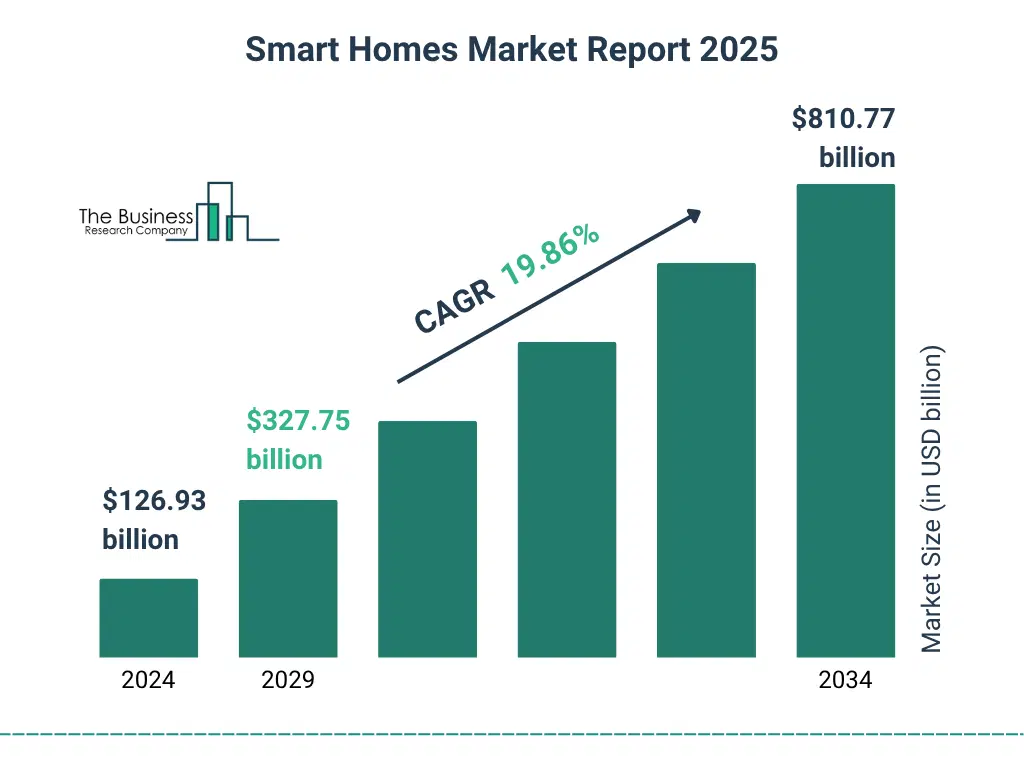
Smart Homes Market Size and growth rate 2025 to 2029: Graph

Smart Homes Market Definition

A smart home is a residence equipped with devices that are connected through a network (often the Internet) to allow remote management and monitoring. These devices, also known as smart devices or home automation devices, can include smart speakers, thermostats, lights, security cameras, door locks and appliances. The primary goal of a smart home is to improve convenience, security, energy efficiency and comfort by allowing users to control various aspects of their home environment through a smartphone app, voice commands or automated settings. The smart homes market consists of sales, by entities (organizations, sole traders and partnerships), of smart home solutions (products, software and services) that enable automation, remote control and monitoring of home functions for convenience, security and energy efficiency.
Research Expert

Book your 30 minutes free consultation with our research experts

Smart Homes Market Size

The global smart homes market reached a value of nearly $126,927.08 million in 2024, having grown at a compound annual growth rate (CAGR) of 14.37% since 2019. The market is expected to grow from $126,927.08 million in 2024 to $327,749.01 million in 2029 at a rate of 20.89%. The market is then expected to grow at a CAGR of 19.86% from 2029 and reach $810,773.69 million in 2034. Growth in the historic period resulted from increasing adoption of IoT solutions, rising demand for energy efficiency solutions, proliferation of affordable smart devices and growing importance of smart security and surveillance systems. Factors that negatively affected growth in the historic period were privacy and security concerns and high costs. Going forward, government initiatives, rising smartphone usage and internet penetration, rise in deployment of 5G networks, increase in work-from-home trends and expansion of e-commerce will drive growth. Factor that could hinder the growth of the smart homes market in the future include were supply chain disruptions and complexity in setup and use.

Smart Homes Market Drivers

The key drivers of the smart homes market include: Government Initiatives During the forecast period, government initiatives are expected to propel the growth of the smart homes market. Government initiatives, such as subsidies for energy-efficient appliances and smart grid integration, encourage the adoption of smart home technologies by reducing costs and improving accessibility. Additionally, policies promoting IoT security standards and sustainable housing drive innovation and consumer confidence, accelerating market growth. For instance, in June 2024, according to a report published by the General Services Administration (GSA), a US-based government agency, the Administrator of the U.S. General Services Administration (GSA) announced an $80 million investment from the Inflation Reduction Act (IRA), the largest climate investment in U.S. history, to implement smart building technologies across approximately 560 federal buildings. Spanning 49 states, the Commonwealth of Puerto Rico, the U.S. Virgin Islands and Washington, DC, this initiative aims to reduce emissions, enhance efficiency and cost savings, improve occupant comfort, create jobs and support the Biden Administration’s goal of achieving net-zero emissions in the federal building portfolio by 2045. Therefore, the government initiatives will people the growth of the smart homes market.

Smart Homes Market Restraints

The key restraints on the smart homes market include: Supply Chain Disruptions Supply chain disruptions are expected to restrict the growth of the smart homes market going forward. Supply chain disruptions negatively impact smart homes by delaying the production and delivery of essential components, leading to higher prices and limited availability of smart devices. These challenges hinder adoption, slow innovation and reduce consumer access to the latest smart home technologies, affecting overall convenience and efficiency. For instance, in January 2025, according to Resilinc, a US-based company that provides supply chain resiliency solutions, supply chain disruptions rose by 38% year over year in 2024. Therefore, the supply chain disruptions may hinder the growth of the smart homes market.

Need data on a specific region in this market?

Opportunities And Recommendations In The Smart Homes Market

Opportunities – The top opportunities in the smart homes market segmented by product will arise in the security and access control segment, which will gain $77,527.17 million of global annual sales by 2029. The top opportunities in the smart homes market segmented by software and services will arise in the behavioral segment, which will gain $119,472.43 million of global annual sales by 2029. The top opportunities in the smart homes market segmented by sales channel will arise in the indirect segment, which will gain $144,625.51 million of global annual sales by 2029. The top opportunities in the smart homes market segmented by technology will arise in the wireless technology segment, which will gain $160,753.15 million of global annual sales by 2029. The smart homes market size will gain the most in the USA at $60,644.12 million. Recommendations- To take advantage of the opportunities, The Business Research Company recommends the smart homes to focus on technological advancements in smart appliances, focus on enhancing smart camera features for security and convenience, focus on AI-powered solutions for energy efficiency and personalized comfort, focus on enhancing security and convenience through smart deadbolts, focus on AI integration for enhanced connectivity and visual clarity, focus on advancements in laser navigation systems for smart home cleaning solutions, focus on next-generation smart lighting solutions, focus on smart home as a service (Shaas) for growth, focus on matter-compatible technologies for seamless integration, expand in emerging markets, continue to focus on developed markets, focus on expanding distribution channels through strategic partnerships, focus on competitive pricing and value-based strategies for smart home companies, focus on targeted digital advertising, focus on influencer and affiliate marketing and focus on targeting end-user needs and preferences.
Research Expert

Book your 30 minutes free consultation with our research experts

Chat with us