
Smarts Sports Equipment Market Report 2026
Global Outlook – By Product Type (Smart Balls, Smart Golf Sticks, Smart Hockey Sticks, Smart Racket And Bats, Other Products), By Connectivity Features (Smartphone Synchronization, Wireless Syncing, Real-Time Data Syncing), By Distribution Channel (Franchise Stores, Specialty Stores, Other Distribution Channels), By End User (Men, Women) – Market Size, Trends, Strategies, and Forecast to 2030
Smarts Sports Equipment Market Overview
• Smarts Sports Equipment market size has reached to $4.2 billion in 2025 • Expected to grow to $6.77 billion in 2030 at a compound annual growth rate (CAGR) of 10% • Growth Driver: Rise In Participation In Sports Drives The Smart Sports Equipment • Market Trend: Advancements In Smart Sports Equipment To Enhance Performance Analytics And Training Efficiency • North America was the largest region in 2025 and Asia-Pacific is the fastest growing region.What Is Covered Under Smarts Sports Equipment Market?
The smart sports equipment refers to equipment’s that are digitally instrumented with sensors, providing real-time analytical details on the user’s behaviour and performance. It is used to analyse player’s performance on the field. Smart sports equipment goes beyond simple metric tracking, such as calories burnt or steps done, to provide with more precise information about form and performance. The main types of products in the smart sports equipment market are smart balls, smart golf sticks, smart hockey sticks, smart rackets and bats, and other products. Smart balls are a type of intelligent balls with an implanted electronic chip. They are created by integrating smart technology such as IoT, and data analytics into sports equipment. Smart sports equipment has connectivity features such as smartphone synchronization, wireless synching, and real-time data syncing. These products are distributed through franchise stores, specialty stores, and other stores. Smart sports equipment is used by end-users such as men and women.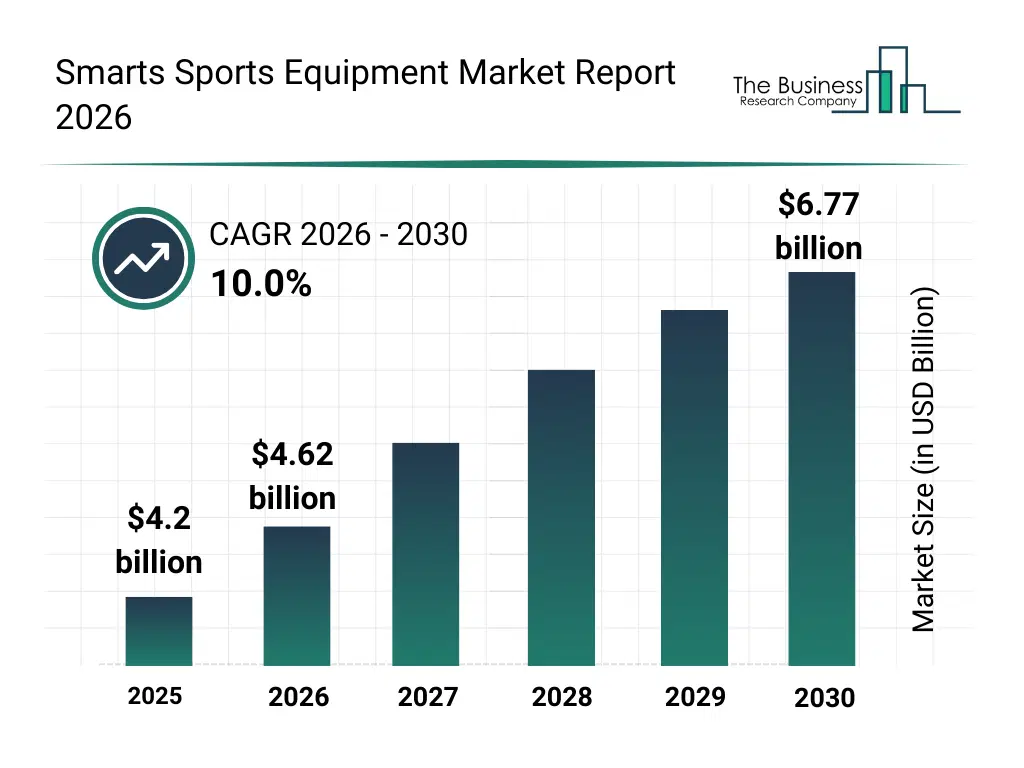
What Is The Smarts Sports Equipment Market Size and Share 2026?
The smarts sports equipment market size has grown strongly in recent years. It will grow from $4.2 billion in 2025 to $4.62 billion in 2026 at a compound annual growth rate (CAGR) of 10.0%. The growth in the historic period can be attributed to rising adoption of wearable fitness devices, increasing focus on athlete performance analytics, growth of professional sports leagues, higher consumer spending on sports equipment, expansion of sports training academies.What Is The Smarts Sports Equipment Market Growth Forecast?
The smarts sports equipment market size is expected to see strong growth in the next few years. It will grow to $6.77 billion in 2030 at a compound annual growth rate (CAGR) of 10.0%. The growth in the forecast period can be attributed to integration of advanced sensors in sports gear, demand for personalized training insights, growth of connected fitness ecosystems, rising adoption of smart equipment in amateur sports, increasing investment in sports technology startups. Major trends in the forecast period include performance based training equipment, real time biometric feedback devices, sport specific skill optimization tools, data driven coaching accessories, personalized athlete performance tracking.Tariff Impact On Smarts Sports Equipment Market
Tariffs have influenced the smart sports equipment market by increasing the cost of imported sensors, semiconductors, and electronic components used in digitally enabled sports gear. These higher costs have affected pricing and supply chains across smart balls, smart rackets, and connected training aids, with Asia Pacific and North America being the most impacted regions due to their strong manufacturing and consumption bases. Distribution channels such as specialty and franchise stores have experienced margin pressure. On the positive side, tariffs are encouraging localized manufacturing, component sourcing diversification, and innovation in cost efficient smart sports equipment designs.
Global Smarts Sports Equipment Market Segmentation
1) By Product Type: Smart Balls, Smart Golf Sticks, Smart Hockey Sticks, Smart Racket And Bats, Other Products 2) By Connectivity Features: Smartphone Synchronization, Wireless Syncing, Real-Time Data Syncing 3) By Distribution Channel: Franchise Stores, Specialty Stores, Other Distribution Channels 4) By End User: Men, Women Subsegments: 1) By Smart Balls: Smart Footballs, Smart Basketballs, Smart Soccer Balls, Smart Tennis Balls 2) By Smart Golf Sticks: Smart Golf Clubs, Smart Putters, Golf Swing Analyzers 3) By Smart Hockey Sticks: Smart Ice Hockey Sticks, Smart Field Hockey Sticks 4) By Smart Rackets and Bats: Smart Tennis Rackets, Smart Badminton Rackets, Smart Baseball Bats, Smart Softball Bats 5) By Other Products: Smart Fitness Equipment, Smart Training AidsWhat Is The Driver Of The Smarts Sports Equipment Market?
The rise in participation in sports is expected to propel the growth of the smart sports equipment market in the coming years. This surge in participation is driven by a combination of factors, including an increased awareness of the importance of physical fitness, the influence of wearable technology and data-driven training, and the appeal of gamified and personalized workout experiences. As more individuals and athletes embrace smart sports equipment to enhance their performance, track their progress, and prevent injuries, the market is expected to see sustained growth. For instance, in February 2025, according to the Sports & Fitness Industry Association (SFIA), a US-based leading trade association for the sports and fitness industry, in 2024, about 247.1 million Americans participated in at least one sport/fitness or outdoor activity up from around 242 million in 2023. Therefore, the rise in participation in sports is driving the smart sports equipment market.Key Players In The Global Smarts Sports Equipment Market
Major companies operating in the smarts sports equipment market are Wilson Sporting Goods Co., BABOLAT VS S.A., Callaway Golf Company, MIZUNO Corporation, Amer Sports Corporation, Zepp Labs Inc., InfoMotion Sports Technologies Inc., DribbleUp Inc., Kinexon GmbH, KINEXON Sports & Media GmbH, Spektacom Technologies Pvt. Ltd., STATSports Group Ltd., Catapult Sports Pty Ltd., ShotTracker Inc., Blast Motion Inc., PIQ Sport Intelligence, Gridiron Technologies Inc., Active Mind Technology Inc., Quattriuum Inc., Garmin Ltd., PlaySight Interactive Ltd., Rapsodo Inc., Whoop Inc., CoachMePlus Inc.
This chart is for illustrative purposes; the full report includes a detailed competitor analysis and comprehensive overview of the top 10 companies in the market.
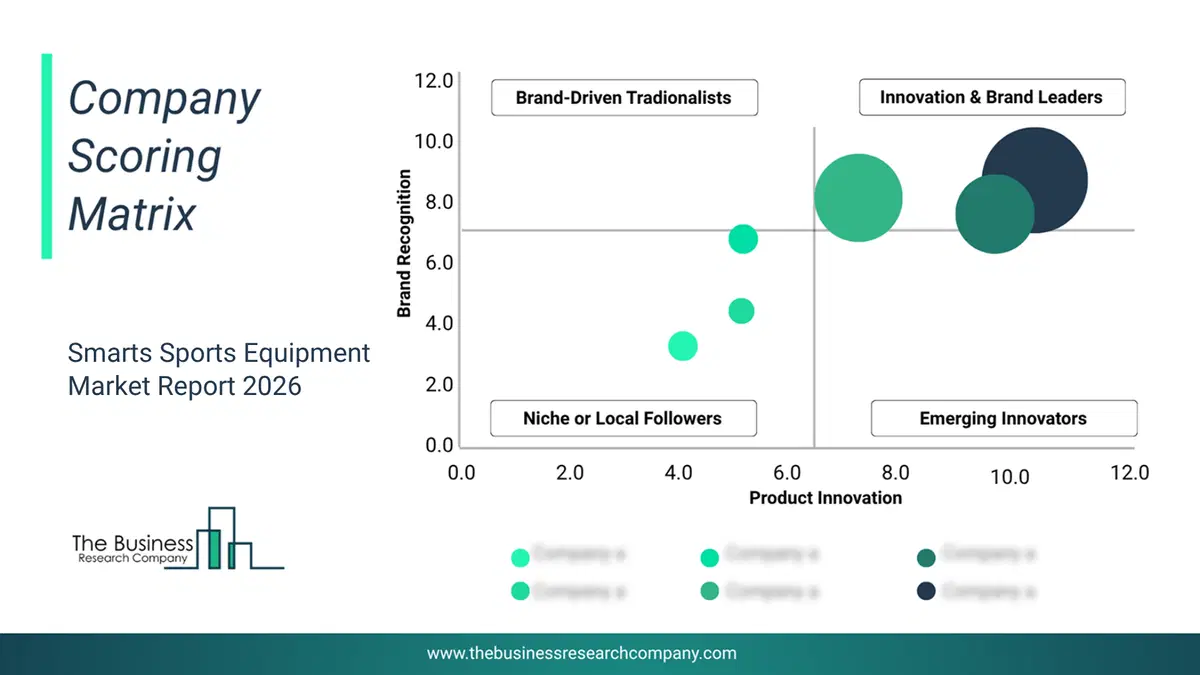
This chart maps companies by product innovation and brand strength, with bubble size indicating relative revenue, helping identify market leaders, challengers, and niche players. This is an illustrative chart; the full report provides a complete and accurate competitive analysis.
Global Smarts Sports Equipment Market Trends and Insights
Major companies operating in the smart sports equipment market are focusing on technological advancements, such as sensor-embedded “connected ball” technology, to meet the rising demand for real-time performance analytics, enhanced training feedback, and smarter coaching & officiating tools across professional and amateur sports. Connected ball technology refers to sports balls (e.g. soccer or footballs) outfitted with internal sensors such as inertial measurement units (IMUs) that track motion data (e.g. speed, spin, trajectory, impact) and transmit that data wirelessly for analysis. Compared to traditional balls that provide no feedback beyond physical feel and manual observation, connected balls enable objective, data-driven insights and open possibilities for performance optimization and automated officiating. For instance, in July 2025, Adidas a Germany-based sports-equipment manufacturing company, introduced a new match-ball featuring connected ball technology engineered in collaboration with KINEXON Sports, a Germany-based sports and media company, designed to deliver real-time ball tracking data during matches for enhanced officiating accuracy and performance analytics. The ball integrates an IMU sensor stabilized inside the ball via a patented suspension system, communicates with field antennas to relay data (ball position, velocity, etc.), and supports faster, more accurate decision making such as offside calls or ball-tracking for training and broadcast analytics. This demonstrates how smart-sports innovations are transforming even the most traditional equipment into data-enabled tools fuelling growth in the smart sports equipment market as demand for analytics, performance monitoring, and immersive fan or athlete experiences rises.What Are Latest Mergers And Acquisitions In The Smarts Sports Equipment Market?
In May 2023, Helios Technologies, a US-based industrial valve manufacturing company, i3 Product Development, for an undisclosed amount. With this acquisition, Helios Technologies aims to expand its product portfolio, enhance its market presence, and leverage synergies to drive innovation and efficiency. I3 Product Development is a US-based manufacturing company that specializes in product design and development.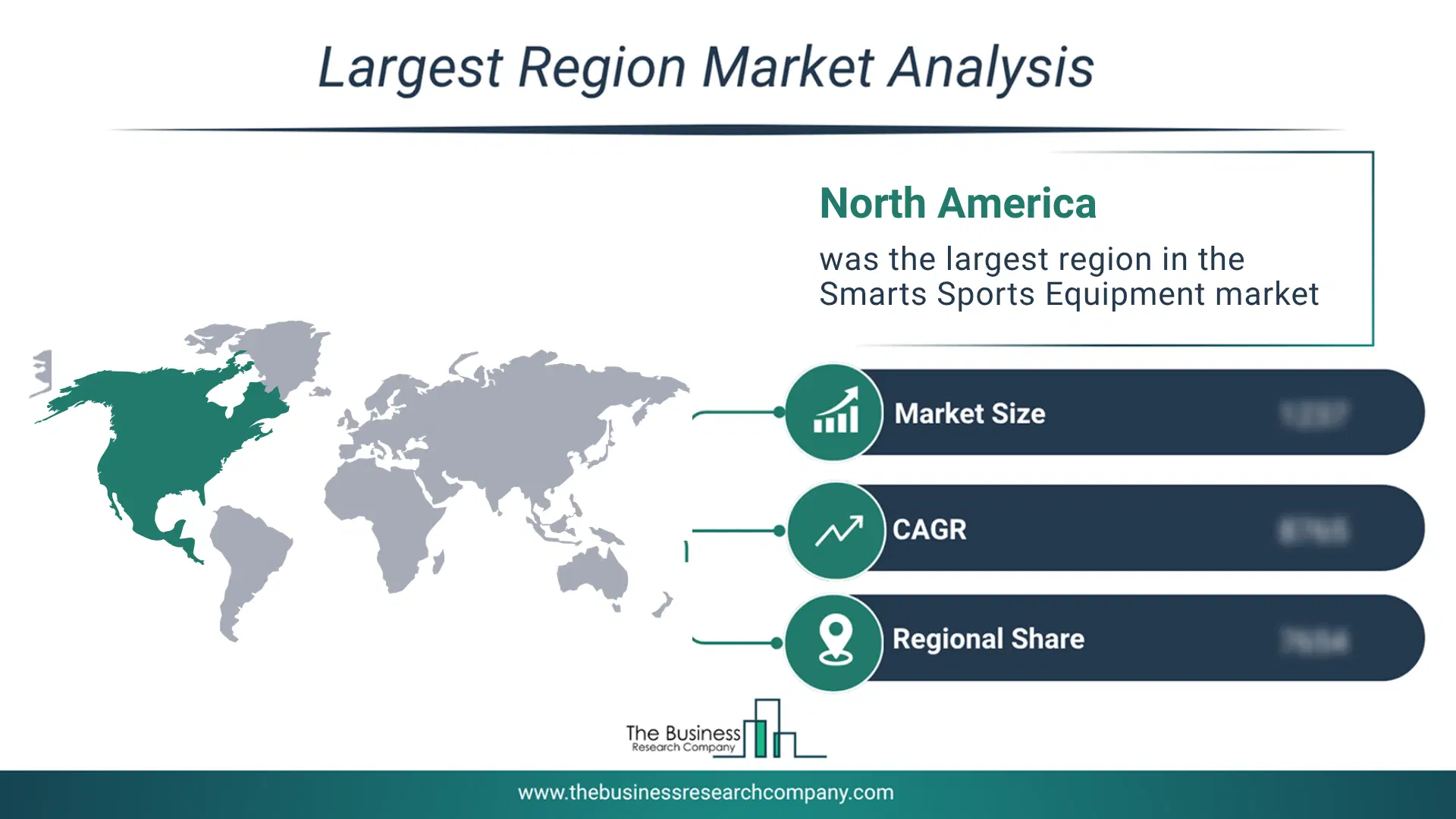
Regional Outlook
North America was the largest region in the smart sports equipment market in 2025. Asia-Pacific is expected to be the fastest-growing region in the forecast period. The regions covered in this market report are Asia-Pacific, South East Asia, Western Europe, Eastern Europe, North America, South America, Middle East, Africa The countries covered in this market report are Australia, Brazil, China, France, Germany, India, Indonesia, Japan, Taiwan, Russia, South Korea, UK, USA, Canada, Italy, Spain.What Defines the Smarts Sports Equipment Market?
The smart sports equipment market consists of sales of smart basketball, smart footballs, and smart helmet. Values in this market are ‘factory gate’ values, that is the value of goods sold by the manufacturers or creators of the goods, whether to other entities (including downstream manufacturers, wholesalers, distributors, and retailers) or directly to end customers. The value of goods in this market includes related services sold by the creators of the goods.How is Market Value Defined and Measured?
The market value is defined as the revenues that enterprises gain from the sale of goods and/or services within the specified market and geography through sales, grants, or donations in terms of the currency (in USD unless otherwise specified). The revenues for a specified geography are consumption values that are revenues generated by organizations in the specified geography within the market, irrespective of where they are produced. It does not include revenues from resales along the supply chain, either further along the supply chain or as part of other products.
This chart presents market attractiveness based on a quantitative evaluation of growth, competition, strategic alignment, and risk, offering a clear view of opportunity areas for decision-making. This chart is for illustrative purposes; the full report contains the complete analysis.

This chart highlights the Total Addressable Market (TAM) by estimating the maximum revenue opportunity using an assumption-driven approach, supporting strategic planning and opportunity sizing across markets. The chart is illustrative; the full report provides a more comprehensive analysis.
What Key Data and Analysis Are Included in the Smarts Sports Equipment Market Report 2026?
The smarts sports equipment market research report is one of a series of new reports from The Business Research Company that provides market statistics, including industry global market size, regional shares, competitors with the market share, detailed market segments, market trends and opportunities, and any further data you may need to thrive in the smarts sports equipment industry. The market research report delivers a complete perspective of everything you need, with an in-depth analysis of the current and future state of the industry.Smarts Sports Equipment Market Report Forecast Analysis
| Report Attribute | Details |
|---|---|
| Market Size Value In 2026 | $4.62 billion |
| Revenue Forecast In 2030 | $6.77 billion |
| Growth Rate | CAGR of 10% from 2026 to 2030 |
| Base Year For Estimation | 2025 |
| Actual Estimates/Historical Data | 2020-2025 |
| Forecast Period | 2026 - 2030 |
| Market Representation | Revenue in USD Billion and CAGR from 2026 to 2030 |
| Segments Covered | Product Type, Connectivity Features, Distribution Channel, End User |
| Regional Scope | Asia-Pacific, Western Europe, Eastern Europe, North America, South America, Middle East, Africa |
| Key Companies Profiled | Wilson Sporting Goods Co., BABOLAT VS S.A., Callaway Golf Company, MIZUNO Corporation, Amer Sports Corporation, Zepp Labs Inc., InfoMotion Sports Technologies Inc., DribbleUp Inc., Kinexon GmbH, KINEXON Sports & Media GmbH, Spektacom Technologies Pvt. Ltd., STATSports Group Ltd., Catapult Sports Pty Ltd., ShotTracker Inc., Blast Motion Inc., PIQ Sport Intelligence, Gridiron Technologies Inc., Active Mind Technology Inc., Quattriuum Inc., Garmin Ltd., PlaySight Interactive Ltd., Rapsodo Inc., Whoop Inc., CoachMePlus Inc. |
| Customization Scope | Request for Customization |
| Pricing And Purchase Options | Explore Purchase Options |