
Space Archaeology Market Report 2026
Global Outlook – By Technology (Remote Sensing, Satellite Imaging, Ground-Penetrating Radar, Other Technologies), By Application (Historical Site Discovery, Artifact Analysis, Environmental Monitoring, Other Applications), By End-User (Academic Research, Government Agencies, Private Sector, Other End-Users) – Market Size, Trends, Strategies, and Forecast to 2030
Space Archaeology Market Overview
• Space Archaeology market size has reached to $1.61 billion in 2025 • Expected to grow to $2.92 billion in 2030 at a compound annual growth rate (CAGR) of 12.5% • Growth Driver: The Increasing Investments In Space Technology Are Fueling The Growth Of The Market Due To Enhanced Capabilities In Satellite Imaging, Remote Sensing, And Data Analytics • Market Trend: Global Collaboration Strengthens Space-Based Heritage Conservation Initiatives • North America was the largest region in 2025 and Asia-Pacific is the fastest growing region.What Is Covered Under Space Archaeology Market?
Space archaeology is the study of human-made objects, structures, and activity in space and on celestial bodies from an archaeological perspective. It involves examining satellites, space debris, landers, and tools left on the Moon, Mars, and other locations to understand the history of space exploration. Space archaeology also includes analyzing launch sites, mission records, and cultural impacts on Earth related to space travel. The main types of space archaeology technologies are remote sensing, satellite imaging, ground-penetrating radar, and others. Remote sensing refers to the process of collecting information about an object or area from a distance, typically using satellites or aircraft-based sensors. It is applicable in various applications, such as historical site discovery, artifact analysis, environmental monitoring, and others, and the key end-users include academic research, government agencies, the private sector, and others.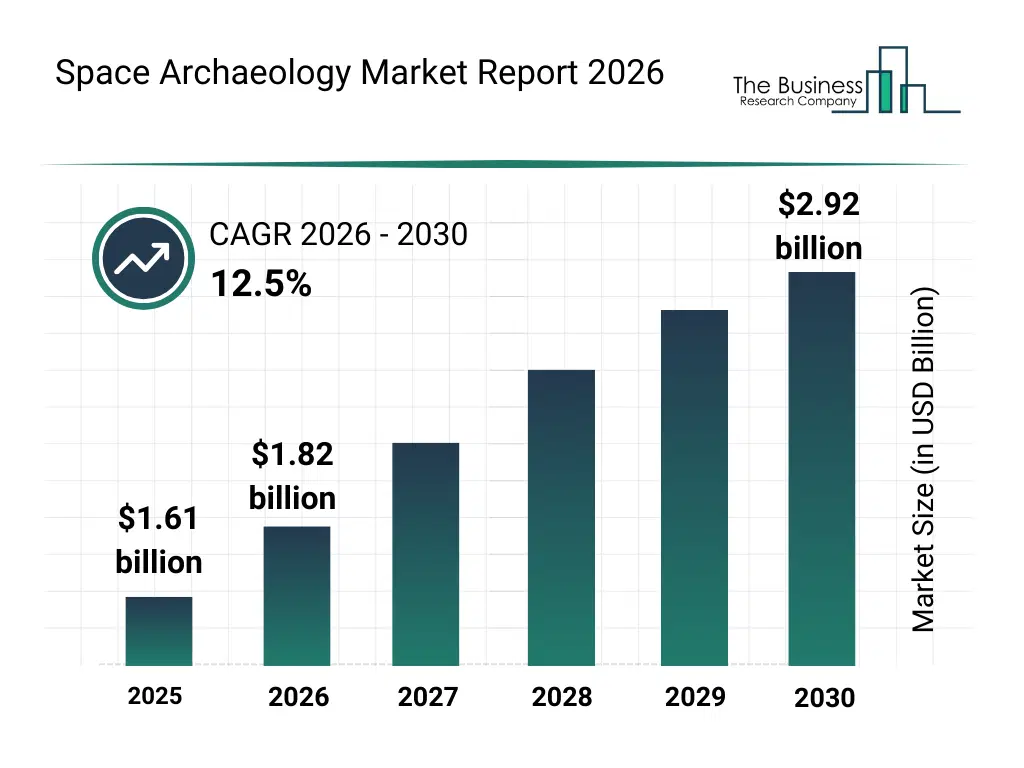
What Is The Space Archaeology Market Size and Share 2026?
The space archaeology market size has grown rapidly in recent years. It will grow from $1.61 billion in 2025 to $1.82 billion in 2026 at a compound annual growth rate (CAGR) of 13.0%. The growth in the historic period can be attributed to increasing accumulation of satellites and space artifacts prompting early documentation efforts, development of remote sensing data packages enabling analysis of orbital debris and lunar objects, expansion of space exploration missions providing new archaeological targets and records, rising academic interest in cultural impacts of human space activity driving structured research, introduction of telescopes and tracking systems supporting observation of heritage objects in orbit.What Is The Space Archaeology Market Growth Forecast?
The space archaeology market size is expected to see rapid growth in the next few years. It will grow to $2.92 billion in 2030 at a compound annual growth rate (CAGR) of 12.5%. The growth in the forecast period can be attributed to growing need for preservation planning as space debris mitigation and heritage protection gain regulatory attention, advancements in robotics and drones enabling detailed inspection of extraterrestrial archaeological sites, increasing commercialization of space creating demand for cultural impact assessments, expansion of public education and outreach programs fostering broader engagement with space heritage, development of archaeological risk assessment models supporting mission planning and heritage-safe operations. Major trends in the forecast period include growth of space heritage preservation programs, rising use of planetary imaging for artifact tracking, expansion of space debris archaeological mapping, increased integration of cultural impact assessments, growing demand for lunar and martian mission record analysis.
Global Space Archaeology Market Segmentation
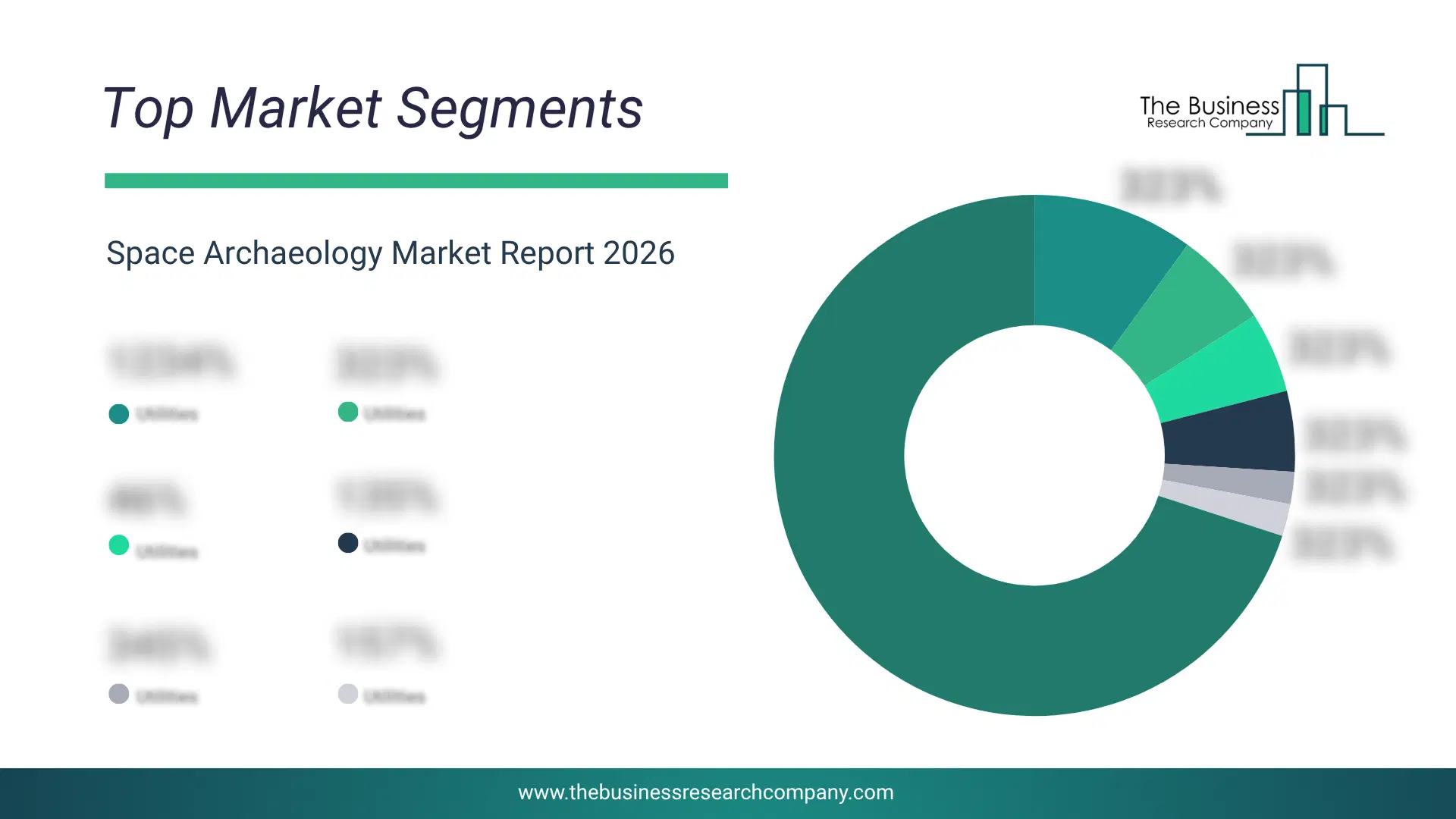
1) By Technology: Remote Sensing, Satellite Imaging, Ground-Penetrating Radar, Other Technologies 2) By Application: Historical Site Discovery, Artifact Analysis, Environmental Monitoring, Other Applications 3) By End-User: Academic Research, Government Agencies, Private Sector, Other End-Users Subsegments: 1) By Remote Sensing: Hyperspectral Imaging, Light Detection And Ranging (LiDAR), Multispectral Imaging, Thermal Imaging, Synthetic Aperture Radar (SAR) 2) By Satellite Imaging,: Optical Imaging Satellites, Radar Imaging Satellites, CubeSats And SmallSats Imaging, Geostationary Satellites, Low Earth Orbit (LEO) Satellites 3) By Ground-Penetrating Radar: High-Frequency Ground-Penetrating Radar Systems, Low-Frequency Ground-Penetrating Radar Systems, Airborne Ground-Penetrating Radar, Vehicle-Mounted Ground-Penetrating Radar, Handheld Ground-Penetrating Radar Devices 4) By Other Technologies: Drone-Based Imaging, Artificial Intelligence And Machine Learning For Data Analysis, Photogrammetry, Three-Dimensional (3D) Modeling And Visualization Tools, Magnetometry SensorsWhat Is Driver Of The Space Archaeology Market?
The increasing investments in space technology are expected to propel the growth of the space archaeology market going forward. Space technology investment refers to allocating financial resources toward developing and deploying technologies used in space exploration, observation, and data collection. Investment in space technology is primarily driven by a heightened governmental focus on satellite innovation to enhance global mapping and monitoring capabilities. Investing in space technology boosts space archaeology by improving satellite imaging, remote sensing, and analytics tools. For instance, in December 2024, according to the European Space Agency, a France-based intergovernmental organization, in 2024, space budgets reached €121 billion ($138.75 billion), reflecting a 7% increase from 2023, with 47% allocated to civil spending, a 5% rise compared to the previous year. Therefore, increasing investments in space technology are driving the growth of the space archaeology industry.Key Players In The Global Space Archaeology Market
Major companies operating in the space archaeology market are Airbus, National Aeronautics and Space Administration (NASA), Hexagon AB, Trimble Inc., European Space Agency (ESA), The German Aerospace Center, Maxar Technologies, L3Harris Technologies, Planet Labs, ICEYE Ltd., Surrey Satellite Technology Limited (SSTL), BlackSky Technology Inc., Capella Space Corp., GHGSat Inc., SatSure, Satellite Imaging Corporation, Satellogic, Astro Digital, Environmental Systems Research Institute Inc. (Esri), Nara Space Technology Inc., Umbra Lab Inc.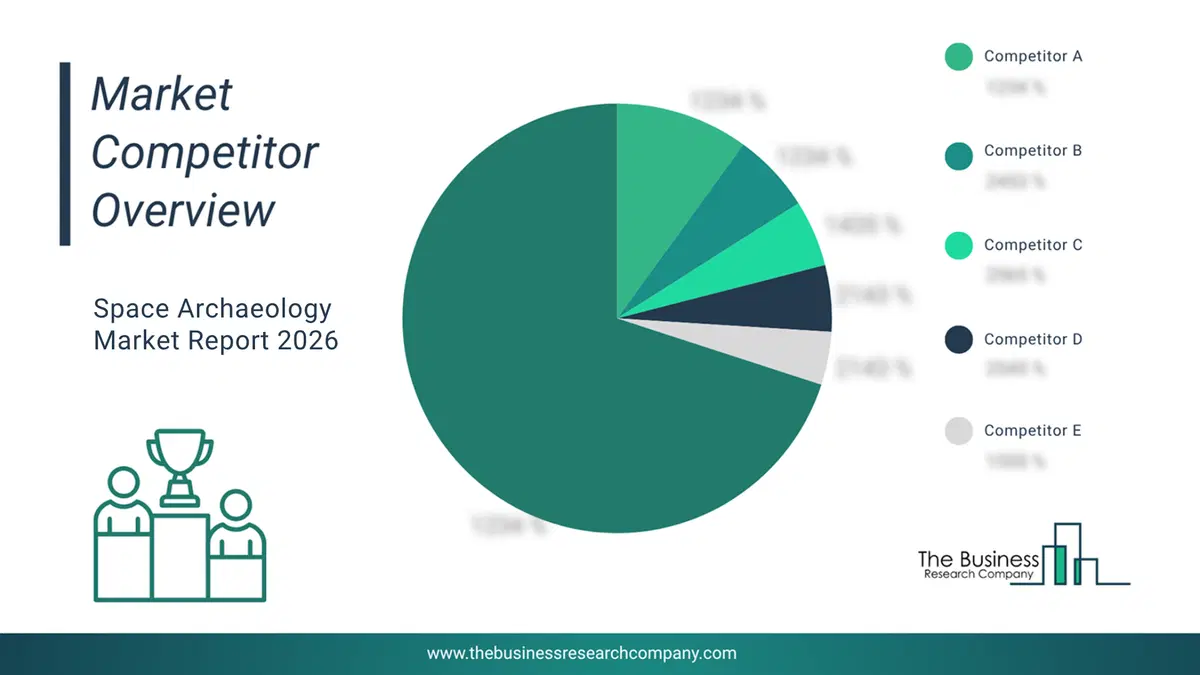
This chart is for illustrative purposes; the full report includes a detailed competitor analysis and comprehensive overview of the top 10 companies in the market.
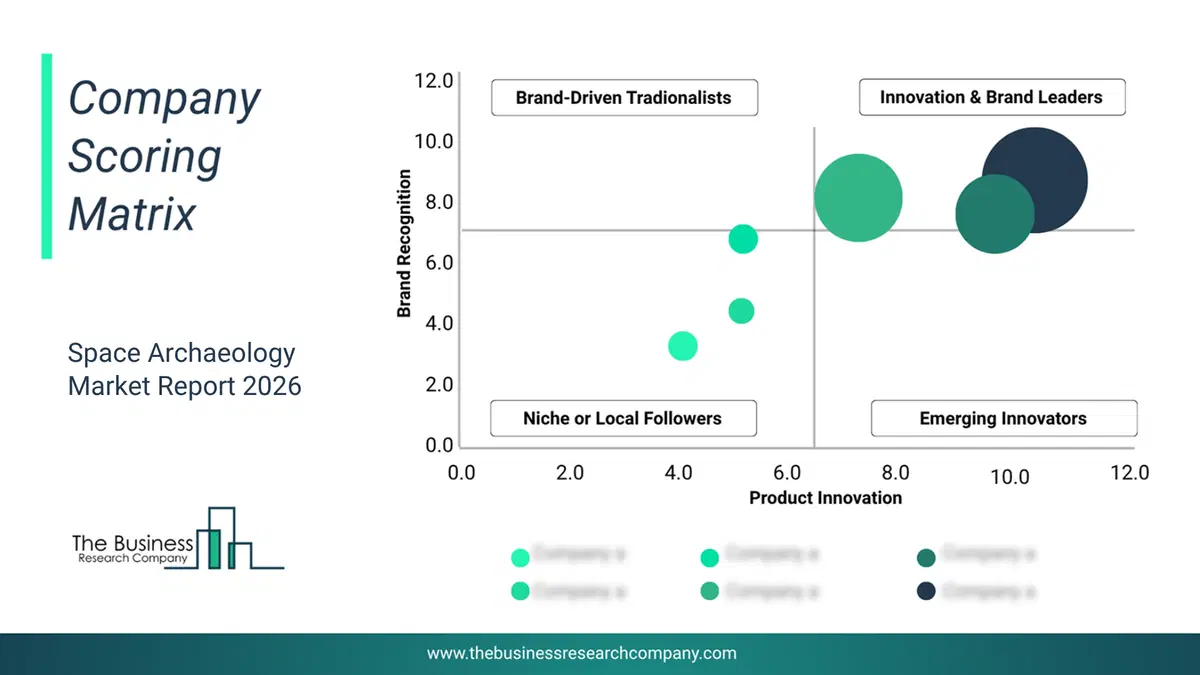
This chart maps companies by product innovation and brand strength, with bubble size indicating relative revenue, helping identify market leaders, challengers, and niche players. This is an illustrative chart; the full report provides a complete and accurate competitive analysis.
Global Space Archaeology Market Trends and Insights
Major companies operating in the space archaeology market are focusing on developing advanced solutions, such as international networking, to enhance data sharing and accelerate the discovery and preservation of ancient sites from space-based observations. International networking refers to collaborating and exchanging information and resources across countries to achieve common research and development goals. For instance, in May 2025, the International Centre on Space Technologies for Natural and Cultural Heritage (HIST), a China-based international platform for integrating space technology with heritage conservation, launched its third-phase operation (2025–2033). This phase was initiated under a new agreement involving the Chinese Academy of Sciences (CAS), UNESCO, and HIST. The collaboration aims to enhance the use of space technologies in monitoring and protecting UNESCO-designated heritage sites. It represents a renewed commitment to supporting global heritage conservation in line with the UN 2030 Sustainable Development Agenda. This new phase signals expanded international cooperation and innovation in space-based heritage protection.What Are Latest Mergers And Acquisitions In The Space Archaeology Market? Space Flight Laboratory (SFL) Partnered With NUVIEW To Pioneer Space-Based 3D Earth Mapping Through Lidar Collaboration
In September 2024, Space Flight Laboratory (SFL), a Canada-based organization specializing in the development and operation of small, micro-, and nano-satellites, partnered with NUVIEW to pioneer precision mapping from space. The collaboration aims to develop and validate a small satellite platform that enables high-resolution, cost-effective global 3D Earth mapping using space-based LiDAR technology. NUVIEW is a US-based provider of a groundbreaking constellation of satellites using LiDAR.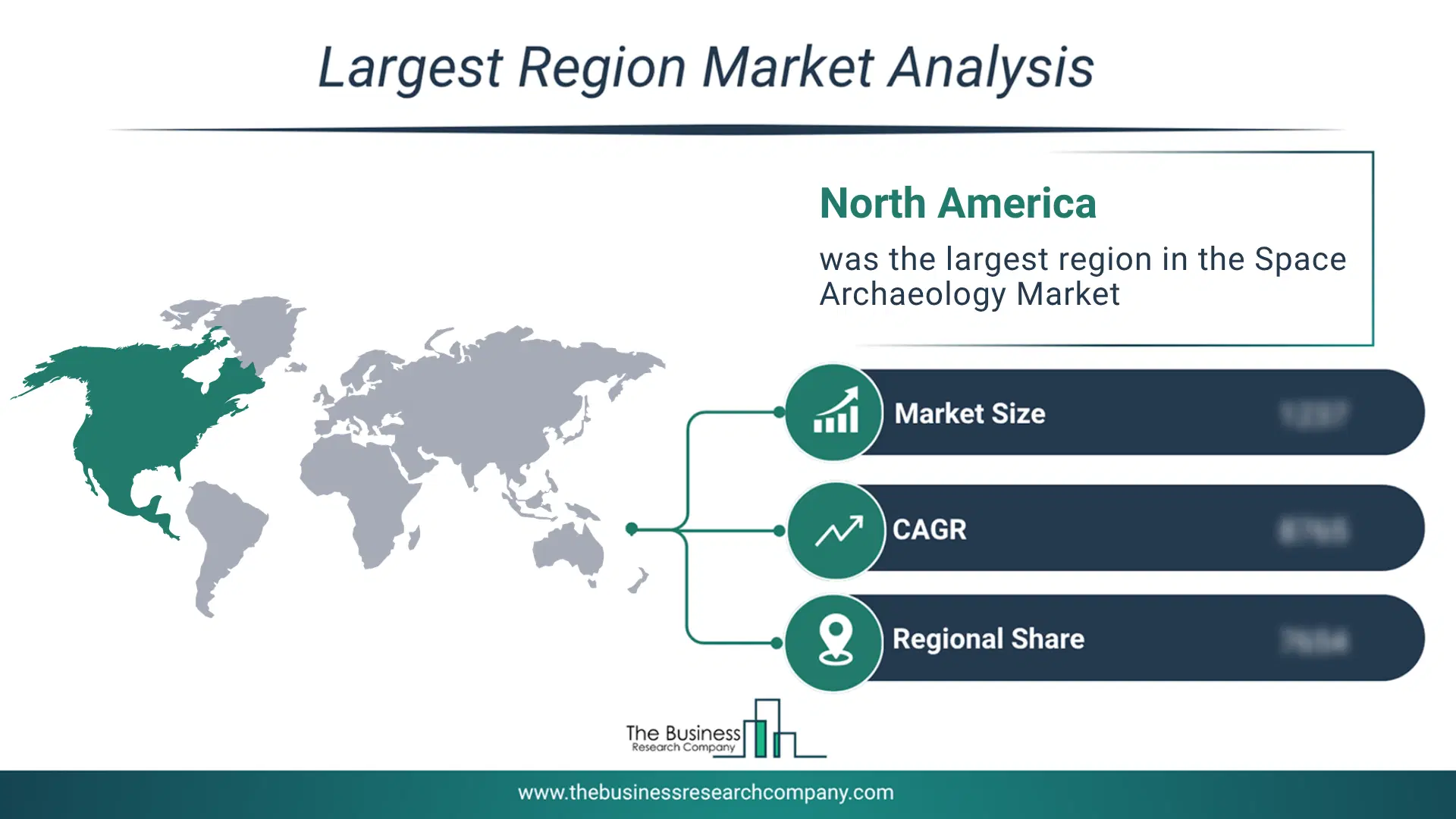
Regional Insights
North America was the largest region in the space archaeology market in 2025. Asia-Pacific is expected to be the fastest-growing region in the forecast period. The regions covered in this market report are Asia-Pacific, South East Asia, Western Europe, Eastern Europe, North America, South America, Middle East, Africa. The countries covered in this market report are Australia, Brazil, China, France, Germany, India, Indonesia, Japan, Taiwan, Russia, South Korea, UK, USA, Canada, Italy, SpainWhat Defines the Space Archaeology Market?
The space archaeology market consists of revenues earned by entities by providing services such as space heritage documentation, cultural impact analysis, public education and outreach, and preservation planning. The market value includes the value of related goods sold by the service provider or included within the service offering. The space archaeology market includes sales of remote sensing data packages, archaeological risk assessment models, telescopes and tracking systems, robotics and drones. Values in this market are ‘factory gate’ values, that is, the value of goods sold by the manufacturers or creators of the goods, whether to other entities (including downstream manufacturers, wholesalers, distributors, and retailers) or directly to end customers. The value of goods in this market includes related services sold by the creators of the goods.How is Market Value Defined and Measured?
The market value is defined as the revenues that enterprises gain from the sale of goods and/or services within the specified market and geography through sales, grants, or donations in terms of the currency (in USD unless otherwise specified). The revenues for a specified geography are consumption values that are revenues generated by organizations in the specified geography within the market, irrespective of where they are produced. It does not include revenues from resales along the supply chain, either further along the supply chain or as part of other products.
This chart presents market attractiveness based on a quantitative evaluation of growth, competition, strategic alignment, and risk, offering a clear view of opportunity areas for decision-making. This chart is for illustrative purposes; the full report contains the complete analysis.

This chart highlights the Total Addressable Market (TAM) by estimating the maximum revenue opportunity using an assumption-driven approach, supporting strategic planning and opportunity sizing across markets. The chart is illustrative; the full report provides a more comprehensive analysis.
What Key Data and Analysis Are Included in the Space Archaeology Market Report 2026?
The space archaeology market research report is one of a series of new reports from The Business Research Company that provides market statistics, including industry global market size, regional shares, competitors with the market share, detailed market segments, market trends and opportunities, and any further data you may need to thrive in the space archaeology industry. The market research report delivers a complete perspective of everything you need, with an in-depth analysis of the current and future state of the industry.Space Archaeology Market Report Forecast Analysis
| Report Attribute | Details |
|---|---|
| Market Size Value In 2026 | $1.82 billion |
| Revenue Forecast In 2030 | $2.92 billion |
| Growth Rate | CAGR of 12.5% from 2026 to 2030 |
| Base Year For Estimation | 2025 |
| Actual Estimates/Historical Data | 2020-2025 |
| Forecast Period | 2026 - 2030 |
| Market Representation | Revenue in USD Billion and CAGR from 2026 to 2030 |
| Segments Covered | Technology, Application, End-User |
| Regional Scope | Asia-Pacific, Western Europe, Eastern Europe, North America, South America, Middle East, Africa |
| Country Scope | The countries covered in the space archaeology market report are Australia, Brazil, China, France, Germany, India, Indonesia, Japan, Taiwan, Russia, South Korea, UK, USA, Canada, Italy, Spain |
| Key Companies Profiled | Airbus, National Aeronautics and Space Administration (NASA), Hexagon AB, Trimble Inc., European Space Agency (ESA), The German Aerospace Center, Maxar Technologies, L3Harris Technologies, Planet Labs, ICEYE Ltd., Surrey Satellite Technology Limited (SSTL), BlackSky Technology Inc., Capella Space Corp., GHGSat Inc., SatSure, Satellite Imaging Corporation, Satellogic, Astro Digital, Environmental Systems Research Institute Inc. (Esri), Nara Space Technology Inc., Umbra Lab Inc. |
| Customization Scope | Request for Customization |
| Pricing And Purchase Options | Explore Purchase Options |