
Third-Party Banking Software Market Report 2026
Global Outlook – By Product Type (Core Banking Software, Omnichannel Banking Software, Business Intelligence Software, Wealth Management Software, Other Product Types), By Deployment (On-Premise, Cloud), By Size Of Financial Institution (Small-Sized Financial Institutions, Medium-Sized Financial Institutions, Large Financial Institutions), By Application (Risk Management, Information Security, Business Intelligence, Training And Consulting Solutions, Other Applications), By End-User (Retail Banks, Commercial Banks, Investment Banks, Other End-Users) – Market Size, Trends, Strategies, and Forecast to 2030
Third-Party Banking Software Market Overview
• Third-Party Banking Software market size has reached to $30.89 billion in 2025 • Expected to grow to $46.95 billion in 2030 at a compound annual growth rate (CAGR) of 8.7% • Growth Driver: Increasing Prevalence Of Cyber-Attacks Fueling Market Growth Due To Growing Digitalization Of Data And Services • Market Trend: Technological Advancements Shaping The Third-Party Banking Software With Artificial Intelligence (AI)-Powered Automation • North America was the largest region in 2025 and Asia-Pacific is the fastest growing region.What Is Covered Under Third-Party Banking Software Market?
Third-party banking software refers to software solutions developed by external vendors (not the bank itself) that are used by financial institutions to manage various banking operations. These solutions can include core banking systems, customer relationship management (CRM) platforms, risk management tools, digital banking applications, fraud detection systems, and more. The main types of products in third-party banking software are core banking software, omnichannel banking software, business intelligence software, wealth management software, and others. Core banking software is a centralized system that manages a bank’s key operations, such as accounts, transactions, and loans, across branches and channels in real time. These software solutions are deployed through on-premise and cloud and cater to financial institutions of various sizes, including small-sized financial institutions, medium-sized financial institutions, and large financial institutions. They are used across several application areas, including risk management, information security, business intelligence, training and consulting solutions, and others, and are adopted by diverse end-users such as retail banks, commercial banks, investment banks, and others.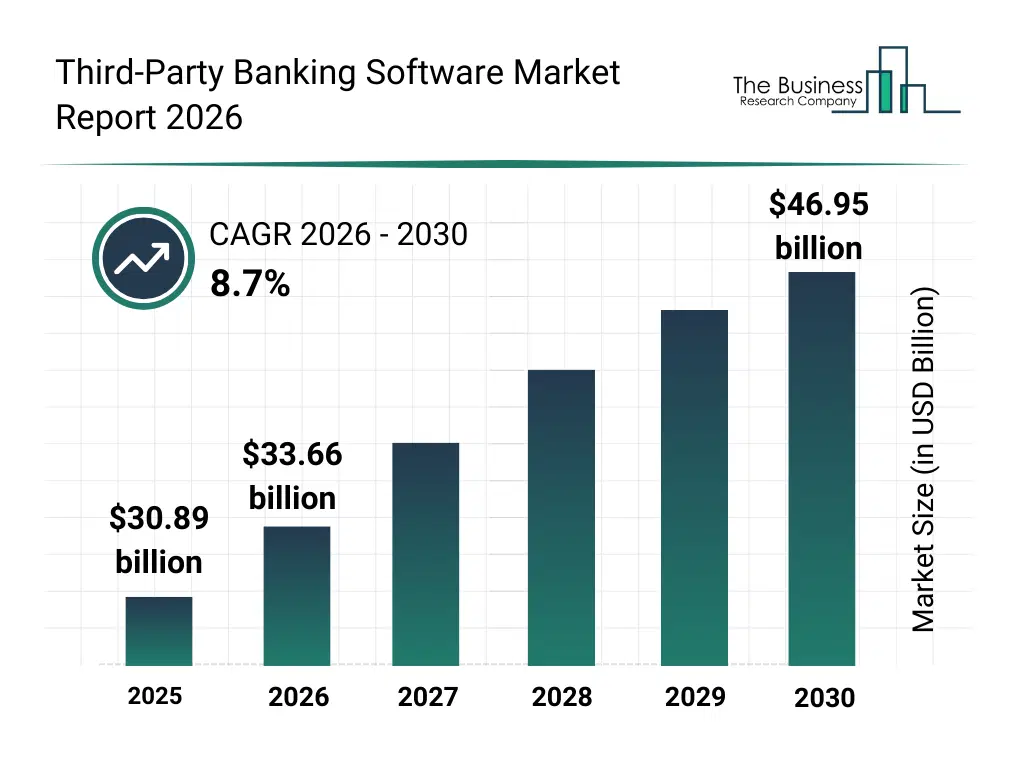
What Is The Third-Party Banking Software Market Size and Share 2026?
The third-party banking software market size has grown strongly in recent years. It will grow from $30.89 billion in 2025 to $33.66 billion in 2026 at a compound annual growth rate (CAGR) of 9.0%. The growth in the historic period can be attributed to increasing digital transformation initiatives in banks, growing demand for scalable banking software, rising regulatory compliance requirements, expansion of online and mobile banking usage, increased outsourcing of banking technology development.What Is The Third-Party Banking Software Market Growth Forecast?
The third-party banking software market size is expected to see strong growth in the next few years. It will grow to $46.95 billion in 2030 at a compound annual growth rate (CAGR) of 8.7%. The growth in the forecast period can be attributed to increasing adoption of ai-powered banking solutions, rising investment in cybersecurity platforms, expansion of open banking ecosystems, growing demand for real-time data analytics, increased migration to cloud-based banking infrastructure. Major trends in the forecast period include increasing adoption of cloud-native core banking systems, rising integration of advanced fraud detection tools, growing use of omnichannel banking platforms, expansion of data-driven risk management solutions, enhanced focus on modular banking architectures.
Global Third-Party Banking Software Market Segmentation
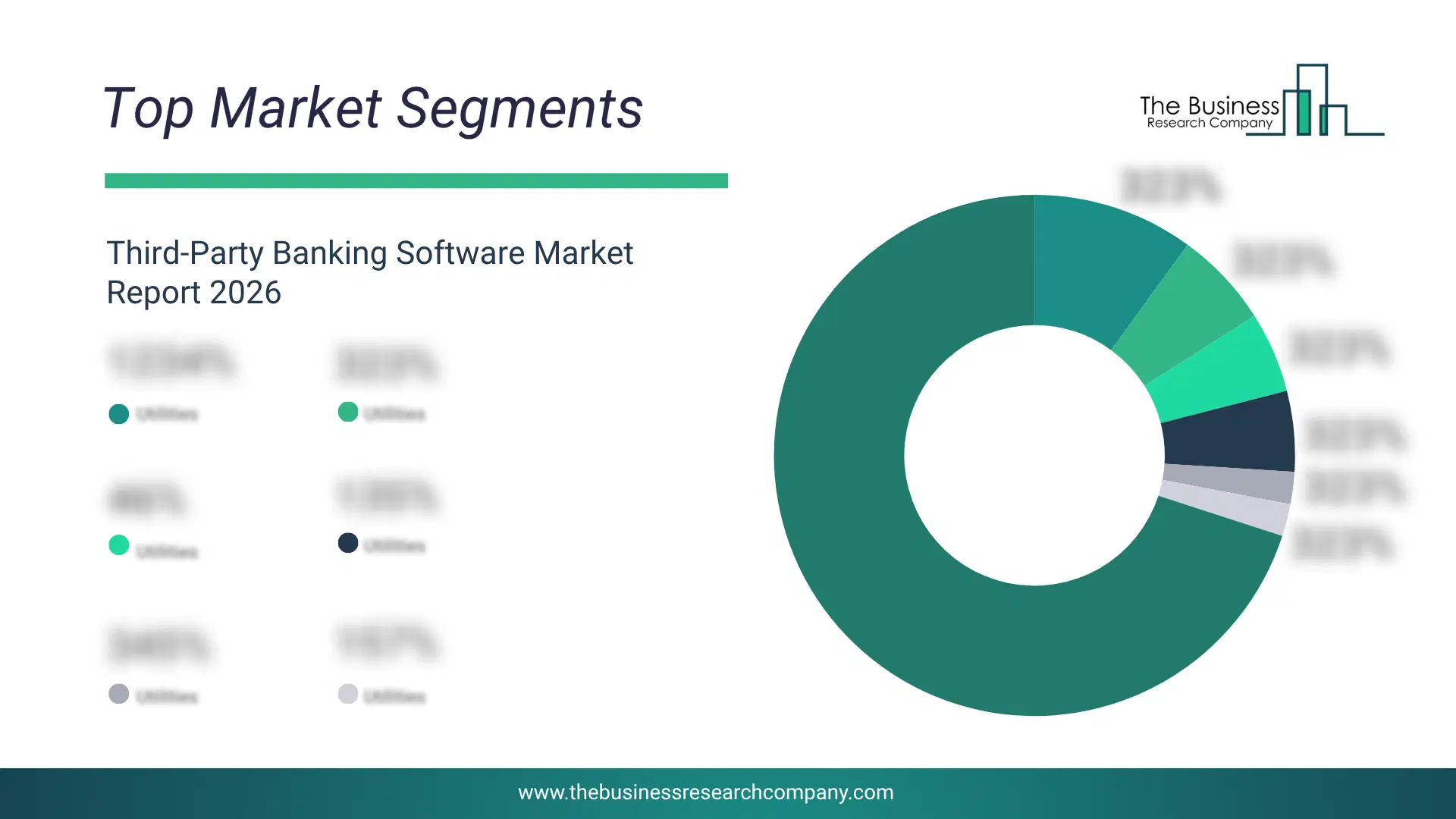
1) By Product Type: Core Banking Software, Omnichannel Banking Software, Business Intelligence Software, Wealth Management Software, Other Product Types 2) By Deployment: On-Premise, Cloud 3) By Size Of Financial Institution: Small-Sized Financial Institutions, Medium-Sized Financial Institutions, Large Financial Institutions 4) By Application: Risk Management, Information Security, Business Intelligence, Training And Consulting Solutions, Other Applications 5) By End-User: Retail Banks, Commercial Banks, Investment Banks, Other End-Users Subsegments: 1) By Core Banking Software: Account Management, Loan Management, Deposit Management, Transaction Processing, Compliance Management 2) By Omnichannel Banking Software: Mobile Banking, Internet Banking, Automated Teller Machine Banking, Branch Banking, Call Center Banking 3) By Business Intelligence Software: Data Analytics, Performance Management, Risk Management, Regulatory Reporting, Customer Insights 4) By Wealth Management Software: Portfolio Management, Financial Planning, Investment Management, Retirement Planning, Tax Optimization 5) By Other Product Types: Payment Processing, Customer Relationship Management, Fraud Detection, Treasury Management, Core Integration ToolsWhat Is The Driver Of The Third-Party Banking Software Market?
The increasing prevalence of cyberattacks is expected to propel the growth of the third-party banking software market going forward. Cyberattack refers to a deliberate attempt by an individual or group to breach the information system of another individual or organization to disrupt or gain unauthorized access to computer systems. The increasing prevalence of cyberattacks is driven by the growing digitalization of data and services, which expands the attack surface and creates more opportunities for cybercriminals to exploit vulnerabilities. Third-party banking software helps prevent cyberattacks by allowing banks to access advanced security technologies with continuous monitoring and enhanced protection and ensures quick responses to emerging threats. For instance, in June 2025, according to a report published by the Department for Science, Innovation and Technology, a UK-based government department, the prevalence of ransomware among businesses rose significantly, with the share affected increasing from less than 0.5% in 2024 to 1% in 2025. Therefore, the increasing prevalence of cyberattacks is driving the growth of the third-party banking software industry.Key Players In The Global Third-Party Banking Software Market
Major companies operating in the third-party banking software market are International Business Machines Corporation (IBM), Oracle Corporation, SAP SE, Salesforce Inc., Tata Consultancy Services Limited (TCS), NEC Corporation, Infosys Limited, Fiserv Inc., DXC Technology Company, Fidelity National Information Services Inc. (FIS), Jack Henry & Associates Inc., Finastra Group Holdings Limited, Temenos AG, Misys International Banking Systems Limited , Sopra Banking Software SA, nCino Inc., Intellect Design Arena Limited, Silverlake Axis Ltd., Mambu B.V., Profile Software S.A.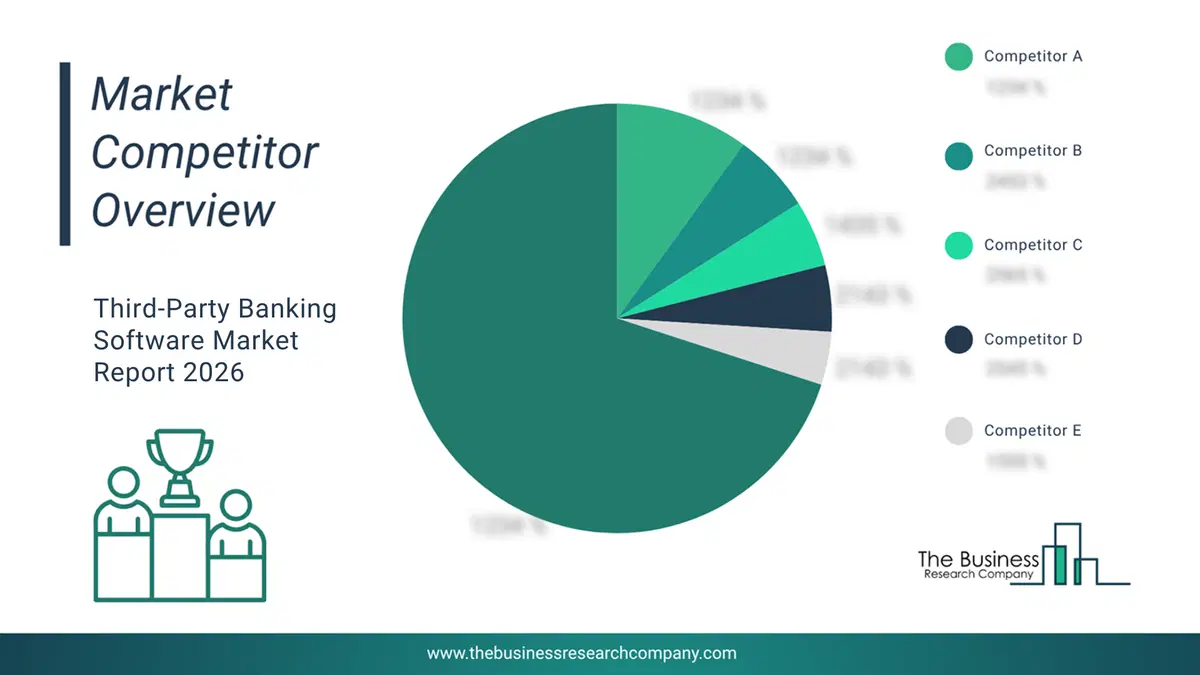
This chart is for illustrative purposes; the full report includes a detailed competitor analysis and comprehensive overview of the top 10 companies in the market.
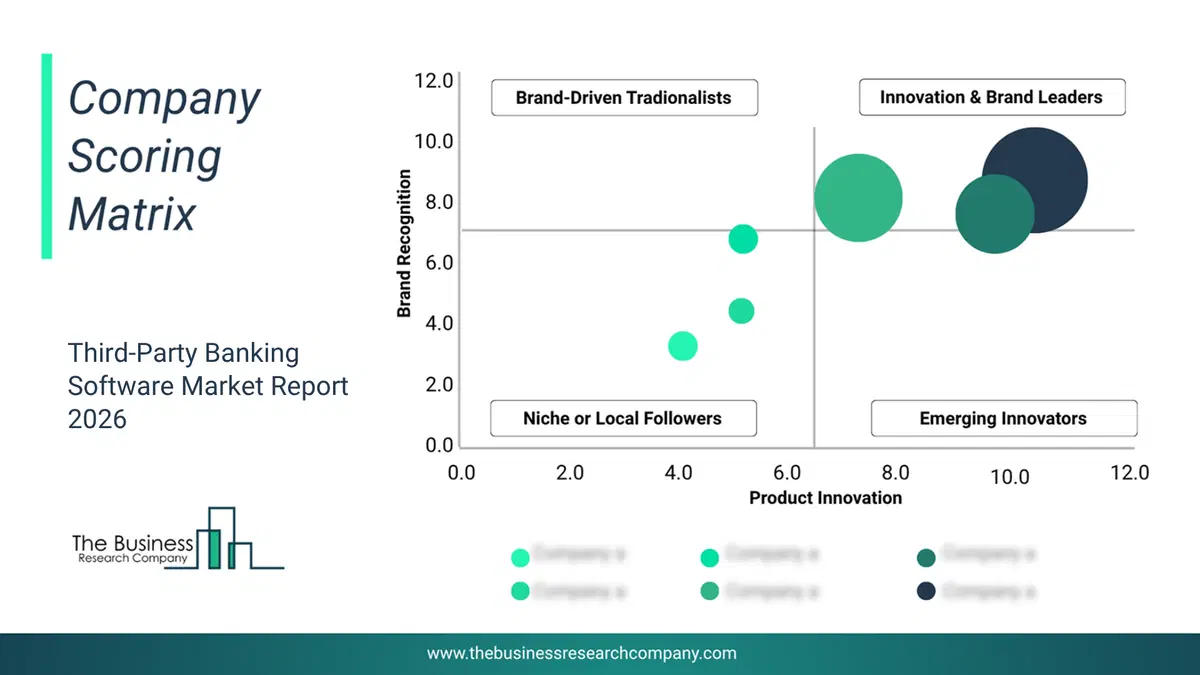
This chart maps companies by product innovation and brand strength, with bubble size indicating relative revenue, helping identify market leaders, challengers, and niche players. This is an illustrative chart; the full report provides a complete and accurate competitive analysis.
Global Third-Party Banking Software Market Trends and Insights
Major companies operating in the third-party banking software market are focusing on technological advancements such as artificial intelligence (AI)-powered automation banking to enhance decision-making and enhance customer experiences, redefining operational efficiency in financial institutions. Artificial intelligence (AI)-powered banking refers to the integration of artificial intelligence (AI) and automation technologies into banking systems to improve decision-making and enable banks to make smarter decisions, which offer personalized customer experiences with less manual effort. For instance, in January 2025, Black Dragon Capital LLC, a US-based technology company, launched Open Banking Solutions (OBS), a cloud-native and digital banking platform that empowers community-based financial institutions to accelerate digital transformation and enhance customer experiences. Open banking solutions (OBS) offer unique features that enhance both customer experience and financial innovation. These solutions are built on API-driven integration, allowing secure and standardized data sharing between banks and third-party providers. Customers retain full control over their financial data through robust consent management systems, ensuring transparency and trust. It also provides real-time access to banking information, enabling quicker credit decisions and personalized financial services.What Are Latest Mergers And Acquisitions In The Third-Party Banking Software Market?
In January 2024, Visa Inc., a US-based payment card services company, acquired Pismo Technological Solutions Ltd. for an undisclosed amount. With this acquisition, Visa Inc. aims to enhance and broaden Visa’s core banking and issuer processing capabilities, enabling it to better serve financial institutions and fintech clients with innovative, cloud-native banking and payment solutions across all product types, payment rails, geographies, and currencies. Pismo Technological Solutions Ltd. is a Brazil-based developer of a cloud-based payment processing platform that offers third-party banking software through its cloud-native, API-based platform designed for core banking.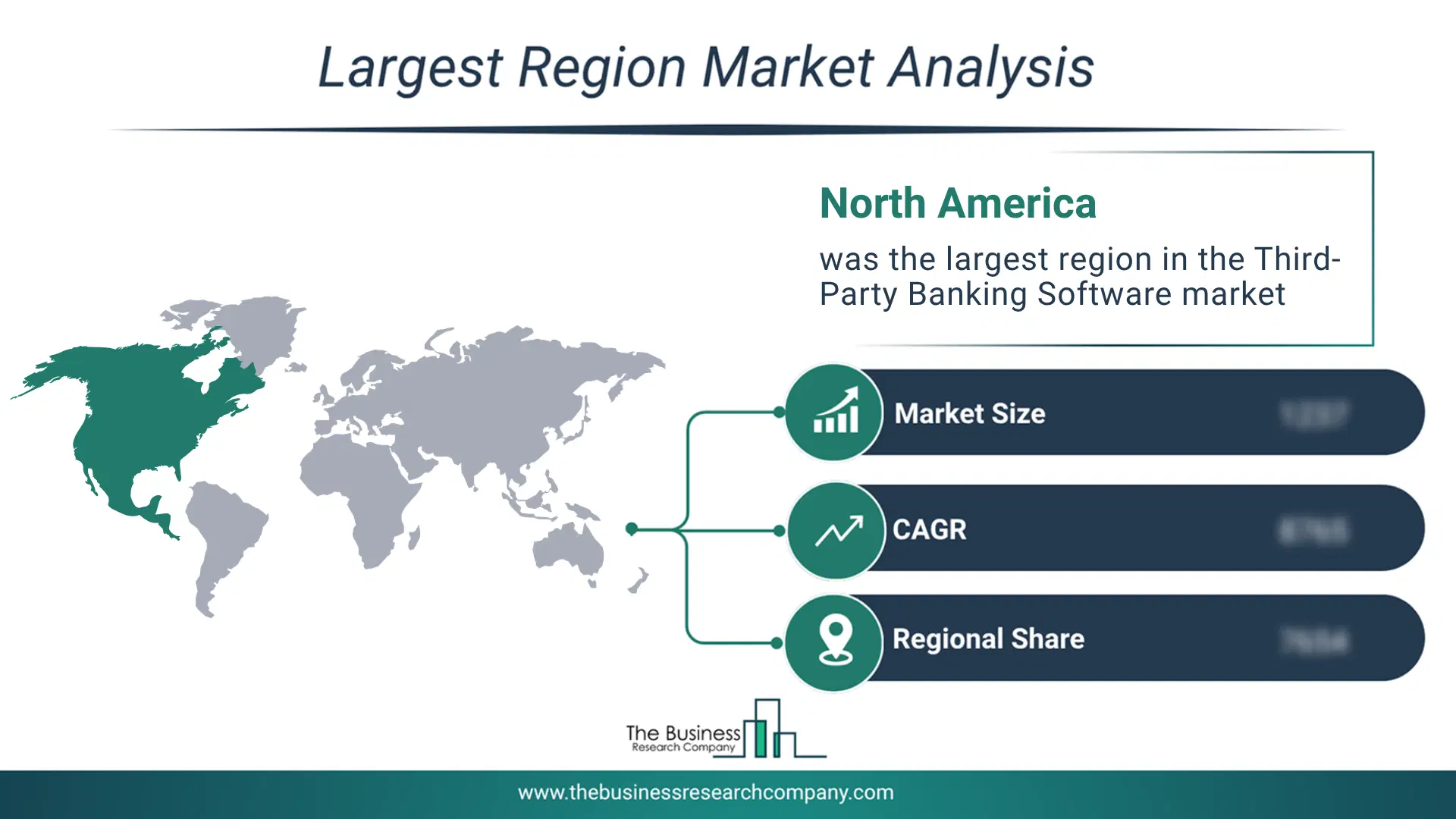
Regional Outlook
North America was the largest region in the third-party banking software market in 2025. Asia-Pacific is expected to be the fastest-growing region in the forecast period. The regions covered in this market report are Asia-Pacific, South East Asia, Western Europe, Eastern Europe, North America, South America, Middle East, Africa. The countries covered in this market report are Australia, Brazil, China, France, Germany, India, Indonesia, Japan, Taiwan, Russia, South Korea, UK, USA, Canada, Italy, Spain.What Defines the Third-Party Banking Software Market?
The third-party banking software market consists of revenues earned by entities by providing services such as core banking services, payment processing, online banking, fraud detection and risk management, customer relationship management, and loan and credit management. The market value includes the value of related goods sold by the service provider or included within the service offering. The third-party banking software market also includes sales of core banking systems, tax optimization tools, risk management tools, and wealth management platforms. Values in this market are ‘factory gate’ values, that is the value of goods sold by the manufacturers or creators of the goods, whether to other entities (including downstream manufacturers, wholesalers, distributors and retailers) or directly to end customers. The value of goods in this market includes related services sold by the creators of the goods.How is Market Value Defined and Measured?
The market value is defined as the revenues that enterprises gain from the sale of goods and/or services within the specified market and geography through sales, grants, or donations in terms of the currency (in USD unless otherwise specified). The revenues for a specified geography are consumption values that are revenues generated by organizations in the specified geography within the market, irrespective of where they are produced. It does not include revenues from resales along the supply chain, either further along the supply chain or as part of other products.
This chart presents market attractiveness based on a quantitative evaluation of growth, competition, strategic alignment, and risk, offering a clear view of opportunity areas for decision-making. This chart is for illustrative purposes; the full report contains the complete analysis.

This chart highlights the Total Addressable Market (TAM) by estimating the maximum revenue opportunity using an assumption-driven approach, supporting strategic planning and opportunity sizing across markets. The chart is illustrative; the full report provides a more comprehensive analysis.
What Key Data and Analysis Are Included in the Third-Party Banking Software Market Report 2026?
The third-party banking software market research report is one of a series of new reports from The Business Research Company that provides market statistics, including Market Report 2026?global market size, regional shares, competitors with the market share, detailed market segments, market trends and opportunities, and any further data you may need to thrive in the third-party banking software Market Report 2026? The market research report delivers a complete perspective of everything you need, with an in-depth analysis of the current and future state of the Market Report 2026?Third-Party Banking Software Market Report Forecast Analysis
| Report Attribute | Details |
|---|---|
| Market Size Value In 2026 | $33.66 billion |
| Revenue Forecast In 2030 | $46.95 billion |
| Growth Rate | CAGR of 9.0% from 2026 to 2030 |
| Base Year For Estimation | 2025 |
| Actual Estimates/Historical Data | 2020-2025 |
| Forecast Period | 2026 - 2030 |
| Market Representation | Revenue in USD Billion and CAGR from 2026 to 2030 |
| Segments Covered | Product Type, Deployment, Size Of Financial Institution, Application, End-User |
| Regional Scope | Asia-Pacific, Western Europe, Eastern Europe, North America, South America, Middle East, Africa |
| Country Scope | The countries covered in the report are Australia, Brazil, China, France, Germany, India, Indonesia, Japan, Taiwan, Russia, South Korea, UK, USA, Canada, Italy, Spain. |
| Key Companies Profiled | International Business Machines Corporation (IBM), Oracle Corporation, SAP SE, Salesforce Inc., Tata Consultancy Services Limited (TCS), NEC Corporation, Infosys Limited, Fiserv Inc., DXC Technology Company, Fidelity National Information Services Inc. (FIS), Jack Henry & Associates Inc., Finastra Group Holdings Limited, Temenos AG, Misys International Banking Systems Limited , Sopra Banking Software SA, nCino Inc., Intellect Design Arena Limited, Silverlake Axis Ltd., Mambu B.V., Profile Software S.A. |
| Customization Scope | Request for Customization |
| Pricing And Purchase Options | Explore Purchase Options |