
Truck Platooning Systems Market Report 2026
Global Outlook – By Component (Forward-Looking Camera, System Display With Rear Time Camera, Driver-Centric Design), By Vehicle Type (Light Commercial Vehicles (LCVs), Medium Commercial Vehicles (MCVs), Heavy Commercial Vehicles (HCVs)), By Technology (Acceleration And Braking Controller, Global Positioning System, Cellular And Wi-Fi Communication, DSRS Vehicle-To-Vehicle Communication) – Market Size, Trends, Strategies, and Forecast to 2030
Truck Platooning Systems Market Overview
• Truck Platooning Systems market size has reached to $1.32 billion in 2025 • Expected to grow to $2.72 billion in 2030 at a compound annual growth rate (CAGR) of 15.1% • Growth Driver: Commercial Vehicle Expansion Fuels The Growth Of The Truck Platooning Systems Market • Market Trend: Integrated Connected Truck Platforms For Seamless Fleet Communication And Management. • North America was the largest region in 2025 and Asia-Pacific is the fastest growing region.What Is Covered Under Truck Platooning Systems Market?
Truck platooning systems are a technologically advanced mode of transportation in which a convoy of trucks moves closely together while utilizing sophisticated communication and control systems to keep a tight formation. These systems offer reduced fuel consumption due to improved aerodynamics, increased highway capacity by reducing the space between vehicles, and enhanced safety through coordinated braking and collision avoidance systems. The main types of components in truck platooning systems are a forward-looking camera, a system display with a rear-time camera, and a driver-centric design. A forward-looking camera typically refers to a camera system mounted on the front of a vehicle such as a car, truck, or autonomous vehicle. It can be used for various vehicle types such as light commercial and heavy commercial, through various technologies, including acceleration and braking controllers, global positioning systems, cellular and Wi-Fi communication, and DSRS vehicle-to-Vehicle communication.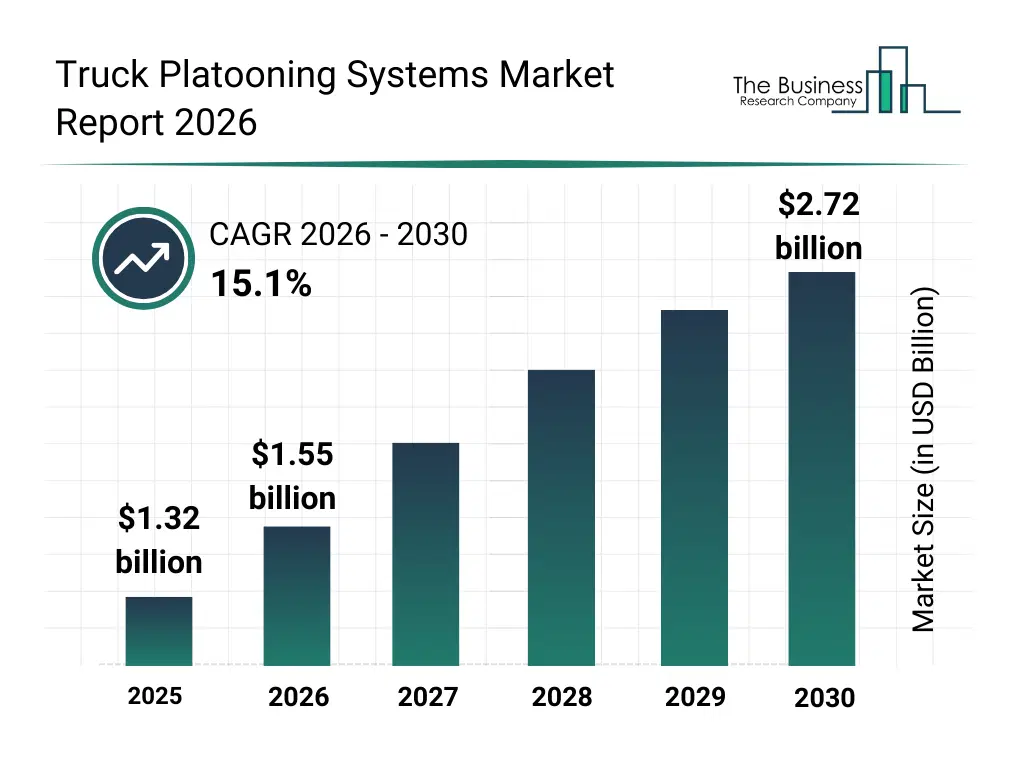
What Is The Truck Platooning Systems Market Size and Share 2026?
The truck platooning systems market size has grown rapidly in recent years. It will grow from $1.32 billion in 2025 to $1.55 billion in 2026 at a compound annual growth rate (CAGR) of 17.6%. The growth in the historic period can be attributed to increasing long-haul freight transportation demand, rising fuel cost pressures on logistics operators, early adoption of advanced driver assistance systems, expansion of connected vehicle infrastructure, growth in commercial trucking fleets.What Is The Truck Platooning Systems Market Growth Forecast?
The truck platooning systems market size is expected to see rapid growth in the next few years. It will grow to $2.72 billion in 2030 at a compound annual growth rate (CAGR) of 15.1%. The growth in the forecast period can be attributed to increasing deployment of semi-autonomous trucks, rising investments in intelligent transportation systems, growing focus on emission reduction in freight transport, expansion of smart highway infrastructure, increasing regulatory support for platooning trials. Major trends in the forecast period include increasing adoption of cooperative driving systems, rising integration of vehicle-to-vehicle communication, growing focus on fuel efficiency optimization, expansion of advanced driver assistance integration, enhanced emphasis on platoon safety protocols.
Global Truck Platooning Systems Market Segmentation
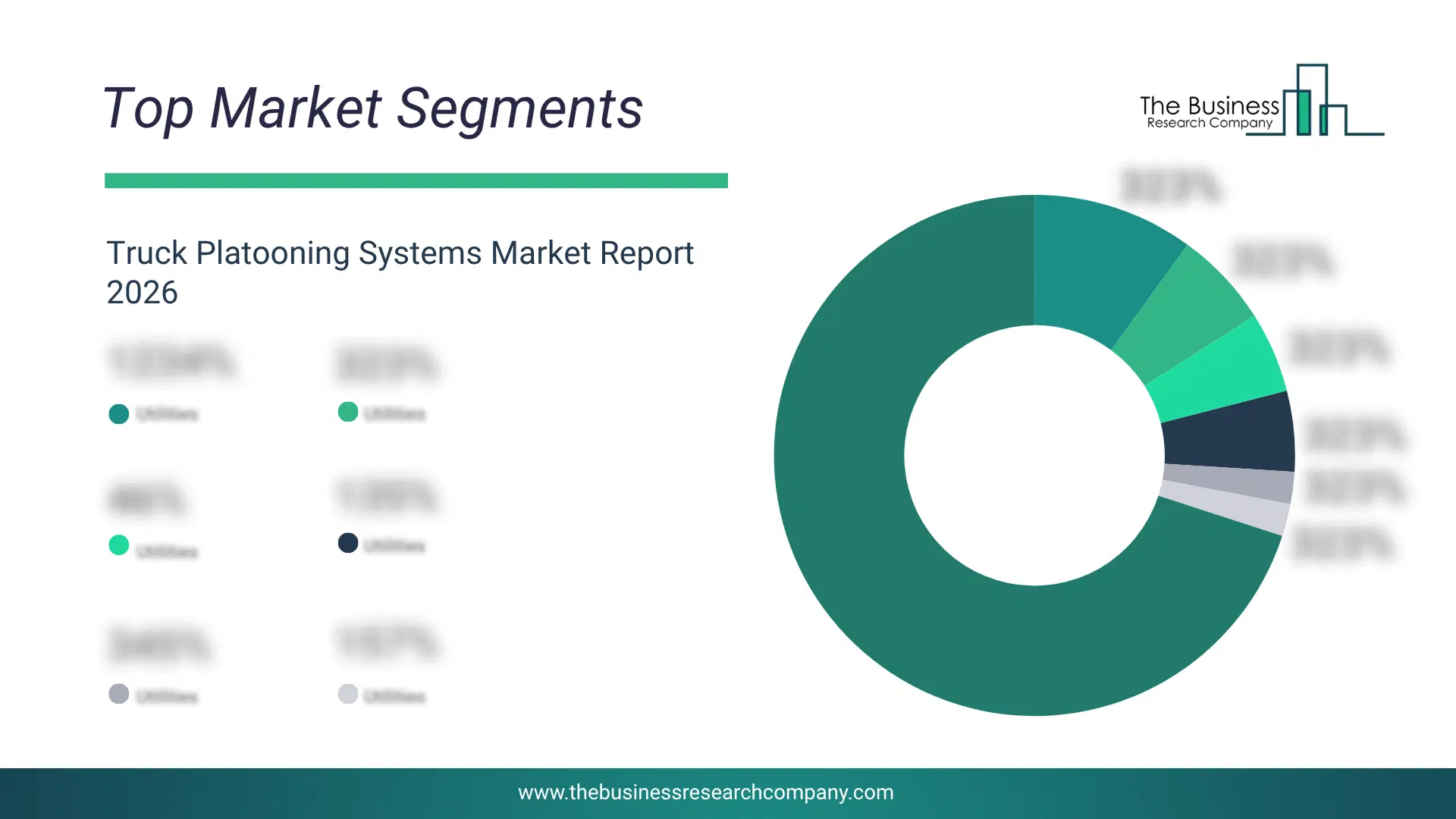
1) By Component: Forward-Looking Camera, System Display With Rear Time Camera, Driver-Centric Design 2) By Vehicle Type: Light Commercial Vehicles (LCVs), Medium Commercial Vehicles (MCVs), Heavy Commercial Vehicles (HCVs) 3) By Technology: Acceleration And Braking Controller, Global Positioning System, Cellular And Wi-Fi Communication, DSRS Vehicle-To-Vehicle Communication Subsegments: 1) By Forward-Looking Camera: Stereoscopic Cameras, Monocular Cameras 2) By System Display With Rear-Time Camera: Real-Time Video Feed Display Systems, Multi-View Display Systems, Rearview And Side-view Camera Systems 3) By Driver-centric Design: Driver Assistance Systems, Driver Monitoring And Safety SystemsWhat Is The Driver Of The Truck Platooning Systems Market?
A growing number of commercial vehicles is expected to propel the growth of the truck platooning systems market going forward. Commercial vehicles are a broad category primarily designed for commercial use rather than personal transportation. The rise in the number of commercial vehicles is due to economic growth, changes in consumer behavior, and the evolving dynamics of global trade and transportation. Truck platooning systems improve commercial vehicles' efficiency, safety, and cost savings, making them an attractive option for fleet operators looking to optimize their operations. For instance, in January 2024, according to the European Automobile Manufacturers Association, a Belgium-based group of the automobile industry, European Union bus registrations in 2023 soared by 19.4% to 32,593 units, while new truck registrations rose by 16.3% to 346,986 units compared to 2022. Therefore, the growing number of commercial vehicles is driving the growth of the truck platooning systems industry.Key Players In The Global Truck Platooning Systems Market
Major companies operating in the truck platooning systems market are Daimler Truck Holding AG, AB Volvo, PACCAR Inc., Scania AB, Iveco Group N.V., MAN Truck & Bus SE, Navistar International Corporation, DAF Trucks N.V., Einride AB, TuSimple Holdings Inc., Plus AI Inc., Aurora Innovation Inc., Kodiak Robotics Inc., Gatik AI Inc., Locomation Inc., Peloton Technology Inc., Volta Trucks AB, Hino Motors Ltd., Isuzu Motors Limited, Toyota Motor Corporation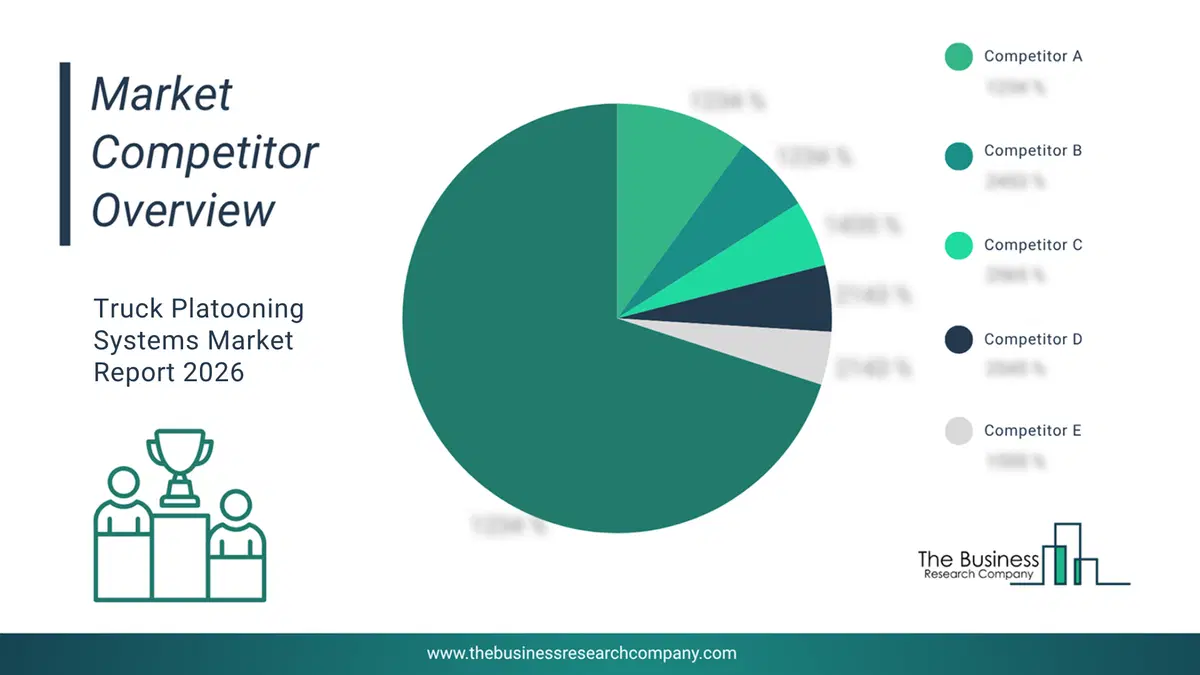
This chart is for illustrative purposes; the full report includes a detailed competitor analysis and comprehensive overview of the top 10 companies in the market.
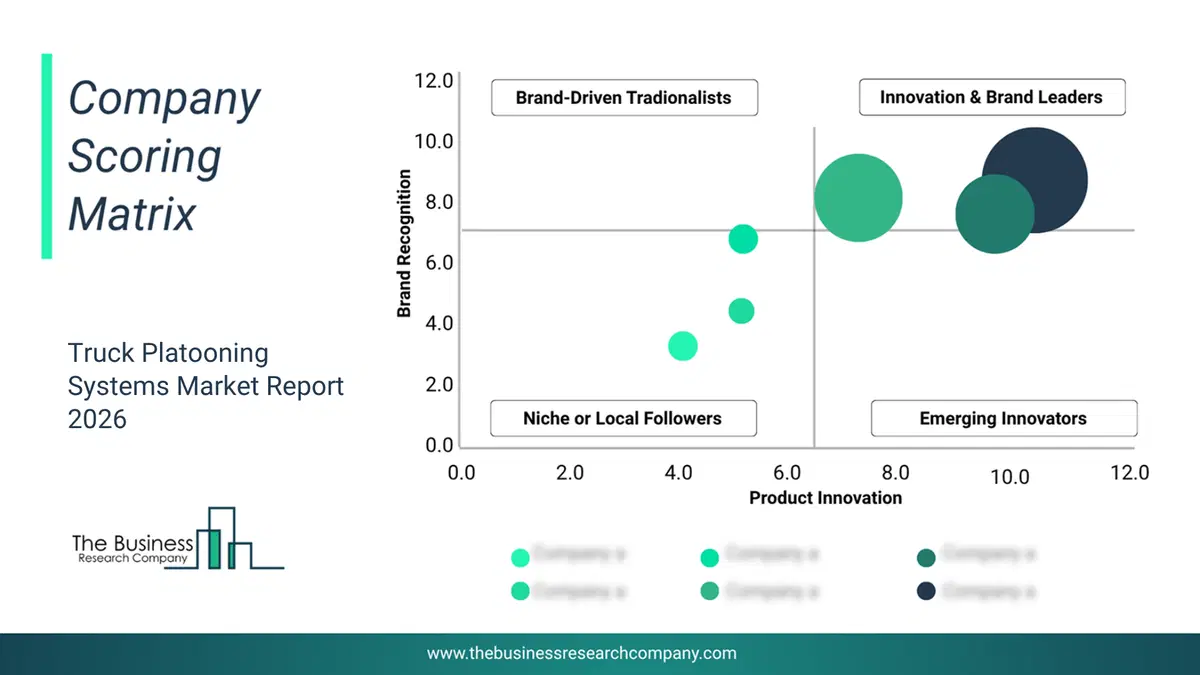
This chart maps companies by product innovation and brand strength, with bubble size indicating relative revenue, helping identify market leaders, challengers, and niche players. This is an illustrative chart; the full report provides a complete and accurate competitive analysis.
Global Truck Platooning Systems Market Trends and Insights
The major companies operating in the truck platooning systems market are focusing on developing advanced solutions such as the connected truck platform to enable seamless communication and coordination between trucks in a platoon. A connected truck platform is a technology solution that integrates various components of a truck's operations, including telematics, software applications, real-time vehicle data, and third-party applications, to provide a unified and customizable platform for fleet management. For instance, in April 2024, DAF Trucks, a Netherlands-based truck manufacturing company, launched the PACCAR Connect fleet management platform. PACCAR Connect is distinguished by its comprehensive system, which includes hardware and software integrated into the truck, an optional detachable tablet in the cab, and an accessible online portal compatible with nearly any fixed or mobile device. This innovative solution offers real-time insights into the performance of individual vehicles and the entire fleet, as well as logistical processes and driver performance, empowering operators to optimize their returns. Users can monitor truck and fleet performance 24/7 online or receive reports via email through the 'Report Scheduler' feature, with customizable route and fuel reports displayed on the dashboard. To enhance efficiency, PACCAR Connect employs geofencing technology that alerts the home base when a truck approaches a delivery location or becomes fully operational again after maintenance.What Are Latest Mergers And Acquisitions In The Truck Platooning Systems Market?
In April 2025, Kratos Defense & Security Solutions, Inc., a US-based aerospace and defense industry, partnered with DriveOhio, INDOT, and EASE Logistics to advance automated truck platooning in the Midwest. The aim of the partnership between Kratos, DriveOhio, INDOT, and EASE Logistics is to advance the adoption and operational deployment of automated truck platooning technology in the Midwest logistics industry. DriveOhio is a US-based company that is involved in a truck platooning project. And INDOT is an Indian-based company that provides technology for the automated truck platooning. EASE Logistics is a US-based company that provides automated truck platooning systems.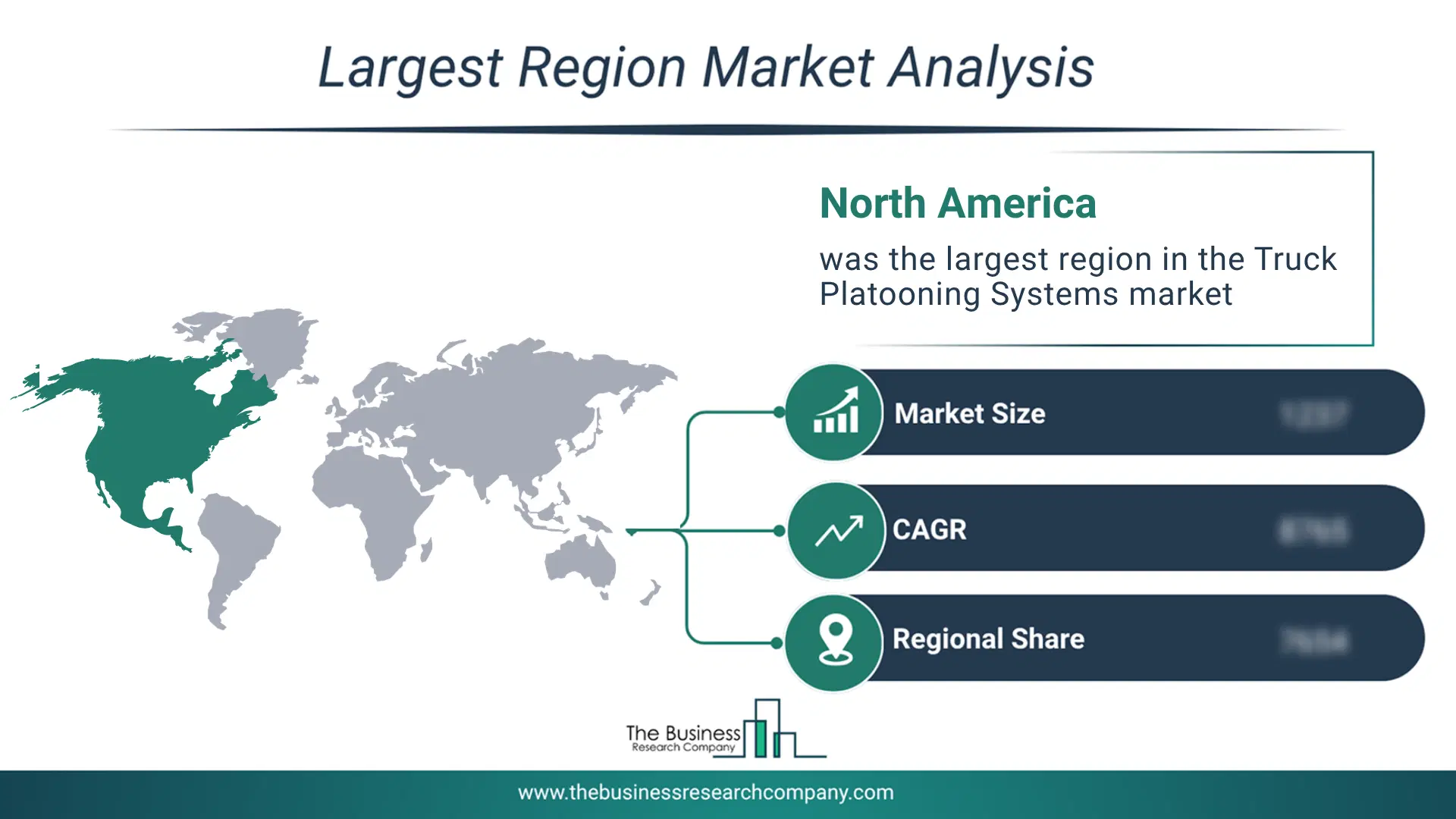
Regional Insights
North America was the largest region in the truck platooning systems market in 2025. Asia-Pacific is expected to be the fastest-growing region in the forecast period. The regions covered in this market report are Asia-Pacific, South East Asia, Western Europe, Eastern Europe, North America, South America, Middle East, Africa. The countries covered in this market report are Australia, Brazil, China, France, Germany, India, Indonesia, Japan, Taiwan, Russia, South Korea, UK, USA, Canada, Italy, Spain.What Defines the Truck Platooning Systems Market?
The truck platooning systems market consists of revenues earned by entities by providing services such as fuel efficiency optimization, fleet management, automated driving, and safety enhancement services. The market value includes the value of related goods sold by the service provider or included within the service offering. The truck platooning systems market also includes sales of products including automated driving systems, onboard computers, collision avoidance systems, lane-keeping assistance systems, and telematics systems. Values in this market are ‘factory gate’ values, that is, the value of goods sold by the manufacturers or creators of the goods, whether to other entities (including downstream manufacturers, wholesalers, distributors, and retailers) or directly to end customers. The value of goods in this market includes related services sold by the creators of the goods.How is Market Value Defined and Measured?
The market value is defined as the revenues that enterprises gain from the sale of goods and/or services within the specified market and geography through sales, grants, or donations in terms of the currency (in USD unless otherwise specified). The revenues for a specified geography are consumption values that are revenues generated by organizations in the specified geography within the market, irrespective of where they are produced. It does not include revenues from resales along the supply chain, either further along the supply chain or as part of other products.
This chart presents market attractiveness based on a quantitative evaluation of growth, competition, strategic alignment, and risk, offering a clear view of opportunity areas for decision-making. This chart is for illustrative purposes; the full report contains the complete analysis.

This chart highlights the Total Addressable Market (TAM) by estimating the maximum revenue opportunity using an assumption-driven approach, supporting strategic planning and opportunity sizing across markets. The chart is illustrative; the full report provides a more comprehensive analysis.
What Key Data and Analysis Are Included in the Truck Platooning Systems Market Report 2026?
The truck platooning systems market research report is one of a series of new reports from The Business Research Company that provides market statistics, including industry global market size, regional shares, competitors with the market share, detailed market segments, market trends and opportunities, and any further data you may need to thrive in the truck platooning systems industry. The market research report delivers a complete perspective of everything you need, with an in-depth analysis of the current and future state of the industry.Truck Platooning Systems Market Report Forecast Analysis
| Report Attribute | Details |
|---|---|
| Market Size Value In 2026 | $1.55 billion |
| Revenue Forecast In 2030 | $2.72 billion |
| Growth Rate | CAGR of 15.1% from 2026 to 2030 |
| Base Year For Estimation | 2025 |
| Actual Estimates/Historical Data | 2020-2025 |
| Forecast Period | 2026 - 2030 |
| Market Representation | Revenue in USD Billion and CAGR from 2026 to 2030 |
| Segments Covered | Component, Vehicle Type, Technology |
| Regional Scope | Asia-Pacific, Western Europe, Eastern Europe, North America, South America, Middle East, Africa |
| Country Scope | The Countries Covered In This Market Report Are Australia, Brazil, China, France, Germany, India, Indonesia, Japan, Taiwan, Russia, South Korea, Uk, Usa, Canada, Italy, Spain. |
| Key Companies Profiled | Daimler Truck Holding AG, AB Volvo, PACCAR Inc., Scania AB, Iveco Group N.V., MAN Truck & Bus SE, Navistar International Corporation, DAF Trucks N.V., Einride AB, TuSimple Holdings Inc., Plus AI Inc., Aurora Innovation Inc., Kodiak Robotics Inc., Gatik AI Inc., Locomation Inc., Peloton Technology Inc., Volta Trucks AB, Hino Motors Ltd., Isuzu Motors Limited, Toyota Motor Corporation |
| Customization Scope | Request for Customization |
| Pricing And Purchase Options | Explore Purchase Options |