
Urinary Retention Drug Market Report 2026
Global Outlook – By Drug Class (Alpha Blockers, Beta-3 Agonists, Anticholinergics), By Indication (Chronic Urinary Retention, Postoperative Urinary Retention, Neurogenic Bladder), By Administration (Oral, Injectable, Transdermal), By End Users (Hospitals, Homecare, Specialty Clinics, Other End Users) – Market Size, Trends, Strategies, and Forecast to 2035
Urinary Retention Drug Market Overview
• Urinary Retention Drug market size has reached to $4.07 billion in 2025 • Expected to grow to $5.39 billion in 2030 at a compound annual growth rate (CAGR) of 5.7% • Growth Driver: Rising Prevalence Of Urinary Disorders Fueling The Market Due To Aging Populations And Increasing Cases Of Diabetes And Hypertension • Market Trend: Developing Extended-Release Generic Drugs In The Market • North America was the largest region in 2025.What Is Covered Under Urinary Retention Drug Market?
Urinary retention drugs are medications used to treat conditions where there is difficulty in emptying the bladder, often by relaxing the bladder muscles or stimulating the bladder to contract, aiding in urine flow. These drugs can be prescribed for conditions such as benign prostatic hyperplasia (BPH) or neurogenic bladder, helping to improve urinary function and relieve discomfort. The main drug classes for urinary retention include alpha blockers, beta-3 agonists, anticholinergics, and surgical agents. Alpha blockers are medications that relax the bladder and prostate muscles to improve urine flow and relieve symptoms of benign prostatic hyperplasia (BPH). These drugs are used for various indications, including chronic urinary retention, postoperative urinary retention, and neurogenic bladder. They are administered through different routes, such as oral, injectable, and transdermal, and are used by various end users, including hospitals, home homecare, specialty clinics, and others.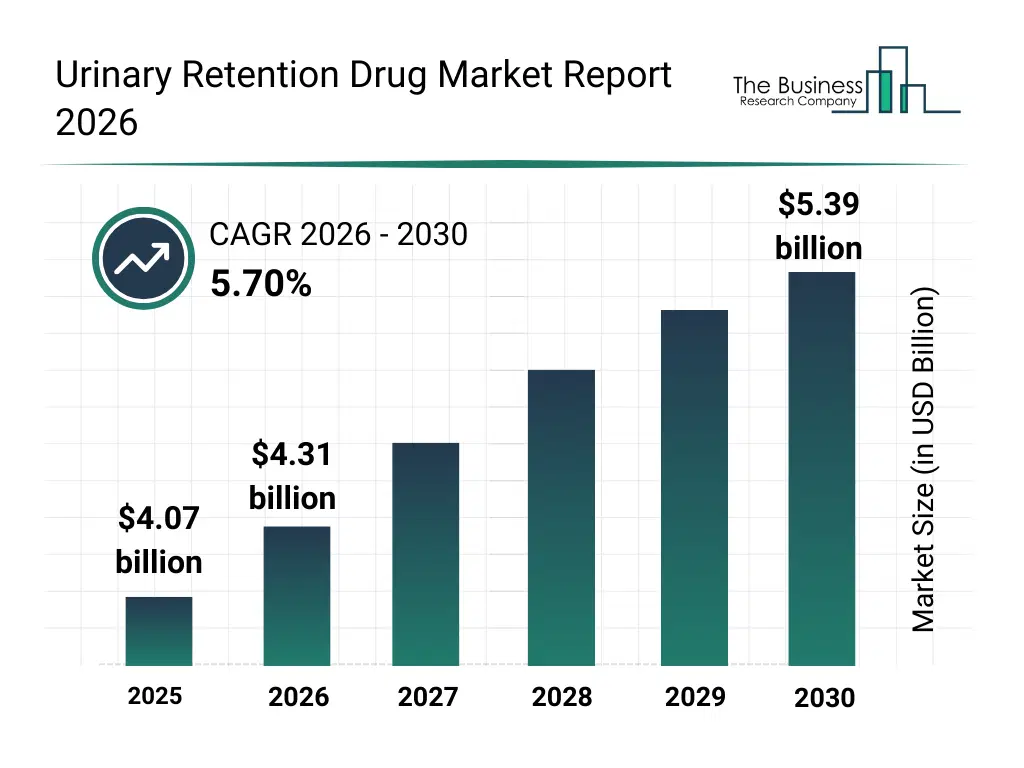
What Is The Urinary Retention Drug Market Size and Share 2026?
The urinary retention drug market size has grown strongly in recent years. It will grow from $4.07 billion in 2025 to $4.31 billion in 2026 at a compound annual growth rate (CAGR) of 5.8%. The growth in the historic period can be attributed to aging male population, increasing BPH prevalence, hospital surgical volume growth, neurogenic disorder diagnosis, catheterization limitations.What Is The Urinary Retention Drug Market Growth Forecast?
The urinary retention drug market size is expected to see strong growth in the next few years. It will grow to $5.39 billion in 2030 at a compound annual growth rate (CAGR) of 5.7%. The growth in the forecast period can be attributed to homecare drug adoption, minimally invasive therapy growth, chronic urinary disorder management, outpatient urology expansion, improved drug adherence. Major trends in the forecast period include rising use of alpha blockers for BPH, growth of neurogenic bladder treatments, expansion of oral retention therapies, increased focus on postoperative care, shift toward long-term bladder management.
Global Urinary Retention Drug Market Segmentation
1) By Drug Class: Alpha Blockers, Beta-3 Agonists, Anticholinergics 2) By Indication: Chronic Urinary Retention, Postoperative Urinary Retention, Neurogenic Bladder 3) By Administration: Oral, Injectable, Transdermal 4) By End Users: Hospitals, Homecare, Specialty Clinics, Other End UsersWhat Is The Driver Of The Urinary Retention Drug Market?
The rising prevalence of urinary disorders is expected to propel the growth of the urinary retention drug market going forward. Urinary disorders refer to conditions that affect the urinary system, causing issues such as difficulty urinating, pain, incontinence, or retention. The rising prevalence of urinary disorders is due to the increasing incidence of diabetes, as high blood sugar levels can damage the kidneys and urinary tract, leading to conditions such as diabetic nephropathy and frequent urinary tract infections. Urinary retention drugs help manage urinary disorders by improving urine flow, relaxing bladder muscles, and alleviating symptoms such as difficulty urinating, thereby enhancing comfort and bladder function. For instance, in October 2023, according to the National Health Service (NHS) England, a UK-based government department, hospitals recorded 147,285 admissions in 2022/23 with a primary diagnosis of urinary tract infection (UTI). Individuals aged over 65 accounted for 56% of these cases, totaling 82,392 admissions. The highest number of admissions occurred in the 80-84 age group, with 17,280 cases. Therefore, the rising prevalence of urinary disorders is driving the growth of urinary retention drug industry.Key Players In The Global Urinary Retention Drug Market
Major companies operating in the urinary retention drug market are Astellas Pharma Inc., Ferring Pharmaceuticals Inc., Teva Pharmaceutical Industries Ltd., Pfizer Inc., AbbVie Inc., Sanofi S.A., AstraZeneca plc, Novartis International AG, Merck & Co. Inc., Takeda Pharmaceutical Company Limited, Sun Pharmaceutical Industries Limited, Aurobindo Pharma Limited, Lupin Limited, Cadila Healthcare Limited, Torrent Pharmaceuticals Limited, Ajanta Pharma Limited, Cipla Limited, Glenmark Pharmaceuticals Ltd., Zydus Lifesciences Limited, Bayer AGGlobal Urinary Retention Drug Market Trends and Insights
Major companies in the urinary retention drug market are focusing on developing novel formulations such as extended-release tablets to improve patient compliance and provide prolonged symptom relief. Extended-release (ER) tablets are a type of medication formulation designed to release the active ingredient gradually over an extended period. This controlled-release mechanism maintains a consistent drug concentration in the bloodstream, reducing the frequency of dosing compared to immediate-release tablets. For instance, in April 2024, Zydus Lifesciences Limited, an India-based pharmaceutical company, launched a generic version of Mirabegron for overactive bladder (OAB). Mirabegron is a selective beta-3 adrenergic agonist that relaxes bladder muscles, reducing urinary urgency, frequency, and incontinence. While primarily used for OAB, it can also help manage urinary retention associated with overactive bladder conditions. The medication is administered as a once-daily oral dosage.What Are Latest Mergers And Acquisitions In The Urinary Retention Drug Market?
In November 2024, Boston Scientific Corporation, a US-based healthcare company, acquired Axonics Inc. for $3.3 billion. With this acquisition, Boston Scientific aims to expand its urology portfolio by incorporating innovative technologies that address urinary and bowel dysfunction. Axonics Inc. is a US-based medical technology company that specializes in providing sacral neuromodulation (SNM) therapy for urinary control, which is indicated for the treatment of urinary retention and the symptoms of overactive bladder.Regional Insights
North America was the largest region in the urinary retention drug market in 2025. The regions covered in this market report are Asia-Pacific, South East Asia, Western Europe, Eastern Europe, North America, South America, Middle East, Africa. The countries covered in this market report are Australia, Brazil, China, France, Germany, India, Indonesia, Japan, Taiwan, Russia, South Korea, UK, USA, Canada, Italy, Spain.What Defines the Urinary Retention Drug Market?
The urinary retention drugs market consist of sales of tamsulosin (flomax), bethanechol (urecholine), terazosin (hytrin), doxazosin (cardura), finasteride (proscar), and alfuzosin (uroxatral). Values in this market are ‘factory gate’ values, that is, the value of goods sold by the manufacturers or creators of the goods, whether to other entities (including downstream manufacturers, wholesalers, distributors, and retailers) or directly to end customers. The value of goods in this market includes related services sold by the creators of the goods.How is Market Value Defined and Measured?
The market value is defined as the revenues that enterprises gain from the sale of goods and/or services within the specified market and geography through sales, grants, or donations in terms of the currency (in USD unless otherwise specified). The revenues for a specified geography are consumption values that are revenues generated by organizations in the specified geography within the market, irrespective of where they are produced. It does not include revenues from resales along the supply chain, either further along the supply chain or as part of other products.What Key Data and Analysis Are Included in the Urinary Retention Drug Market Report 2026?
The urinary retention drug market research report is one of a series of new reports from The Business Research Company that provides market statistics, including industry global market size, regional shares, competitors with the market share, detailed market segments, market trends and opportunities, and any further data you may need to thrive in the urinary retention drug industry. The market research report delivers a complete perspective of everything you need, with an in-depth analysis of the current and future state of the industry.Urinary Retention Drug Market Report Forecast Analysis
| Report Attribute | Details |
|---|---|
| Market Size Value In 2026 | $4.31 billion |
| Revenue Forecast In 2035 | $5.39 billion |
| Growth Rate | CAGR of 5.8% from 2026 to 2035 |
| Base Year For Estimation | 2025 |
| Actual Estimates/Historical Data | 2020-2025 |
| Forecast Period | 2026 - 2030 - 2035 |
| Market Representation | Revenue in USD Billion and CAGR from 2026 to 2035 |
| Segments Covered | Drug Class, Indication, Administration, End Users |
| Regional Scope | Asia-Pacific, Western Europe, Eastern Europe, North America, South America, Middle East, Africa |
| Country Scope | The countries covered in the report are Australia, Brazil, China, France, Germany, India, ... |
| Key Companies Profiled | Astellas Pharma Inc., Ferring Pharmaceuticals Inc., Teva Pharmaceutical Industries Ltd., Pfizer Inc., AbbVie Inc., Sanofi S.A., AstraZeneca plc, Novartis International AG, Merck & Co. Inc., Takeda Pharmaceutical Company Limited, Sun Pharmaceutical Industries Limited, Aurobindo Pharma Limited, Lupin Limited, Cadila Healthcare Limited, Torrent Pharmaceuticals Limited, Ajanta Pharma Limited, Cipla Limited, Glenmark Pharmaceuticals Ltd., Zydus Lifesciences Limited, Bayer AG |
| Customization Scope | Request for Customization |
| Pricing And Purchase Options | Explore Purchase Options |