

Virtual Dressing Rooms Market Report 2026
Global Outlook – By Component (Hardware, Software, Services), By Application (Apparel, Beauty And Cosmetic, Eyewear, Footwear, Other Applications), By End User (E-Commerce, Physical Stores) – Market Size, Trends, Strategies, and Forecast to 2030
Virtual Dressing Rooms Market Overview
• Virtual Dressing Rooms market size has reached to $6.92 billion in 2025 • Expected to grow to $12.29 billion in 2030 at a compound annual growth rate (CAGR) of 11.8% • Growth Driver: Impact Of Online Shopping Growth On Virtual Dressing Room Market • Market Trend: Enhancing Online Shopping With 3D Avatar-Based Try-On Technology • North America was the largest region in 2025 and Asia-Pacific is the fastest growing region.What Is Covered Under Virtual Dressing Rooms Market?
Virtual dressing rooms refer to technology that allows customers to virtually try on clothing items or beauty products without physically touching the items themselves. This technology is based on augmented reality (AR) or artificial intelligence (AI), overlays the chosen clothing or accessories on a live video feed of the customer. The main component types of virtual dressing rooms are hardware, software, services. Software for virtual dressing rooms enhances the online shopping experience by providing personalized recommendations, improving visualization, reducing returns, and integrating advanced technologies. These are used in various applications such as apparel, beauty and cosmetic, eyewear, footwear, others and also by various end users such as e-commerce, physical stores.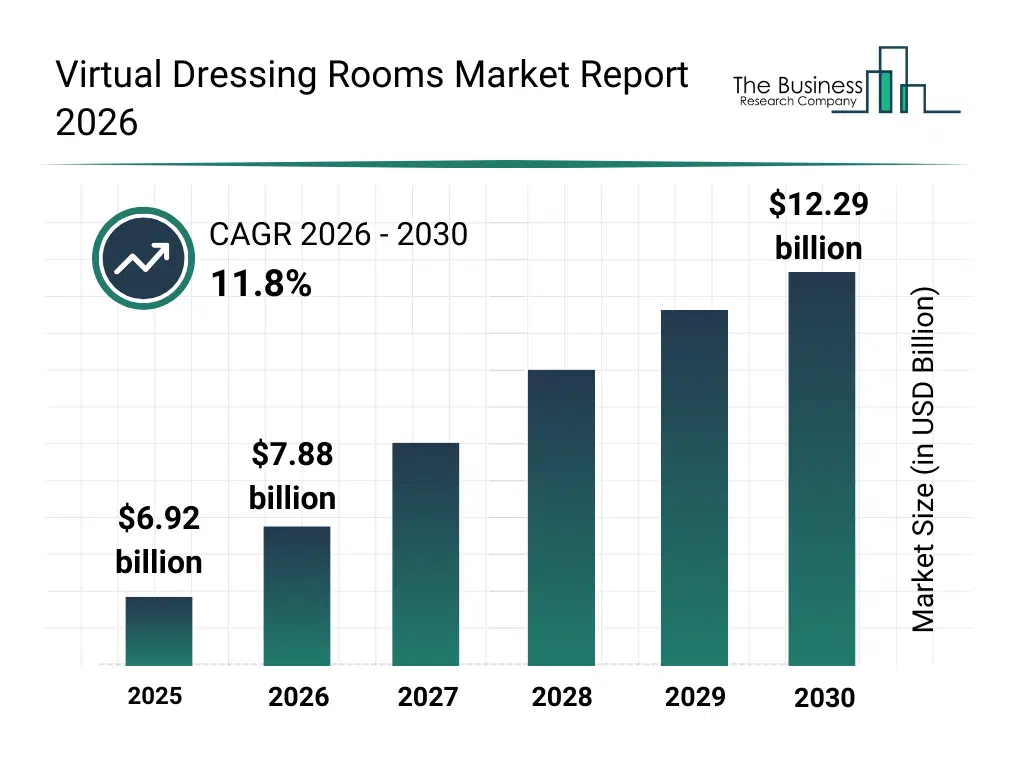
What Is The Virtual Dressing Rooms Market Size and Share 2026?
The virtual dressing rooms market size has grown rapidly in recent years. It will grow from $6.92 billion in 2025 to $7.88 billion in 2026 at a compound annual growth rate (CAGR) of 13.9%. The growth in the historic period can be attributed to growth of e-commerce and online fashion retail, increasing consumer demand for interactive shopping experiences, expansion of mobile commerce usage, rising focus on digital brand engagement, adoption of visualization technologies.What Is The Virtual Dressing Rooms Market Growth Forecast?
The virtual dressing rooms market size is expected to see rapid growth in the next few years. It will grow to $12.29 billion in 2030 at a compound annual growth rate (CAGR) of 11.8%. The growth in the forecast period can be attributed to increasing investments in immersive retail technologies, rising demand for hyper-personalized shopping, expansion of virtual commerce platforms, growing integration with social commerce channels, increasing focus on sustainability through reduced returns. Major trends in the forecast period include increasing adoption of AI-powered virtual try-on solutions, rising use of ar-based shopping experiences, growing integration of personalization engines, expansion of omnichannel retail engagement tools, enhanced focus on reducing product return rates.
Global Virtual Dressing Rooms Market Segmentation
1) By Component: Hardware, Software, Services 2) By Application: Apparel, Beauty And Cosmetic, Eyewear, Footwear, Other Applications 3) By End User: E-Commerce, Physical Stores Subsegments: 1) By Hardware: Display Systems (Touchscreens, AR-Enabled Devices), Sensors (Motion Sensors, Body Tracking Sensors), Cameras (3D Cameras, Depth Sensors), Smart Mirrors, Interactive Kiosks 2) By Software: Augmented Reality (AR) Software, 3D Visualization Software, Virtual Try-On Software, Image Recognition Software, AI-Powered Recommendation Engines 3) By Services: Installation And Setup, Customization And Integration, Training And Support, Cloud Services, Maintenance And UpdatesWhat Is The Driver Of The Virtual Dressing Rooms Market?
The growing online shopping is expected to propel the growth of the virtual dressing room market going forward. Online shopping refers to the process of purchasing goods or services directly from a seller over the internet, without the need for an intermediary service. The growth of online shopping is due to several reasons, such as convenience, product selection, cost savings, technological advancements, price comparison, time- savings, personalization, easier returns and refunds, and reviews and recommendations. Virtual dressing rooms enhance the online shopping experience for customers, increase sales and customer satisfaction for e-commerce businesses, and contribute to a more sustainable and efficient retail industry. For instance, in February 2024, according to a report published by the Census Bureau, an US-based government agency, total e-commerce sales for 2023 were estimated at $1,118.7 billion, an increase of 7.6 percent (±1.2%) from 2022, and total retail sales in 2023 increased 2.1 percent (±0.4%) from 2022. Therefore, growing online shopping is driving the growth of the virtual dressing room industry.Key Players In The Global Virtual Dressing Rooms Market
Major companies operating in the virtual dressing rooms market are Reactive Reality AG, Finery, Visenze Pte. Ltd., ELSE Corp., Virtusize Co. Ltd., 3DLook Inc., Style.me, Fitle, Dressformer, Sizebay, AstraFit, Metail, Vue.ai, FXGear Inc., Fit Analytics GmbH, True Fit Corp., Autonomous Retail Shopping Solutions, Zeekit Online Shopping Ltd., MemoMi Labs Inc., Zugara, Fision Technologies Inc.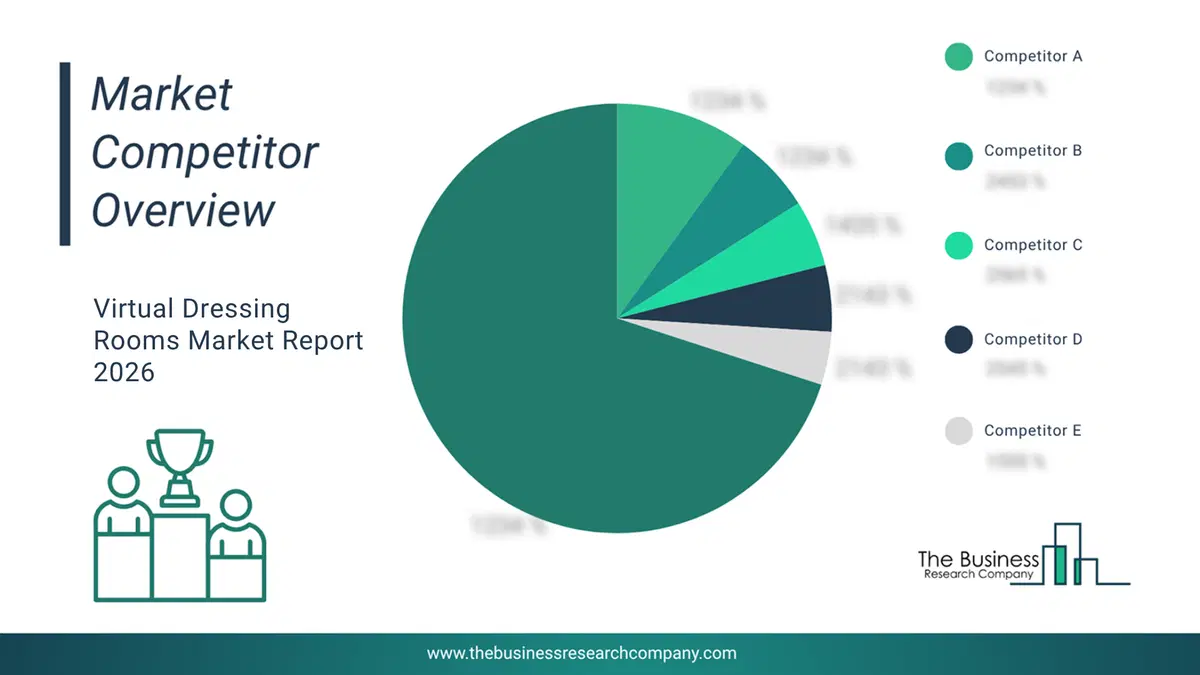
This chart is for illustrative purposes; the full report includes a detailed competitor analysis and comprehensive overview of the top 10 companies in the market.
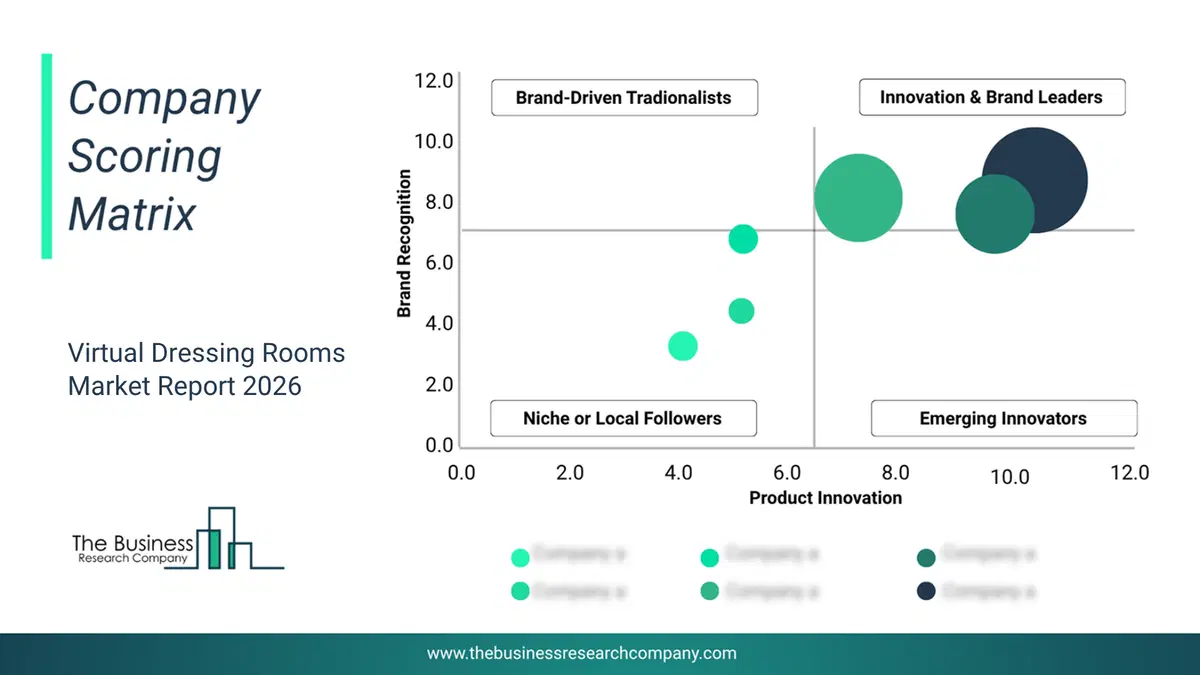
This chart maps companies by product innovation and brand strength, with bubble size indicating relative revenue, helping identify market leaders, challengers, and niche players. This is an illustrative chart; the full report provides a complete and accurate competitive analysis.
Global Virtual Dressing Rooms Market Trends and Insights
Major companies operating in the virtual fitting room market are focusing on developing innovative solutions, such as avatar-based virtual fitting, to meet the rising demand for improved customer experience, accurate sizing and reduced product returns. Avatar-based virtual fitting refers to a technology that allows shoppers to create a 3D digital version of themselves by entering personal measurements like height, weight and gender, enabling a realistic virtual try-on experience that offers greater accuracy than traditional size charts or static product images. For instance, in May 2023, Zalando, a Germany-based online fashion retailer, launched its Virtual Fitting Room pilot that allowed customers to generate a 3D avatar and try on 22 different jeans from multiple brands to understand how various sizes would fit their digital model.What Are Latest Mergers And Acquisitions In The Virtual Dressing Rooms Market?
In February 2023, MATCH, a US-based technology company partnered with Savage X Fenty. With this partnership, both companies aim to revolutionize in-store shopping by leveraging advanced body shape technology to offer personalized product recommendations from precise body scans, enhancing customer confidence and satisfaction while integrating physical and digital retail experiences. Savage X Fenty is a US-based lingerie brand known for its inclusive and diverse range of products, including bras, underwear, sleepwear, and loungewear.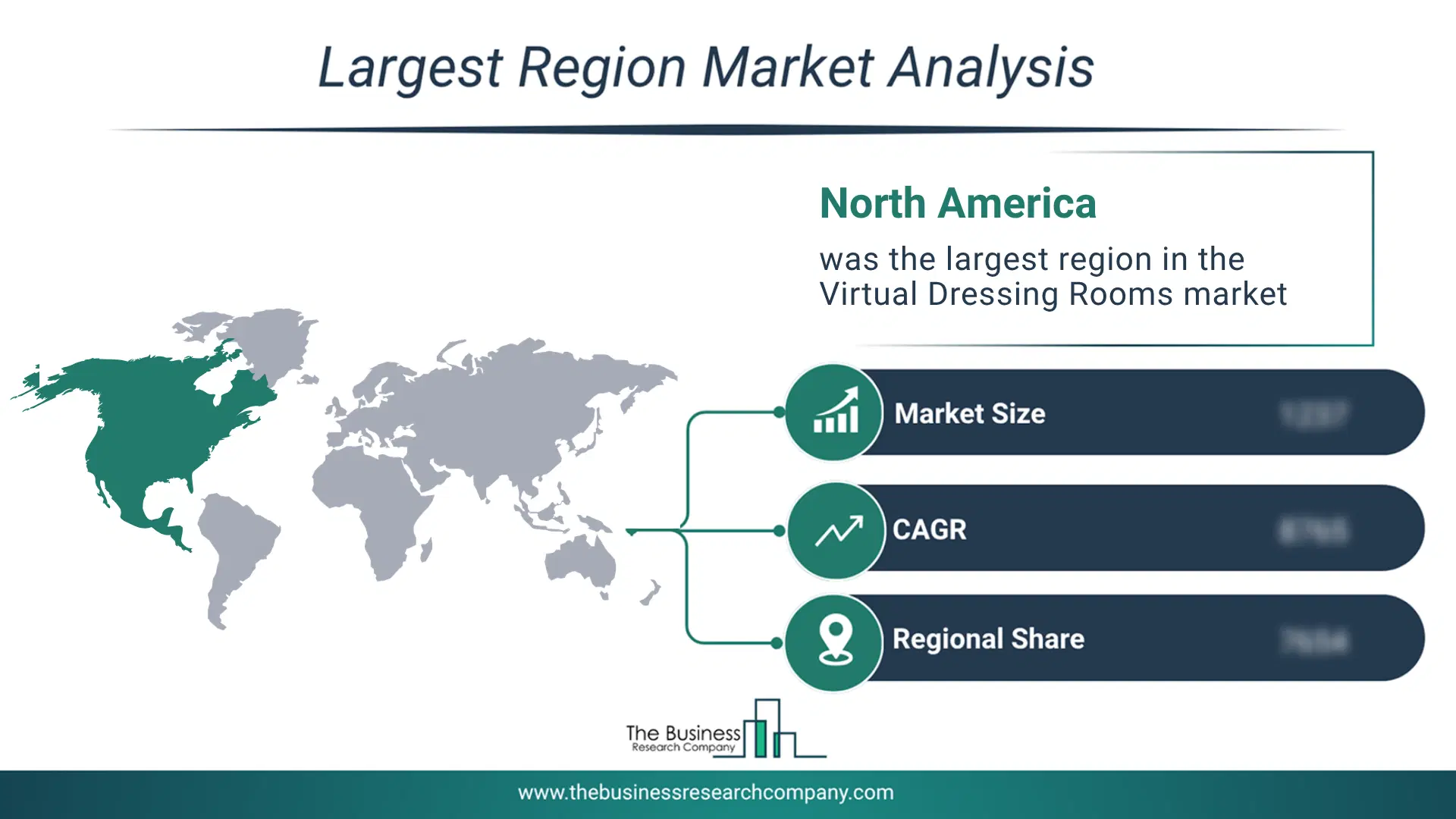
Regional Insights
North America was the largest region in the virtual dressing rooms market in 2025. Asia-Pacific is expected to be the fastest-growing region in the forecast period. The regions covered in this market report are Asia-Pacific, South East Asia, Western Europe, Eastern Europe, North America, South America, Middle East, Africa. The countries covered in this market report are Australia, Brazil, China, France, Germany, India, Indonesia, Japan, Taiwan, Russia, South Korea, UK, USA, Canada, Italy, Spain.What Defines the Virtual Dressing Rooms Market?
The virtual dressing room market consists of revenues earned by entities by providing services such as virtual try-ons, size recommendations, style suggestions, outfit creation, and 360-degree views. The market value includes the value of related goods sold by the service provider or included within the service offering. The virtual dressing room market also includes sales of clothing and accessories, body measurement tools, integration with e-commerce platforms, and compatibility with multiple devices. Values in this market are ‘factory gate’ values, that is, the value of goods sold by the manufacturers or creators of the goods, whether to other entities (including downstream manufacturers, wholesalers, distributors, and retailers) or directly to end customers. The value of goods in this market includes related services sold by the creators of the goods.How is Market Value Defined and Measured?
The market value is defined as the revenues that enterprises gain from the sale of goods and/or services within the specified market and geography through sales, grants, or donations in terms of the currency (in USD unless otherwise specified). The revenues for a specified geography are consumption values that are revenues generated by organizations in the specified geography within the market, irrespective of where they are produced. It does not include revenues from resales along the supply chain, either further along the supply chain or as part of other products.
This chart presents market attractiveness based on a quantitative evaluation of growth, competition, strategic alignment, and risk, offering a clear view of opportunity areas for decision-making. This chart is for illustrative purposes; the full report contains the complete analysis.

This chart highlights the Total Addressable Market (TAM) by estimating the maximum revenue opportunity using an assumption-driven approach, supporting strategic planning and opportunity sizing across markets. The chart is illustrative; the full report provides a more comprehensive analysis.
What Key Data and Analysis Are Included in the Virtual Dressing Rooms Market Report 2026?
The virtual dressing rooms market research report is one of a series of new reports from The Business Research Company that provides market statistics, including industry global market size, regional shares, competitors with the market share, detailed market segments, market trends and opportunities, and any further data you may need to thrive in the virtual dressing rooms industry. The market research report delivers a complete perspective of everything you need, with an in-depth analysis of the current and future state of the industry.Virtual Dressing Rooms Market Report Forecast Analysis
| Report Attribute | Details |
|---|---|
| Market Size Value In 2026 | $7.88 billion |
| Revenue Forecast In 2030 | $12.29 billion |
| Growth Rate | CAGR of 11.8% from 2026 to 2030 |
| Base Year For Estimation | 2025 |
| Actual Estimates/Historical Data | 2020-2025 |
| Forecast Period | 2026 - 2030 |
| Market Representation | Revenue in USD Billion and CAGR from 2026 to 2030 |
| Segments Covered | Component, Application, End User |
| Regional Scope | Asia-Pacific, Western Europe, Eastern Europe, North America, South America, Middle East, Africa |
| Country Scope | The Countries Covered In This Market Report Are Australia, Brazil, China, France, Germany, India, Indonesia, Japan, Taiwan, Russia, South Korea, Uk, Usa, Canada, Italy, Spain. |
| Key Companies Profiled | Reactive Reality AG, Finery, Visenze Pte. Ltd., ELSE Corp., Virtusize Co. Ltd., 3DLook Inc., Style.me, Fitle, Dressformer, Sizebay, AstraFit, Metail, Vue.ai, FXGear Inc., Fit Analytics GmbH, True Fit Corp., Autonomous Retail Shopping Solutions, Zeekit Online Shopping Ltd., MemoMi Labs Inc., Zugara, Fision Technologies Inc. |
| Customization Scope | Request for Customization |
| Pricing And Purchase Options | Explore Purchase Options |