

Social Commerce Market Report 2026
Global Outlook – By Product Type (Personal And Beauty Care, Apparel, Accessories, Home Products, Health Supplements, Food And Beverage, Other Products), By Device Type (Laptops And PCs, Mobiles, Other Devices), By Business Model (B2C, B2B, C2C), By End User (Individual, Commercial) – Market Size, Trends, Strategies, and Forecast to 2030
Social Commerce Market Overview
• Social Commerce market size has reached to $872.71 billion in 2025 • Expected to grow to $1616.99 billion in 2030 at a compound annual growth rate (CAGR) of 13% • Growth Driver: Rising Social Media Usage Fuels Growth In The Social Commerce Market • Market Trend: TikTok Shop Launches In the U.S. WithA New Era In Social Commerce • North America was the largest region in 2025.Market Gains By 2030 – Top Opportunities By Segment
Market Gain identifies the most promising market opportunities by highlighting the segments or products expected to generate the highest incremental revenue growth over the next five years.
What Is Covered Under Social Commerce Market?
Social commerce is the direct purchase and sale of products or services using a social media platform. It combines social networking and e-commerce, allowing users to discover, share, and buy products while interacting with friends, influencers, and brands within the same platform. The main types of products in social commerce are personal and beauty care, apparel, accessories, home products, health supplements, food and beverages, and others. The customers can purchase the beauty and personal care products or services directly through social commerce app. social commerce websites are accessible through different device types such as laptops and PCs, mobiles, others and applied to different business models such as B2C, B2B, and C2C. Social commerce is used by both individuals and commercials.
What Is The Social Commerce Market Size and Share 2026?
The social commerce market size has grown rapidly in recent years. It will grow from $872.71 billion in 2025 to $992.38 billion in 2026 at a compound annual growth rate (CAGR) of 13.7%. The growth in the historic period can be attributed to early adoption of social media platforms, rise of mobile commerce, growth of influencer marketing, increasing smartphone penetration, expansion of digital payment systems.What Is The Social Commerce Market Growth Forecast?
The social commerce market size is expected to see rapid growth in the next few years. It will grow to $1616.99 billion in 2030 at a compound annual growth rate (CAGR) of 13.0%. The growth in the forecast period can be attributed to adoption of ai-powered recommendation engines, growth of shoppable livestreams, expansion of cross-border social commerce, rise of augmented reality shopping experiences, increased adoption of blockchain for secure transactions. Major trends in the forecast period include influencer-led marketing, social media integration with e-commerce platforms, user-generated content and reviews, livestream shopping experiences, gamification of shopping.

Global Social Commerce Market Segmentation
1) By Product Type: Personal And Beauty Care, Apparel, Accessories, Home Products, Health Supplements, Food And Beverage, Other Products 2) By Device Type: Laptops And PCs, Mobiles, Other Devices 3) By Business Model: B2C, B2B, C2C 4) By End User: Individual, Commercial Subsegments: 1) By Personal And Beauty Care: Skincare Products, Makeup And Cosmetics, Hair Care Products 2) By Apparel: Clothing, Footwear, Activewear 3) By Accessories: Jewelry, Bags and Purses, Watches 4) By Home Products: Furniture, Home Decor, Kitchenware 5) By Health Supplements: Vitamins and Minerals, Protein Supplements, Herbal Products 6) By Food and Beverage: Snacks, Beverages, Gourmet Foods 7) By Other Products: Electronics, Pet Supplies, Baby Products The top segments in the social commerce market will be: • Apparel will reach $533 Billion by 2030. • Personal And Beauty Care will reach $402 Billion by 2030. • Accessories will reach $228 Billion by 2030. • Home Products will reach $172 Billion by 2030. • Food and Beverage will reach $126 Billion by 2030.What Is The Driver Of The Social Commerce Market?
The increasing social media usage is expected to propel the growth of the social commerce market going forward. Social media usage refers to the engagement of individuals with platforms such as Facebook, Instagram, and YouTube for communication, entertainment, shopping, and marketing purposes. Increasing social media usage is primarily due to widespread smartphone adoption, as smartphones provide constant internet access and easy connectivity, enabling users to engage with social platforms anytime and anywhere. Social commerce leverages social media platforms to enable businesses and consumers to buy and sell products directly through social interactions and online communities. For instance, in January 2024, according to We Are Social Ltd, a UK-based media company, social media usage rose to 1.5%, compared to 0.9% in January 2023. Therefore, the increasing social media usage is driving the growth of the social commerce industry.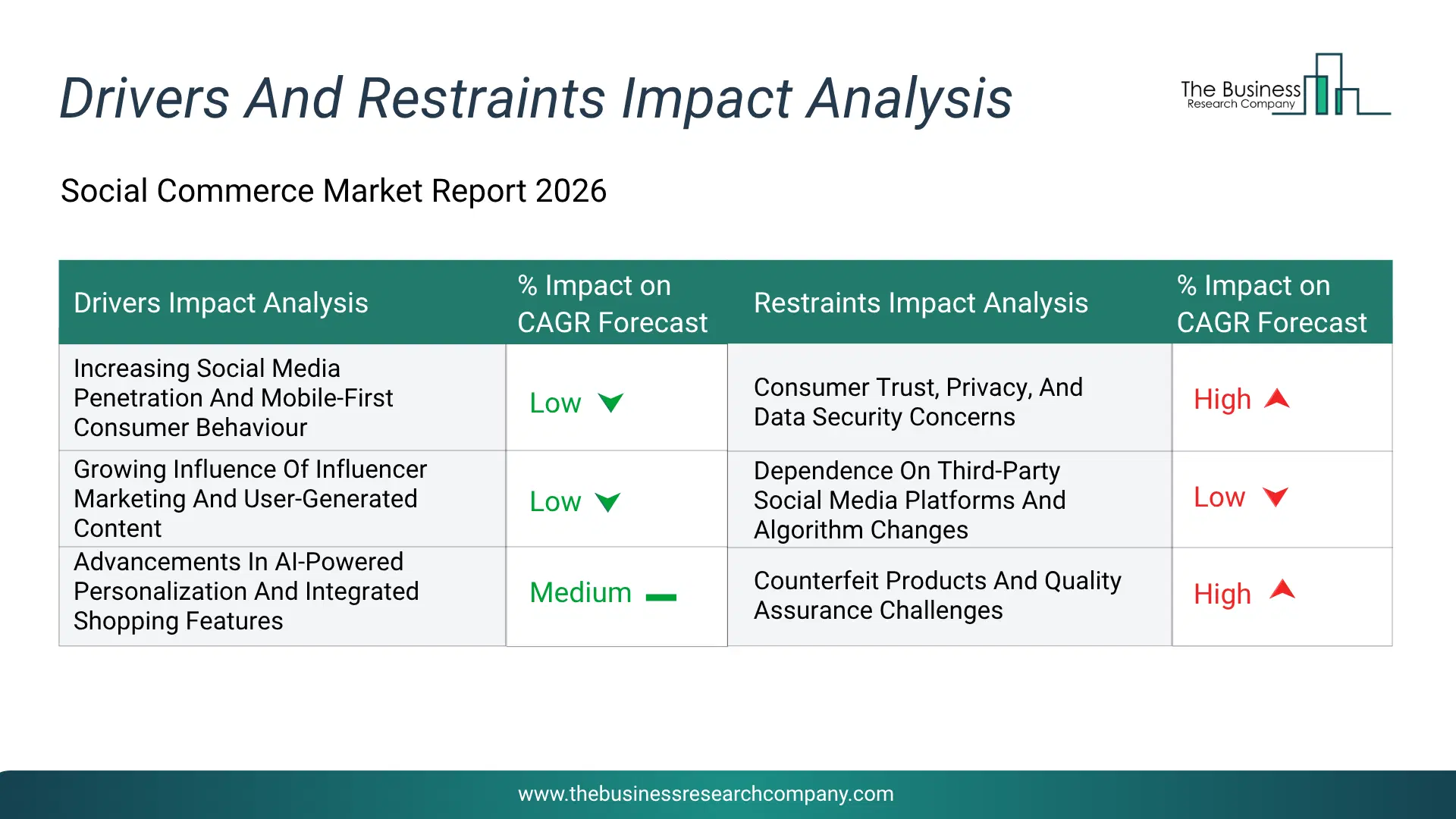
Infographic Chart Showing Key Market Drivers Analysis And Restraints For Social Commerce Market
The chart presents an impact analysis of key drivers and restraints, quantifying their relative influence on the market's growth rate and helping assess the balance between growth enablers and limiting factors. This chart offers a high-level perspective; the full report contains more detailed insights.
How Will The Drivers Impact Growth In The Global Social Commerce Market?
• Increasing Social Media Penetration And Mobile-First Consumer Behaviour (Low) – During the forecast period, the increasing social media penetration and mobile-first consumer behaviour are expected to emerge as a major factor driving the expansion of the social commerce market by 2030. the widespread adoption of smartphones, affordable mobile internet, and high-speed connectivity is enabling consumers to discover, compare, and purchase products directly through social media platforms. features such as in-app shopping, live commerce, digital wallets, and seamless checkout experiences are reducing purchasing friction while encouraging higher customer engagement and impulse buying. • Growing Influence Of Influencer Marketing And User-Generated Content (Low) – During the forecast period, the growing influence of influencer marketing and user-generated content is expected to emerge as a major factor driving the expansion of the social commerce market by 2030. consumers increasingly trust authentic recommendations, product reviews, live demonstrations, and creator-generated content when making purchasing decisions. highly engaged online communities and interactive social platforms are enabling brands to strengthen customer relationships, improve brand credibility, and increase conversion rates through personalized engagement strategies. • Advancements In AI-Powered Personalization And Integrated Shopping Features (Medium) – During the forecast period, the advancements in AI-powered personalization and integrated shopping features are expected to act as a key growth catalyst for the social commerce market by 2030. artificial intelligence is enabling highly personalized product recommendations, targeted advertising, AI-driven customer support, and immersive shopping experiences through technologies such as virtual try-ons and automated product discovery. combined with one-click checkout, embedded payment solutions, and personalized promotional offers, these innovations are enhancing customer satisfaction and improving sales performance.How Will The Restraints Impact Growth In The Global Social Commerce Market?
• Consumer Trust, Privacy, And Data Security Concerns (Low) – During the forecast period, consumer Trust, Privacy, And Data Security Concerns continue to restrain the growth of the Social Commerce market despite increasing digital adoption. Consumers frequently hesitate to complete purchases on social media platforms because of concerns regarding identity theft, financial fraud, unauthorized use of personal information, fake online stores, and payment security risks. High-profile cybersecurity incidents and data breaches have further reduced consumer confidence in digital transactions. Moreover, governments worldwide are implementing stricter data privacy regulations, requiring businesses to invest substantially in cybersecurity infrastructure, compliance systems, and secure payment technologies. These additional investments increase operational costs while privacy concerns discourage many first-time users from adopting social commerce, limiting overall market growth. • Dependence On Third-Party Social Media Platforms And Algorithm Changes (Low) – During the forecast period, dependence On Third-Party Social Media Platforms And Algorithm Changes presents a significant operational challenge for businesses participating in the Social Commerce market. Most brands depend heavily on platforms such as Meta, TikTok, Pinterest, and Snapchat for product visibility, customer engagement, and revenue generation. However, these platforms regularly update their content-ranking algorithms, advertising policies, privacy rules, and monetization strategies. Such changes can substantially reduce organic reach, increase advertising expenses, and negatively impact customer acquisition efforts. Businesses therefore face uncertainty in maintaining consistent traffic and sales performance while continuously adapting their digital marketing strategies. This platform dependency increases operational risk, raises customer acquisition costs, and limits long-term business stability for many social commerce vendors. • Counterfeit Products And Quality Assurance Challenges (Medium) – During the forecast period, counterfeit Products And Quality Assurance Challenges remain major obstacles to the widespread adoption of Social Commerce. Social media marketplaces enable thousands of independent sellers to offer products directly to consumers, making it difficult to consistently monitor product authenticity and quality. The availability of counterfeit goods, misleading advertisements, inaccurate product descriptions, and unauthorized branded merchandise often results in poor customer experiences, increased product returns, and declining consumer trust. In response, social commerce platforms and legitimate brands must invest heavily in seller verification systems, AI-based fraud detection, product authentication technologies, and content moderation processes. While these initiatives improve marketplace credibility, they also increase operational complexity and costs, thereby restraining overall market growth.Key Players In The Global Social Commerce Market
Major companies operating in the social commerce market are Amazon.com Inc., Microsoft Corporation, Alibaba Group Holding Limited, Facebook Inc., Tencent Holdings Limited, ByteDance Ltd., Instagram LLC, YouTube LLC, PayPal Payments Private Limited, Salesforce.com Inc., Xiaohongshu Inc., Pinduoduo Inc., Adobe Inc., LinkedIn Corporation, eBay Inc., TikTok Inc., Shopify Inc., Twitter Inc., Snapchat Inc., Pinterest Inc., Etsy Inc., Sina Corporation, Weibo Corporation, Wix.com Ltd., Squarespace Inc., BigCommerce Holdings Inc., Poshmark Inc., Automattic Inc., Renren Inc., Fabulous Inc., Big Cartel LLC, Volusion LLC, Ecwid Inc., PrestaShop SA, OpenCart Limited, Miva Inc., Zen Cart
This chart is for illustrative purposes; the full report includes a detailed competitor analysis and comprehensive overview of the top 10 companies in the market.

This chart maps companies by product innovation and brand strength, with bubble size indicating relative revenue, helping identify market leaders, challengers, and niche players. This is an illustrative chart; the full report provides a complete and accurate competitive analysis.
Global Social Commerce Market Trends and Insights
Major companies operating in the social commerce market are focusing on developing innovative platform features, such as creator-driven product tagging, to enhance user engagement, streamline shopping experiences, and boost online sales. Creator-driven product tagging refers to a feature that allows social media content creators to tag products directly in their posts or videos, enabling seamless discovery and purchase by users. For instance, in September 2023, ByteDance Ltd., a China-based company that offers internet technology launched "TikTok Shop" in the U.S., introducing a social commerce platform that includes a dedicated shop tab, product tagging by creators, and secure checkout options. This initiative has attracted over 100,000 creators and 200,000 sellers, aiming to capitalize on the growing trend of product discovery through social media, where 57% of users report finding products this way. As companies like TikTok continue to innovate in this space, the potential for social commerce to reshape online shopping dynamics becomes more apparent.What Are Latest Mergers And Acquisitions In The Social Commerce Market?
In September 2025, AnyMind Group, a Japan‑based technology company acquired Vibula for an undisclosed amount. With this acquisition, AnyMind aims to enhance its live commerce and social commerce capabilities and accelerate expansion of integrated human‑AI commerce solutions across Southeast Asia and its existing markets. Vibula Group Joint Stock Company is a Vietnam‑based live and social commerce agency that specializes in providing live commerce operations, social commerce marketing, e‑commerce store management, campaign management, and influencer or affiliate network services to brands and merchants.
Regional Outlook
North America was the largest region in the social commerce market share in 2025. Europe was the second-largest region in the social commerce market. The regions covered in this market report are Asia-Pacific, South East Asia, Western Europe, Eastern Europe, North America, South America, Middle East, Africa. The countries covered in this market report are Australia, Brazil, China, France, Germany, India, Indonesia, Japan, Taiwan, Russia, South Korea, UK, USA, Canada, Italy, Spain.What Defines the Social Commerce Market?
The social commerce market includes revenues earned by entities by offering services like promoting and selling products or services within the framework of a social media platform. Social commerce is the incorporation of e-commerce and social media which is used for buying or selling goods or services directly within a social media platform such as Facebook and Instagram. It also includes local and global marketplaces, including small businesses that sell products to various social media followers and individual buyers. The market value includes the value of related goods sold by the service provider or included within the service offering. Only goods and services traded between entities or sold to end consumers are included.How is Market Value Defined and Measured?
The market value is defined as the revenues that enterprises gain from the sale of goods and/or services within the specified market and geography through sales, grants, or donations in terms of the currency (in USD unless otherwise specified). The revenues for a specified geography are consumption values that are revenues generated by organizations in the specified geography within the market, irrespective of where they are produced. It does not include revenues from resales along the supply chain, either further along the supply chain or as part of other products.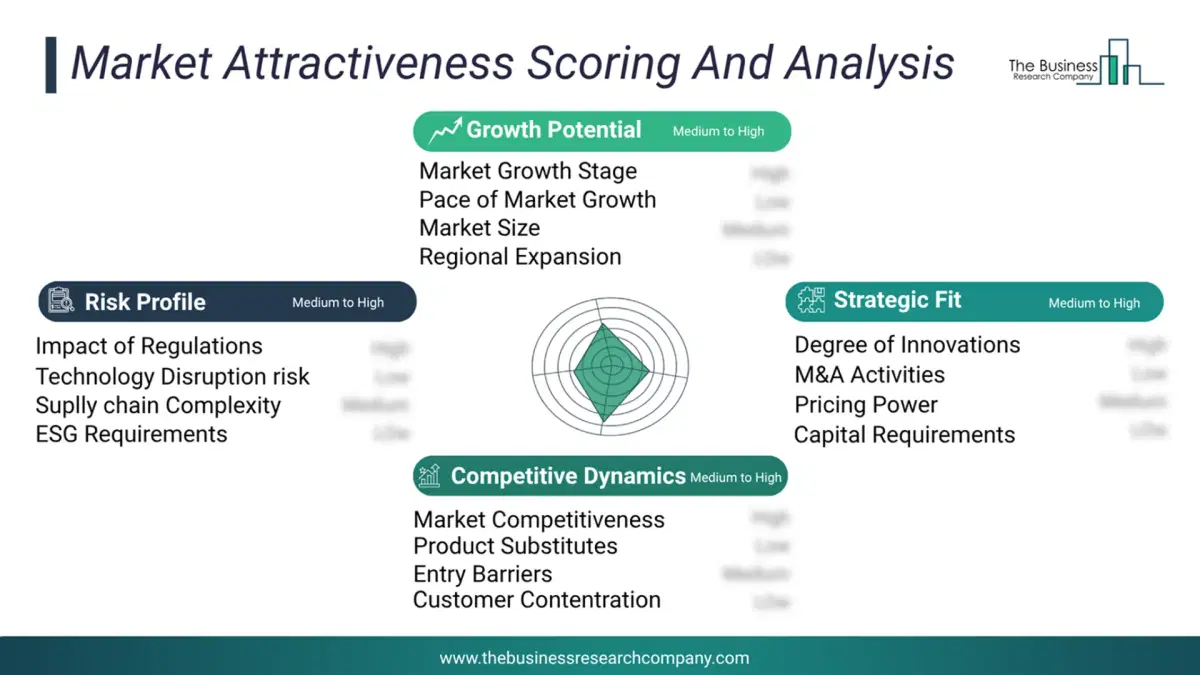
This chart presents market attractiveness based on a quantitative evaluation of growth, competition, strategic alignment, and risk, offering a clear view of opportunity areas for decision-making. This chart is for illustrative purposes; the full report contains the complete analysis.
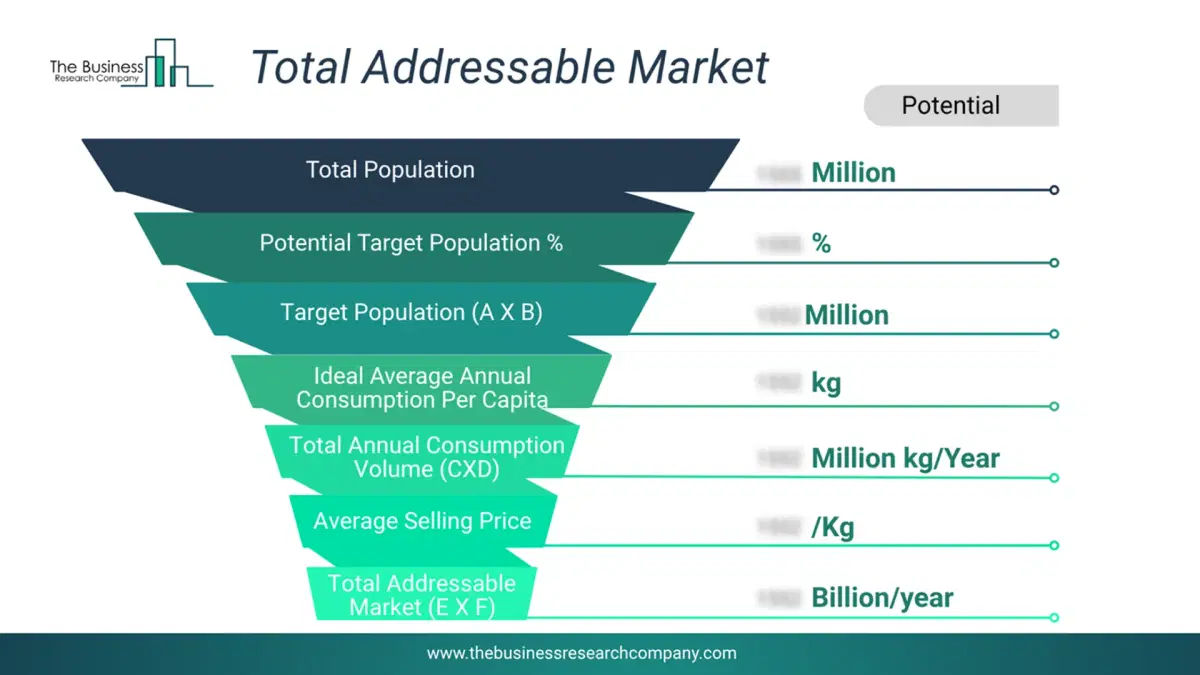
This chart highlights the Total Addressable Market (TAM) by estimating the maximum revenue opportunity using an assumption-driven approach, supporting strategic planning and opportunity sizing across markets. The chart is illustrative; the full report provides a more comprehensive analysis.
What Key Data and Analysis Are Included in the Social Commerce Market Report 2026?
The social commerce market research report is one of a series of new reports from The Business Research Company that provides market statistics, including industry global market size, regional shares, competitors with the market share, detailed market segments, market trends and opportunities, and any further data you may need to thrive in the social commerce industry. The market research report delivers a complete perspective of everything you need, with an in-depth analysis of the current and future state of the industry.Social Commerce Market Report Forecast Analysis
| Report Attribute | Details |
|---|---|
| Market Size Value In 2026 | $992.38 billion |
| Revenue Forecast In 2030 | $1616.99 billion |
| Growth Rate | CAGR of 13% from 2026 to 2030 |
| Base Year For Estimation | 2025 |
| Actual Estimates/Historical Data | 2020-2025 |
| Forecast Period | 2026 - 2030 |
| Market Representation | Revenue in USD Billion and CAGR from 2026 to 2030 |
| Segments Covered | Product Type, Device Type, Business Model, End User |
| Regional Scope | Asia-Pacific, Western Europe, Eastern Europe, North America, South America, Middle East, Africa |
| Country Scope | The countries covered in the report are Australia, Brazil, China, France, Germany, India, Indonesia, Japan, Taiwan, Russia, South Korea, UK, USA, Canada, Italy, Spain. |
| Key Companies Profiled | Amazon.com Inc., Microsoft Corporation, Alibaba Group Holding Limited, Facebook Inc., Tencent Holdings Limited, ByteDance Ltd., Instagram LLC, YouTube LLC, PayPal Payments Private Limited, Salesforce.com Inc., Xiaohongshu Inc., Pinduoduo Inc., Adobe Inc., LinkedIn Corporation, eBay Inc., TikTok Inc., Shopify Inc., Twitter Inc., Snapchat Inc., Pinterest Inc., Etsy Inc., Sina Corporation, Weibo Corporation, Wix.com Ltd., Squarespace Inc., BigCommerce Holdings Inc., Poshmark Inc., Automattic Inc., Renren Inc., Fabulous Inc., Big Cartel LLC, Volusion LLC, Ecwid Inc., PrestaShop SA, OpenCart Limited, Miva Inc., Zen Cart |
| Customization Scope | Request for Customization |
| Pricing And Purchase Options | Explore Purchase Options |