

Virtual Mirror Market Report 2026
Global Outlook – By Component (Software, Hardware, Services), By Deployment Mode (Cloud, On-Premises), By Technology (3D Body Scanning, Photo Accurate VFR, 3D Augmented Reality And Virtual Reality), By Industry (Retail, Healthcare And Fitness, Other Industries) – Market Size, Trends, Strategies, and Forecast to 2030
Virtual Mirror Market Overview
• Virtual Mirror market size has reached to $13.05 billion in 2025 • Expected to grow to $36.38 billion in 2030 at a compound annual growth rate (CAGR) of 22.7% • Growth Driver: Surge in Online Shopping Fueling the Growth of the Market Due to Rising Digital Connectivity • Market Trend: Innovative Augmented Reality Mirrors Transform In-Store Shopping Experiences • North America was the largest region in 2025 and Asia-Pacific is the fastest growing region.What Is Covered Under Virtual Mirror Market?
The virtual mirror refers to a technology that is used in retail stores for customers to try their dresses, tops, and other apparel on their virtual avatars in the mirror. It uses augmented reality technology to show the user how the outfit would look on them without having to try it on physically. It displays the outfit and uses motion rendering technology to let the spectator see the appearance in a variety of motions and lighting conditions (for both day and night looks). The main types of virtual mirror markets are software, hardware, and services. Software refers to the computer program and forms an integral part of virtual mirrors, as it forms the programming behind the functioning of these mirrors. Software provides algorithms for the working of virtual mirrors, such as the face alignment algorithm, and programming such as the tracking algorithm engine. The various technologies include 3D body scanning, photo accurate VFR, 3D augmented reality, and virtual reality, which are used in retail and other industries. The various deployment modes are cloud and on-premises.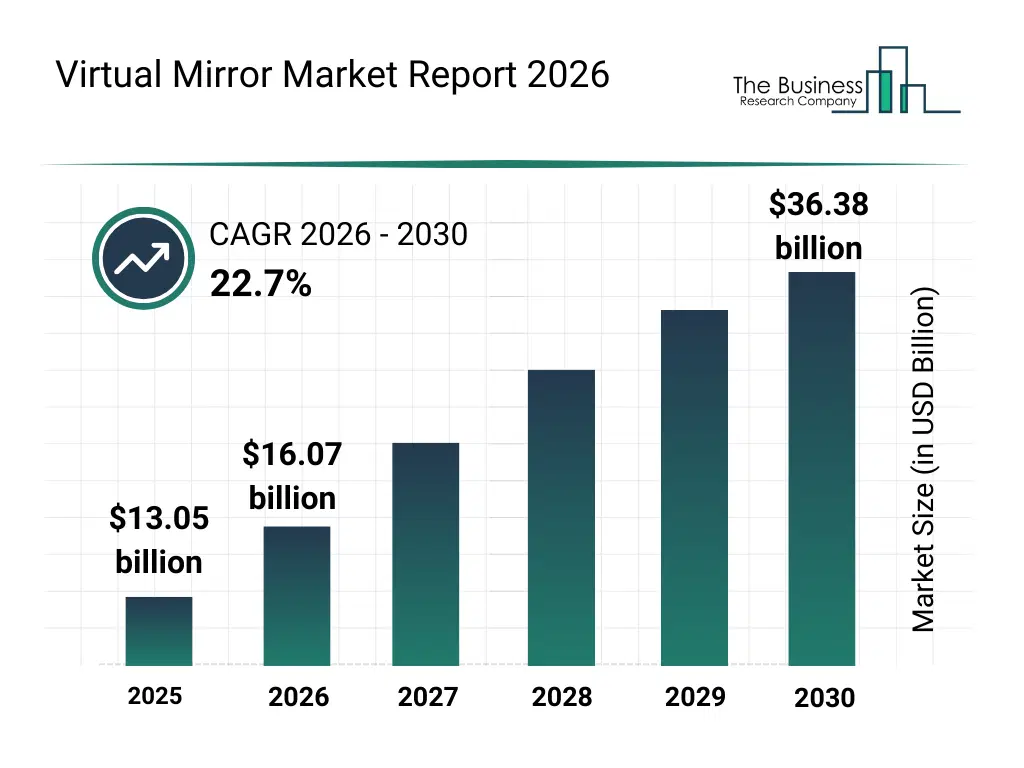
What Is The Virtual Mirror Market Size and Share 2026?
The virtual mirror market size has grown exponentially in recent years. It will grow from $13.05 billion in 2025 to $16.07 billion in 2026 at a compound annual growth rate (CAGR) of 23.2%. The growth in the historic period can be attributed to growth of omnichannel retail strategies, increased adoption of digital retail technologies, rising consumer preference for experiential shopping, expansion of smart retail stores, advancements in display and sensor technologies.What Is The Virtual Mirror Market Growth Forecast?
The virtual mirror market size is expected to see exponential growth in the next few years. It will grow to $36.38 billion in 2030 at a compound annual growth rate (CAGR) of 22.7%. The growth in the forecast period can be attributed to growing deployment of ai-driven personalization engines, rising investments in immersive retail solutions, expansion of virtual commerce platforms, increasing use of cloud-based visualization tools, growing focus on reducing product return rates. Major trends in the forecast period include increasing adoption of ar-based virtual try-on solutions, rising demand for personalized shopping experiences, growing integration of motion and body tracking technologies, expansion of in-store digital engagement tools, enhanced focus on customer experience optimization.

Global Virtual Mirror Market Segmentation
1) By Component: Software, Hardware, Services 2) By Deployment Mode: Cloud, On-Premises 3) By Technology: 3D Body Scanning, Photo Accurate VFR, 3D Augmented Reality And Virtual Reality 4) By Industry: Retail, Healthcare And Fitness, Other Industries Subsegments: 1) By Software: Augmented Reality (AR) Software, Virtual Try-On Applications, Customization And Personalization Tools 2) By Hardware: Display Screens, Cameras And Sensors, Interactive Touchscreens 3) By Services: Installation And Setup Services, Maintenance And Support Services, Consulting Services For IntegrationWhat Is The Driver Of The Virtual Mirror Market?
The increasing online shopping activities are expected to propel the growth of the virtual mirror market going forward. Online shopping refers to the process of purchasing goods or services through digital platforms such as e-commerce websites or mobile applications. The growth of online shopping activities is due to the expanding internet penetration and the widespread use of smartphones, which have made digital purchasing more convenient for consumers. The virtual mirror supports this shift by providing augmented reality-based try-on solutions that allow online shoppers to visualize apparel and accessories on themselves before making a purchase, thereby enhancing confidence and reducing return rates. For instance, in February 2025, according to the Census Bureau, a US-based government agency, total e-commerce sales in 2024 were estimated at $1,192.6 billion, reflecting an 8.1 percent increase (±1.1) compared to 2023. In 2024, e-commerce sales represented 16.1 percent of overall retail sales, up from 15.3 percent in 2023. Therefore, the increasing online shopping activities are driving the growth of the virtual mirror industry.Key Players In The Global Virtual Mirror Market
Major companies operating in the virtual mirror market are Virtooal Studio SRL; ICON Multimedia S. L.; Fitnect Interactive Inc.; Metail Limited; MemoMi Labs Inc.; Zugara Inc.; My Size Inc.; Virtusize Co. Ltd.; ViuBox S. L.; Dressformer LLC; Astrafit LLC; zSpace Inc.; 3D-A-Porter Limited; Styku Inc.; Total Immersion SAS; ViewAR GmbH; Vuforia Solutions Inc.; Wikitude GmbH; YouAR GmbH; Zappar Limited; Blippar Limited; Virtalis Limited; Vizoo GmbH; SenseMi Technologies Pvt. Ltd.; Terawe Corporation; DigitalDM Inc.; Cisco Systems Inc.
This chart is for illustrative purposes; the full report includes a detailed competitor analysis and comprehensive overview of the top 10 companies in the market.
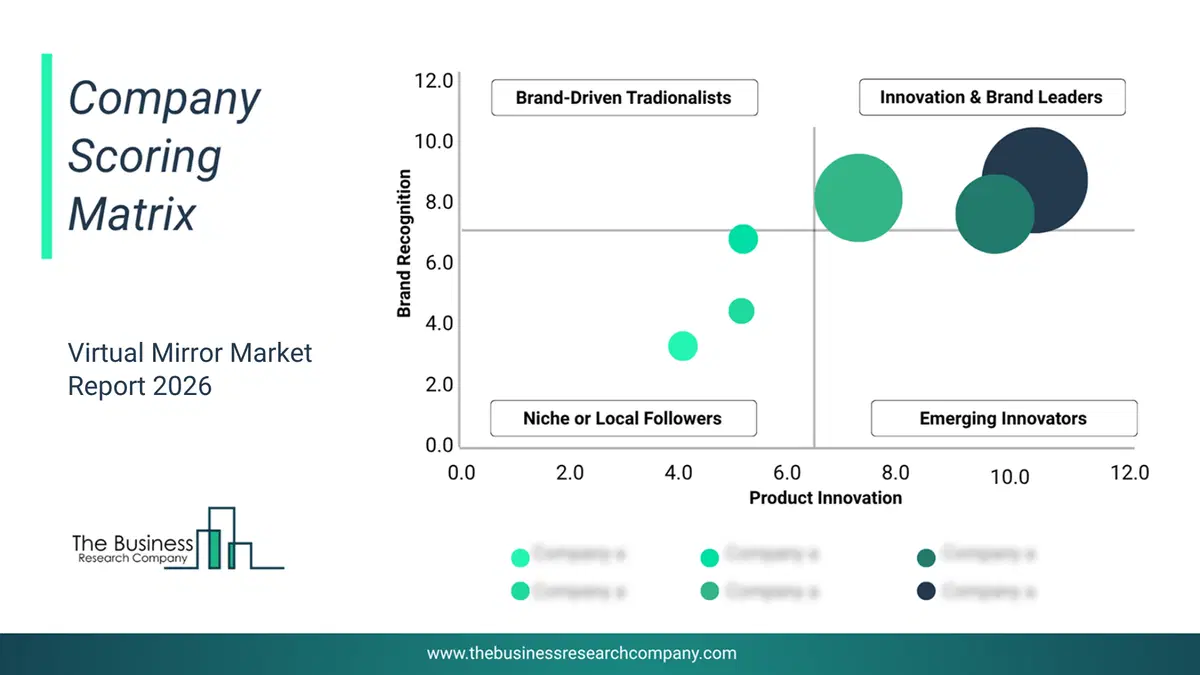
This chart maps companies by product innovation and brand strength, with bubble size indicating relative revenue, helping identify market leaders, challengers, and niche players. This is an illustrative chart; the full report provides a complete and accurate competitive analysis.
Global Virtual Mirror Market Trends and Insights
Major companies operating in the virtual mirror market are focusing on developing innovative solutions, such as augmented reality smart mirrors, to enhance personalized shopping experiences and virtual try ons. Augmented reality smart mirrors are interactive mirrors that overlay digital information or virtual images onto a user’s reflection to enable virtual try ons, styling previews, or personalized recommendations. For instance, in February 2023, Vyking Limited, a UK-based AI and computer vision company, launched an in-store augmented reality (AR) solution called Magic Mirror, enabling consumers to virtually try on footwear through a smart mirror. The solution uses an AR-enabled mirror to display 3D models of shoes on customers’ feet in real time. Activated by simply approaching the full-length digital mirror, users can select footwear via an in-store tablet and see how the shoes look without physically trying them on. This technology reduces customer wait times, eases pressure on store staff, expands product offerings without additional inventory, and provides retailers with omnichannel marketing opportunities in physical locations.What Are Latest Mergers And Acquisitions In The Virtual Mirror Market?
In May 2025, Kiranapro Software Private Limited, an India-based quick-commerce company, acquired Likeo for $1 million. Through this acquisition, KiranaPro aims to integrate augmented reality-based virtual trial room features into BLACK, its fashion-focused platform, to enhance online shopping experiences, increase customer confidence, and reduce return rates. Likeo is an India-based company that provides AR-powered virtual try-on technology for fashion and accessories.
Regional Insights
North America was the largest region in the virtual mirror market in 2025. Asia-Pacific is expected to be the fastest-growing region in the forecast period. The regions covered in this market report are Asia-Pacific, South East Asia, Western Europe, Eastern Europe, North America, South America, Middle East, Africa. The countries covered in this market report are Australia, Brazil, China, France, Germany, India, Indonesia, Japan, Taiwan, Russia, South Korea, UK, USA, Canada, Italy, SpainWhat Defines the Virtual Mirror Market?
The virtual mirror market consists of revenues earned by entities by providing virtual payment terminal software including mobile applications and firmware. Values in this market are ‘factory gate’ values, that is, the value of goods sold by the manufacturers or creators of the goods, whether to other entities (including downstream manufacturers, wholesalers, distributors, and retailers) or directly to end customers. The value of goods in this market includes related services sold by the creators of the goods.How is Market Value Defined and Measured?
The market value is defined as the revenues that enterprises gain from the sale of goods and/or services within the specified market and geography through sales, grants, or donations in terms of the currency (in USD unless otherwise specified). The revenues for a specified geography are consumption values that are revenues generated by organizations in the specified geography within the market, irrespective of where they are produced. It does not include revenues from resales along the supply chain, either further along the supply chain or as part of other products.
This chart presents market attractiveness based on a quantitative evaluation of growth, competition, strategic alignment, and risk, offering a clear view of opportunity areas for decision-making. This chart is for illustrative purposes; the full report contains the complete analysis.

This chart highlights the Total Addressable Market (TAM) by estimating the maximum revenue opportunity using an assumption-driven approach, supporting strategic planning and opportunity sizing across markets. The chart is illustrative; the full report provides a more comprehensive analysis.
What Key Data and Analysis Are Included in the Virtual Mirror Market Report 2026?
The virtual mirror market research report is one of a series of new reports from The Business Research Company that provides market statistics, including industry global market size, regional shares, competitors with the market share, detailed market segments, market trends and opportunities, and any further data you may need to thrive in the virtual mirror industry. The market research report delivers a complete perspective of everything you need, with an in-depth analysis of the current and future state of the industry.Virtual Mirror Market Report Forecast Analysis
| Report Attribute | Details |
|---|---|
| Market Size Value In 2026 | $16.07 billion |
| Revenue Forecast In 2030 | $36.38 billion |
| Growth Rate | CAGR of 22.7% from 2026 to 2030 |
| Base Year For Estimation | 2025 |
| Actual Estimates/Historical Data | 2020-2025 |
| Forecast Period | 2026 - 2030 |
| Market Representation | Revenue in USD Billion and CAGR from 2026 to 2030 |
| Segments Covered | Component, Deployment Mode, Technology, Industry |
| Regional Scope | Asia-Pacific, Western Europe, Eastern Europe, North America, South America, Middle East, Africa |
| Country Scope | The Countries Covered In This Market Report Are Australia, Brazil, China, France, Germany, India, Indonesia, Japan, Taiwan, Russia, South Korea, Uk, Usa, Canada, Italy, Spain. |
| Key Companies Profiled | Virtooal Studio SRL, ICON Multimedia S. L., Fitnect Interactive Inc., Metail Limited, MemoMi Labs Inc., Zugara Inc., My Size Inc., Virtusize Co. Ltd., ViuBox S. L., Dressformer LLC, Astrafit LLC, zSpace Inc., 3D-A-Porter Limited, Styku Inc., Total Immersion SAS, ViewAR GmbH, Vuforia Solutions Inc., Wikitude GmbH, YouAR GmbH, Zappar Limited, Blippar Limited, Virtalis Limited, Vizoo GmbH, SenseMi Technologies Pvt. Ltd., Terawe Corporation, DigitalDM Inc., Cisco Systems Inc. |
| Customization Scope | Request for Customization |
| Pricing And Purchase Options | Explore Purchase Options |