

Virtual Reality Box Glasses Market Report 2026
Global Outlook – By Product Type (Standalone Virtual Reality Glasses, Mobile Virtual Reality Glasses, Personal Computer-Tethered Virtual Reality Glasses, Augmented Reality (AR) Combos, Mixed Reality Headsets), By Technology (Optical Tracking, Positional Tracking, Mobile Technology, 3D Audio Technology, Motion Sensing Technology), By Application (Gaming, Education And Training, Healthcare, Real Estate, Retail, Other Applications), By Distribution Channel (Online Stores, Specialty Stores, Supermarkets Or Hypermarkets, Other Distribution Channels), By End-User (Consumer, Commercial, Industrial) – Market Size, Trends, Strategies, and Forecast to 2030
Virtual Reality Box Glasses Market Overview
• Virtual Reality Box Glasses market size has reached to $6.56 billion in 2025 • Expected to grow to $14.6 billion in 2030 at a compound annual growth rate (CAGR) of 17.3% • Growth Driver: Increasing Demand For Immersive Experiences Fueling The Growth Of The Market Due To Rising Consumer Preference For Realistic And Interactive Digital Environments • Market Trend: Advanced Standalone MR Headsets Deliver Fully Immersive Experiences • North America was the largest region in 2025 and Asia-Pacific is the fastest growing region.What Is Covered Under Virtual Reality Box Glasses Market?
Virtual reality (VR) box glasses are wearable devices that use lenses to immerse the user in a 3D virtual environment by displaying content from a smartphone or compatible device. It helps to provide an interactive and immersive experience for gaming, simulations, education, and virtual tours, making digital content feel more lifelike. They are designed to enhance visual perception and create a sense of presence within a virtual world. The main product types of virtual reality box glasses are standalone virtual reality glasses, mobile virtual reality glasses, personal computer-tethered virtual reality glasses, augmented reality (AR) combos, and mixed reality headsets. Standalone virtual reality glasses are self-contained VR headsets that do not require a connection to a PC, console, or smartphone to operate, as they have built-in processors, displays, and sensors. They incorporate various technologies, including optical tracking, positional tracking, mobile technology, 3D audio technology, and motion sensing technology, and are applied across multiple applications, such as gaming, education and training, healthcare, real estate, retail, and others. They are distributed through diverse channels, including online stores, specialty stores, supermarkets or hypermarkets, and others and cater to various end users such as consumers, commercial, and industrial.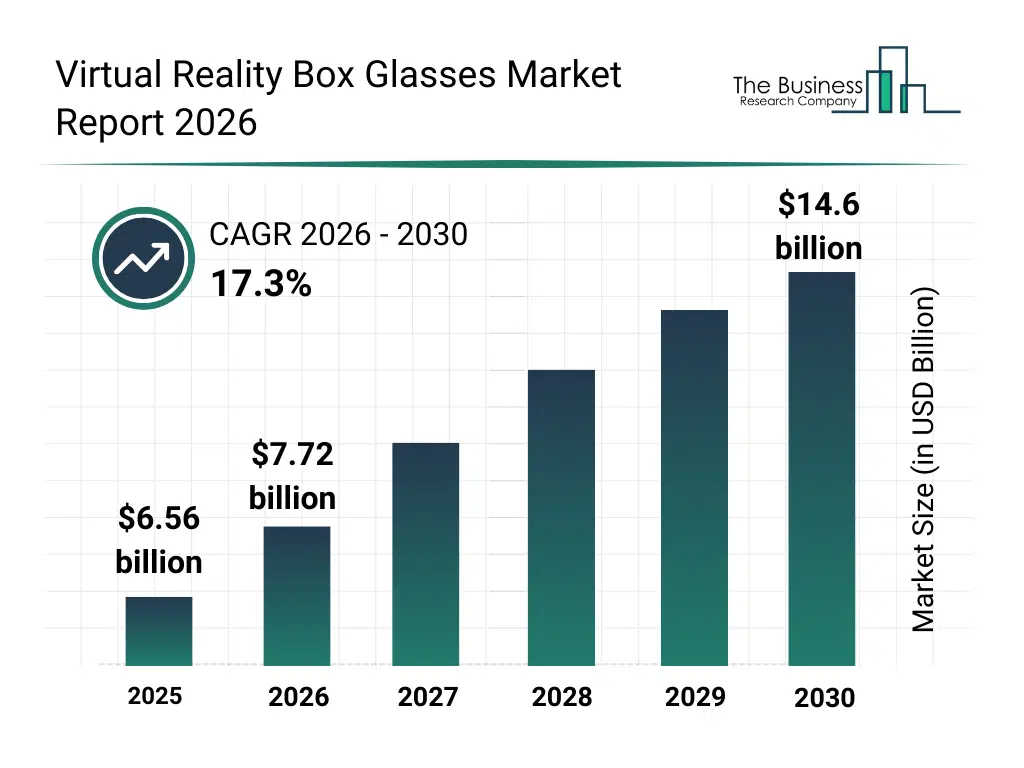
What Is The Virtual Reality Box Glasses Market Size and Share 2026?
The virtual reality box glasses market size has grown rapidly in recent years. It will grow from $6.56 billion in 2025 to $7.72 billion in 2026 at a compound annual growth rate (CAGR) of 17.6%. The growth in the historic period can be attributed to rising popularity of mobile vr gaming, early adoption of pc-tethered vr headsets in entertainment, growth of vr in education and training, demand for immersive retail experiences, increasing awareness of vr-assisted healthcare applications.What Is The Virtual Reality Box Glasses Market Growth Forecast?
The virtual reality box glasses market size is expected to see rapid growth in the next few years. It will grow to $14.6 billion in 2030 at a compound annual growth rate (CAGR) of 17.3%. The growth in the forecast period can be attributed to expansion of enterprise vr solutions for training and collaboration, growth of mixed reality and ar combo devices, adoption of foldable and portable vr headsets, integration of AI-driven motion tracking, rising demand for 3D audio-enabled immersive experiences. Major trends in the forecast period include smartphone-compatible vr glasses, high-end gaming vr headsets, foldable mobile vr headsets, enterprise-focused standalone vr glasses, 3D audio and motion sensing integration.
Global Virtual Reality Box Glasses Market Segmentation
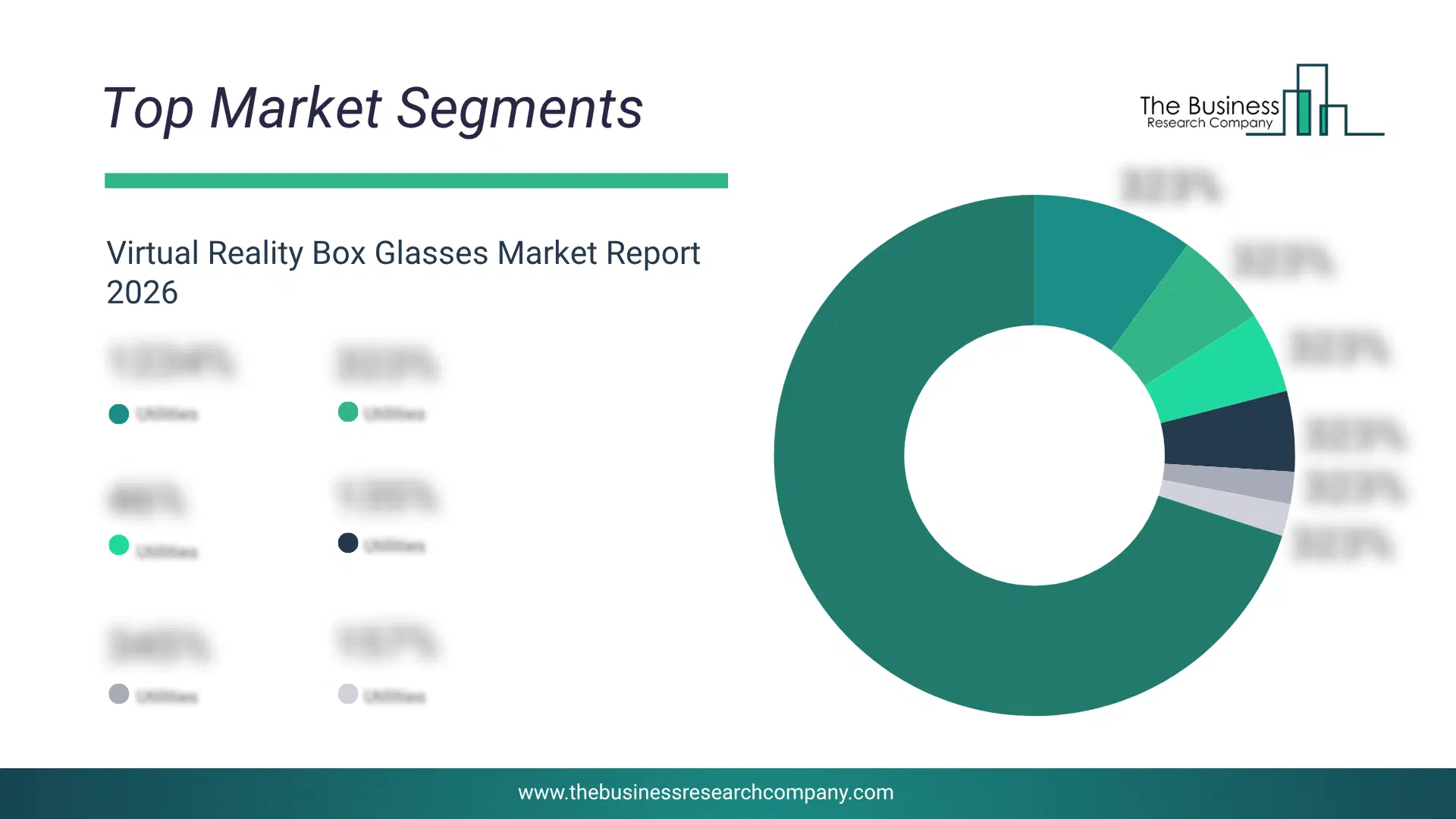
1) By Product Type: Standalone Virtual Reality Glasses, Mobile Virtual Reality Glasses, Personal Computer-Tethered Virtual Reality Glasses, Augmented Reality (AR) Combos, Mixed Reality Headsets 2) By Technology: Optical Tracking, Positional Tracking, Mobile Technology, 3D Audio Technology, Motion Sensing Technology 3) By Application: Gaming, Education And Training, Healthcare, Real Estate, Retail, Other Applications 4) By Distribution Channel: Online Stores, Specialty Stores, Supermarkets Or Hypermarkets, Other Distribution Channels 5) By End-User: Consumer, Commercial, Industrial Subsegments: 1) By Standalone Virtual Reality Glasses: Basic Standalone Headsets, Premium Standalone Headsets, Gaming Focused Standalone Headsets, Enterprise Focused Standalone Headsets 2) By Mobile Virtual Reality Glasses: Smartphone Compatible Glasses, Lightweight Mobile Headsets, Foldable Mobile Headsets, Portable Gaming Headsets 3) By Personal Computer-Tethered Virtual Reality Glasses: High-End Gaming Headsets, Professional Simulation Headsets, Multi-Sensor Tracking Headsets 4) By Augmented Reality Combos: Augmented Reality Assisted Gaming Glasses, Enterprise Augmented Reality Glasses, Education Focused Augmented Reality Glasses 5) By Mixed Reality Headsets: Immersive Mixed Reality Headsets, Enterprise Mixed Reality Headsets, Industrial Mixed Reality Headsets, Consumer Mixed Reality HeadsetsWhat Is The Driver Of The Virtual Reality Box Glasses Market?
The increasing demand for immersive experiences is expected to propel the growth of the virtual reality box glasses market going forward. Immersive experiences are fully engaging digital environments that make users feel present within a virtual or augmented world. The increasing consumer demand for immersive experiences is due to the growing desire for realistic, engaging, and interactive digital environments that closely mimic real-life sensations. Virtual reality box glasses enhance immersive experiences by providing fully engaging virtual environments, making them ideal for gaming, education, and entertainment. They increase user interaction by delivering realistic visuals and spatial audio, improving overall digital engagement. For instance, in August 2024, according to the United States Government Accountability Office, a US-based government agency, in 2022 and 2023, 17 out of 23 civilian agencies engaged in activities using immersive technologies, with 13 agencies acknowledging benefits from their use. Therefore, the increasing demand for immersive experiences is driving the growth of the virtual reality box glasses industry.Key Players In The Global Virtual Reality Box Glasses Market
Major companies operating in the virtual reality box glasses market are Google LLC, Xiaomi Corporation, Samsung Electronics Co. Ltd., Meta Platforms Inc., Huawei Technologies Co. Ltd., Sony Corporation, Lenovo Group Limited., HP Inc., Goertek Inc., Valve Corporation, iQIYI Inc., HTC Corporation, Unity Technologies, Pimax Innovation Inc., Varjo Technologies Oy, Pico Interactive Inc., Quytech, Dongguan Shinecon Industrial Co. Ltd., Vrgineers s.r.o.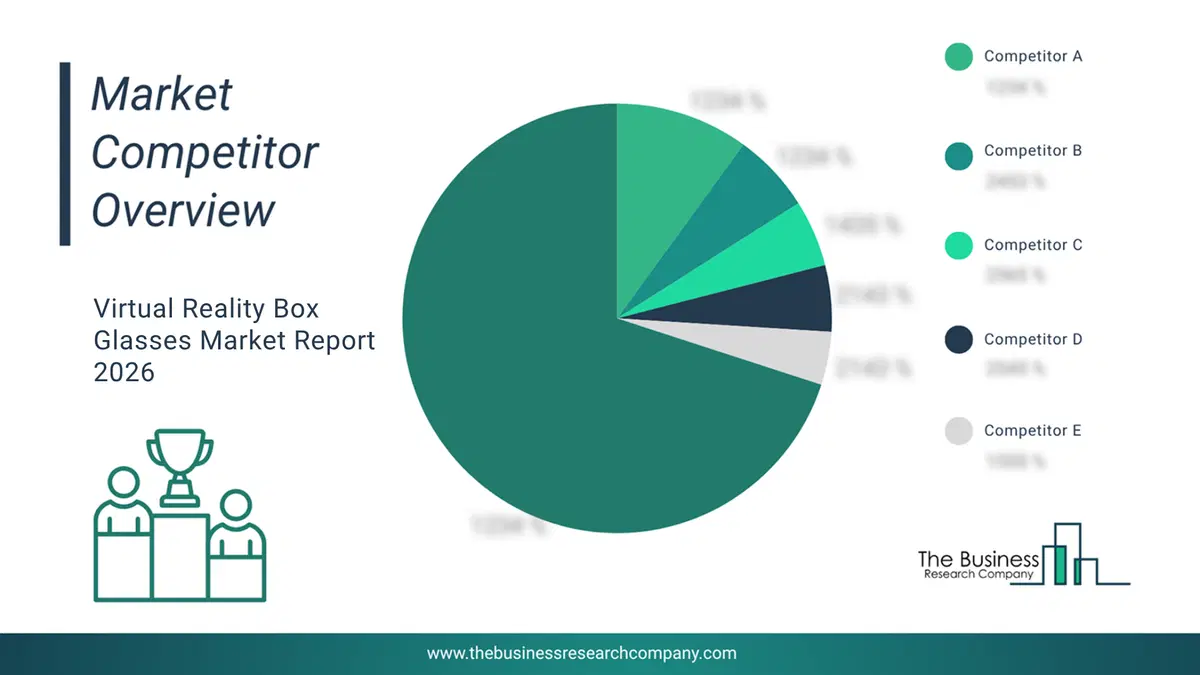
This chart is for illustrative purposes; the full report includes a detailed competitor analysis and comprehensive overview of the top 10 companies in the market.
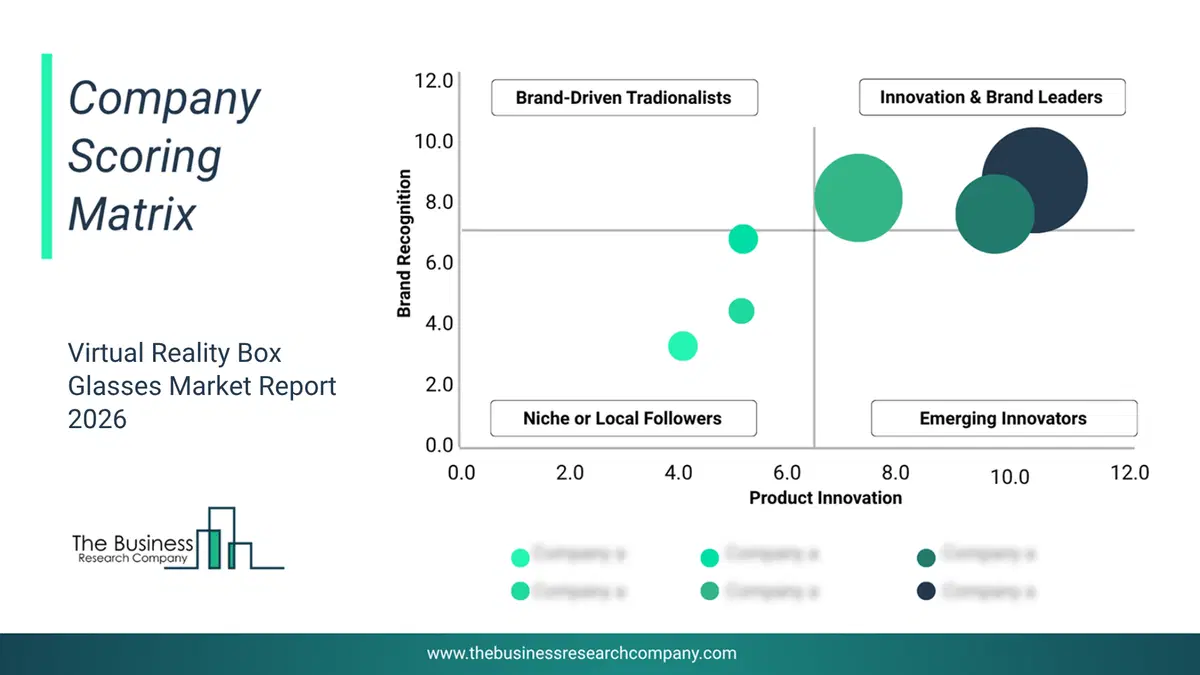
This chart maps companies by product innovation and brand strength, with bubble size indicating relative revenue, helping identify market leaders, challengers, and niche players. This is an illustrative chart; the full report provides a complete and accurate competitive analysis.
Global Virtual Reality Box Glasses Market Trends and Insights
Major companies operating in the virtual reality box glasses market are focusing on developing advanced products, such as standalone mixed reality (MR) headsets, to deliver fully immersive experiences without the need for external devices. A standalone mixed reality (MR) headset is a self-contained device that blends virtual and real-world elements, functioning without requiring connection to a PC or smartphone. For instance, in September 2024, Meta Platforms Inc., a US-based technology company, launched the Quest 3S VR headset, designed to provide an affordable yet immersive virtual reality experience. This mixed reality headset delivers powerful performance with a Qualcomm Snapdragon XR2 Gen 2 processor and 8GB of RAM. It features a single LCD display with Fresnel lenses, offering a resolution of 1832 × 1920 pixels per eye and a 96° horizontal and 90° vertical field of view, and it supports full-color passthrough for mixed reality experiences. The headset also provides 2.5 hours of battery life, hand tracking, precise controller support, and access to the full Horizon app store, making it a budget-friendly yet capable option for VR and mixed reality users.What Are Latest Mergers And Acquisitions In The Virtual Reality Box Glasses Market?
In February 2025, Hisense Visual Technology Co. Ltd., a China-based display technology company, partnered with XREAL. This partnership aims to develop advanced virtual and augmented reality devices, enhance display performance in virtual reality and augmented reality headsets, and deliver more immersive and high-quality user experiences. XREAL is a China-based company specializing in virtual reality box glasses and immersive hardware solutions.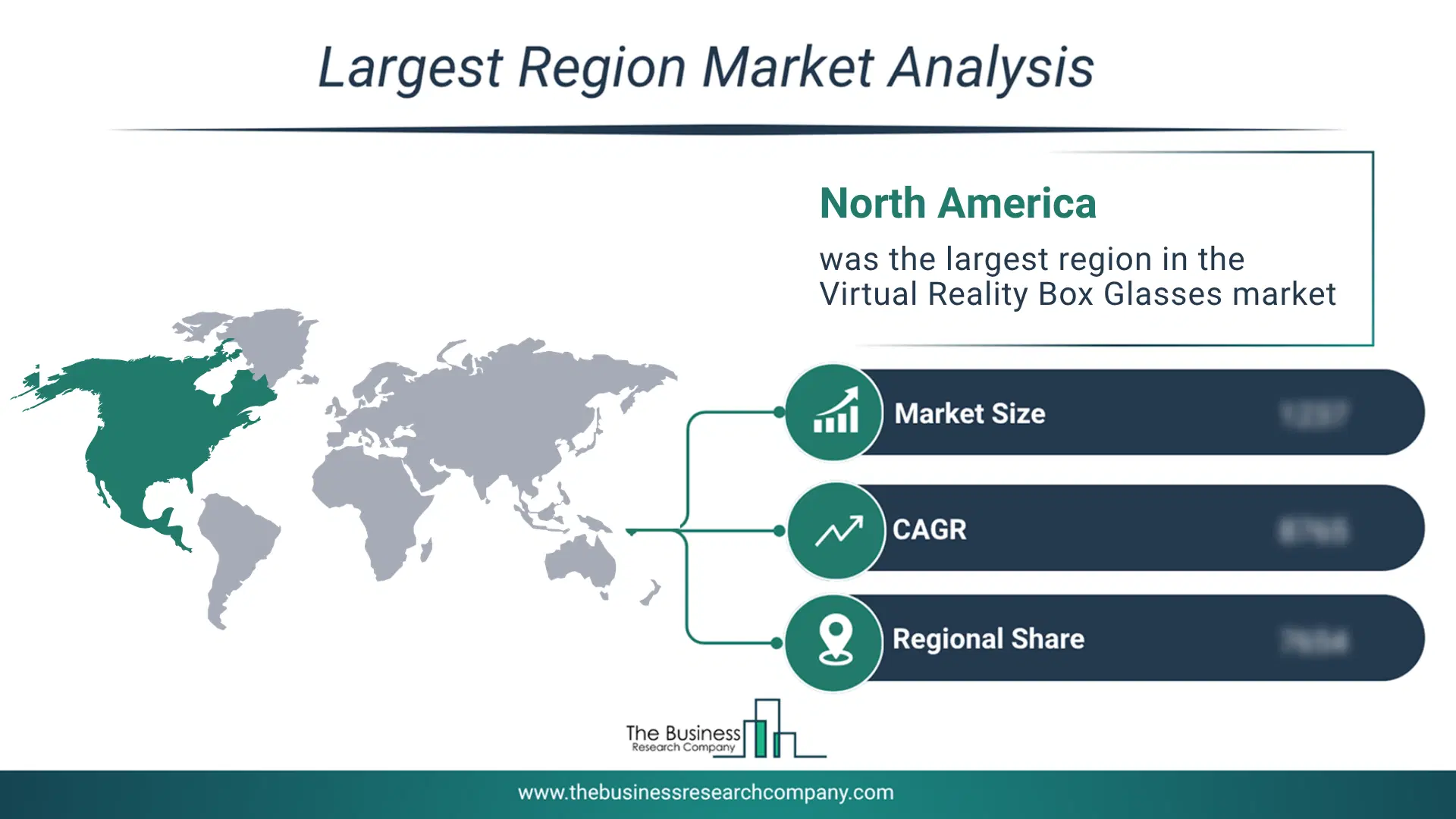
Regional Insights
North America was the largest region in the virtual reality box glasses market in 2025. Asia-Pacific is expected to be the fastest-growing region in the forecast period. The regions covered in this market report are Asia-Pacific, South East Asia, Western Europe, Eastern Europe, North America, South America, Middle East, Africa. The countries covered in this market report are Australia, Brazil, China, France, Germany, India, Indonesia, Japan, Taiwan, Russia, South Korea, UK, USA, Canada, Italy, Spain.What Defines the Virtual Reality Box Glasses Market?
The virtual reality (VR) box glasses market consists of revenues earned by entities by providing services such as educational and training programs, entertainment and media streaming, simulation and professional training, and healthcare and therapy solutions. The market value includes the value of related goods sold by the service provider or included within the service offering. The virtual reality (VR) box glasses market also includes sales of standalone virtual reality headsets, tethered virtual reality headsets, mixed reality (MR) headsets, virtual reality headset accessories, and low-end virtual reality headsets. Values in this market are 'factory gate' values; that is, the value of goods sold by the manufacturers or creators of the goods, whether to other entities (including downstream manufacturers, wholesalers, distributors, and retailers) or directly to end customers. The value of goods in this market includes related services sold by the creators of the goods.How is Market Value Defined and Measured?
The market value is defined as the revenues that enterprises gain from the sale of goods and/or services within the specified market and geography through sales, grants, or donations in terms of the currency (in USD unless otherwise specified). The revenues for a specified geography are consumption values that are revenues generated by organizations in the specified geography within the market, irrespective of where they are produced. It does not include revenues from resales along the supply chain, either further along the supply chain or as part of other products.
This chart presents market attractiveness based on a quantitative evaluation of growth, competition, strategic alignment, and risk, offering a clear view of opportunity areas for decision-making. This chart is for illustrative purposes; the full report contains the complete analysis.

This chart highlights the Total Addressable Market (TAM) by estimating the maximum revenue opportunity using an assumption-driven approach, supporting strategic planning and opportunity sizing across markets. The chart is illustrative; the full report provides a more comprehensive analysis.
What Key Data and Analysis Are Included in the Virtual Reality Box Glasses Market Report 2026?
The virtual reality box glasses market research report is one of a series of new reports from The Business Research Company that provides market statistics, including industry global market size, regional shares, competitors with the market share, detailed market segments, market trends and opportunities, and any further data you may need to thrive in the virtual reality box glasses industry. The market research report delivers a complete perspective of everything you need, with an in-depth analysis of the current and future state of the industry.Virtual Reality Box Glasses Market Report Forecast Analysis
| Report Attribute | Details |
|---|---|
| Market Size Value In 2026 | $7.72 billion |
| Revenue Forecast In 2030 | $14.6 billion |
| Growth Rate | CAGR of 17.3% from 2026 to 2030 |
| Base Year For Estimation | 2025 |
| Actual Estimates/Historical Data | 2020-2025 |
| Forecast Period | 2026 - 2030 |
| Market Representation | Revenue in USD Billion and CAGR from 2026 to 2030 |
| Segments Covered | Product Type, Technology, Application, Distribution Channel, End-User |
| Regional Scope | Asia-Pacific, Western Europe, Eastern Europe, North America, South America, Middle East, Africa |
| Country Scope | The Countries Covered In This Market Report Are Australia, Brazil, China, France, Germany, India, Indonesia, Japan, Taiwan, Russia, South Korea, Uk, Usa, Canada, Italy, Spain. |
| Key Companies Profiled | Google LLC, Xiaomi Corporation, Samsung Electronics Co. Ltd., Meta Platforms Inc., Huawei Technologies Co. Ltd., Sony Corporation, Lenovo Group Limited., HP Inc., Goertek Inc., Valve Corporation, iQIYI Inc., HTC Corporation, Unity Technologies, Pimax Innovation Inc., Varjo Technologies Oy, Pico Interactive Inc., Quytech, Dongguan Shinecon Industrial Co. Ltd., Vrgineers s.r.o. |
| Customization Scope | Request for Customization |
| Pricing And Purchase Options | Explore Purchase Options |