
Vitamin D Testing Market Report 2026
Global Outlook – By Product (25 -Hydroxy Vitamin D Testing, 1,25-Dihydroxy Vitamin D Testing, 24,25-Dihydroxy Vitamin D Testing), By Technique (Radioimmunoassay (RIA), Enzyme-Linked Immunosorbent Assay (ELISA), High-Performance Liquid Chromatography (HPLC), Liquid Chromatography–Mass Spectrometry (LC–MS), Other Techniques), By Indication (Osteoporosis, Rickets, Malabsorption, Vitamin D Deficiency, Other Indications), By Application (Clinical Testing, Research Testing), By End-User (Hospitals, Diagnostic Laboratories, Home Care, Point-of-Care, Other End-Users) - Market Size, Trends, Strategies, and Forecast to 2030
Vitamin D Testing Market Overview
• Vitamin D Testing market size has reached to $1 billion in 2025 • Expected to grow to $1.56 billion in 2030 at a compound annual growth rate (CAGR) of 9.1% • Growth Driver: Rising Vitamin D Deficiency And Its Impact On The Growth Of The Vitamin D Testing Market • Market Trend: Innovative Advances In Vitamin D Testing • North America was the largest region in 2025 and Asia-Pacific is the fastest growing region.What Is Covered Under Vitamin D Testing Market?
Vitamin D testing is a process that measures the level of vitamin D in the blood to assess whether a person has a deficiency or is at risk for related health issues. Vitamin D is essential for maintaining healthy bones and immune function. The test usually measures the level of 25-hydroxyvitamin D (25(OH)D) in the blood, which is the most widely used marker for assessing vitamin D status. The main vitamin D testing are 25-hydroxy vitamin D testing, 1,25-dihydroxy vitamin D testing, and 24,25-dihydroxy vitamin D testing. 25-hydroxy vitamin D testing measures the level of calcidiol, which is a form of vitamin D created when the body processes vitamin D from sunlight or supplements. It uses various techniques such as radioimmunoassay (RIA), enzyme-linked immunosorbent assay (ELISA), high-performance liquid chromatography (HPLC), liquid chromatography-mass spectrometry (LC-MS), and others, and it is used for several indications, including osteoporosis, rickets, malabsorption, vitamin D deficiency, and others. It is applied for clinical testing and research testing by various end-users such as hospitals, diagnostic laboratories, home care, point-of-care, and others.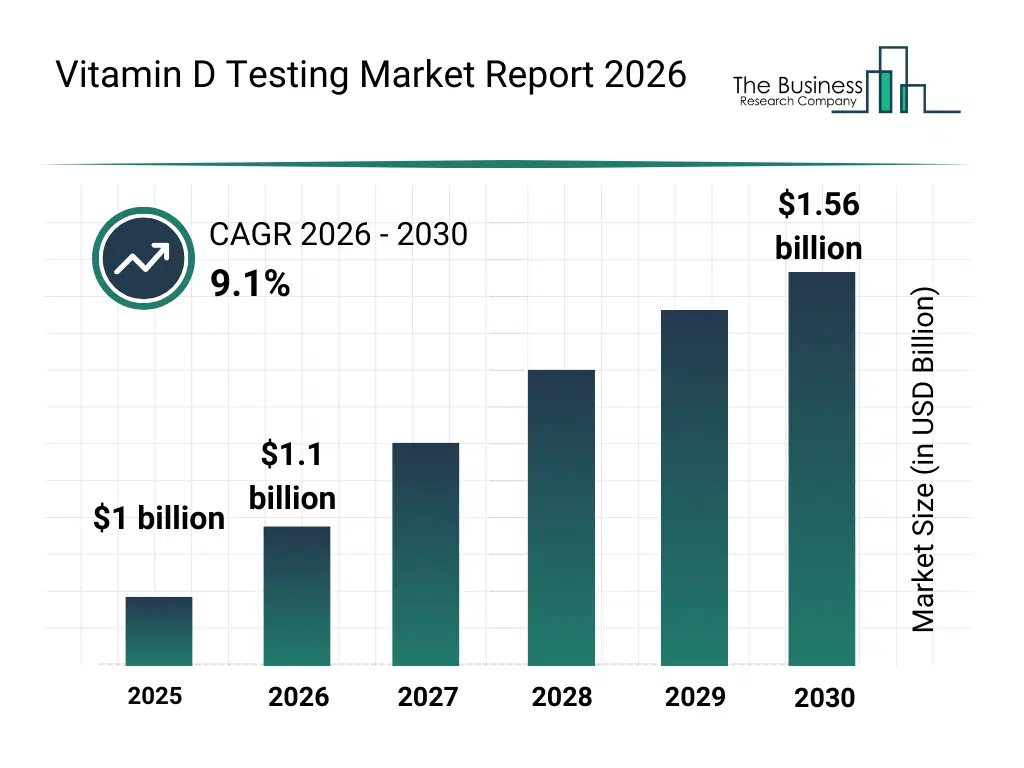
What Is The Vitamin D Testing Market Size and Share 2026?
The vitamin d testing market size has grown strongly in recent years. It will grow from $1 billion in 2025 to $1.1 billion in 2026 at a compound annual growth rate (CAGR) of 9.4%. The growth in the historic period can be attributed to rising prevalence of vitamin d deficiency, expansion of diagnostic laboratory networks, increasing awareness of bone health, adoption of standardized testing protocols, growth in clinical testing volumes.What Is The Vitamin D Testing Market Growth Forecast?
The vitamin d testing market size is expected to see strong growth in the next few years. It will grow to $1.56 billion in 2030 at a compound annual growth rate (CAGR) of 9.1%. The growth in the forecast period can be attributed to increasing demand for preventive healthcare diagnostics, expansion of home-based testing solutions, rising use of advanced analytical techniques, growing focus on personalized nutrition assessment, increased testing in aging populations. Major trends in the forecast period include increasing adoption of automated vitamin d assays, rising use of high-precision lc–ms techniques, expansion of preventive health screening programs, growing integration of laboratory information systems, enhanced focus on diagnostic accuracy.

Global Vitamin D Testing Market Segmentation
1) By Product: 25 -Hydroxy Vitamin D Testing, 1,25-Dihydroxy Vitamin D Testing, 24,25-Dihydroxy Vitamin D Testing 2) By Technique: Radioimmunoassay (RIA), Enzyme-Linked Immunosorbent Assay (ELISA), High-Performance Liquid Chromatography (HPLC), Liquid Chromatography–Mass Spectrometry (LC–MS), Other Techniques 3) By Indication: Osteoporosis, Rickets, Malabsorption, Vitamin D Deficiency, Other Indications 4) By Application: Clinical Testing, Research Testing 5) By End-User: Hospitals, Diagnostic Laboratories, Home Care, Point-of-Care, Other End-Users Subsegments: 1) By 25-Hydroxy Vitamin D Testing: Immunoassays, Liquid Chromatography-Mass Spectrometry (LC-MS), Enzyme-Linked Immunosorbent Assay (ELISA) 2) By 1,25-Dihydroxy Vitamin D Testing: Radioimmunoassays (RIA), High-Performance Liquid Chromatography (HPLC), LC-MS Techniques 3) By 24,25-Dihydroxy Vitamin D Testing: Mass Spectrometry, Immunoassays, HPLC MethodsWhat Is The Driver Of The Vitamin D Testing Market?
The awareness of vitamin D deficiency disorders is expected to propel the growth of the vitamin D testing market going forward. Vitamin D deficiency disorder is a condition resulting from insufficient vitamin D levels, leading to impaired calcium absorption and causing issues such as weakened bones, muscle pain, and an increased risk of fractures. Vitamin D deficiency disorders occur due to reduced sunlight exposure, increased use of sunscreen, dietary insufficiencies, and sedentary lifestyles. Vitamin D testing is required for vitamin D deficiency disorders to accurately assess and diagnose insufficient vitamin D levels, enabling appropriate treatment and prevention of related health issues. For instance, in July 2024, a survey on 1,400 customers conducted by Forth, a UK-based health and wellness company, found that 57% of persons had vitamin D levels below the recommended range (75-100 nmol/L). The average value was 78.7 nmol/L. Therefore, the increasing awareness of vitamin D deficiency disorders drives the vitamin D testing industry.Key Players In The Global Vitamin D Testing Market
Major companies operating in the vitamin d testing market are Siemens AG, Thermo Fisher Scientific Inc., Abbott Laboratories Inc., F. Hoffmann-La Roche AG, Laboratory Corporation of America Holdings, Quest Diagnostics Incorporated, bioMérieux SA, Tosoh Bioscience LLC, Revvity Inc., Quidel Corporation, Beckman Coulter Inc., Bio-Rad Laboratories Inc., DiaSorin S.p.A., Tecan Group Ltd., Randox Laboratories Ltd., Boditech Med Inc., Everlywell Inc., BioVendor Laboratorni medicina AS, Diazyme Laboratories Inc., DiaSys Diagnostic Systems GmbH, Qualigen Therapeutics Inc.
This chart is for illustrative purposes; the full report includes a detailed competitor analysis and comprehensive overview of the top 10 companies in the market.

This chart maps companies by product innovation and brand strength, with bubble size indicating relative revenue, helping identify market leaders, challengers, and niche players. This is an illustrative chart; the full report provides a complete and accurate competitive analysis.
Global Vitamin D Testing Market Trends and Insights
Major companies operating in the vitamin D testing market are developing innovative products, such as vitamin D test kits, to monitor vitamin D levels at home or in clinical settings. Vitamin D test kits are diagnostic tools used to measure the vitamin D level in a person's blood, helping to assess and monitor their vitamin D status. For instance, in August 2023, Biohit Oyj, a Finland-based diagnostics company, launched its Total 25OH Vitamin D ELISA kit, a quantitative immuno-enzymatic assay that detects both 25-hydroxyvitamin D2 and D3 and is validated against the ID-LC/MS-MS reference measurement procedure. The kit is designed for clinical-laboratory use, offers a simplified 6-step protocol, can be automated on standard ELISA platforms, and delivers reliable assessment of vitamin D status for deficiency, insufficiency, or intoxication.What Are Latest Mergers And Acquisitions In The Vitamin D Testing Market?
In July 2024, Thyrocare Technologies Ltd., an India-based diagnostic and pathology service provider, acquired the pathology diagnostic business of Polo Labs for an undisclosed amount. The acquisition enhances Thyrocare’s diagnostic capabilities and service portfolio by incorporating Polo Labs' network in North India. It also improves service delivery, turnaround times, and patient convenience through the combined infrastructure. Polo Labs is an India-based company that provides vitamin D testing.
Regional Outlook
North America was the largest region in the vitamin D testing market in 2025. Asia-Pacific is expected to be the fastest-growing region in the forecast period. The regions covered in this market report are Asia-Pacific, South East Asia, Western Europe, Eastern Europe, North America, South America, Middle East, Africa. The countries covered in this market report are Australia, Brazil, China, France, Germany, India, Indonesia, Japan, Taiwan, Russia, South Korea, UK, USA, Canada, Italy, Spain.What Defines the Vitamin D Testing Market?
The vitamin D testing market consists of revenues earned by entities by providing services such as consultation services, custom supplement recommendations, advanced metabolite testing and bone health assessments. The market value includes the value of related goods sold by the service provider or included within the service offering. The vitamin D testing market also includes sales of blood collection devices, test reagents and consumables, vitamin d test strips and related products. Values in this market are ‘factory gate’ values, that is the value of goods sold by the manufacturers or creators of the goods, whether to other entities (including downstream manufacturers, wholesalers, distributors and retailers) or directly to end customers. The value of goods in this market includes related services sold by the creators of the goods.How is Market Value Defined and Measured?
The market value is defined as the revenues that enterprises gain from the sale of goods and/or services within the specified market and geography through sales, grants, or donations in terms of the currency (in USD unless otherwise specified). The revenues for a specified geography are consumption values that are revenues generated by organizations in the specified geography within the market, irrespective of where they are produced. It does not include revenues from resales along the supply chain, either further along the supply chain or as part of other products.
This chart presents market attractiveness based on a quantitative evaluation of growth, competition, strategic alignment, and risk, offering a clear view of opportunity areas for decision-making. This chart is for illustrative purposes; the full report contains the complete analysis.

This chart highlights the Total Addressable Market (TAM) by estimating the maximum revenue opportunity using an assumption-driven approach, supporting strategic planning and opportunity sizing across markets. The chart is illustrative; the full report provides a more comprehensive analysis.
What Key Data and Analysis Are Included in the Vitamin D Testing Market Report 2026?
The vitamin d testing market research report is one of a series of new reports from The Business Research Company that provides market statistics, including industry global market size, regional shares, competitors with the market share, detailed market segments, market trends and opportunities, and any further data you may need to thrive in the vitamin d testing industry. The market research report delivers a complete perspective of everything you need, with an in-depth analysis of the current and future state of the industry.Vitamin D Testing Market Report Forecast Analysis
| Report Attribute | Details |
|---|---|
| Market Size Value In 2026 | $1.1 billion |
| Revenue Forecast In 2030 | $1.56 billion |
| Growth Rate | CAGR of 9.1% from 2026 to 2030 |
| Base Year For Estimation | 2025 |
| Actual Estimates/Historical Data | 2020-2025 |
| Forecast Period | 2026 - 2030 |
| Market Representation | Revenue in USD Billion and CAGR from 2026 to 2030 |
| Segments Covered | Product, Technique, Indication, Application, End-User |
| Regional Scope | Asia-Pacific, Western Europe, Eastern Europe, North America, South America, Middle East, Africa |
| Country Scope | The countries covered in the report are Australia, Brazil, China, France, Germany, India, Indonesia, Japan, Taiwan, Russia, South Korea, UK, USA, Canada, Italy, Spain |
| Key Companies Profiled | Siemens AG, Thermo Fisher Scientific Inc., Abbott Laboratories Inc., F. Hoffmann-La Roche AG, Laboratory Corporation of America Holdings, Quest Diagnostics Incorporated, bioMérieux SA, Tosoh Bioscience LLC, Revvity Inc., Quidel Corporation, Beckman Coulter Inc., Bio-Rad Laboratories Inc., DiaSorin S.p.A., Tecan Group Ltd., Randox Laboratories Ltd., Boditech Med Inc., Everlywell Inc., BioVendor Laboratorni medicina AS, Diazyme Laboratories Inc., DiaSys Diagnostic Systems GmbH, Qualigen Therapeutics Inc. |
| Customization Scope | Request for Customization |
| Pricing And Purchase Options | Explore Purchase Options |