
Wearable Payments Market Report 2026
Global Outlook – By Device (Smart Watches, Fitness Trackers, Payment Wristbands, Smart Rings, Other Devices), By Technology (Barcodes, Contactless Point Of Sale (POS) Terminals, Near Field Communication (NFC), Quick Response (QR) Codes, Radio Frequency Identification (RFID)), By Application (Festival And Life Events, Fitness, Healthcare, Retail, Transportation, Other Applications) – Market Size, Trends, Strategies, and Forecast to 2030
Wearable Payments Market Overview
• Wearable Payments market size has reached to $79.59 billion in 2025 • Expected to grow to $186.25 billion in 2030 at a compound annual growth rate (CAGR) of 18.5% • Growth Driver: Impact Of Cashless Transaction In Wearable Payments Market • Market Trend: Innovative Silicon Wristbands Enhance Convenience And Security In Wearable Payments • North America was the largest region in 2025 and Asia-Pacific is the fastest growing region.What Is Covered Under Wearable Payments Market?
Wearable payments refer to the capability of making contactless payments using wearable devices, such as smartwatches, fitness trackers, or other connected accessories. These devices are equipped with technology that allows users to securely link their payment information and make transactions at point-of-sale terminals without needing to use traditional payment methods such as credit cards or cash. Wearable payments provide convenience, speed, and enhanced security for transactions in various retail and service environments. The main devices for wearable payments are smartwatches, fitness trackers, payment wristbands, smart rings, and others. Smartwatches are wearable devices that resemble traditional wristwatches but include advanced functionalities such as fitness tracking, notifications, and often the ability to make payments electronically. The various technologies include barcodes, contactless point of sale (POS) terminals, near-field communication (NFC), quick response (QR) codes, and radio frequency identification (RFID) used for varying applications such as festival and life events, fitness, healthcare, retail, transportation, and others.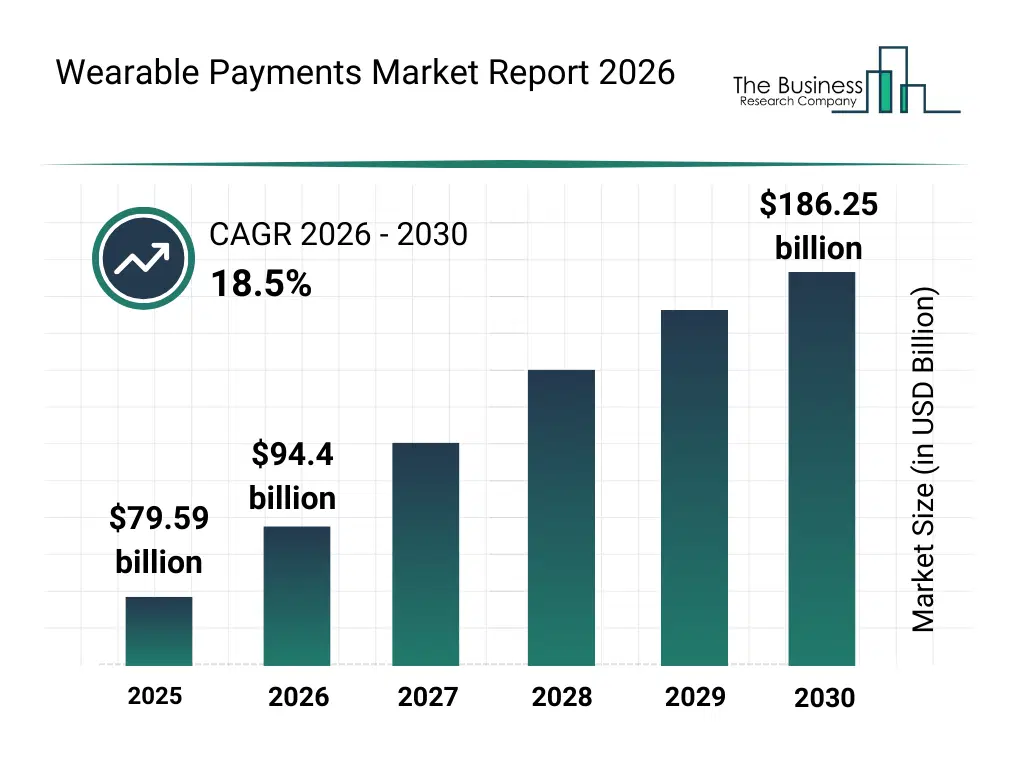
What Is The Wearable Payments Market Size and Share 2026?
The wearable payments market size has grown rapidly in recent years. It will grow from $79.59 billion in 2025 to $94.4 billion in 2026 at a compound annual growth rate (CAGR) of 18.6%. The growth in the historic period can be attributed to increasing consumer preference for cashless transactions, expansion of contactless payment infrastructure, growth in smartwatch and fitness tracker adoption, rising urbanization and digital lifestyles, improved payment network acceptance.What Is The Wearable Payments Market Growth Forecast?
The wearable payments market size is expected to see rapid growth in the next few years. It will grow to $186.25 billion in 2030 at a compound annual growth rate (CAGR) of 18.5%. The growth in the forecast period can be attributed to growing adoption of multi-functional wearable devices, rising demand for seamless omnichannel payments, expansion of wearable payments in transit systems, increasing investments in secure payment authentication, growing integration with digital identity platforms. Major trends in the forecast period include expansion of contactless payment wearables, rising adoption of nfc-enabled devices, growing integration with mobile wallet ecosystems, increasing focus on biometric authentication, enhanced security features in wearable payments.
Global Wearable Payments Market Segmentation
1) By Device: Smart Watches, Fitness Trackers, Payment Wristbands, Smart Rings, Other Devices 2) By Technology: Barcodes, Contactless Point Of Sale (POS) Terminals, Near Field Communication (NFC), Quick Response (QR) Codes, Radio Frequency Identification (RFID) 3) By Application: Festival And Life Events, Fitness, Healthcare, Retail, Transportation, Other Applications Subsegments: 1) By Smart Watches: Apple Watches, Android Smart Watches, Hybrid Smart Watches 2) By Fitness Trackers: Basic Fitness Trackers, Advanced Fitness Trackers 3) By Payment Wristbands: Contactless Payment Wristbands, Near-Field Communication (NFC)-Enabled Payment Wristbands 4) By Smart Rings: Near-Field Communication (NFC)-Enabled Smart Rings, Bluetooth-Enabled Smart Rings 5) By Other Devices: Wearable Payment Patches, Wearable Payment Stickers, Smart Glasses With Payment CapabilitiesWhat Is The Driver Of The Wearable Payments Market?
The increase in cashless transactions is expected to propel the growth of the wearable payments market going forward. Cashless transactions refer to payments made without physical currency, typically using electronic methods such as cards, mobile wallets, or online transfers. The increase in cashless transactions is due to factors such as convenience, security, technological advancements in payment systems, and shifting consumer preferences towards digital and contactless payment methods. Wearable payments facilitate cashless transactions by enabling users to make payments conveniently and securely through devices such as smartwatches and fitness trackers, integrating payment functionalities seamlessly into daily activities. For instance, in July 2024, according to the European Central Bank, a Germany-based central bank for the eurosytem, in 2023, the number of contactless card payments in the second half of the year rose by 16%, reaching 23.2 billion compared to the same period in 2022. Therefore, the increase in cashless transactions is driving the growth of the wearable payments industry.Key Players In The Global Wearable Payments Market
Major companies operating in the wearable payments market are Samsung Group, American Express Company, Xiaomi Corporation, Visa Inc., PayPal Holdings Inc., Mastercard Incorporated, Thales Group, NXP Semiconductors N.V., Garmin Ltd., Timex Group, Ingenico Group, Fitbit Inc., Polar Electro Oy, Suunto Inc., Kerv Wearables, Nymi Inc., Zwipe AS, Netclearance Systems Inc., Tappy Technologies Limited, Fidesmo AB, Wirecard AG
This chart is for illustrative purposes; the full report includes a detailed competitor analysis and comprehensive overview of the top 10 companies in the market.
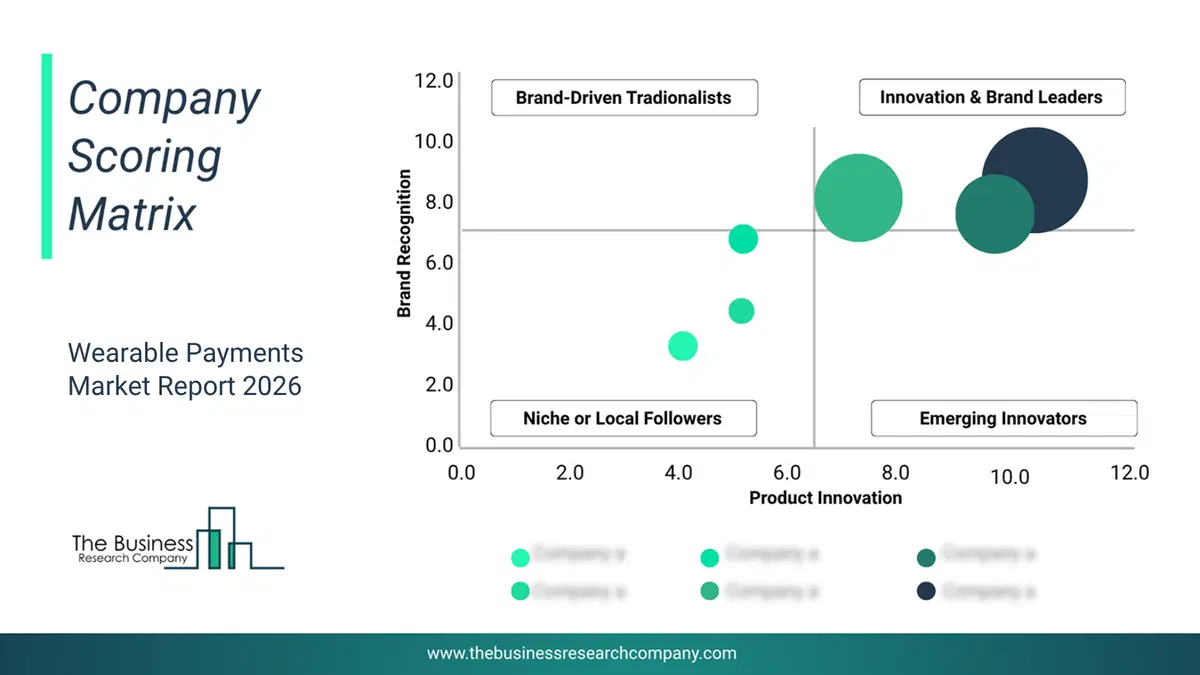
This chart maps companies by product innovation and brand strength, with bubble size indicating relative revenue, helping identify market leaders, challengers, and niche players. This is an illustrative chart; the full report provides a complete and accurate competitive analysis.
Global Wearable Payments Market Trends and Insights
Major companies operating in the wearable payments market are developing advanced solutions such as silicon wristbands to offer consumers more convenient and secure payment options. A silicon wristband is a stretchy band made of silicone rubber, often used as an accessory or for holding electronic components. For instance, in May 2024, Sampath Bank, a Sri Lankan-based commercial bank, launched Sampath PayBand. It is Sri Lanka's first wearable payment device designed for seamless and secure transactions. This innovative silicon wristband, embedded with a payment chip, integrates directly with Sampath Bank Savings accounts. Users can effortlessly make payments with a tap at any near field communication (NFC)-enabled Point of Sale (POS) terminal, eliminating the need for wallets, cards, or phones.What Are Latest Mergers And Acquisitions In The Wearable Payments Market?
In October 2025, Conzumex Industries Private Limited an India-based provider of wearable payment devices, partnered with the National Payments Corporation to launch India’s first wearable payments ecosystem. Through this collaboration, the companies aim to enable secure, contactless payments via wearable devices such as rings, bands, and watches, providing consumers with a convenient and frictionless payment experience. National Payments Corporation India-based company that provides wearable payments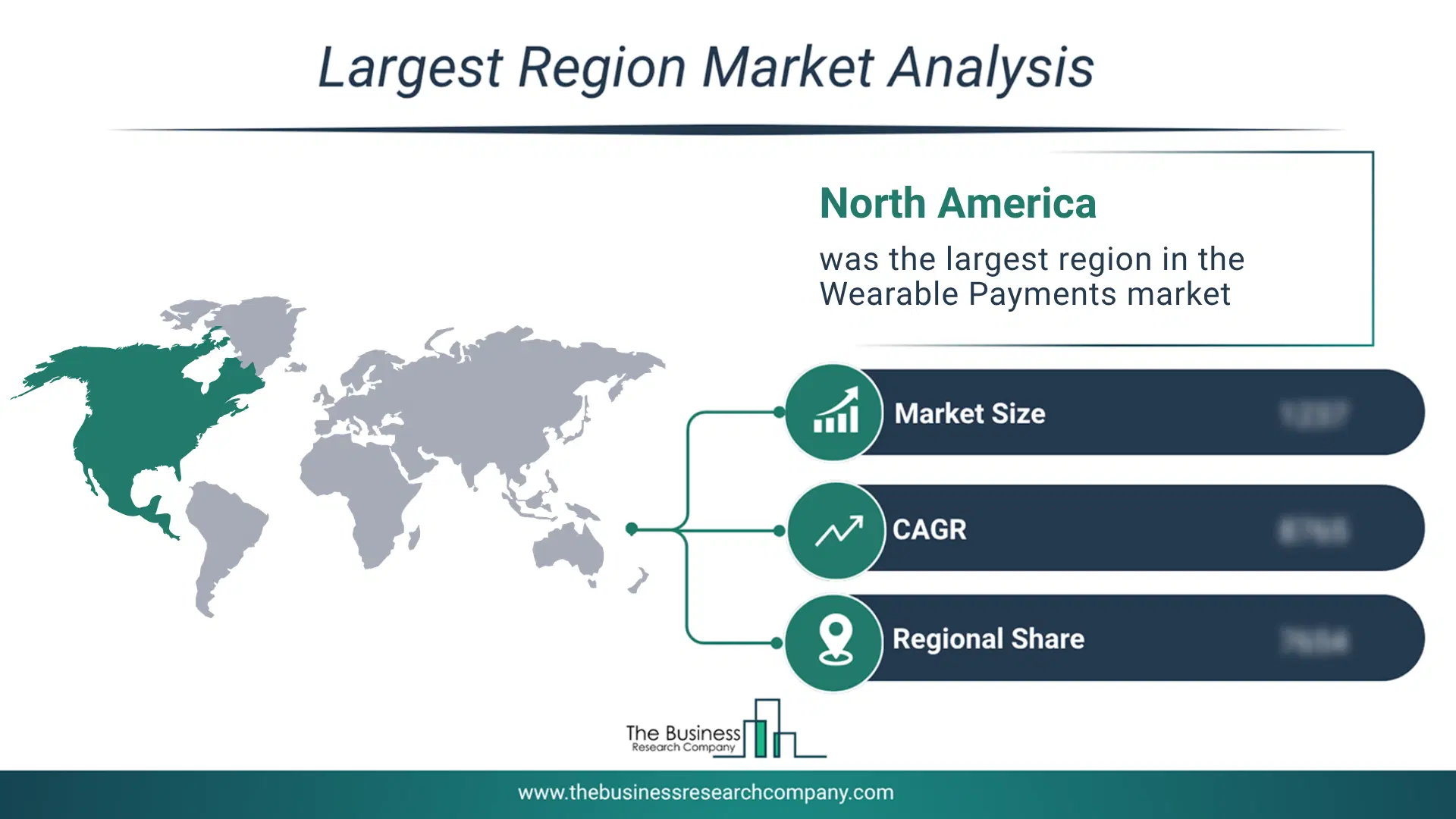
Regional Outlook
North America was the largest region in the wearable payments market in 2025. Asia-Pacific is expected to be the fastest-growing region in the forecast period. The regions covered in this market report are Asia-Pacific, South East Asia, Western Europe, Eastern Europe, North America, South America, Middle East, Africa. The countries covered in this market report are Australia, Brazil, China, France, Germany, India, Indonesia, Japan, Taiwan, Russia, South Korea, UK, USA, Canada, Italy, Spain.What Defines the Wearable Payments Market?
The wearable payments market consists of sales of payment-enabled keychains, smart eyewear, smart jewelry, and smart gloves. Values in this market are ‘factory gate’ values, that is, the value of goods sold by the manufacturers or creators of the goods, whether to other entities (including downstream manufacturers, wholesalers, distributors, and retailers) or directly to end customers. The value of goods in this market includes related services sold by the creators of the goods.How is Market Value Defined and Measured?
The market value is defined as the revenues that enterprises gain from the sale of goods and/or services within the specified market and geography through sales, grants, or donations in terms of the currency (in USD unless otherwise specified). The revenues for a specified geography are consumption values that are revenues generated by organizations in the specified geography within the market, irrespective of where they are produced. It does not include revenues from resales along the supply chain, either further along the supply chain or as part of other products.
This chart presents market attractiveness based on a quantitative evaluation of growth, competition, strategic alignment, and risk, offering a clear view of opportunity areas for decision-making. This chart is for illustrative purposes; the full report contains the complete analysis.

This chart highlights the Total Addressable Market (TAM) by estimating the maximum revenue opportunity using an assumption-driven approach, supporting strategic planning and opportunity sizing across markets. The chart is illustrative; the full report provides a more comprehensive analysis.
What Key Data and Analysis Are Included in the Wearable Payments Market Report 2026?
The wearable payments market research report is one of a series of new reports from The Business Research Company that provides market statistics, including Market Report 2026?global market size, regional shares, competitors with the market share, detailed market segments, market trends and opportunities, and any further data you may need to thrive in the wearable payments Market Report 2026? The market research report delivers a complete perspective of everything you need, with an in-depth analysis of the current and future state of the Market Report 2026?Wearable Payments Market Report Forecast Analysis
| Report Attribute | Details |
|---|---|
| Market Size Value In 2026 | $94.4 billion |
| Revenue Forecast In 2030 | $186.25 billion |
| Growth Rate | CAGR of 18.6% from 2026 to 2030 |
| Base Year For Estimation | 2025 |
| Actual Estimates/Historical Data | 2020-2025 |
| Forecast Period | 2026 - 2030 |
| Market Representation | Revenue in USD Billion and CAGR from 2026 to 2030 |
| Segments Covered | Device, Technology, Application |
| Regional Scope | Asia-Pacific, Western Europe, Eastern Europe, North America, South America, Middle East, Africa |
| Country Scope | The countries covered in the report are Australia, Brazil, China, France, Germany, India, Indonesia, Japan, Taiwan, Russia, South Korea, UK, USA, Canada, Italy, Spain. |
| Key Companies Profiled | Samsung Group, American Express Company, Xiaomi Corporation, Visa Inc., PayPal Holdings Inc., Mastercard Incorporated, Thales Group, NXP Semiconductors N.V., Garmin Ltd., Timex Group, Ingenico Group, Fitbit Inc., Polar Electro Oy, Suunto Inc., Kerv Wearables, Nymi Inc., Zwipe AS, Netclearance Systems Inc., Tappy Technologies Limited, Fidesmo AB, Wirecard AG |
| Customization Scope | Request for Customization |
| Pricing And Purchase Options | Explore Purchase Options |