
Acetic Acid Market Report 2026
Global Outlook – By Type (Glacial Acetic Acid, Diluted (Aqueous) Acetic Acid, Food-Grade Acetic Acid, Pharmaceutical-Grade Acetic Acid), By Application (Vinyl Acetate Monomer, Acetic Anhydride, Acetate Esters, Other Applications), By End-Use (Food And beverages, Paints And coating, Plastics And Polymers, Pharmaceutical, Chemicals, Other End-Uses) – Market Size, Trends, Strategies, and Forecast to 2030
Acetic Acid Market Overview
• Acetic Acid market size has reached to $16.86 billion in 2025 • Expected to grow to $22.73 billion in 2030 at a compound annual growth rate (CAGR) of 6% • Growth Driver: Surging Chemical Production Drives Growth In The Acetic Acid Market • Market Trend: Acetic Acid Market Witnesses Major Companies Investing In Sustainable Production • Asia-Pacific was the largest region and fastest growing region.What Is Covered Under Acetic Acid Market?
Acetic acid is an organic substance with a strong odor and sour flavor. It is a carboxylic acid comprised of a carboxyl functional group connected to a methyl group with the chemical formula CH3COOH and usually, it is a by-product of fermentation. The main types of sales channels are direct company sales, direct import, distributors and traders, and retailers. Direct company sales refer to sales that involve direct communication between a vendor and a customer. Acetic acid is sold through direct company sales directly outside of a retail setting and major demand for acetic acid is fulfilled by direct import by the customers. The main applications of acetic acid are vinyl acetate monomer, acetic anhydride, acetate esters, purified terephthalic acid, ethanol, and others. The major end-users are food and beverages, paints and coating, plastics and polymers, pharmaceutical, chemicals, and others.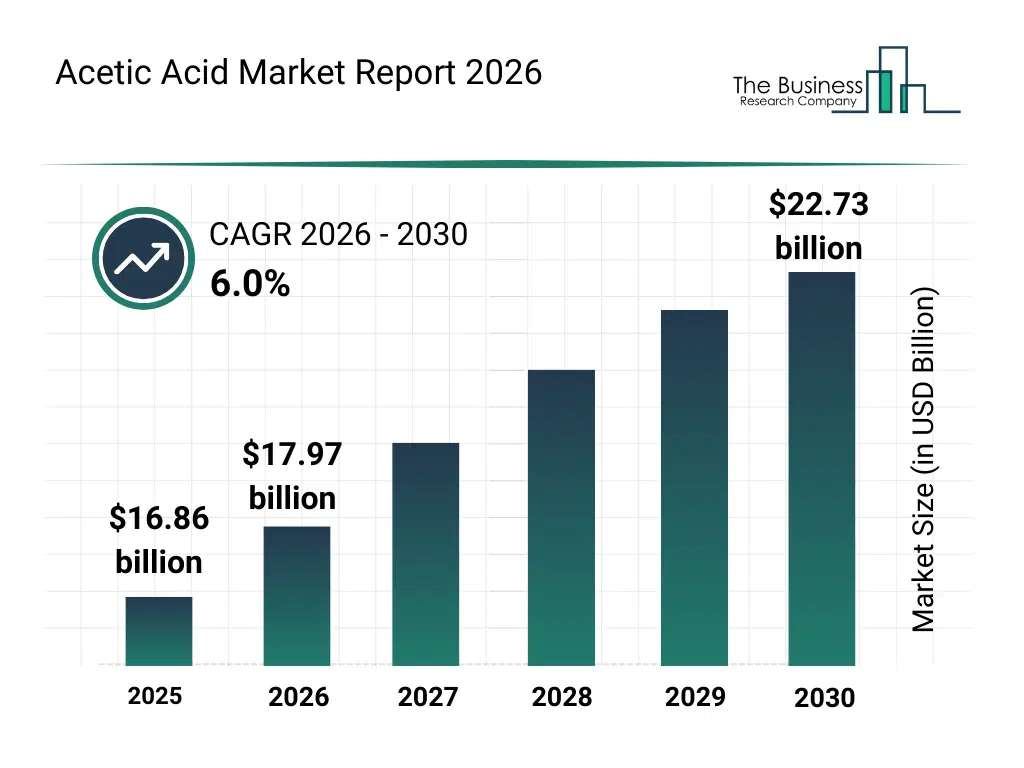
What Is The Acetic Acid Market Size and Share 2026?
The acetic acid market size has grown strongly in recent years. It will grow from $16.86 billion in 2025 to $17.97 billion in 2026 at a compound annual growth rate (CAGR) of 6.6%. The growth in the historic period can be attributed to expansion of chemical processing industries, widespread use in food preservation, growth of paints and coatings sector, availability of fermentation-based production, rising industrial acid demand.What Is The Acetic Acid Market Growth Forecast?
The acetic acid market size is expected to see strong growth in the next few years. It will grow to $22.73 billion in 2030 at a compound annual growth rate (CAGR) of 6.0%. The growth in the forecast period can be attributed to increasing investments in green chemical production, rising demand for sustainable solvents, expansion of polymer and resin manufacturing, growing pharmaceutical industry requirements, increasing focus on emission reduction technologies. Major trends in the forecast period include increasing adoption of bio-based acetic acid production, rising demand from vinyl acetate applications, growing use in pharmaceutical manufacturing, expansion of food-grade acid applications, enhanced focus on process optimization.
Global Acetic Acid Market Segmentation
1) By Type: Glacial Acetic Acid, Diluted (Aqueous) Acetic Acid, Food-Grade Acetic Acid, Pharmaceutical-Grade Acetic Acid 2) By Application: Vinyl Acetate Monomer, Acetic Anhydride, Acetate Esters, Other Applications 3) By End-Use: Food And beverages, Paints And coating, Plastics And Polymers, Pharmaceutical, Chemicals, Other End-Uses Subsegments: 1) By Glacial Acetic Acid: ≥99.5% Concentration, 99.0%–99.5% Concentration, Synthetic (Methanol Carbonylation–Based), Fermentation-Derived Glacial Acetic Acid 2) By Diluted (Aqueous) Acetic Acid: 30%–60% Concentration, 10%–30% Concentration, <10% Concentration, Industrial Dilution Grades 3) By Food-Grade Acetic Acid: Vinegar Production Grade, Food Preservative Grade, Flavoring & Acidulant Grade, Fermentation-Derived Food-Grade Acetic Acid 4) By Pharmaceutical-Grade Acetic Acid: USP Grade, EP Grade, Injectable / Sterile Grade, Laboratory & Analytical GradeWhat Is The Driver Of The Acetic Acid Market?
Growing chemical production is expected to propel the growth of the acetic acid market going forward. Chemical production refers to the process of manufacturing chemicals for various applications, including agricultural, pharmaceutical, construction, and manufacturing. Acetic acid is a versatile chemical reagent that plays a significant role in chemical production and various industrial applications. It is produced both synthetically and by bacterial fermentation. Acetic acid is used as a raw material and solvent in the production of other chemical products. For instance, in February 2023, according to a report shared by BASF SE, a Germany-based chemicals company, global chemical production (excluding pharmaceuticals) is expected to grow by 2.0% in 2023. In China, the world’s largest chemical market, chemical production is forecast to grow by 5.9%. Therefore, growing chemical production is driving the growth of the acetic acid industry.Key Players In The Global Acetic Acid Market
Major companies operating in the acetic acid market are Eastman Chemical Company, Celanese Corporation, BP PLC, Daicel Corporation, Shanghai Huayi Group Corporation Limited, Indian Oil Corporation Limited, Wacker Chemie AG, Mitsubishi Chemical Corporation, Showa Denko K.K., Kingboard Chemical Holdings Ltd., Gujarat Narmada Valley Fertilizers & Chemicals Limited (GNFC), China Petroleum & Chemical Corporation (Sinopec), PetroChina Company Limited, Jiangsu Danhua Group Co. Ltd., Chang Chun Group, Chongqing Chuandong Chemical (Group) Co. Ltd., Yankuang Cathay Coal Chemicals Co. Ltd., Sichuan Vinylon Works, Shandong Yankuang Group Co. Ltd., Sasol Limited, Saudi International Petrochemical Company, Solvay SA, Kuraray Co. Ltd.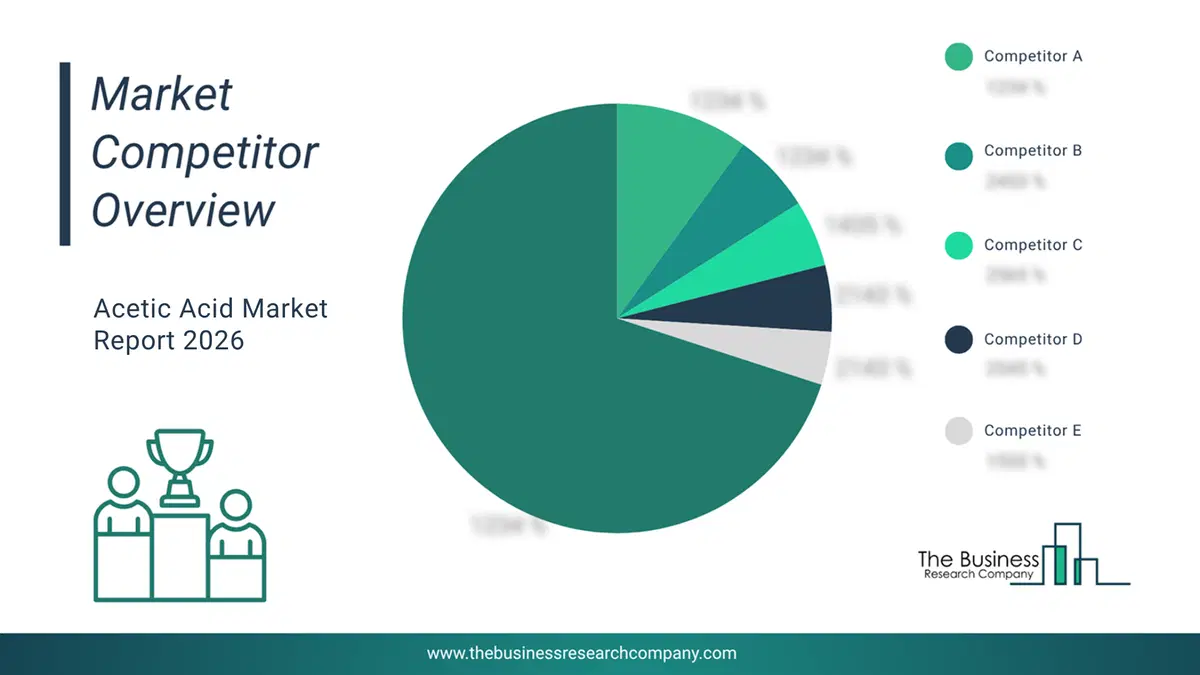
This chart is for illustrative purposes; the full report includes a detailed competitor analysis and comprehensive overview of the top 10 companies in the market.
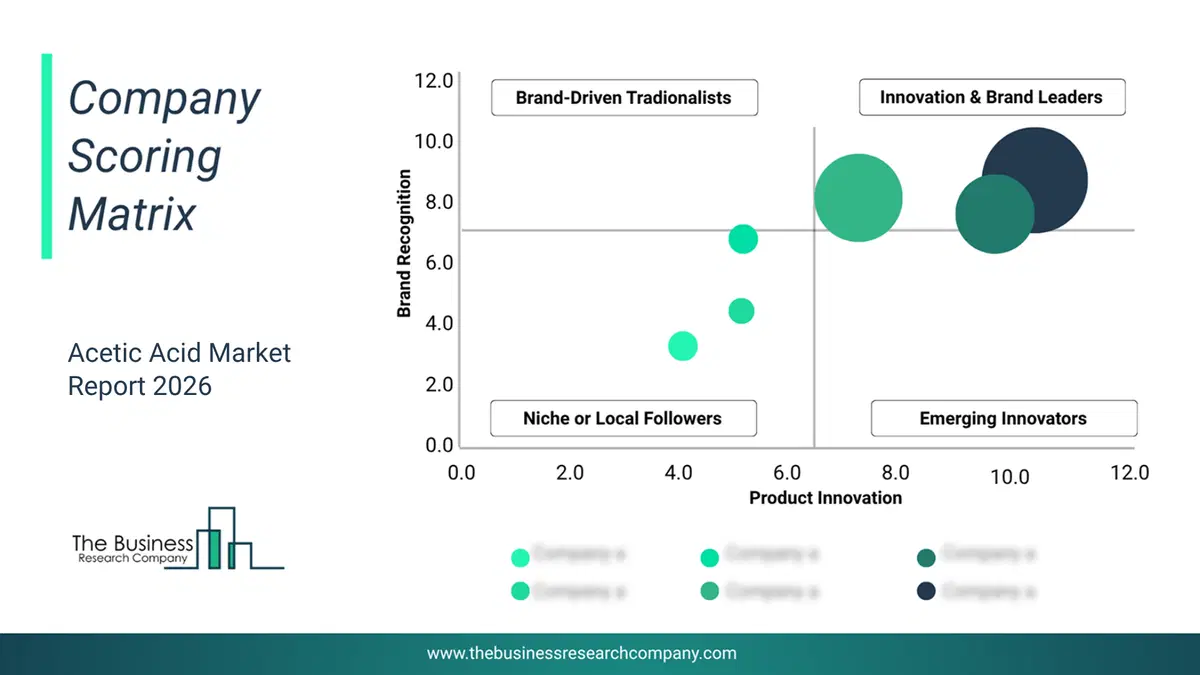
This chart maps companies by product innovation and brand strength, with bubble size indicating relative revenue, helping identify market leaders, challengers, and niche players. This is an illustrative chart; the full report provides a complete and accurate competitive analysis.
Global Acetic Acid Market Trends and Insights
Major companies operating in the acetic acid market are focused on investing in producing bio-based acetic acid to reduce the carbon footprint and gain a competitive edge in the market. Investment in bio-based acetic acid production refers to the allocation of resources, capital, and research and development activities towards the production of acetic acid from renewable resources such as agricultural waste, forestry residues, and cellulosic materials. For example, in May 2023, Sekab, a Sweden-based green chemical company, launched expanded production of bio-based acetic acid to reduce carbon emissions by as much as 50%. Acetic Acid Pure, the company's primary product, marks a significant advancement in sustainability. Businesses can minimize their carbon dioxide emissions because of the product's 100% physical bio-based composition. Acetic Acid Pure's exclusive sustainability and traceability have been validated by extensive certification in compliance with ISCC+ requirements. This product, which has been producing zero unexpected downtime for several years, is made in a production facility that is stable and well-known for its knowledge of bio-based chemicals. Now that Sekab has invested in additional production capacity, greater and faster deliveries are possible.What Are Latest Mergers And Acquisitions In The Acetic Acid Market?
In March 2023, KBR Inc. is a U.S.-based engineering company providing technology and engineering solutions in various sectors, including energy, infrastructure, and government services. Acetic Acid Technology for an undisclosed amount. With this acquisition, KBR, Inc. aims to enhance its strategic capabilities, expand its market presence, and integrate new technologies or services. Acetic Acid Technology is a US-based chemical manufacturing company.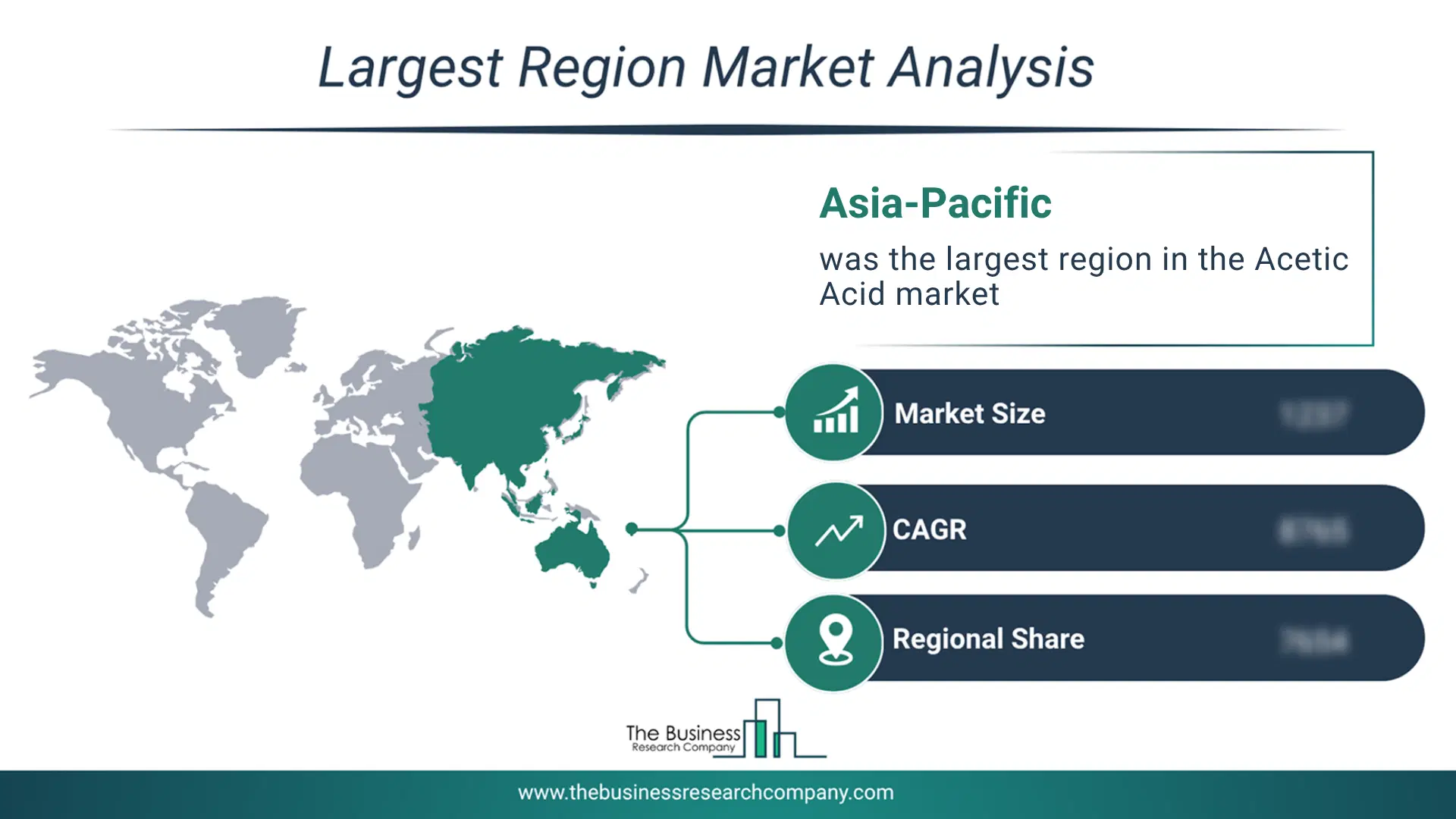
Regional Insights
Asia-Pacific was the largest region in the acetic acid market analysis in 2025. Asia-Pacific is expected to be the fastest-growing region in the forecast period. The regions covered in this market report are Asia-Pacific, South East Asia, Western Europe, Eastern Europe, North America, South America, Middle East, Africa The countries covered in this market report are Australia, Brazil, China, France, Germany, India, Indonesia, Japan, Taiwan, Russia, South Korea, UK, USA, Canada, Italy, SpainWhat Defines the Acetic Acid Market?
The acetic acid market consists of sales of acetic acid that is used to produce metal acetates, cellulose acetate and volatile organic esters. Values in this market are ‘factory gate’ values, that is the value of goods sold by the manufacturers or creators of the goods, whether to other entities (including downstream manufacturers, wholesalers, distributors and retailers) or directly to end customers. The value of goods in this market includes related services sold by the creators of the goods.How is Market Value Defined and Measured?
The market value is defined as the revenues that enterprises gain from the sale of goods and/or services within the specified market and geography through sales, grants, or donations in terms of the currency (in USD unless otherwise specified). The revenues for a specified geography are consumption values that are revenues generated by organizations in the specified geography within the market, irrespective of where they are produced. It does not include revenues from resales along the supply chain, either further along the supply chain or as part of other products.
This chart presents market attractiveness based on a quantitative evaluation of growth, competition, strategic alignment, and risk, offering a clear view of opportunity areas for decision-making. This chart is for illustrative purposes; the full report contains the complete analysis.

This chart highlights the Total Addressable Market (TAM) by estimating the maximum revenue opportunity using an assumption-driven approach, supporting strategic planning and opportunity sizing across markets. The chart is illustrative; the full report provides a more comprehensive analysis.
What Key Data and Analysis Are Included in the Acetic Acid Market Report 2026?
The acetic acid market research report is one of a series of new reports from The Business Research Company that provides market statistics, including industry global market size, regional shares, competitors with the market share, detailed market segments, market trends and opportunities, and any further data you may need to thrive in the acetic acid industry. The market research report delivers a complete perspective of everything you need, with an in-depth analysis of the current and future state of the industry.Acetic Acid Market Report Forecast Analysis
| Report Attribute | Details |
|---|---|
| Market Size Value In 2026 | $17.97 billion |
| Revenue Forecast In 2030 | $22.73 billion |
| Growth Rate | CAGR of 6.6% from 2026 to 2030 |
| Base Year For Estimation | 2025 |
| Actual Estimates/Historical Data | 2020-2025 |
| Forecast Period | 2026 - 2030 |
| Market Representation | Revenue in USD Billion and CAGR from 2026 to 2030 |
| Segments Covered | Type, Application, End-Use |
| Regional Scope | Asia-Pacific, Western Europe, Eastern Europe, North America, South America, Middle East, Africa |
| Country Scope | The countries covered in this market report are Australia, Brazil, China, France, Germany, India, Indonesia, Japan, Taiwan, Russia, South Korea, UK, USA, Canada, Italy, Spain |
| Key Companies Profiled | Eastman Chemical Company, Celanese Corporation, BP PLC, Daicel Corporation, Shanghai Huayi Group Corporation Limited, Indian Oil Corporation Limited, Wacker Chemie AG, Mitsubishi Chemical Corporation, Showa Denko K.K., Kingboard Chemical Holdings Ltd., Gujarat Narmada Valley Fertilizers & Chemicals Limited (GNFC), China Petroleum & Chemical Corporation (Sinopec), PetroChina Company Limited, Jiangsu Danhua Group Co. Ltd., Chang Chun Group, Chongqing Chuandong Chemical (Group) Co. Ltd., Yankuang Cathay Coal Chemicals Co. Ltd., Sichuan Vinylon Works, Shandong Yankuang Group Co. Ltd., Sasol Limited, Saudi International Petrochemical Company, Solvay SA, Kuraray Co. Ltd. |
| Customization Scope | Request for Customization |
| Pricing And Purchase Options | Explore Purchase Options |