
Aerospace Tester Market Report 2026
Global Outlook – By Product Type (Avionics Testers, Communication Testers, Structural Testers, Propulsion System Testers), By Application (Flight Control System Testing, Communication System Testing, Engine Testing, Structural Testing, Environmental Testing), By End User (Commercial Aviation, Defense And Military, Space And Satellite) – Market Size, Trends, Strategies, and Forecast to 2030
Aerospace Tester Market Overview
• Aerospace Tester market size has reached to $26.17 billion in 2025 • Expected to grow to $31.05 billion in 2030 at a compound annual growth rate (CAGR) of 3.5% • Growth Driver: Driving Forces Behind Aerospace Tester Market Growth Amid Expansion Of The Commercial Space Industry • Market Trend: The Case of Next-Generation Rotor Analysis Diagnostic Systems (RADS) • Asia-Pacific was the largest region and fastest growing region.What Is Covered Under Aerospace Tester Market?
An aerospace tester refers to a specialized piece of equipment or system used in the aerospace industry to conduct numerous tests and assessments on aircraft components, systems, or the complete aircraft. It is used to test aircraft equipment's performance, dependability, durability, and functionality in various situations, including temperature extremes, vibration, pressure, and electromagnetic interference. The main types of aerospace tester products are avionics testers, communication testers, structural testers, and propulsion system testers. Avionics testers are devices or systems used to verify, test, and diagnose the functionality of avionics equipment. These are used for several applications, including flight control system testing, communication system testing, engine testing, structural testing, and environmental testing, by various end-users, such as commercial aviation, defense and military, and space and satellite.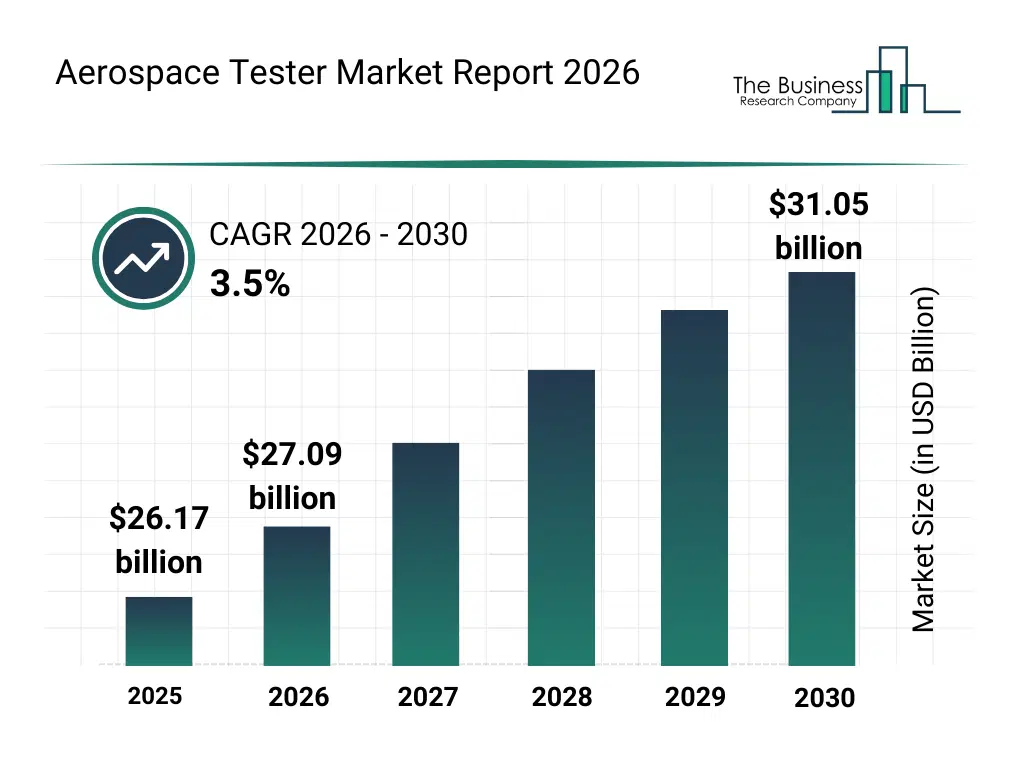
What Is The Aerospace Tester Market Size and Share 2026?
The aerospace tester market size has grown steadily in recent years. It will grow from $26.17 billion in 2025 to $27.09 billion in 2026 at a compound annual growth rate (CAGR) of 3.5%. The growth in the historic period can be attributed to increasing aircraft production driving demand for engine test stands and ndt equipment, rising regulatory requirements for safety and performance testing of aircraft components, advancements in environmental test chamber technologies enabling more accurate simulation of extreme conditions, expansion of manufacturer-provided warranty-period testing and calibration services, growth in maintenance, repair, and overhaul activities requiring specialized aerospace testers.What Is The Aerospace Tester Market Growth Forecast?
The aerospace tester market size is expected to see steady growth in the next few years. It will grow to $31.05 billion in 2030 at a compound annual growth rate (CAGR) of 3.5%. The growth in the forecast period can be attributed to growing demand for advanced testers to validate next-generation aircraft systems including electric and hybrid propulsion, increasing adoption of automated and digital ndt solutions to improve testing efficiency, rising need for electromagnetic interference and compatibility testing for modern avionics, expanding aircraft fleets in emerging markets boosting procurement of aerospace testers, expected growth in integrated lifecycle testing services bundled with new aerospace tester equipment. Major trends in the forecast period include development of high-precision engine test stands, adoption of advanced non-destructive testing (ndt) methods, integration of environmental simulation chambers for extreme conditions, automation in aerospace testing workflows, expansion of testing solutions for next-generation aircraft and spacecraft.
Global Aerospace Tester Market Segmentation
1) By Product Type: Avionics Testers, Communication Testers, Structural Testers, Propulsion System Testers 2) By Application: Flight Control System Testing, Communication System Testing, Engine Testing, Structural Testing, Environmental Testing 3) By End User: Commercial Aviation, Defense And Military, Space And Satellite Subsegments: 1) By Avionics Testers: Flight Control Testers, Navigation Testers, Display Testers, Communication Testers 2) By Communication Testers: Radio Frequency Testers, Satellite Communication Testers, Ground Support Communication Testers 3) By Structural Testers: Vibration Testers, Fatigue Testers, Load Testers 4) By Propulsion System Testers: Engine Testers, Fuel System Testers, Thrust Measurement TestersWhat Is Driver Of The Aerospace Tester Market?
The expansion of the commercial space industry is expected to propel the growth of the aerospace tester market going forward. The commercial space industry refers to economic activities related to the manufacture and delivery of components that go into Earth's orbit or beyond, as well as the provision of services derived from those components. The commercial space industry is experiencing rapid growth due to several factors, including growing demand for satellite services, space tourism, asteroid mining, and increasing private investments in this sector. Aerospace testers are used to perform rigorous testing and validation methods to ensure that spacecraft, satellites, propulsion systems, avionics, and other aerospace technology fulfill demanding quality standards and regulatory requirements before being deployed for commercial space missions. For instance, in January 2023, according to Space Foundation, a US-based nonprofit organization, the global space economy expanded by 8%, reaching a total of $546 billion, and the commercial sector in space industry saw a growth of nearly 8% reaching $427.6 billion. Therefore, the expansion of the commercial space industry is driving the growth of the aerospace tester industry.Key Players In The Global Aerospace Tester Market
Major companies operating in the aerospace tester market are Agilent Technologies, Keysight Technologies Inc., Teradyne Inc., Rohde & Schwarz GmbH & Co. KG, National Instruments Corporation, Mistras Group Inc., Astronics Corporation, Marvin Test Solutions Inc., ADMET Inc., Dayton T. Brown Inc., NTS Group BV, Element Materials Technology, Bureau Veritas SA, Intertek Group Plc, DEKRA SE, ECA Group, Qualitest International Inc., MOOG Inc., Illinois Tool Works Inc., Textron Inc., Leonardo S.p.A., Ball Corp., CapitalWorks.
This chart is for illustrative purposes; the full report includes a detailed competitor analysis and comprehensive overview of the top 10 companies in the market.
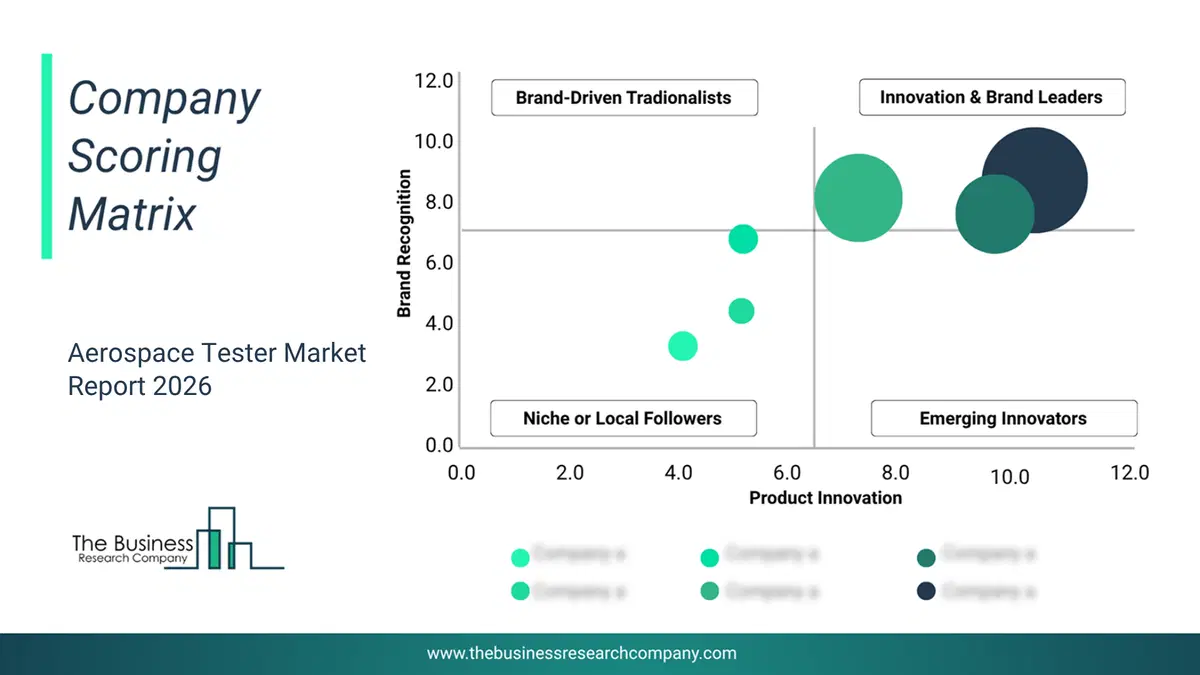
This chart maps companies by product innovation and brand strength, with bubble size indicating relative revenue, helping identify market leaders, challengers, and niche players. This is an illustrative chart; the full report provides a complete and accurate competitive analysis.
Global Aerospace Tester Market Trends and Insights
Major companies operating in the aerospace tester market are innovating new technological products, such as next-generation Rotor Analysis Diagnostic Systems (RADS), to increase their profitability in the market. The next-generation Rotor Analysis Diagnostic System (RADS) is a portable vibration diagnostics solution that enables operators to finish rotor track and balance operations and diagnostics in fewer flights. For instance, in March 2023, GE Aerospace, a US-based aerospace company, launched next-generation Rotor Analysis Diagnostic Systems (RADS), an aerospace tester designed to reduce pilot time and save fuel by enabling operators to complete rotor track and balance analysis more efficiently. It is intended for use in monitoring the rotor health of both military and commercial helicopters. When a permanent installation is not feasible or as a supplement to existing systems, GE Aerospace's portable vibration diagnostics solution for helicopters will be replaced by the RADS-NG, which will also replace the RADS-AT (Advanced Technology) and the RADS-AVA (Aviation Vibration Analyzer). It offers a faster, more user-friendly interface and the flexibility to service all major helicopter models. Additionally, the system provides vibration diagnostics for fixed-wing aircraft, including the Lockheed C-130 Hercules.What Are Latest Mergers And Acquisitions In The Aerospace Tester Market? BAE Systems Acquires Ball Aerospace To Expand Its Presence In The Market
In February 2024, BAE Systems, a UK-based aerospace company, acquired Ball Aerospace for $5.5 billion. This acquisition will significantly broaden BAE System's footprint in this increasingly crucial space domain and further improve its value-compounding model of top-line growth, margin expansion, and high cash generation. Ball Aerospace is a US-based manufacturer of aerospace testers.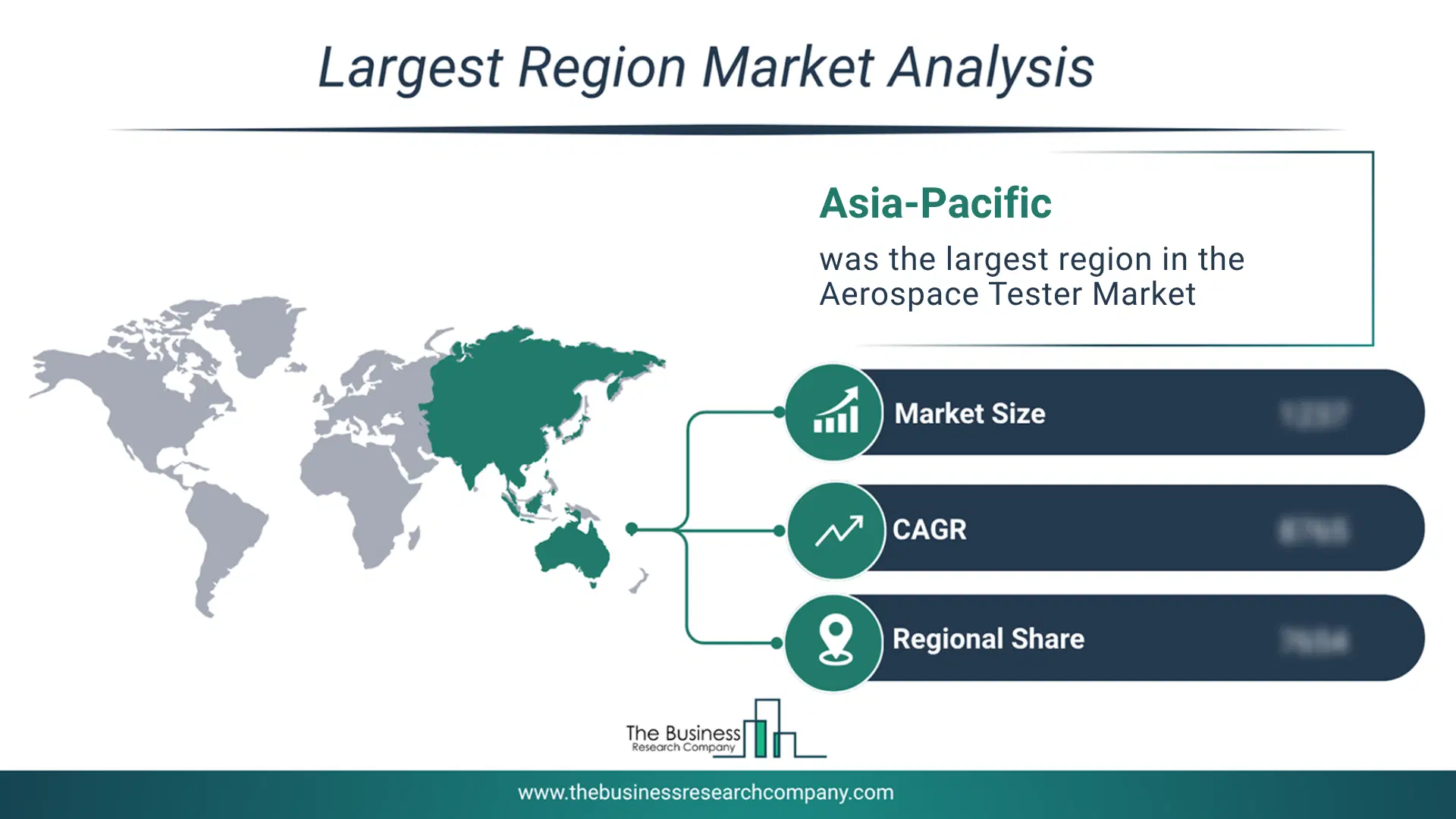
Regional Insights
Asia-Pacific was the largest region in the aerospace tester market in 2025. It is expected to be the fastest-growing region in the forecast period. The regions covered in this market report are Asia-Pacific, South East Asia, Western Europe, Eastern Europe, North America, South America, Middle East, Africa. The countries covered in this market report are Australia, Brazil, China, France, Germany, India, Indonesia, Japan, Taiwan, Russia, South Korea, UK, USA, Canada, Italy, SpainWhat Defines the Aerospace Tester Market?
The aerospace tester market consists of sales of engine test stands, non-destructive testing (NDT) equipment, electrical testers, environmental test chambers, and others. Values in this market are ‘factory gate’ values, that is the value of goods sold by the manufacturers or creators of the goods, whether to other entities (including downstream manufacturers, wholesalers, distributors and retailers) or directly to end customers. The value of goods in this market includes related services sold by the creators of the goods.How is Market Value Defined and Measured?
The market value is defined as the revenues that enterprises gain from the sale of goods and/or services within the specified market and geography through sales, grants, or donations in terms of the currency (in USD unless otherwise specified). The revenues for a specified geography are consumption values that are revenues generated by organizations in the specified geography within the market, irrespective of where they are produced. It does not include revenues from resales along the supply chain, either further along the supply chain or as part of other products.
This chart presents market attractiveness based on a quantitative evaluation of growth, competition, strategic alignment, and risk, offering a clear view of opportunity areas for decision-making. This chart is for illustrative purposes; the full report contains the complete analysis.

This chart highlights the Total Addressable Market (TAM) by estimating the maximum revenue opportunity using an assumption-driven approach, supporting strategic planning and opportunity sizing across markets. The chart is illustrative; the full report provides a more comprehensive analysis.
What Key Data and Analysis Are Included in the Aerospace Tester Market Report 2026?
The aerospace tester market research report is one of a series of new reports from The Business Research Company that provides market statistics, including industry global market size, regional shares, competitors with the market share, detailed market segments, market trends and opportunities, and any further data you may need to thrive in the aerospace tester industry. The market research report delivers a complete perspective of everything you need, with an in-depth analysis of the current and future state of the industry.Aerospace Tester Market Report Forecast Analysis
| Report Attribute | Details |
|---|---|
| Market Size Value In 2026 | $27.09 billion |
| Revenue Forecast In 2030 | $31.05 billion |
| Growth Rate | CAGR of 3.5% from 2026 to 2030 |
| Base Year For Estimation | 2025 |
| Actual Estimates/Historical Data | 2020-2025 |
| Forecast Period | 2026 - 2030 |
| Market Representation | Revenue in USD Billion and CAGR from 2026 to 2030 |
| Segments Covered | Product Type, Application, End User |
| Regional Scope | Asia-Pacific, Western Europe, Eastern Europe, North America, South America, Middle East, Africa |
| Country Scope | The countries covered in the aerospace tester market report are Australia, Brazil, China, France, Germany, India, Indonesia, Japan, Taiwan, Russia, South Korea, UK, USA, Canada, Italy, Spain |
| Key Companies Profiled | Agilent Technologies, Keysight Technologies Inc., Teradyne Inc., Rohde & Schwarz GmbH & Co. KG, National Instruments Corporation, Mistras Group Inc., Astronics Corporation, Marvin Test Solutions Inc., ADMET Inc., Dayton T. Brown Inc., NTS Group BV, Element Materials Technology, Bureau Veritas SA, Intertek Group Plc, DEKRA SE, ECA Group, Qualitest International Inc., MOOG Inc., Illinois Tool Works Inc., Textron Inc., Leonardo S.p.A., Ball Corp., CapitalWorks. |
| Customization Scope | Request for Customization |
| Pricing And Purchase Options | Explore Purchase Options |