
Airborne Satellite Communication (SATCOM) System Market Report 2026
Global Outlook – By Component (Transceivers, Airborne Radio, Modems And Routers, SATCOM Terminals), By Frequency (C-Band, L-Band, Ka-Band, Ku-Band, UHF-Band), By Platform (Fixed-Wing Aircraft, Rotary-Wing Aircraft, Unmanned Aerial Vehicles), By Application (Military Communication, Commercial Aviation, Search And Rescue, Remote Sensing, Disaster Management), By End Use (Government, Defense, Private Aviation, Commercial Airlines) – Market Size, Trends, Strategies, and Forecast to 2030
Airborne Satellite Communication (SATCOM) System Market Overview
• Airborne Satellite Communication (SATCOM) System market size has reached to $6.88 billion in 2025 • Expected to grow to $10.84 billion in 2030 at a compound annual growth rate (CAGR) of 9.5% • Growth Driver: Rising Air Passenger Traffic Driving The Growth Of The Market Due To Increasing Demand For In-Flight Communication And Connectivity • Market Trend: Advancements In Multi-Orbit Satellite Connectivity For Seamless Global Coverage • North America was the largest region in 2025 and Asia-Pacific is the fastest growing region.What Is Covered Under Airborne Satellite Communication (SATCOM) System Market?
Airborne satellite communication (SATCOM) system refers to a satellite communication system installed on aircraft, including fixed-wing planes, helicopters, or drones, to enable reliable long-distance voice, data, and video transmission. It provides seamless connectivity in remote areas, over oceans, or during military operations where terrestrial networks are unavailable. The main components of the airborne satellite communication (SATCOM) system include transceivers, airborne radios, modems and routers, and SATCOM terminals. Transceivers refer to devices that both transmit and receive signals, enabling reliable two-way communication between aircraft and satellites in real time. Multiple frequencies are C-Band, L-Band, Ka-Band, Ku-Band, and UHF-Band. The different platforms include fixed-wing aircraft, rotary-wing aircraft, and unmanned aerial vehicles (UAVs). The various applications involved are military communication, commercial aviation, search and rescue, remote sensing, and disaster management, and they are used by several end-users such as government, defense, private aviation, and commercial airlines.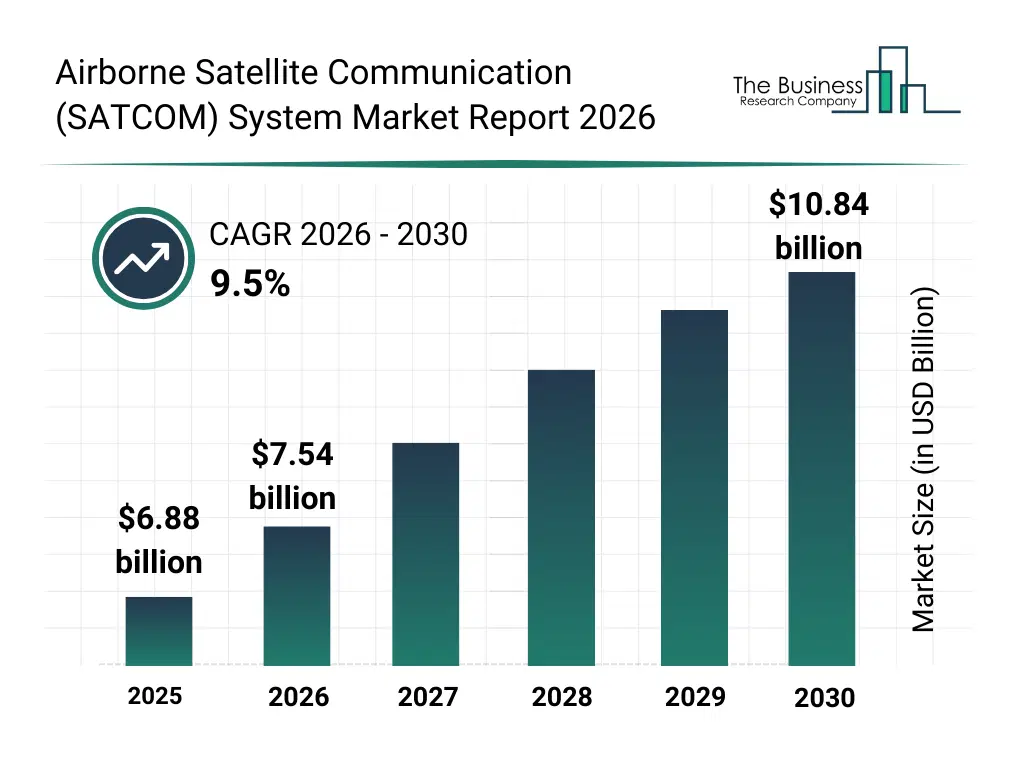
What Is The Airborne Satellite Communication (SATCOM) System Market Size and Share 2026?
The airborne satellite communication (SATCOM) system market size has grown strongly in recent years. It will grow from $6.88 billion in 2025 to $7.54 billion in 2026 at a compound annual growth rate (CAGR) of 9.7%. The growth in the historic period can be attributed to increasing reliance on airborne communication for remote operations, growth in military and commercial aviation connectivity, advancements in antenna stabilization and multiplexing technologies, adoption of satcom systems for long-distance military missions, rising investments in high-reliability airborne communication networks.What Is The Airborne Satellite Communication (SATCOM) System Market Growth Forecast?
The airborne satellite communication (SATCOM) system market size is expected to see strong growth in the next few years. It will grow to $10.84 billion in 2030 at a compound annual growth rate (CAGR) of 9.5%. The growth in the forecast period can be attributed to development of next-generation high-throughput satcom systems, integration with AI-based network optimization, expansion in drone and UAV communication applications, growth in multi-band and multi-orbit satcom adoption, rising demand for seamless global airborne connectivity for defense missions. Major trends in the forecast period include expansion of satellite-based connectivity for remote aviation, growth in multi-band satcom adoption, rising demand for secure airborne communications, increasing integration of satcom in unmanned aerial platforms, advancements in high-altitude long-endurance (hale) connectivity.
Global Airborne Satellite Communication (SATCOM) System Market Segmentation
1) By Component: Transceivers, Airborne Radio, Modems And Routers, SATCOM Terminals 2) By Frequency: C-Band, L-Band, Ka-Band, Ku-Band, UHF-Band 3) By Platform: Fixed-Wing Aircraft, Rotary-Wing Aircraft, Unmanned Aerial Vehicles 4) By Application: Military Communication, Commercial Aviation, Search And Rescue, Remote Sensing, Disaster Management 5) By End Use: Government, Defense, Private Aviation, Commercial Airlines Subsegments:: 1) By Transceivers: Ku Band Transceivers, Ka Band Transceivers, L Band Transceivers, S Band Transceivers 2) By Airborne Radio: Vhf Radios, Uhf Radios, Satcom Radios, High Frequency Radios 3) By Modems And Routers: Satellite Modems, Ip Routers, Network Routers, Data Modems 4) By Satcom Terminals: airborne satcom Terminals, Mobile Satcom Terminals, Fixed Satcom Terminals, Portable Satcom TerminalsWhat Is Driver Of The Airborne Satellite Communication (SATCOM) System Market?
The increasing air passenger traffic is expected to propel the growth of the airborne satellite communication (SATCOM) system market going forward. Air passenger traffic is the measure of the total number of people traveling on commercial aircraft over a given period, including both domestic and international flights. Air passenger traffic is rising due to growing middle-class income levels, which enable more people to afford air travel for both business and leisure purposes, increasing the number of travelers globally. Air passenger traffic drives demand for airborne SATCOM systems as airlines require reliable in-flight communication and internet services to manage larger passenger volumes efficiently while ensuring safety, operational coordination, and passenger connectivity. For instance, in January 2025, according to the International Air Transport Association, a Canada-based trade association, domestic full-year air traffic increased by 5.7% in 2024 over the previous year, accompanied by a 2.5% growth in available capacity. Therefore, the increasing air passenger traffic is driving the growth of the airborne satellite communication (SATCOM) system industry.Key Players In The Global Airborne Satellite Communication (SATCOM) System Market
Major companies operating in the airborne satellite communication (SATCOM) system market are RTX Corporation, Northrop Grumman Corporation, Honeywell International Inc., BAE Systems plc, Collins Aerospace, Thales S.A., L3Harris Technologies Inc., Ball Corporation, Singapore Technologies Engineering Ltd., Israel Aerospace Industries Ltd., Viasat Inc., General Dynamics Mission Systems Inc., ASELSAN Electronics Industry and Trade Inc., Intelsat S.A., Telesat Corporation, Smiths Interconnect Inc., Hughes Network Systems LLC, Gilat Satellite Networks Ltd., Orbit Communications Systems Ltd., Cobham Aerospace Communications Dourdan SACA.
This chart is for illustrative purposes; the full report includes a detailed competitor analysis and comprehensive overview of the top 10 companies in the market.
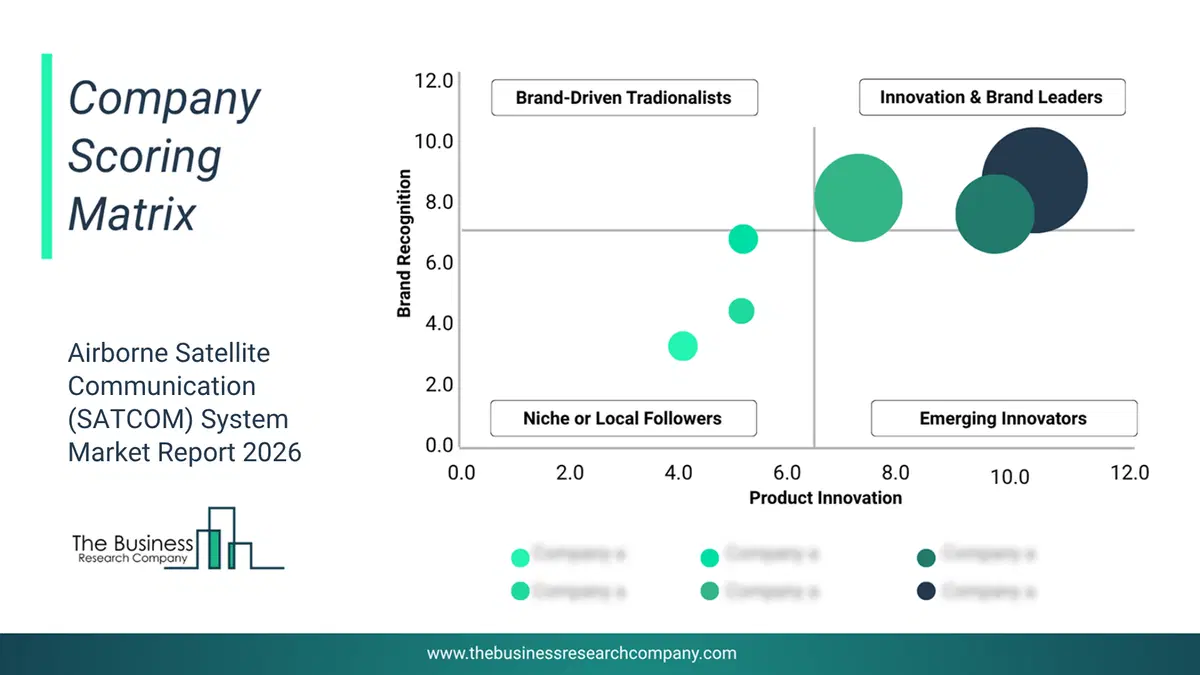
This chart maps companies by product innovation and brand strength, with bubble size indicating relative revenue, helping identify market leaders, challengers, and niche players. This is an illustrative chart; the full report provides a complete and accurate competitive analysis.
Global Airborne Satellite Communication (SATCOM) System Market Trends and Insights
Major companies operating in the airborne satellite communication (SATCOM) system market are focusing on developing multi-orbit capability to enhance global satellite coverage, improve network reliability, and enable seamless high-speed connectivity across diverse regions. Multi-orbit capability refers to a satellite system’s ability to operate across different orbital regimes, enabling enhanced coverage, redundancy, and flexibility for communication, navigation, and data services. For instance, in May 2024, SES S.A., a Luxembourg-based traded satellite communications company, launched SES Open Orbits, a multi-orbit Ka-band inflight connectivity network for airlines. The network brings together SES’s GEO (geostationary) and MEO (medium-earth orbit) satellites, plus regional partners Neo Space Group, AeroSat Link, and Hughes Communications India, enabling seamless, global coverage. Its open-architecture design allows traffic to be dynamically steered across different satellite systems so airlines can deliver consistent connectivity from take-off to landing. This launch aims to revolutionize in-flight connectivity by providing airlines with uninterrupted, high-speed internet access worldwide, enhancing passenger experience and operational efficiency.What Are Latest Mergers And Acquisitions In The Airborne Satellite Communication (SATCOM) System Market? Gogo Inc. Acquires Satcom Direct To Enhance Global In-Flight Connectivity
In December 2024, Gogo Inc., a US-based telecommunications services company, acquired Satcom Direct Inc. for an undisclosed amount. Through this acquisition, Gogo Inc. aims to strengthen its position in the in-flight connectivity sector by integrating Satcom Direct, Inc.'s advanced satellite communication solutions, enhancing global coverage, improving network reliability, and delivering seamless, high-speed connectivity to commercial and business aircraft. Satcom Direct Inc. is a US-based company specializing in airborne SATCOM systems.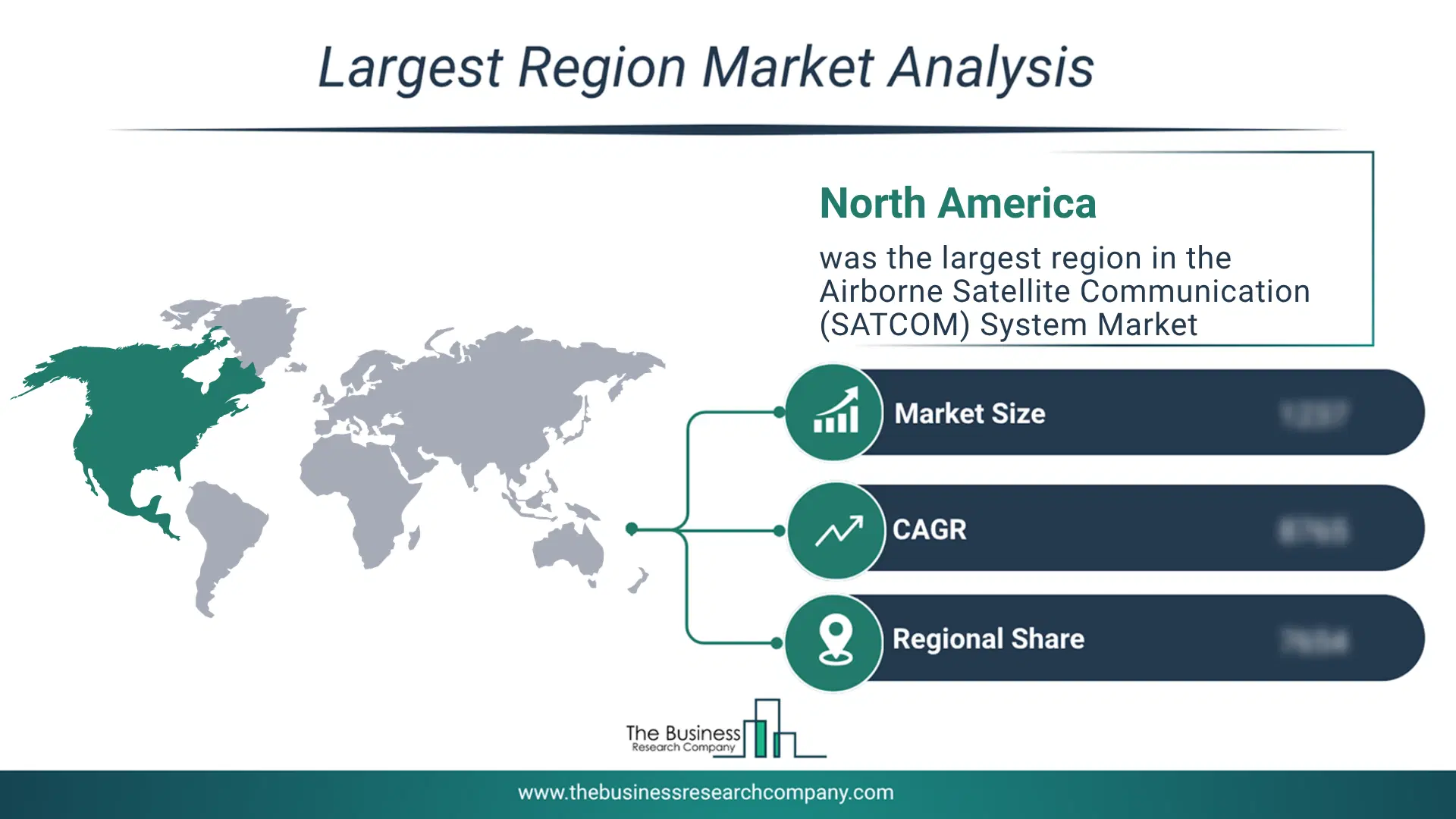
Regional Insights
North America was the largest region in the airborne satellite communication (SATCOM) system market in 2025. Asia-Pacific is expected to be the fastest-growing region in the forecast period. The regions covered in the airborne satellite communication (SATCOM) system market report are Asia-Pacific, South East Asia, Western Europe, Eastern Europe, North America, South America, Middle East, Africa. The countries covered in the airborne satellite communication (satcom) system market report are Australia, Brazil, China, France, Germany, India, Indonesia, Japan, Taiwan, Russia, South Korea, UK, USA, Canada, Italy, SpainWhat Defines the Airborne Satellite Communication (SATCOM) System Market?
The airborne satellite communication (SATCOM) system market consists of sales of antenna mounts, stabilization gimbals, diplexers, and multiplexers. Values in this market are ‘factory gate’ values, that is the value of goods sold by the manufacturers or creators of the goods, whether to other entities (including downstream manufacturers, wholesalers, distributors and retailers) or directly to end customers. The value of goods in this market includes related services sold by the creators of the goods.How is Market Value Defined and Measured?
The market value is defined as the revenues that enterprises gain from the sale of goods and/or services within the specified market and geography through sales, grants, or donations in terms of the currency (in USD unless otherwise specified). The revenues for a specified geography are consumption values that are revenues generated by organizations in the specified geography within the market, irrespective of where they are produced. It does not include revenues from resales along the supply chain, either further along the supply chain or as part of other products.
This chart presents market attractiveness based on a quantitative evaluation of growth, competition, strategic alignment, and risk, offering a clear view of opportunity areas for decision-making. This chart is for illustrative purposes; the full report contains the complete analysis.

This chart highlights the Total Addressable Market (TAM) by estimating the maximum revenue opportunity using an assumption-driven approach, supporting strategic planning and opportunity sizing across markets. The chart is illustrative; the full report provides a more comprehensive analysis.
What Key Data and Analysis Are Included in the Airborne Satellite Communication (SATCOM) System Market Report 2026?
The airborne satellite communication (satcom) system market research report is one of a series of new reports from The Business Research Company that provides market statistics, including industry global market size, regional shares, competitors with the market share, detailed market segments, market trends and opportunities, and any further data you may need to thrive in the airborne satellite communication (satcom) system industry. The market research report delivers a complete perspective of everything you need, with an in-depth analysis of the current and future state of the industry.Airborne Satellite Communication (SATCOM) System Market Report Forecast Analysis
| Report Attribute | Details |
|---|---|
| Market Size Value In 2026 | $7.54 billion |
| Revenue Forecast In 2030 | $10.84 billion |
| Growth Rate | CAGR of 9.5% from 2026 to 2030 |
| Base Year For Estimation | 2025 |
| Actual Estimates/Historical Data | 2020-2025 |
| Forecast Period | 2026 - 2030 |
| Market Representation | Revenue in USD Billion and CAGR from 2026 to 2030 |
| Segments Covered | Component, Frequency, Platform, Application, End Use |
| Regional Scope | Asia-Pacific, Western Europe, Eastern Europe, North America, South America, Middle East, Africa |
| Country Scope | The countries covered in the airborne satellite communication (satcom) system market report are Australia, Brazil, China, France, Germany, India, Indonesia, Japan, Taiwan, Russia, South Korea, UK, USA, Canada, Italy, Spain |
| Key Companies Profiled | RTX Corporation, Northrop Grumman Corporation, Honeywell International Inc., BAE Systems plc, Collins Aerospace, Thales S.A., L3Harris Technologies Inc., Ball Corporation, Singapore Technologies Engineering Ltd., Israel Aerospace Industries Ltd., Viasat Inc., General Dynamics Mission Systems Inc., ASELSAN Electronics Industry and Trade Inc., Intelsat S.A., Telesat Corporation, Smiths Interconnect Inc., Hughes Network Systems LLC, Gilat Satellite Networks Ltd., Orbit Communications Systems Ltd., Cobham Aerospace Communications Dourdan SACA. |
| Customization Scope | Request for Customization |
| Pricing And Purchase Options | Explore Purchase Options |