
Airport 4.0 Market Report 2026
Global Outlook – By Technology (Automated Check-In Systems, Biometric Security Systems, Smart Baggage Handling, Internet Of Things-Enabled Infrastructure, Artificial Intelligence-Powered Customer Service), By Size (Large, Medium, Small), By Service Type (Passenger Services, Cargo Services, Maintenance And Ground Services, Airport Security Services), By Application (Airside, Airtraffic Maintenance, Aircraft Maintenance, Passenger Screening, Other Applications), By End Market (Implementation, Upgrade And Services) – Market Size, Trends, Strategies, and Forecast to 2030
Airport 4.0 Market Overview
• Airport 4.0 market size has reached to $12.95 billion in 2025 • Expected to grow to $23.79 billion in 2030 at a compound annual growth rate (CAGR) of 12.9% • Growth Driver: The Rise In Air Travel Demand Driving The Growth Of The Airport 4.0 Market Due To Increasing Passenger Traffic And Technological Integration • Market Trend: Advanced Digital Platform Transforms Airport Operations And Safety Oversight • North America was the largest region in 2025 and Asia-Pacific is the fastest growing region.What Is Covered Under Airport 4.0 Market?
Airport 4.0 refers to the digital transformation of airports using advanced technologies such as artificial intelligence, the Internet of Things (IoT), big data analytics, and automation to enhance operational efficiency and passenger experience. It emphasizes smart, interconnected systems that enable real-time decision-making, predictive maintenance, seamless passenger flow, and improved safety and security. The main technologies of airport 4.0 are automated check-in systems, biometric security systems, smart baggage handling, Internet of Things-enabled infrastructure, and artificial intelligence-powered customer service. Automated check-in systems refer to self-service technologies at airports that allow passengers to check in, select seats, and print boarding passes without the need for airline staff assistance. It is implemented across airports of various sizes, including large, medium, and small. The solution supports a wide range of service types, including passenger services, cargo handling, maintenance and ground operations, and airport security. Its applications span airside operations, air traffic maintenance, aircraft maintenance, passenger screening, and other airport functions. These solutions cater to different end users through both new implementations and system upgrades and services.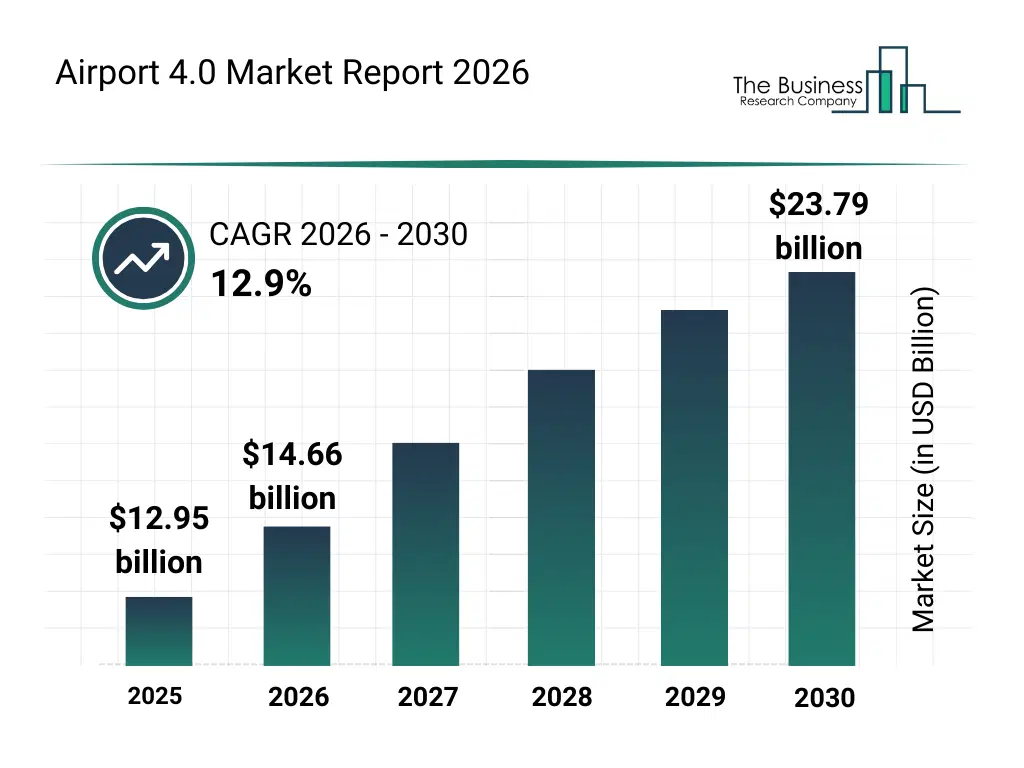
What Is The Airport 4.0 Market Size and Share 2026?
The airport 4.0 market size has grown rapidly in recent years. It will grow from $12.95 billion in 2025 to $14.66 billion in 2026 at a compound annual growth rate (CAGR) of 13.2%. The growth in the historic period can be attributed to increasing adoption of cloud-based airport operations management systems, deployment of biometric systems for identity verification, rising use of smart kiosks to streamline passenger processing, implementation of digital twin and simulation tools for operational planning, integration of cybersecurity systems to protect airport infrastructure.What Is The Airport 4.0 Market Growth Forecast?
The airport 4.0 market size is expected to see rapid growth in the next few years. It will grow to $23.79 billion in 2030 at a compound annual growth rate (CAGR) of 12.9%. The growth in the forecast period can be attributed to growing investment in AI-driven predictive maintenance and operational optimization, expansion of mobile app-based passenger services and real-time notifications, adoption of iot-enabled sensors and monitoring systems for airport efficiency, integration of real-time language translation and passenger assistance technologies, increasing procurement of advanced cloud infrastructure solutions for scalable airport operations. Major trends in the forecast period include expansion of digital twin-based airport operations, increased deployment of biometric passenger authentication, growth in predictive maintenance solutions for airport assets, rising adoption of automated passenger services, integration of smart baggage tracking and reconciliation systems.
Global Airport 4.0 Market Segmentation
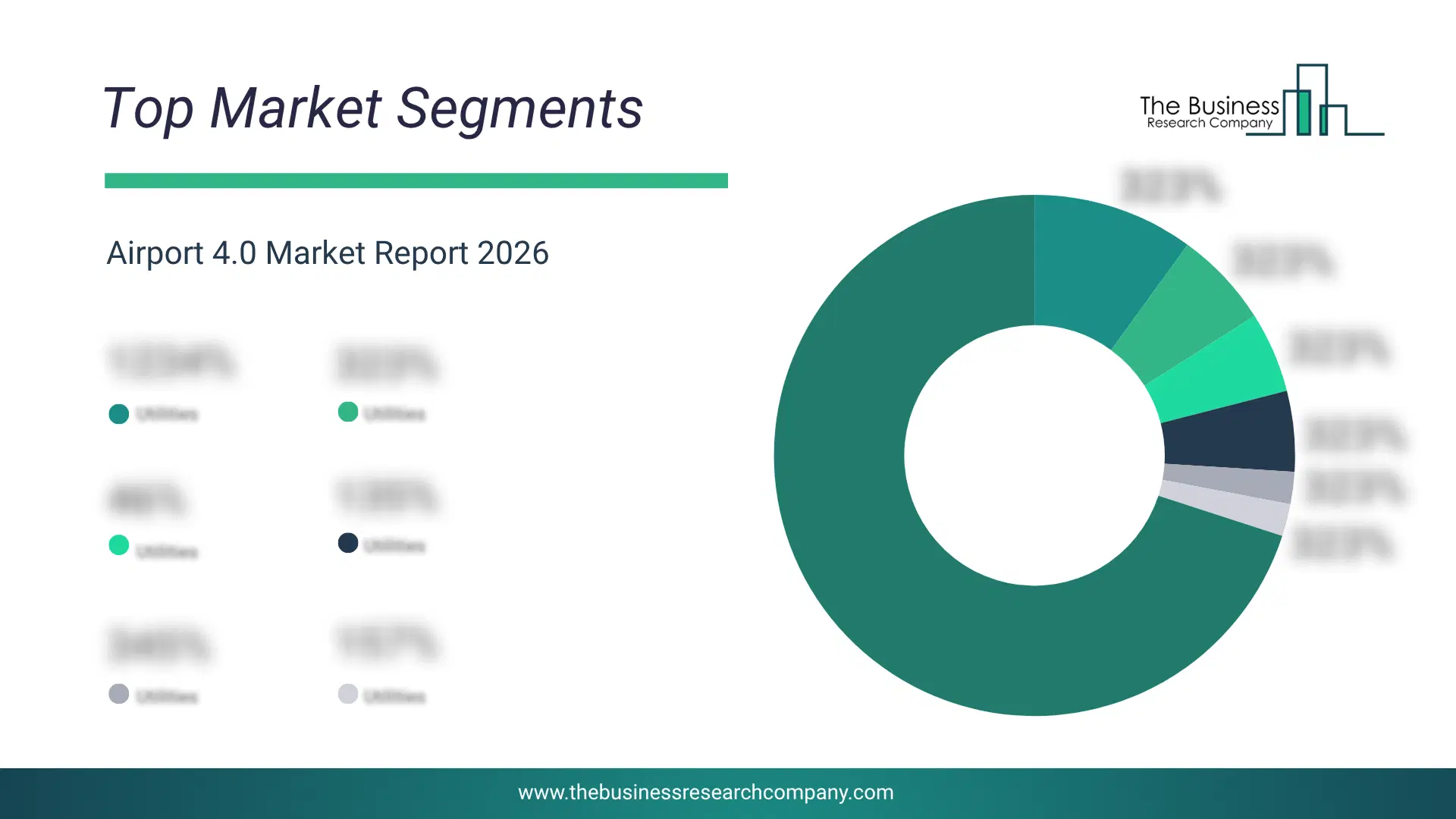
1) By Technology: Automated Check-In Systems, Biometric Security Systems, Smart Baggage Handling, Internet Of Things-Enabled Infrastructure, Artificial Intelligence-Powered Customer Service 2) By Size: Large, Medium, Small 3) By Service Type: Passenger Services, Cargo Services, Maintenance And Ground Services, Airport Security Services 4) By Application: Airside, Airtraffic Maintenance, Aircraft Maintenance, Passenger Screening, Other Applications 5) By End Market: Implementation, Upgrade And Services Subsegments: 1) By Automated Check-In Systems: Self-Service Kiosks, Mobile Check-In Solutions, Web-Based Check-In Platforms, Facial Recognition-Enabled Check-In, E-gates And Boarding Pass Scanners 2) By Biometric Security Systems: Facial Recognition Systems, Fingerprint Scanners, Iris Recognition Systems, Biometric E-Passport Verification, Multi-Modal Biometric Systems 3) By Smart Baggage Handling: Radio Frequency Identification Baggage Tracking, Automated Baggage Sorting Systems, Baggage Reconciliation Systems, Smart Baggage Tags, Baggage Handling Robotics 4) By Internet of Things (IoT)-Enabled Infrastructure: Smart Sensors And Devices, Predictive Maintenance Systems, Internet Of Things Enabled Asset Tracking, Smart Heating, Ventilation, And Air Conditioning And Lighting Systems, Airport Facility Automation 5) By Artificial Intelligence-Powered Customer Service: Artificial Intelligence Based Virtual Assistants And Chatbots, Predictive Analytics For Passenger Flow, Artificial Intelligence Driven Passenger Feedback Systems, Real-Time Information And Recommendation Engines, Language Translation And Voice Recognition ToolsWhat Is Driver Of The Airport 4.0 Market?
The increasing air travel demand is expected to propel the growth of the airport 4.0 market going forward. Air travel refers to the transportation of passengers or goods by aircraft, typically over long distances, through the use of commercial or private flights. The increasing demand for air travel is due to rising disposable incomes, which enable more people to afford air transportation for business and leisure purposes. Airport 4.0 revolutionizes air travel by seamlessly integrating advanced technologies such as artificial intelligence, the Internet of Things, and automation to enhance efficiency, safety, and passenger experience throughout the journey. For instance, in January 2025 according to the International Air Transport Association (IATA), a Canada-based trade association, international air traffic saw a 13.6% increase in 2024 compared to 2023, while overall flight capacity grew by 12.8% during the same period. Therefore, the increasing air travel demand is driving the growth of the airport 4.0 industry.Key Players In The Global Airport 4.0 Market
Major companies operating in the airport 4.0 market are Huawei Technologies Co. Ltd., Siemens AG, Raytheon Technologies, The Boeing Company, Airbus SE, Honeywell International Inc., Thales Group, Leidos Holdings Inc., T-Systems International GmbH, Indra Sistemas S.A, Amadeus IT Group S.A., Daifuku Co. Ltd., Vanderlande Industries B.V, SITA, ADB Safegate BVBA, PSI Software AG, Vision-Box, TAV Bilisim Hizmetleri A.S, TADERA GmbH, Zensors Inc.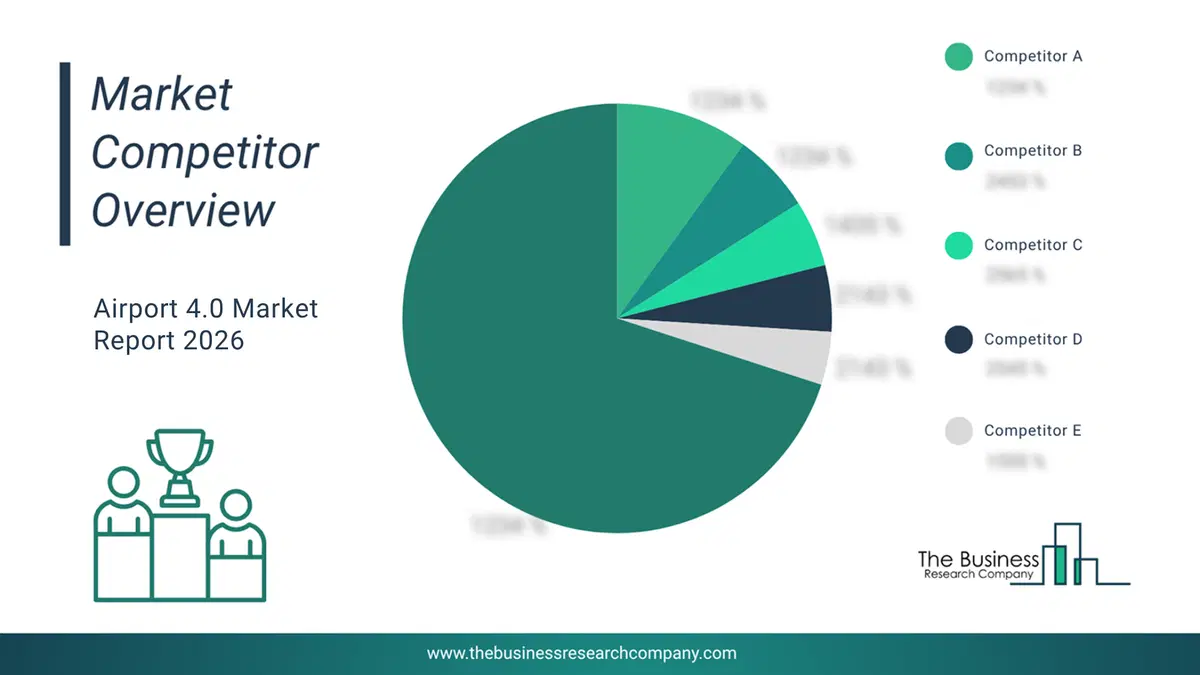
This chart is for illustrative purposes; the full report includes a detailed competitor analysis and comprehensive overview of the top 10 companies in the market.
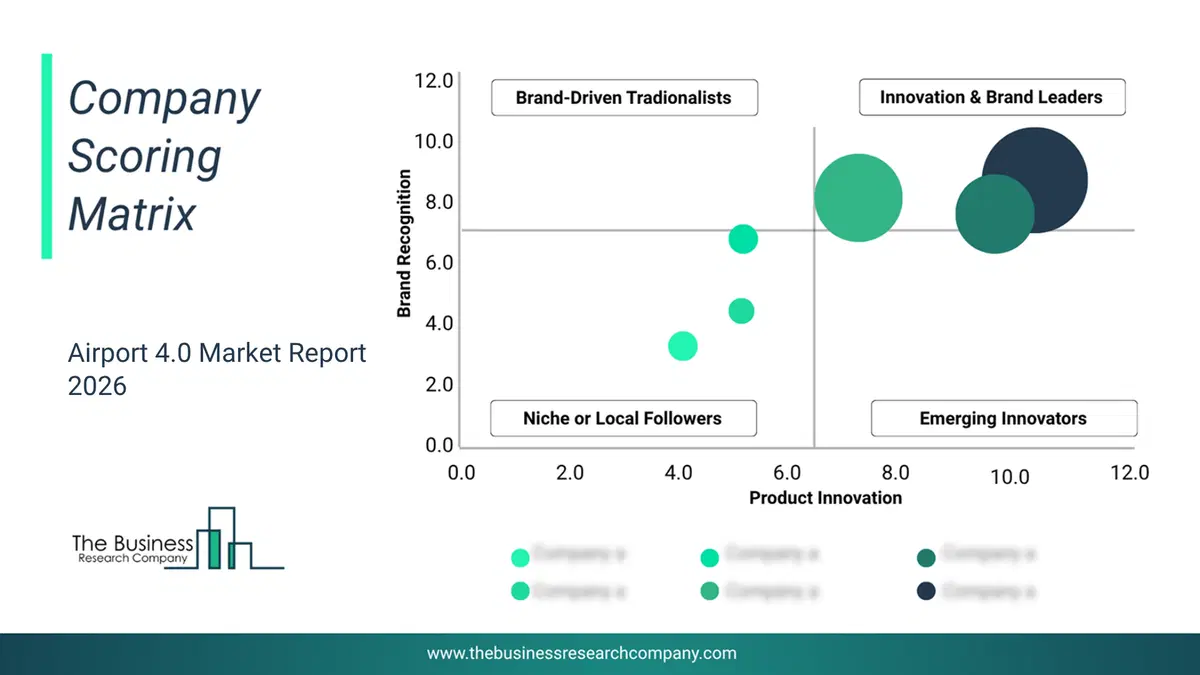
This chart maps companies by product innovation and brand strength, with bubble size indicating relative revenue, helping identify market leaders, challengers, and niche players. This is an illustrative chart; the full report provides a complete and accurate competitive analysis.
Global Airport 4.0 Market Trends and Insights
Major companies operating in the airport 4.0 market are focusing on developing innovative solutions such as airport operations management software to streamline inspections, enhance safety compliance, and improve asset management. Operations management software is a mobile-first platform that enables airports to manage inspections, safety reporting, work orders, and asset maintenance with GIS integration and compliance tracking. For instance, in July 2024, TADERA, a US-based aviation technology company, launched AirportIQ Operations 4.0, an advanced operations module integrated into its AirportIQ (AIQ) platform. This platform supports airports in efficiently managing safety, inspections, compliance, asset tracking, incident reporting, and work orders, all within a unified system aligned with FAR Part 139 regulations. Designed for ease of use across web, tablet, and mobile devices (with offline capabilities), it also provides administrators with customizable checklists and forms, enabling streamlined operations and data-driven decision-making.What Are Latest Mergers And Acquisitions In The Airport 4.0 Market? SITA Acquires Materna IPS To Revolutionize Airport Passenger Experience
In May 2024, SITA, a Switzerland-based aviation company, acquired Materna IPS for an undisclosed amount. With this acquisition, SITA aims to reshape the aviation industry by creating the world’s most powerful passenger portfolio for airports and digital travel, enabling smoother, more efficient, and seamless passenger experiences through innovative, end-to-end solutions. Materna IPS GmbH is a Germany-based company specializing in passenger handling systems such as self-service bag drop and check-in solutions for airports and airlines.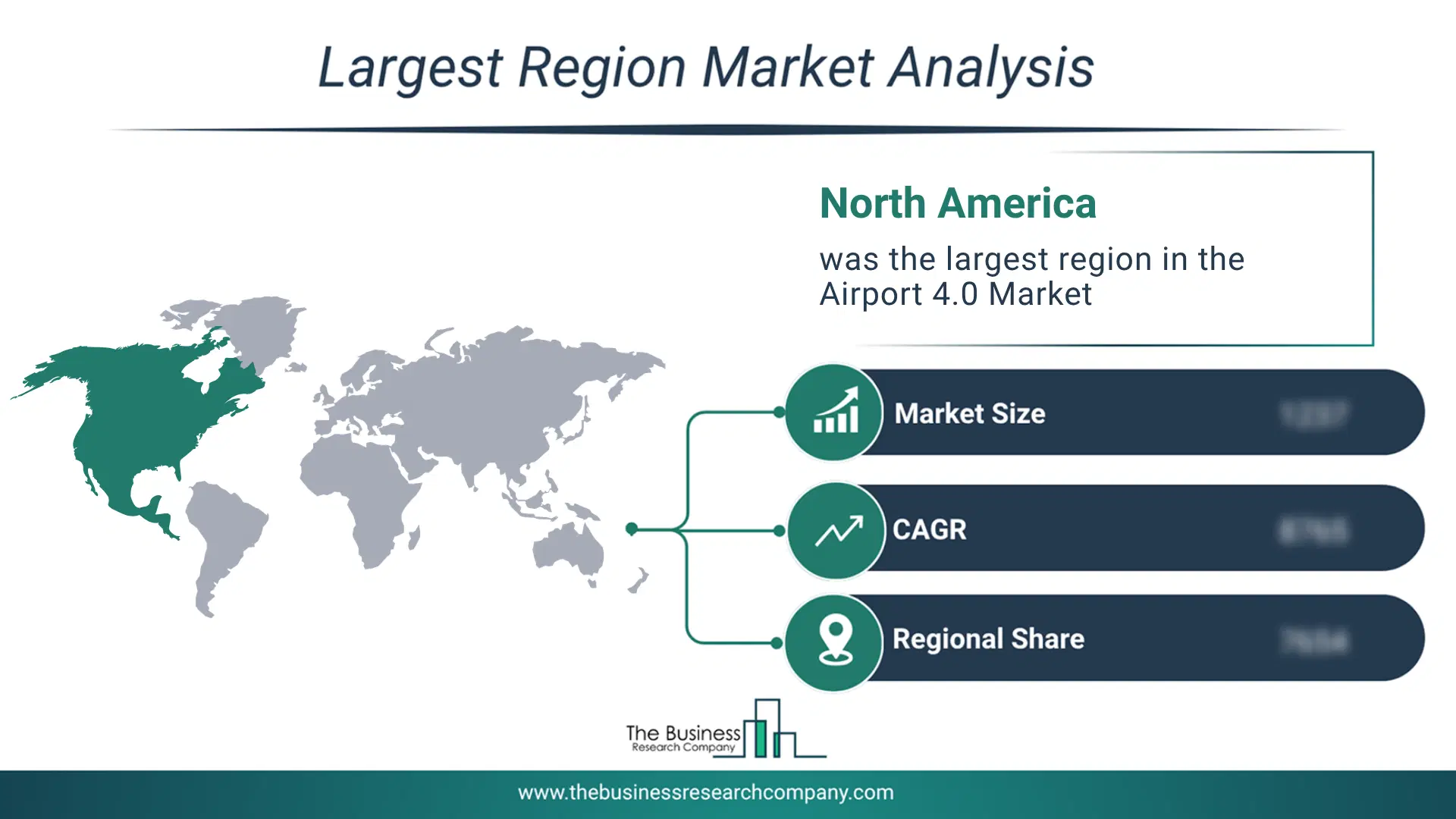
Regional Insights
North America was the largest region in the airport 4.0 market in 2025. Asia-Pacific is expected to be the fastest-growing region in the forecast period. The regions covered in this market report are Asia-Pacific, South East Asia, Western Europe, Eastern Europe, North America, South America, Middle East, Africa. The countries covered in this market report are Australia, Brazil, China, France, Germany, India, Indonesia, Japan, Taiwan, Russia, South Korea, UK, USA, Canada, Italy, SpainWhat Defines the Airport 4.0 Market?
The airport 4.0 market consists of revenues earned by entities by providing services such as cloud-based airport operations management, biometrics for identity verification, mobile app-based passenger services, digital twin and simulation services, and real-time language translation services. The market value includes the value of related goods sold by the service provider or included within the service offering. The airport 4.0 market also includes sales of smart kiosks, biometric systems, cloud infrastructure solutions, and cybersecurity systems. Values in this market are ‘factory gate’ values, that is, the value of goods sold by the manufacturers or creators of the goods, whether to other entities (including downstream manufacturers, wholesalers, distributors, and retailers) or directly to end customers. The value of goods in this market includes related services sold by the creators of the goods.How is Market Value Defined and Measured?
The market value is defined as the revenues that enterprises gain from the sale of goods and/or services within the specified market and geography through sales, grants, or donations in terms of the currency (in USD unless otherwise specified). The revenues for a specified geography are consumption values that are revenues generated by organizations in the specified geography within the market, irrespective of where they are produced. It does not include revenues from resales along the supply chain, either further along the supply chain or as part of other products.
This chart presents market attractiveness based on a quantitative evaluation of growth, competition, strategic alignment, and risk, offering a clear view of opportunity areas for decision-making. This chart is for illustrative purposes; the full report contains the complete analysis.

This chart highlights the Total Addressable Market (TAM) by estimating the maximum revenue opportunity using an assumption-driven approach, supporting strategic planning and opportunity sizing across markets. The chart is illustrative; the full report provides a more comprehensive analysis.
What Key Data and Analysis Are Included in the Airport 4.0 Market Report 2026?
The airport 4.0 market research report is one of a series of new reports from The Business Research Company that provides market statistics, including industry global market size, regional shares, competitors with the market share, detailed market segments, market trends and opportunities, and any further data you may need to thrive in the airport 4.0 industry. The market research report delivers a complete perspective of everything you need, with an in-depth analysis of the current and future state of the industry.Airport 4.0 Market Report Forecast Analysis
| Report Attribute | Details |
|---|---|
| Market Size Value In 2026 | $14.66 billion |
| Revenue Forecast In 2030 | $23.79 billion |
| Growth Rate | CAGR of 12.9% from 2026 to 2030 |
| Base Year For Estimation | 2025 |
| Actual Estimates/Historical Data | 2020-2025 |
| Forecast Period | 2026 - 2030 |
| Market Representation | Revenue in USD Billion and CAGR from 2026 to 2030 |
| Segments Covered | Technology, Size, Service Type, Application, End Market |
| Regional Scope | Asia-Pacific, Western Europe, Eastern Europe, North America, South America, Middle East, Africa |
| Country Scope | The countries covered in the airport 4.0 market report are Australia, Brazil, China, France, Germany, India, Indonesia, Japan, Taiwan, Russia, South Korea, UK, USA, Canada, Italy, Spain |
| Key Companies Profiled | Huawei Technologies Co. Ltd., Siemens AG, Raytheon Technologies, The Boeing Company, Airbus SE, Honeywell International Inc., Thales Group, Leidos Holdings Inc., T-Systems International GmbH, Indra Sistemas S.A, Amadeus IT Group S.A., Daifuku Co. Ltd., Vanderlande Industries B.V, SITA, ADB Safegate BVBA, PSI Software AG, Vision-Box, TAV Bilisim Hizmetleri A.S, TADERA GmbH, Zensors Inc. |
| Customization Scope | Request for Customization |
| Pricing And Purchase Options | Explore Purchase Options |