
Anti-Counterfeit Packaging Market Report 2026
Global Outlook – By Technology (Mass Encoding, Radio Frequency Identification (RFID), Holograms, Forensic Markers, Tamper Evidence, Other Technologies), By Packaging Format (Bottles And Jars, Vials And Ampoules, Blisters, Trays, Pouches And Sachets, Other Packaging Formats), By End Use (Food And Beverage, Healthcare, Automotive, Personal Care And Cosmetics, Electrical And Electronics, Other End Users) – Market Size, Trends, Strategies, and Forecast to 2030
Anti-Counterfeit Packaging Market Overview
• Anti-Counterfeit Packaging market size has reached to $190.09 billion in 2025 • Expected to grow to $351.72 billion in 2030 at a compound annual growth rate (CAGR) of 13.1% • Growth Driver: Rise In E-Commerce And Online Shopping To Drive Market Growth • Market Trend: Next-Generation Visual Security Innovations Transforming How Brands Protect Their Products • Asia-Pacific was the largest region and fastest growing region.Market Gains By 2030 – Top Opportunities By Segment
Market Gain identifies the most promising market opportunities by highlighting the segments or products expected to generate the highest incremental revenue growth over the next five years.
What Is Covered Under Anti-Counterfeit Packaging Market?
Anti-counterfeit packaging refers to the method of assigning secure packaging to a product or using technologies to prevent imitation of the product. Anti-counterfeit packaging is designed to prevent the imitation and illegal reproduction of products, ensuring the authenticity and safety of goods. The main anti-counterfeit packaging technologies include mass encoding, radio frequency identification (RFID), holograms, forensic markers, tamper evidence and others. Mass encoding is used for identifying specific information of different products. Mass encoding refers to the process of converting a string of characters (letters, numbers, punctuation, and other symbols) into a specific format for efficient transmission or storage for mass objects. Mass encoding is used for identifying particular information about different products. The different formats include bottles and jars, vials and ampoules, blisters, trays, pouches and sachets and others, used by end-users including food and beverage, healthcare, automotive, personal care and cosmetics, electrical and electronics and others.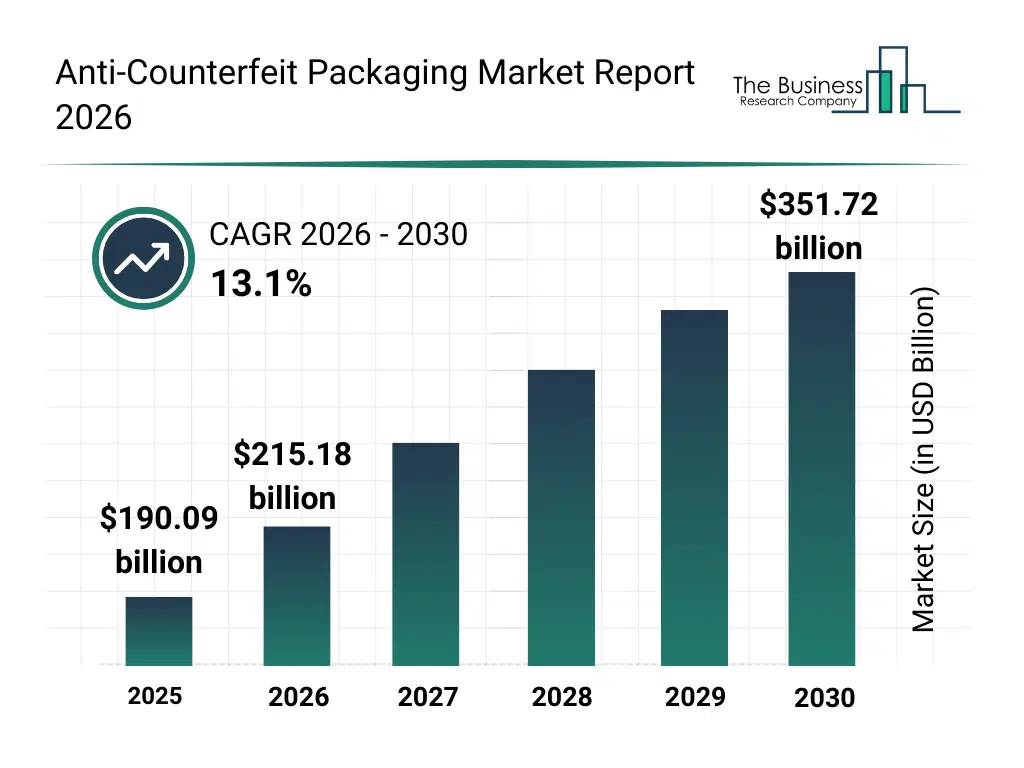
What Is The Anti-Counterfeit Packaging Market Size and Share 2026?
The anti-counterfeit packaging market size has grown rapidly in recent years. It will grow from $190.09 billion in 2025 to $215.18 billion in 2026 at a compound annual growth rate (CAGR) of 13.2%. The growth in the historic period can be attributed to rising counterfeit product circulation, increasing regulatory enforcement on product authenticity, adoption of barcodes and holograms, growth in global supply chains, increasing awareness of brand protection.What Is The Anti-Counterfeit Packaging Market Growth Forecast?
The anti-counterfeit packaging market size is expected to see rapid growth in the next few years. It will grow to $351.72 billion in 2030 at a compound annual growth rate (CAGR) of 13.1%. The growth in the forecast period can be attributed to increasing use of blockchain-based authentication, rising investments in smart packaging technologies, expansion of pharmaceutical and food safety regulations, growing demand for real-time product verification, increasing focus on supply chain transparency. Major trends in the forecast period include increasing adoption of smart authentication technologies, rising use of track-and-trace packaging solutions, growing integration of digital watermarks and qr codes, expansion of tamper-evident packaging formats, enhanced focus on brand protection.
Global Anti-Counterfeit Packaging Market Segmentation
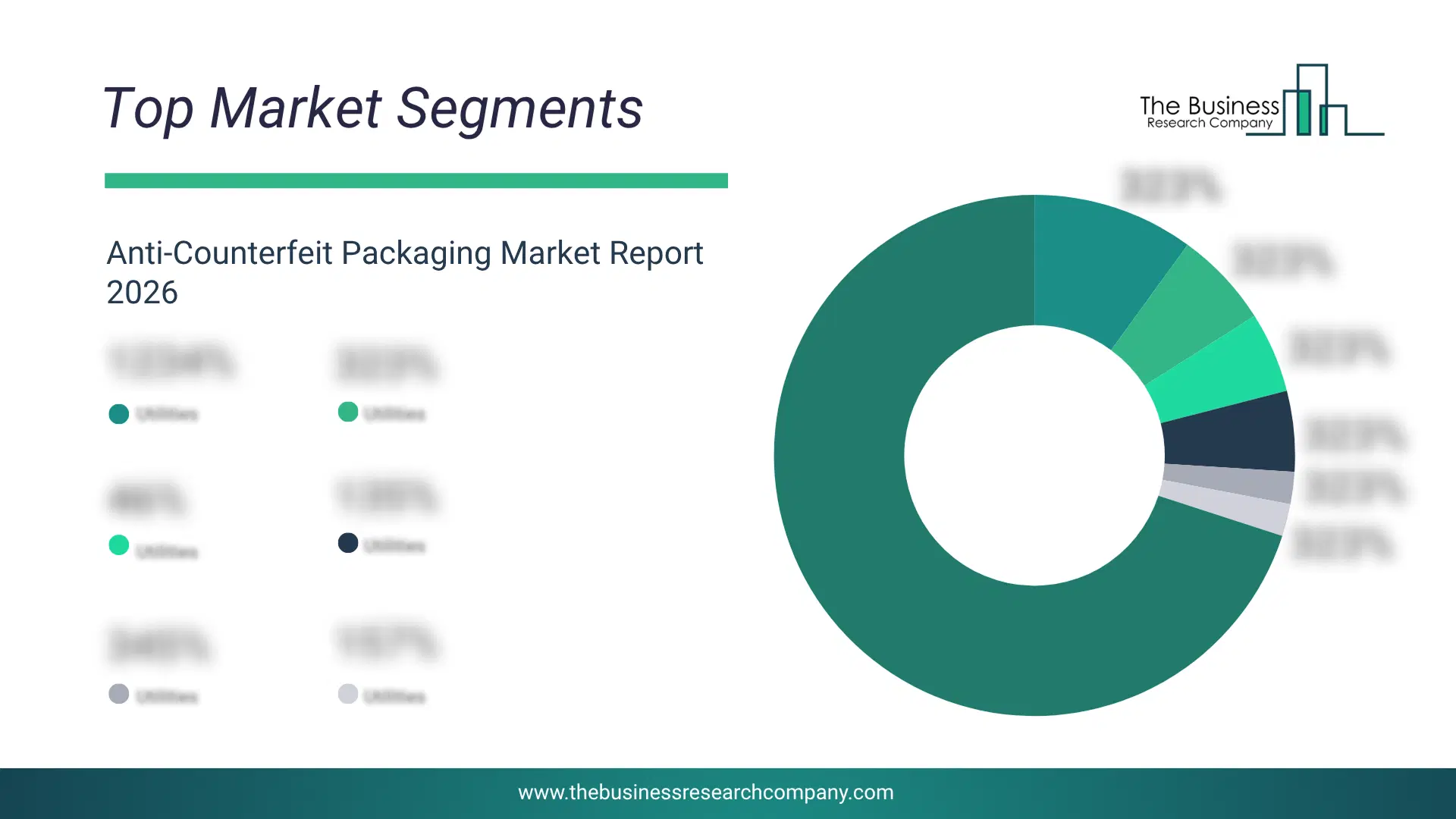
1) By Technology: Mass Encoding, Radio Frequency Identification (RFID), Holograms, Forensic Markers, Tamper Evidence, Other Technologies 2) By Packaging Format: Bottles And Jars, Vials And Ampoules, Blisters, Trays, Pouches And Sachets, Other Packaging Formats 3) By End Use: Food And Beverage, Healthcare, Automotive, Personal Care And Cosmetics, Electrical And Electronics, Other End Users Subsegments: 1) By Mass Encoding: Barcodes, QR Codes, 2D Data Matrix Codes 2) By Radio Frequency Identification (RFID): Passive RFID, Active RFID, Semi-Passive RFID 3) By Holograms: Security Holograms, 3D Holograms, Custom Holograms 4) By Forensic Markers: DNA Markers, Chemical Markers, Microtagging 5) By Tamper Evidence: Tamper-Evident Seals, Shrink Bands, Breakable Caps 6) By Other Technologies: Invisible Ink, Digital Watermarks, Smart Labels The top segments in the anti-counterfeit packaging market will be: • Mass Encoding will reach $107.9 Billion by 2030. • Radio Frequency Identification (RFID) will reach $83.88 Billion by 2030. • Holograms will reach $50.93 Billion by 2030. • Forensic Markers will reach $41.11 Billion by 2030. • Tamper Evidence will reach $39.76 Billion by 2030.What Is The Driver Of The Anti-Counterfeit Packaging Market?
The increasing expansion of e-commerce and online shopping is expected to propel the growth of anti-counterfeit packaging market going forward. E-commerce is the buying and selling of goods and services conducted electronically, often facilitated through online shopping platforms. Growth of e-commerce and online shopping has heightened the risk of counterfeiting, making anti-counterfeit packaging pivotal in securing products through globalized and complex supply chains. The lack of physical inspection, direct-to-consumer sales, and the need for consumer trust and brand protection drive the adoption of anti-counterfeit measures. For instance, in August 2023, according to the United States Census Bureau, a US-based government agency, when compared to the second quarter of 2022, the estimate for e-commerce in the second quarter of 2023 increased by 7.5% (or 1.4%), while overall retail sales increased by 0.6% (or 0.4%). 15.4% of all sales in the second quarter of 2023 were made through online stores. Therefore, the increasing expansion of e-commerce and online shopping is driving the growth of the anti-counterfeit packaging industry.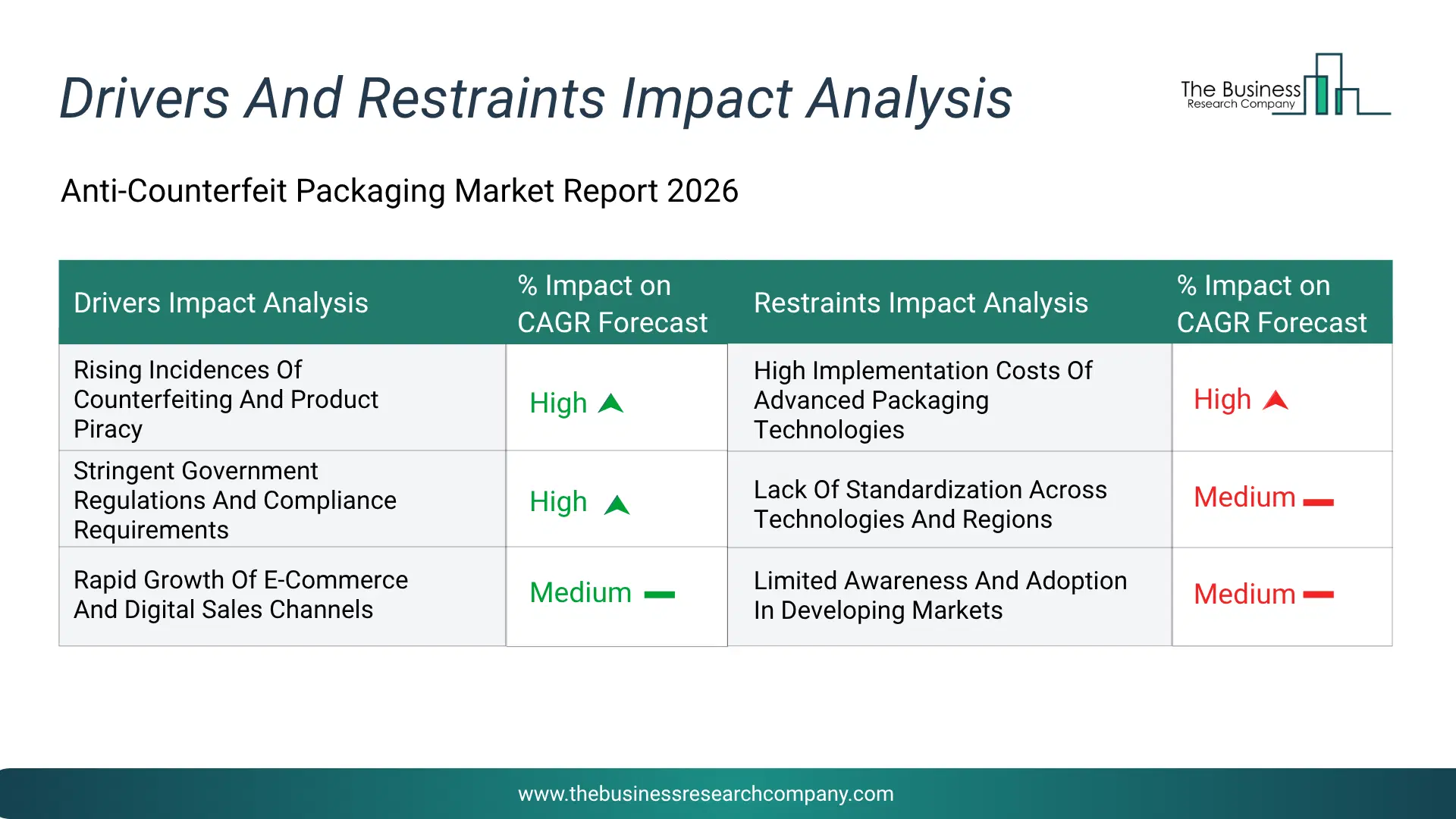
Infographic Chart Showing Key Market Drivers Analysis And Restraints For Anti-Counterfeit Packaging Market
The chart presents an impact analysis of key drivers and restraints, quantifying their relative influence on the market's growth rate and helping assess the balance between growth enablers and limiting factors. This chart offers a high-level perspective; the full report contains more detailed insights.
How Will The Drivers Impact Growth In The Global Anti-Counterfeit Packaging Market?
• Rising Incidences Of Counterfeiting And Product Piracy (High) – During the forecast period, the rising incidences of counterfeiting and product piracy is expected to become a key growth driver for the anti-counterfeit packaging market by 2030. Rising incidences of counterfeiting and product piracy acts as a major driver for the anti-counterfeit packaging market because the increasing presence of fake products across pharmaceuticals, electronics, and luxury goods is creating significant financial and reputational risks for manufacturers. Companies are compelled to adopt secure packaging technologies such as holograms, RFID, and track-and-trace systems to protect their products. This growing threat also pushes governments and organizations to invest more in anti-counterfeit measures. As counterfeit goods continue to expand globally, the demand for authentication and security packaging solutions rises accordingly. • Stringent Government Regulations And Compliance Requirements (High) – During the forecast period, the stringent government regulations and compliance requirements is expected to emerge as a major factor driving the expansion of the anti-counterfeit packaging market by 2030. Stringent government regulations and compliance requirements acts as a major driver for the anti-counterfeit packaging market because regulatory bodies mandate serialization, traceability, and tamper-proof packaging to ensure product safety and authenticity. Industries such as pharmaceuticals and food must comply with strict guidelines to prevent counterfeit goods from entering supply chains. These rules force companies to adopt advanced packaging technologies to meet legal standards and avoid penalties. Compliance also enhances transparency and accountability across distribution networks. • Rapid Growth Of E-Commerce And Digital Sales Channels (Medium) – During the forecast period, the rapid growth of e-commerce and digital sales channels is expected to act as a key growth catalyst for the anti-counterfeit packaging market by 2030. Rapid growth of e-commerce and digital sales channels acts as a major driver for the anti-counterfeit packaging market because online platforms make it easier for counterfeiters to distribute fake products to a wider audience. This has increased the need for authentication technologies such as QR codes, NFC tags, and digital verification tools that allow consumers to confirm product authenticity. Brands are investing heavily in smart packaging solutions to combat online fraud and maintain customer trust. The expansion of global trade and cross-border transactions further intensifies this need.How Will The Restraints Impact Growth In The Global Anti-Counterfeit Packaging Market?
• High Implementation Costs Of Advanced Packaging Technologies (High) – During the forecast period, the high implementation costs of advanced packaging technologies act as a key restraint in the anti-counterfeit packaging market by increasing the financial burden on manufacturers, especially small and medium enterprises. Technologies such as RFID tags, holograms, and smart labels require significant upfront investment in materials, integration, and infrastructure. This raises product costs, making it difficult for price-sensitive industries to adopt these solutions at scale. Additionally, ongoing maintenance and technology upgrades further add to operational expenses. As a result, cost-related barriers slow down widespread adoption and limit market penetration despite growing demand. • Lack Of Standardization Across Technologies And Regions (High) – During the forecast period, the lack of standardization across technologies and regions acts as a restraint by creating inconsistencies in implementation and interoperability of anti-counterfeit solutions. Different countries and industries follow varied regulations and technology standards, making it difficult for global companies to adopt a unified packaging approach. This fragmentation increases complexity in supply chains and leads to inefficiencies in tracking and authentication systems. It also raises compliance costs and slows down cross-border trade operations. Consequently, the absence of uniform standards hinders seamless adoption and scalability of anti-counterfeit packaging solutions. • Limited Awareness And Adoption In Developing Markets (Medium) – During the forecast period, the limited awareness and adoption in developing markets act as a significant restraint by reducing the overall demand for anti-counterfeit packaging solutions. Many businesses in emerging economies lack knowledge about advanced anti-counterfeiting technologies and their long-term benefits. Cost sensitivity and preference for traditional packaging methods further discourage adoption. Additionally, weak enforcement of intellectual property rights reduces the urgency to implement such solutions. This results in slower market growth and uneven adoption across regions, restricting the global expansion of the anti-counterfeit packaging market.Key Players In The Global Anti-Counterfeit Packaging Market
Major companies operating in the anti-counterfeit packaging market are AlpVision SA, Applied DNA Sciences, Authentix, Avery Dennison Corporation, 3M Company, SATO Holdings, CCL Industries, Sicpa, 3D AG, NeuroTags Inc, Advance Track & Trace, Inksure Technologies, Impinj Inc, Zebra Technologies Corporation, U-NICA Solutions AG, Alien Technology Corp, Intelligent Label Solutions, SML Group, DuPont de Nemours Inc, Systech International, PharmaSecure Inc, Uflex Limited, SAVI Technology Inc, Suvision Holdings Private Limited, TruTag Technologies Inc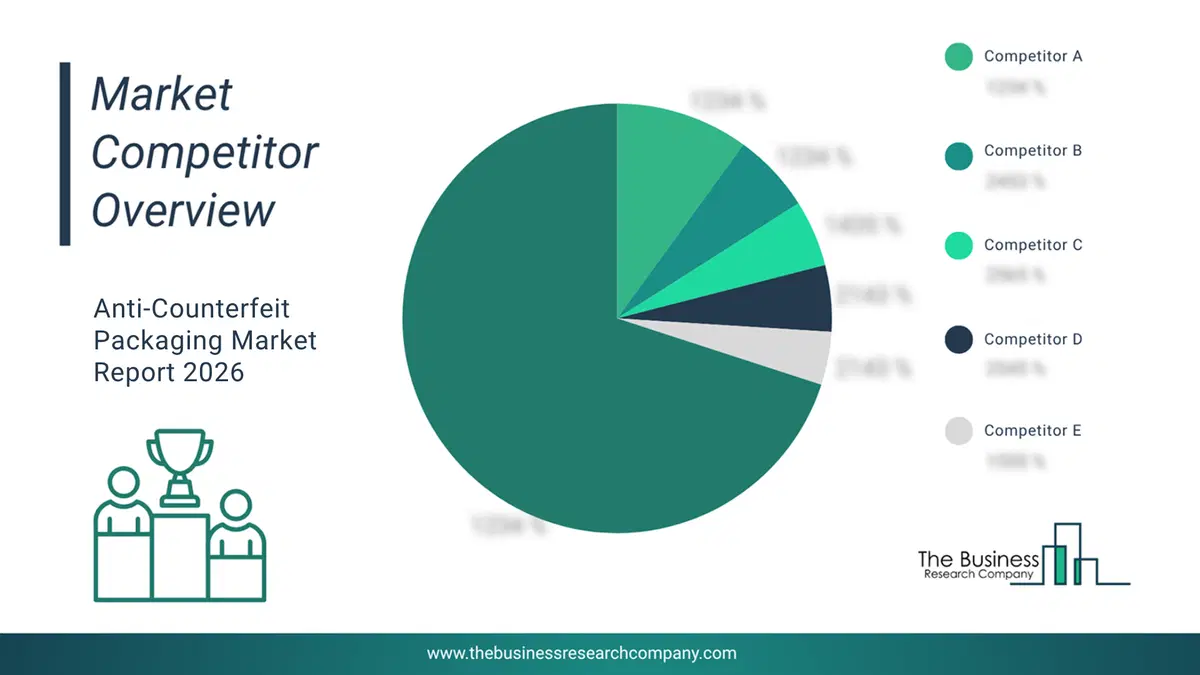
This chart is for illustrative purposes; the full report includes a detailed competitor analysis and comprehensive overview of the top 10 companies in the market.
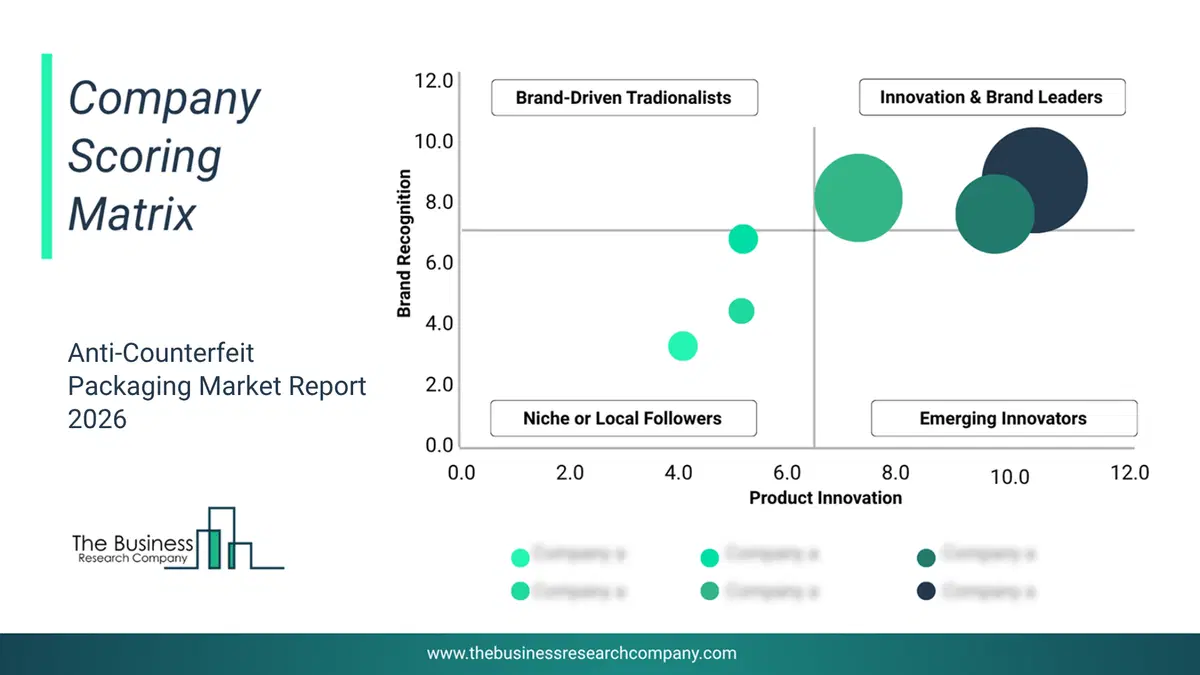
This chart maps companies by product innovation and brand strength, with bubble size indicating relative revenue, helping identify market leaders, challengers, and niche players. This is an illustrative chart; the full report provides a complete and accurate competitive analysis.
Global Anti-Counterfeit Packaging Market Trends and Insights
Major companies operating in the anti-counterfeit packaging market are focusing on developing innovative solutions, such as next-generation micro-optic visual authentication technologies, to enhance product security and enable instant, consumer-friendly authentication. Next-generation micro-optic visual authentication technologies are advanced security features that use microscopic optical structures to create dynamic 3D, motion, and depth effects that cannot be replicated with conventional printing or holograms, helping brands protect products by enabling instant, tool-free authentication that consumers can verify with the naked eye. For instance, in September 2025, Rolling Optics, a Sweden-based technology company, launched Fidaro, an innovative visual authentication technology designed specifically for brand protection applications. Fidaro is engineered with a new generation of patented micro-optical effects, enabling instant product authentication through highly visible, intuitive motion and depth effects that consumers can verify by simply looking at the label or package. The solution combines overt and covert security layers, offers customizable visual designs for brand storytelling, and can be integrated into packaging, labels, and products across industries including cosmetics, apparel, pharma, electronics, and premium consumer goods. By eliminating the need for special devices, lighting, or apps, Fidaro significantly enhances both accessibility and security compared to traditional holograms or printed features, strengthening brands’ ability to combat counterfeiting at scale.What Are Latest Mergers And Acquisitions In The Anti-Counterfeit Packaging Market?
In July 2024, Authentix Inc., a US-based provider of authentication, security printing, and anti counterfeiting solutions, acquired substantially all assets of Nanotech Security Corp. for approximately US$ 10 million. With this acquisition, Authentix aimed to enhance and expand its high security optical authentication and anti counterfeit labeling capabilities, thereby strengthening its portfolio of advanced security features for pharmaceuticals, luxury goods, and other high value products. Nanotech Security Corp. is a Canada based provider of nano optic holographic security features used in banknotes, secure documents, and product labels.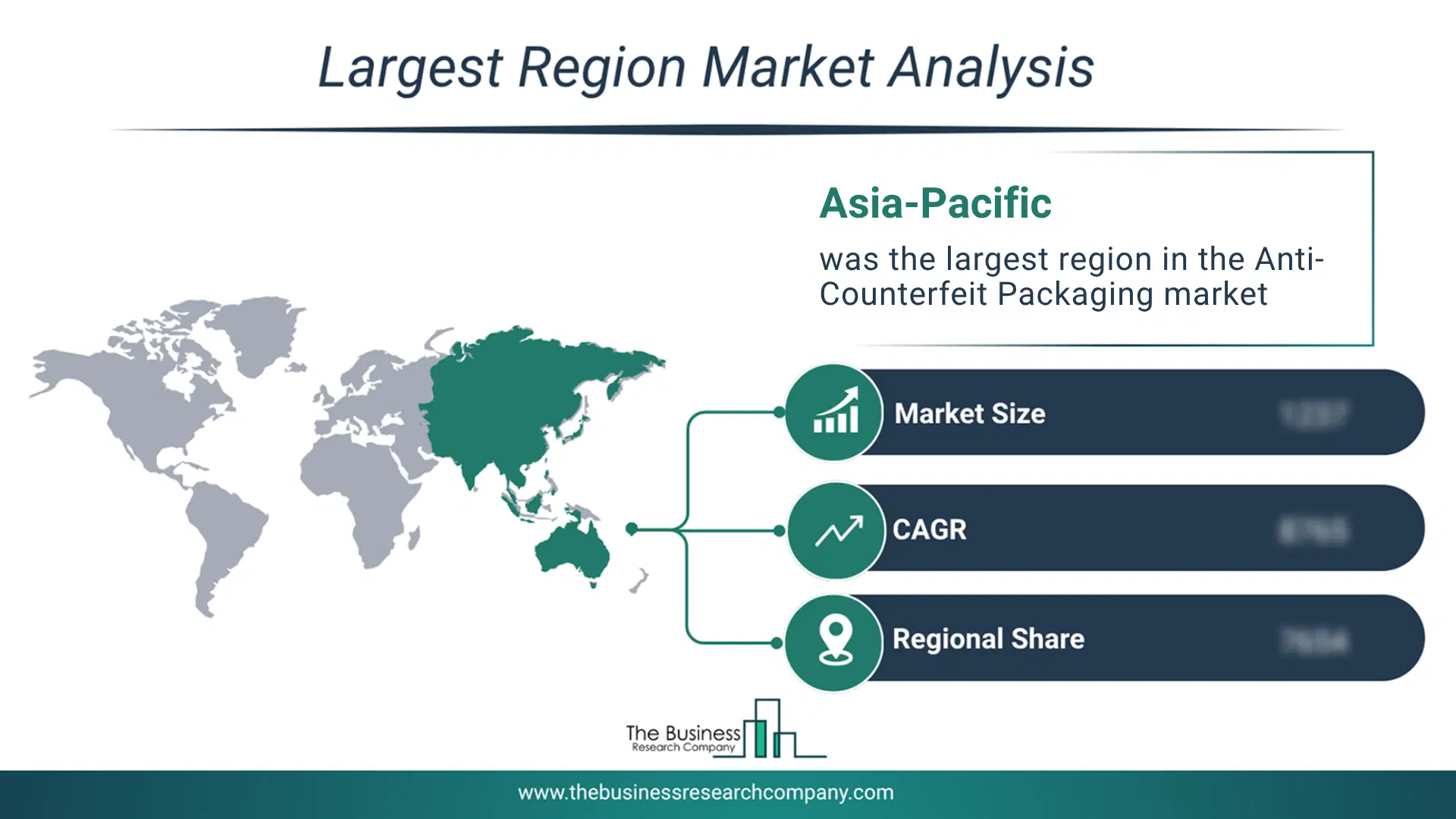
Regional Outlook
Asia-Pacific was the largest region in the anti-counterfeit packaging market in 2025. Asia-Pacific is expected to be the fastest-growing region in the anti-counterfeit packaging market report during the forecast period. The regions covered in this market report are Asia-Pacific, South East Asia, Western Europe, Eastern Europe, North America, South America, Middle East, Africa. The countries covered in this market report are Australia, Brazil, China, France, Germany, India, Indonesia, Japan, Taiwan, Russia, South Korea, UK, USA, Canada, Italy, Spain.What Defines the Anti-Counterfeit Packaging Market?
The anti-counterfeit packaging market consists of sales of security inks and coatings, security seals barcodes, security labels, and color shifting inks. Values in this market are ‘factory gate’ values, that is the value of goods sold by the manufacturers or creators of the goods, whether to other entities (including downstream manufacturers, wholesalers, distributors and retailers) or directly to end customers. The value of goods in this market includes related services sold by the creators of the goods.How is Market Value Defined and Measured?
The market value is defined as the revenues that enterprises gain from the sale of goods and/or services within the specified market and geography through sales, grants, or donations in terms of the currency (in USD unless otherwise specified). The revenues for a specified geography are consumption values that are revenues generated by organizations in the specified geography within the market, irrespective of where they are produced. It does not include revenues from resales along the supply chain, either further along the supply chain or as part of other products.
This chart presents market attractiveness based on a quantitative evaluation of growth, competition, strategic alignment, and risk, offering a clear view of opportunity areas for decision-making. This chart is for illustrative purposes; the full report contains the complete analysis.

This chart highlights the Total Addressable Market (TAM) by estimating the maximum revenue opportunity using an assumption-driven approach, supporting strategic planning and opportunity sizing across markets. The chart is illustrative; the full report provides a more comprehensive analysis.
What Key Data and Analysis Are Included in the Anti-Counterfeit Packaging Market Report 2026?
The anti-counterfeit packaging market research report is one of a series of new reports from The Business Research Company that provides market statistics, including Market Report 2026?global market size, regional shares, competitors with the market share, detailed market segments, market trends and opportunities, and any further data you may need to thrive in the anti-counterfeit packaging Market Report 2026? The market research report delivers a complete perspective of everything you need, with an in-depth analysis of the current and future state of the Market Report 2026?Anti-Counterfeit Packaging Market Report Forecast Analysis
| Report Attribute | Details |
|---|---|
| Market Size Value In 2026 | $215.18 billion |
| Revenue Forecast In 2030 | $351.72 billion |
| Growth Rate | CAGR of 13.2% from 2026 to 2030 |
| Base Year For Estimation | 2025 |
| Actual Estimates/Historical Data | 2020-2025 |
| Forecast Period | 2026 - 2030 |
| Market Representation | Revenue in USD Billion and CAGR from 2026 to 2030 |
| Segments Covered | Technology, Packaging Format, End Use |
| Regional Scope | Asia-Pacific, Western Europe, Eastern Europe, North America, South America, Middle East, Africa |
| Country Scope | The countries covered in the report are Australia, Brazil, China, France, Germany, India, Indonesia, Japan, Taiwan, Russia, South Korea, UK, USA, Canada, Italy, Spain. |
| Key Companies Profiled | AlpVision SA, Applied DNA Sciences, Authentix, Avery Dennison Corporation, 3M Company, SATO Holdings, CCL Industries, Sicpa, 3D AG, NeuroTags Inc, Advance Track & Trace, Inksure Technologies, Impinj Inc, Zebra Technologies Corporation, U-NICA Solutions AG, Alien Technology Corp, Intelligent Label Solutions, SML Group, DuPont de Nemours Inc, Systech International, PharmaSecure Inc, Uflex Limited, SAVI Technology Inc, Suvision Holdings Private Limited, TruTag Technologies Inc |
| Customization Scope | Request for Customization |
| Pricing And Purchase Options | Explore Purchase Options |