
Antibiotic Free Meat Market Report 2026
Global Outlook – By Product (Bovine Antibiotic-Free Meat, Swine Antibiotic-Free Meat, Poultry Antibiotic-Free Meat, Ovine Antibiotic-Free Meat ), By Form (Fresh Antibiotic-Free Meat, Processed Antibiotic-Free Meat ), By Distribution Channel (Business To Business, Business To Consumer ), By End-Users (Household, Foodservice, Food Processing) – Market Size, Trends, Strategies, and Forecast to 2030
Antibiotic Free Meat Market Overview
• Antibiotic Free Meat market size has reached to $182.39 billion in 2025 • Expected to grow to $285.86 billion in 2030 at a compound annual growth rate (CAGR) of 9.4% • Growth Driver: Increasing Demand For Premium And Healthy Meat Boosts Antibiotic-Free Meat Market • Market Trend: Strategic Investment To Support Manufacturing • Asia-Pacific was the largest region in 2025.What Is Covered Under Antibiotic Free Meat Market?
Antibiotic-free meat is meat that is free of antibiotics and is medicated during breeding to treat sickness in animals. Antibiotic-free meat is produced by raising animals without the use of antibiotics. The main types of antibiotic-free meat products include bovine antibiotic-free meat, swine antibiotic-free meat, poultry antibiotic-free meat, and ovine antibiotic-free meat. Bovine antibiotic-free meat refers to meat obtained from cattle and water buffalo that is not treated with antibiotics and hormones. It is sold in different forms including fresh antibiotic-free meat and processed antibiotic-free meat, and distributed through channels such as business-to-business and business-to-consumer. It is used by households, food service, and food processing providers.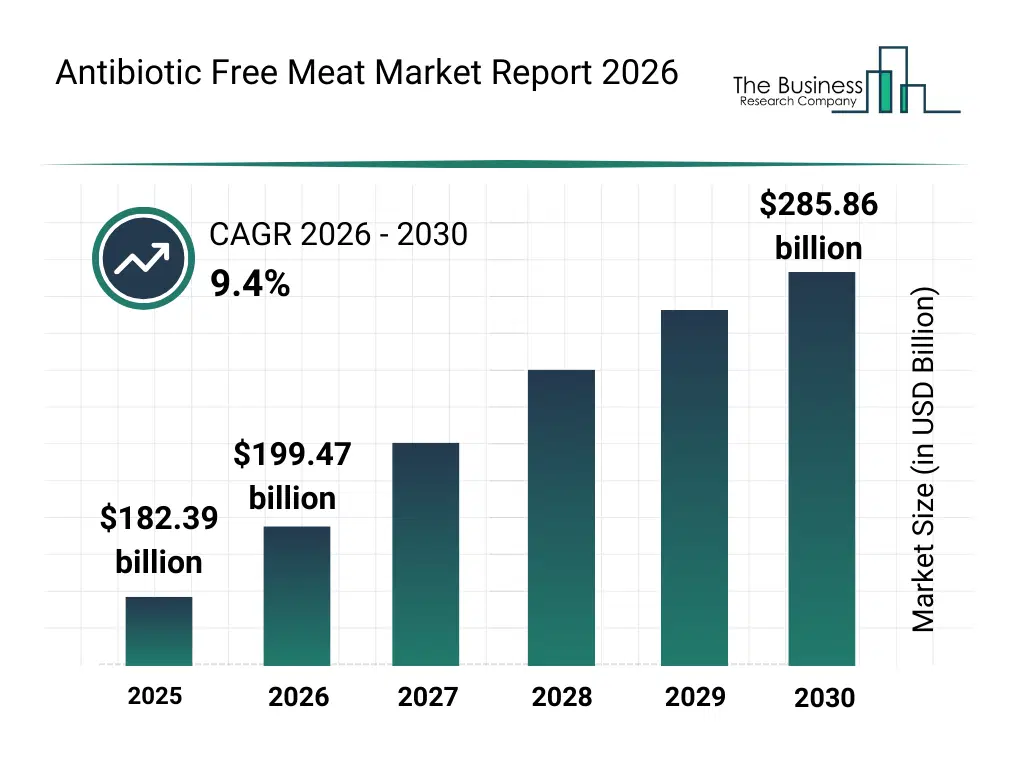
What Is The Antibiotic Free Meat Market Size and Share 2026?
The antibiotic free meat market size has grown strongly in recent years. It will grow from $182.39 billion in 2025 to $199.47 billion in 2026 at a compound annual growth rate (CAGR) of 9.4%. The growth in the historic period can be attributed to rising consumer awareness of food safety, increasing concerns over antibiotic resistance, expansion of organized meat retailing, growth of premium protein consumption, improved livestock management practices.What Is The Antibiotic Free Meat Market Growth Forecast?
The antibiotic free meat market size is expected to see strong growth in the next few years. It will grow to $285.86 billion in 2030 at a compound annual growth rate (CAGR) of 9.4%. The growth in the forecast period can be attributed to increasing demand for sustainably produced meat, rising regulatory pressure on antibiotic usage, expansion of certified meat supply chains, growing investments in traceable meat production, increasing preference for health-focused protein diets. Major trends in the forecast period include increasing consumer preference for clean-label meat products, rising adoption of antibiotic-free livestock rearing practices, growing demand for transparent meat traceability, expansion of premium meat product offerings, enhanced focus on animal welfare standards.
Global Antibiotic Free Meat Market Segmentation
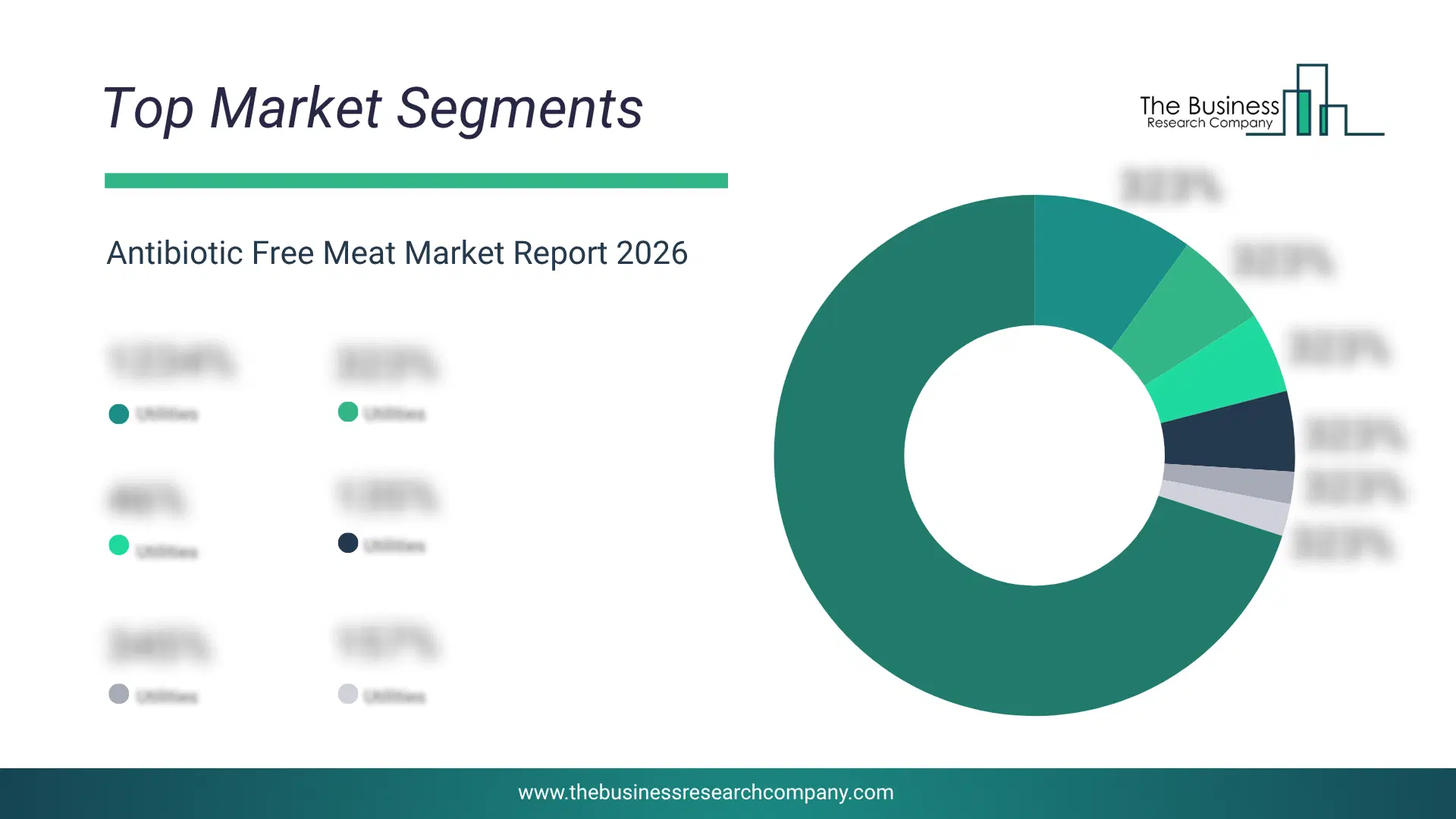
1) By Product: Bovine Antibiotic-Free Meat, Swine Antibiotic-Free Meat, Poultry Antibiotic-Free Meat, Ovine Antibiotic-Free Meat 2) By Form: Fresh Antibiotic-Free Meat, Processed Antibiotic-Free Meat 3) By Distribution Channel: Business To Business, Business To Consumer 4) By End-Users: Household, Foodservice, Food Processing Subsegments: 1) By Bovine Antibiotic-Free Meat: Grass-Fed Beef, Grain-Fed Beef 2) By Swine Antibiotic-Free Meat: Fresh Pork, Processed Pork 3) By Poultry Antibiotic-Free Meat: Chicken, Turkey 4) By Ovine Antibiotic-Free Meat: Lamb, MuttonWhat Are The Drivers Of The Antibiotic Free Meat Market?
The increasing demand for healthy and premium-quality meat is expected to propel the growth of the antibiotic-free meat market going forward. Healthy and premium-quality meat refers to meat products made from high-quality ingredients enriched with essential nutrients that support better health outcomes. Demand for such meat is rising as consumers increasingly prioritize cleaner, safer, and more nutritious protein options. The antibiotic-free meat supports this shift by offering naturally raised, high-quality meat that aligns with consumer expectations for purity, safety, and overall wellness. For instance, in October 2025, according to the Central Statistics Office, an Ireland-based agricultural statistics agency, annual per capita human consumption of total meat increased by 1% to 100 kg in 2024, while per capita poultry meat consumption grew by 2 kg (+5%) to 49 kg compared to the previous year. Therefore, the increasing demand for healthy and premium-quality meat is driving the growth of the antibiotic-free meat market. The rise of e-commerce is expected to propel the growth of the antibiotic-free meat market going forward. E-commerce refers to the buying and selling of goods and services over the Internet through online retail platforms and digital transactions. E-commerce adoption is increasing as consumers shift toward convenient online shopping experiences across food and grocery categories. The antibiotic-free meat benefits by leveraging online platforms to reach health-conscious consumers seeking responsibly sourced and sustainable meat products. For instance, in August 2023, the Census, a US-based government agency, reported that US retail e-commerce sales in the second quarter of 2023 reached $277.6 billion, reflecting a 2.1% increase from the previous quarter. Therefore, the rise of e-commerce is driving the growth of the antibiotic-free meat market.Key Players In The Global Antibiotic Free Meat Market
Major companies operating in the antibiotic free meat market are Cargill Incorporated, Tyson Foods Inc., Hormel Foods Corporation, Perdue Farms Incorporated, Meyer Natural Angus LLC, Saffron Road Foods Inc., MamaMancini's Holdings Corporation, Ranch Foods Direct LLC, White Oak Pastures Inc., American Foods Group LLC, Koch Foods Inc., Smithfield Foods Inc., Wayne Farms Inc., Nema Halal Foods Inc., Sanderson Farms Inc., Pilgrim's Pride Corporation, Foster Farms LLC, Bell & Evans Inc., Mary's Free Range Chicken Inc., Plainville Farms, Coleman Natural Foods, Niman Ranch Inc., Springer Mountain Farms, Applegate Natural & Organic Meats Inc., Laura's Lean Beef, Gunthorp Farms, D'Artagnan LLC, Tendergrass Farms LLC, Pasturebird Inc., Joyce Farms Inc., Kadejan LLC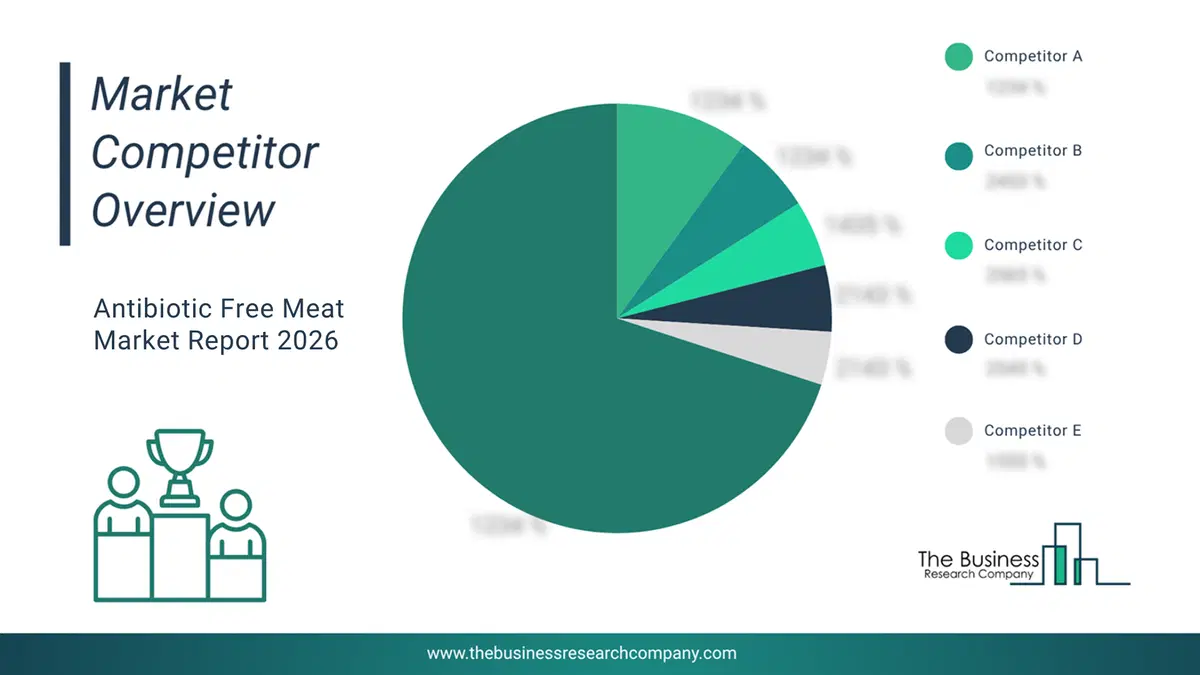
This chart is for illustrative purposes; the full report includes a detailed competitor analysis and comprehensive overview of the top 10 companies in the market.
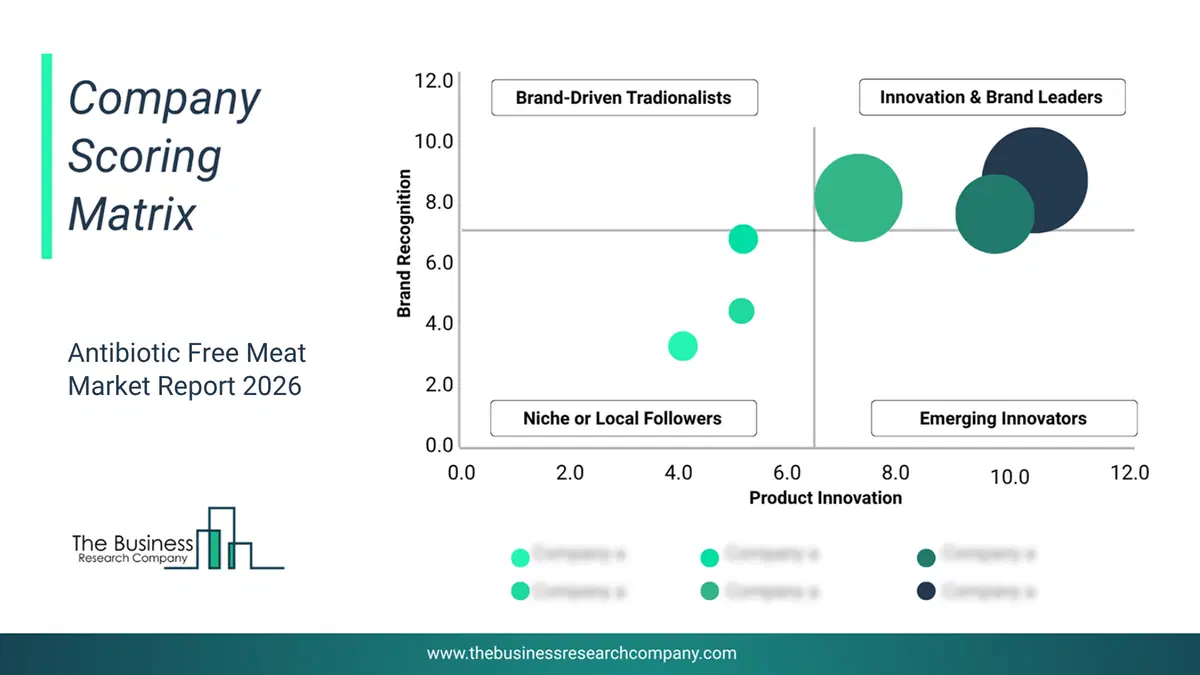
This chart maps companies by product innovation and brand strength, with bubble size indicating relative revenue, helping identify market leaders, challengers, and niche players. This is an illustrative chart; the full report provides a complete and accurate competitive analysis.
What Are Latest Mergers And Acquisitions In The Antibiotic Free Meat Market?
Regional Outlook
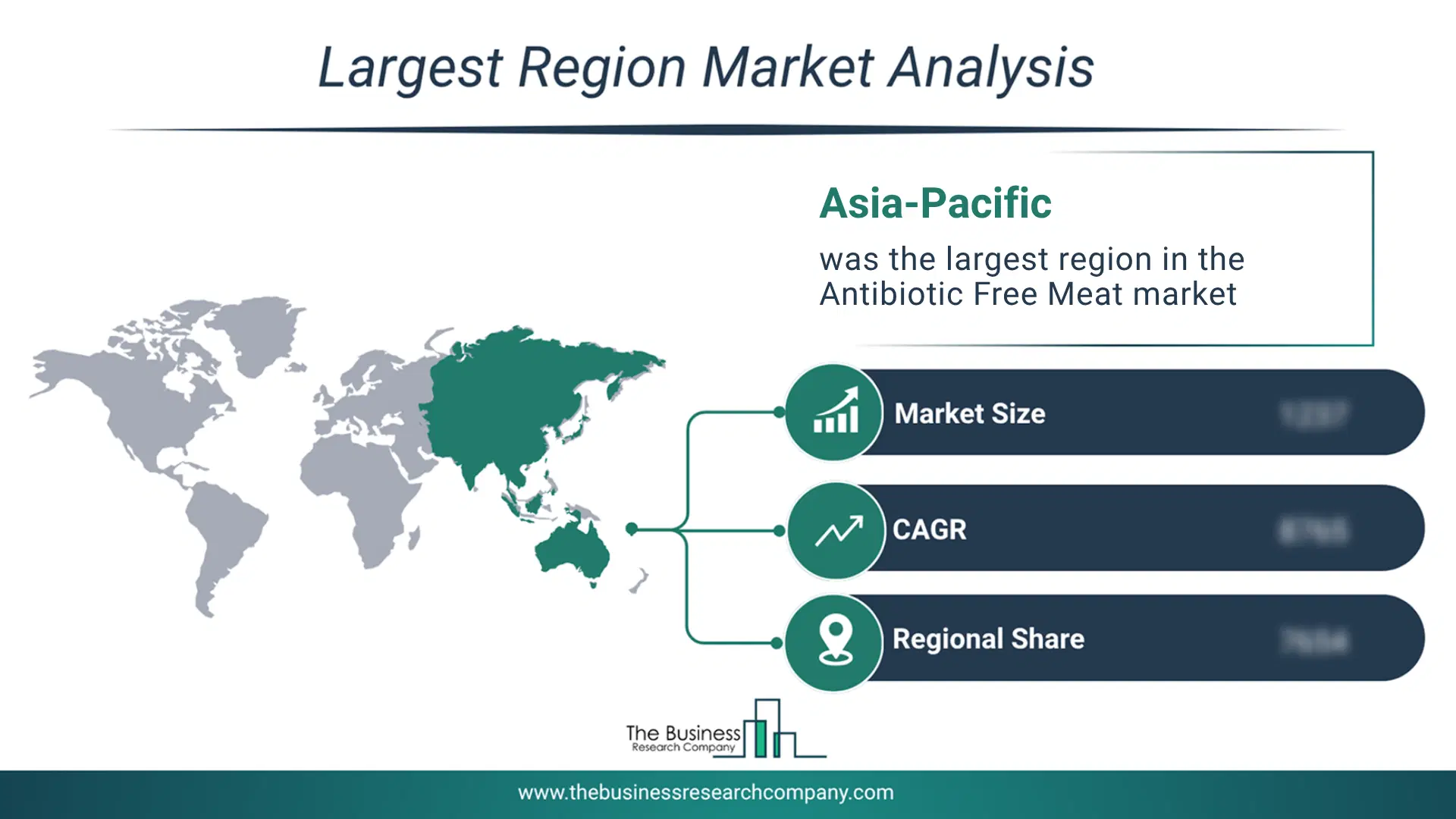
Asia-Pacific was the largest region in the antibiotic-free meat market share in 2025. The regions covered in this market report are Asia-Pacific, South East Asia, Western Europe, Eastern Europe, North America, South America, Middle East and Africa. The countries covered in this market report are Australia, Brazil, China, France, Germany, India, Indonesia, Japan, Taiwan, Russia, South Korea, UK, USA, Italy, Spain, CanadaWhat Defines the Antibiotic Free Meat Market?
The antibiotic-free meat market consists of sales of turkey antibiotic-free meat and frozen antibiotic-free meat. Values in this market are ‘factory gate’ values, that is the value of goods sold by the manufacturers or creators of the goods, whether to other entities (including downstream manufacturers, wholesalers, distributors, and retailers) or directly to end customers. The value of goods in this market includes related services sold by the creators of the goods.How is Market Value Defined and Measured?
The market value is defined as the revenues that enterprises gain from the sale of goods and/or services within the specified market and geography through sales, grants, or donations in terms of the currency (in USD unless otherwise specified). The revenues for a specified geography are consumption values that are revenues generated by organizations in the specified geography within the market, irrespective of where they are produced. It does not include revenues from resales along the supply chain, either further along the supply chain or as part of other products.
This chart presents market attractiveness based on a quantitative evaluation of growth, competition, strategic alignment, and risk, offering a clear view of opportunity areas for decision-making. This chart is for illustrative purposes; the full report contains the complete analysis.

This chart highlights the Total Addressable Market (TAM) by estimating the maximum revenue opportunity using an assumption-driven approach, supporting strategic planning and opportunity sizing across markets. The chart is illustrative; the full report provides a more comprehensive analysis.
What Key Data and Analysis Are Included in the Antibiotic Free Meat Market Report 2026?
The antibiotic free meat market research report is one of a series of new reports from The Business Research Company that provides market statistics, including industry global market size, regional shares, competitors with the market share, detailed market segments, market trends and opportunities, and any further data you may need to thrive in the antibiotic free meat industry. The market research report delivers a complete perspective of everything you need, with an in-depth analysis of the current and future state of the industry.Antibiotic Free Meat Market Report Forecast Analysis
| Report Attribute | Details |
|---|---|
| Market Size Value In 2026 | $199.47 billion |
| Revenue Forecast In 2030 | $285.86 billion |
| Growth Rate | CAGR of 9.4% from 2026 to 2030 |
| Base Year For Estimation | 2025 |
| Actual Estimates/Historical Data | 2020-2025 |
| Forecast Period | 2026 - 2030 |
| Market Representation | Revenue in USD Billion and CAGR from 2026 to 2030 |
| Segments Covered | Product, Form, Distribution Channel, End-Users |
| Regional Scope | Asia-Pacific, Western Europe, Eastern Europe, North America, South America, Middle East, Africa |
| Country Scope | The countries covered in the report are Australia, Brazil, China, France, Germany, India, Indonesia, Japan, Taiwan, Russia, South Korea, UK, USA, Canada, Italy, Spain. |
| Key Companies Profiled | Cargill Incorporated, Tyson Foods Inc., Hormel Foods Corporation, Perdue Farms Incorporated, Meyer Natural Angus LLC, Saffron Road Foods Inc., MamaMancini's Holdings Corporation, Ranch Foods Direct LLC, White Oak Pastures Inc., American Foods Group LLC, Koch Foods Inc., Smithfield Foods Inc., Wayne Farms Inc., Nema Halal Foods Inc., Sanderson Farms Inc., Pilgrim's Pride Corporation, Foster Farms LLC, Bell & Evans Inc., Mary's Free Range Chicken Inc., Plainville Farms, Coleman Natural Foods, Niman Ranch Inc., Springer Mountain Farms, Applegate Natural & Organic Meats Inc., Laura's Lean Beef, Gunthorp Farms, D'Artagnan LLC, Tendergrass Farms LLC, Pasturebird Inc., Joyce Farms Inc., Kadejan LLC |
| Customization Scope | Request for Customization |
| Pricing And Purchase Options | Explore Purchase Options |