
Augmented Reality Software Market Report 2026
Global Outlook – By Deployment (Cloud Based, On-Premise), By Software Function (3D Modelling, Workflow optimization, Visualization, Navigation, Remote collaboration, Documentation, Other Software Functions), By Vertical (Enterprise, Oil and gas, Mining, Telecom, Aerospace and defense, Medical, Other Verticals) – Market Size, Trends, Strategies, and Forecast to 2030
Augmented Reality Software Market Overview
• Augmented Reality Software market size has reached to $113.73 billion in 2025 • Expected to grow to $624.52 billion in 2030 at a compound annual growth rate (CAGR) of 40.6% • Growth Driver: Growth in E-commerce Is Driving The Market Growth Due To Increasing Online Shopping • Market Trend: Innovations In Augmented Reality (AR) Technology Drive App Development And Enhance Digital Interaction • Asia-Pacific was the largest region in 2025 and North America is the fastest growing region.What Is Covered Under Augmented Reality Software Market?
Augmented reality (AR) software is a tool that digitally augments the representation of the real physical environment using digital visual components, music, or other sensory stimulation given via technology. The main function types of augmented reality software are 3D modeling, workflow optimization, visualization, navigation, remote collaboration, documentation, and others. Workflow optimization is the process of improving an existing workflow by lowering operating costs, increasing work efficiency, adding new functions to an existing workflow, reducing the time required to complete the task at hand, and other factors to ensure the workflow runs as efficiently as possible. The software is deployed through cloud-based and on-premises modes that are used by various industry verticals such as oil and gas, mining, telecom, aerospace and defense, and medical, among others.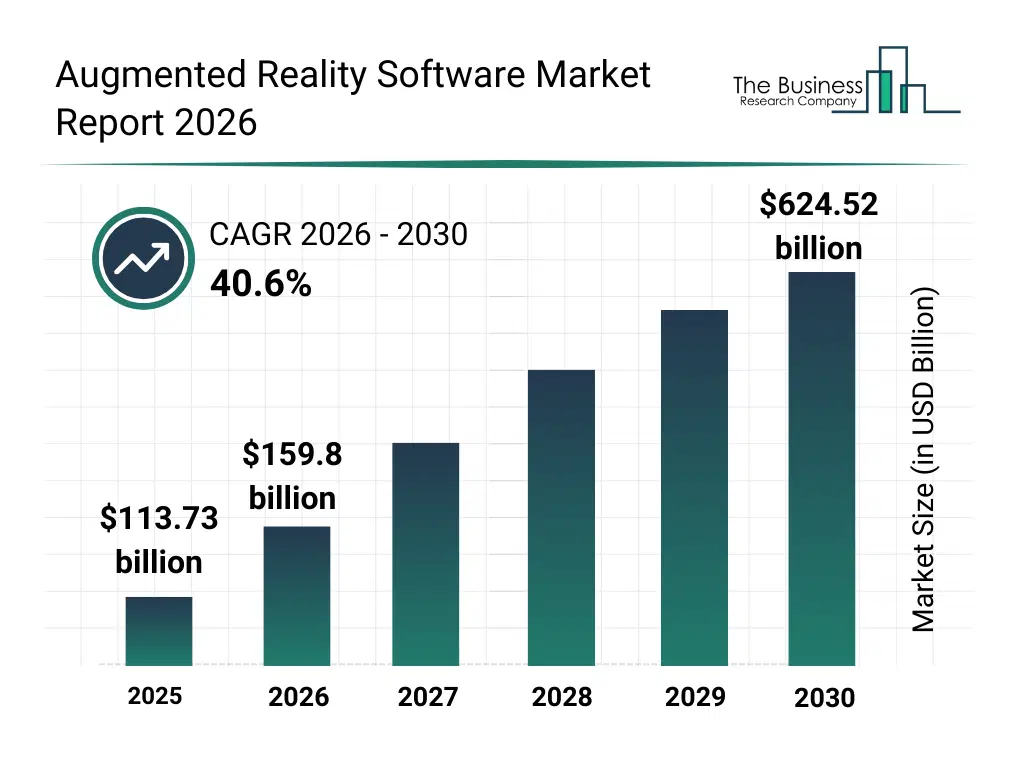
What Is The Augmented Reality Software Market Size and Share 2026?
The augmented reality software market size has grown exponentially in recent years. It will grow from $113.73 billion in 2025 to $159.8 billion in 2026 at a compound annual growth rate (CAGR) of 40.5%. The growth in the historic period can be attributed to growth in mobile computing power, early adoption in gaming and entertainment, advancements in 3D visualization tools, enterprise digitization initiatives, declining hardware costs.What Is The Augmented Reality Software Market Growth Forecast?
The augmented reality software market size is expected to see exponential growth in the next few years. It will grow to $624.52 billion in 2030 at a compound annual growth rate (CAGR) of 40.6%. The growth in the forecast period can be attributed to expansion of enterprise ar use cases, integration with AI driven vision systems, demand for remote collaboration tools, rise of industrial metaverse concepts, cloud based ar software adoption. Major trends in the forecast period include spatial computing software evolution, real time environment mapping, cross platform ar development tools, ar content management optimization, enterprise grade ar security controls.
Global Augmented Reality Software Market Segmentation
1) By Deployment: Cloud Based, On-Premise 2) By Software Function: 3D Modelling, Workflow optimization, Visualization, Navigation, Remote collaboration, Documentation, Other Software Functions 3) By Vertical: Enterprise, Oil and gas, Mining, Telecom, Aerospace and defense, Medical, Other Verticals Subsegments: 1) By Cloud Based: Cloud-Hosted Augmented Reality (AR) Software, Multi-Tenant Cloud AR Platforms, Subscription-Based Cloud AR Solutions, Scalable Cloud AR Deployment 2) By On-Premise: Enterprise-Hosted Augmented Reality (AR) Software, Private Server AR Solutions, Customizable On-Premise AR Platforms, Secure Local AR DeploymentWhat Is The Driver Of The Augmented Reality Software Market?
The growth in e-commerce is expected to propel the growth of the augmented reality software market going forward. E-commerce refers to the buying and selling of goods and services over the internet, where transactions are conducted through digital platforms and online channels. The rising growth of e-commerce is driven by increased smartphone adoption, as mobile devices enable convenient access to online shopping platforms anytime and anywhere, making digital purchasing more accessible to consumers. The expansion of online retail channels creates greater demand for augmented reality software that enables virtual product visualization and interactive shopping experiences. For instance, in February 2024, according to the U.S. Census Bureau, a U.S.-based government agency, in 2023, total e-commerce sales were estimated at $1,118.7 billion, representing a 7.6% increase compared to 2022. Therefore, growth in e-commerce is driving the growth of the augmented reality software industry.Key Players In The Global Augmented Reality Software Market
Major companies operating in the augmented reality software market are Wikitude GmbH, DAQRI LLC, Zugara Inc., PTC Inc., Catchoom Technologies S.L., Ubimax GmbH, Marxent Labs LLC, Inglobe Technologies Srl, Total Immersion, Atheer Inc., Pristine Inc., Infinity Augmented Reality Inc., JBKnowledge Inc., Magic Leap Inc., ViewAR GmbH, Microsoft Corporation, Unity Technologies Inc., Apple Inc., Blippar Ltd., Zappar Limited, Niantic Inc., Kudan Limited, Maxst Inc., Miralupa Inc., Augmate Corporation
This chart is for illustrative purposes; the full report includes a detailed competitor analysis and comprehensive overview of the top 10 companies in the market.
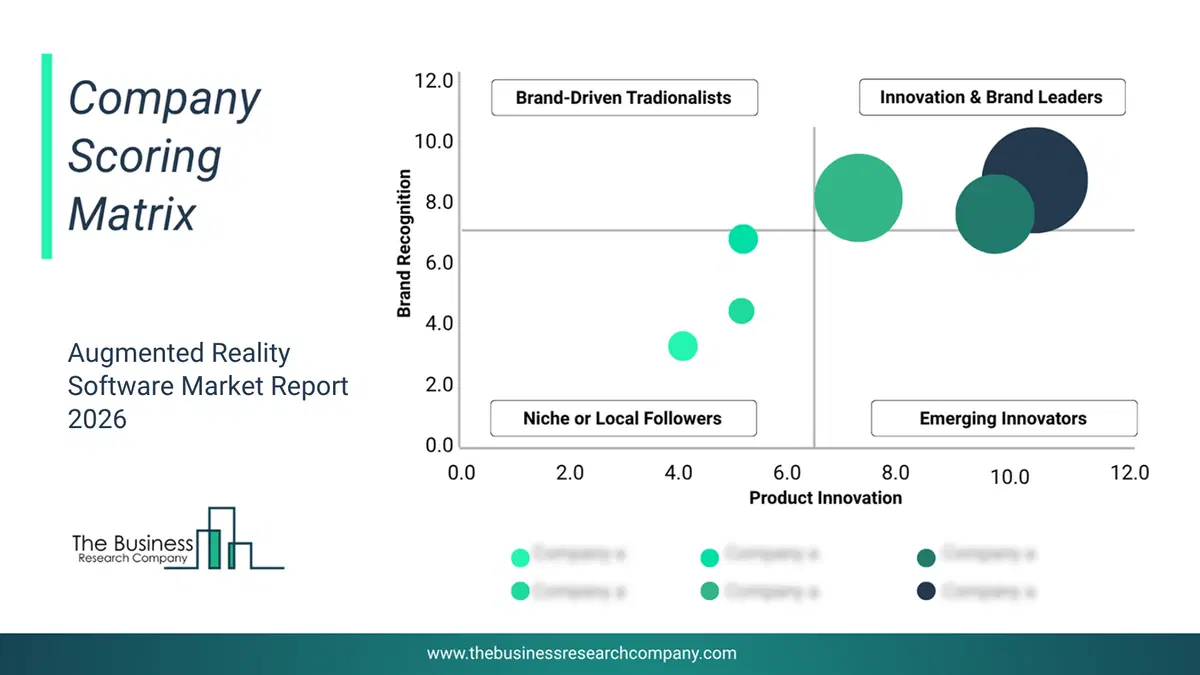
This chart maps companies by product innovation and brand strength, with bubble size indicating relative revenue, helping identify market leaders, challengers, and niche players. This is an illustrative chart; the full report provides a complete and accurate competitive analysis.
Global Augmented Reality Software Market Trends and Insights
Major companies operating in the augmented reality (AR) software market are focusing on developing advanced solutions, such as spatial computing and real-time environment blending, to enhance digital interaction, support remote workflows, and improve productivity across enterprise and consumer applications. Spatial computing refers to the capability of AR systems to understand and interact with the physical environment in real time, enabling more immersive and context-aware experiences. For instance, in June 2023, Apple Inc., a US-based technology company, unveiled the Apple Vision Pro AR headset, marking its first major hardware launch in nearly a decade. Designed to leverage high-resolution displays and advanced spatial computing capabilities, the device encourages new AR app development, expands enterprise and consumer use cases, and strengthens the AR software ecosystem.What Are Latest Mergers And Acquisitions In The Augmented Reality Software Market?
In November 2024, RealWear Inc., a US-based provider of wearable computing for industrial applications, acquired Almer Technologies for an undisclosed amount. Through this acquisition, RealWear aims to accelerate its industrial augmented reality (AR) capabilities by leveraging Almer’s ultra-compact and user-friendly AR headsets, with strategic and financial backing from TeamViewer, a leading provider of enterprise AR software. Almer Technologies is a Switzerland-based provider of a complete augmented reality (AR) software solution.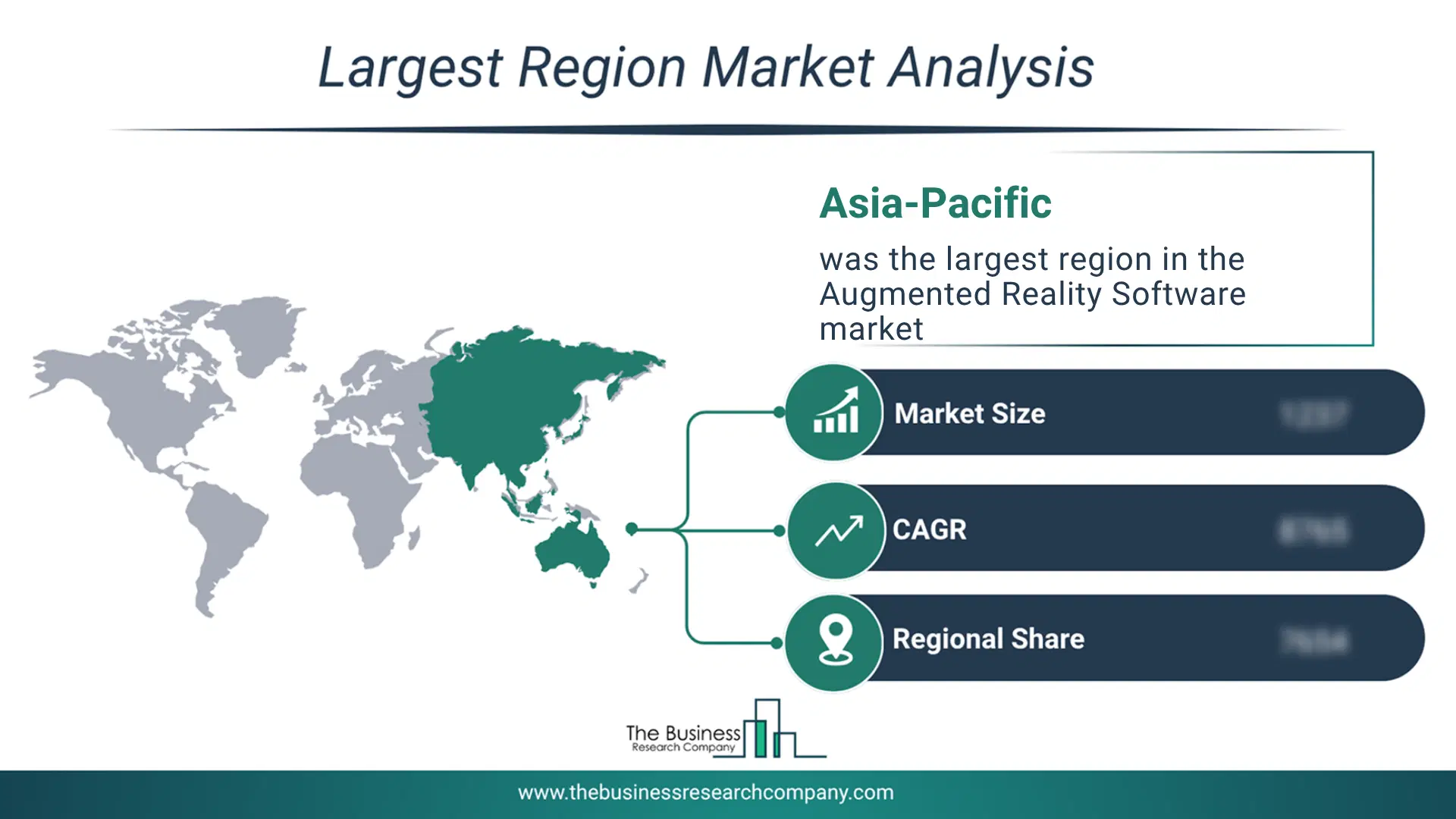
Regional Insights
Asia-Pacific was the largest region in the augmented reality software market in 2025. North America was the second largest region in the augmented reality software market. The regions covered in this market report are Asia-Pacific, South East Asia, Western Europe, Eastern Europe, North America, South America, Middle East, Africa. The countries covered in this market report are Australia, Brazil, China, France, Germany, India, Indonesia, Japan, Taiwan, Russia, South Korea, UK, USA, Canada, Italy, Spain.What Defines the Augmented Reality Software Market?
The augmented reality software market includes revenues earned by entities by offering software, that can be used to provide an innovative human-machine interaction that overlays virtual components in a real-world environment. Augmented reality has many potential applications in different fields, such as training activities, entertainment, and head-up displays in car windscreens. Values in the augmented reality software market are factory gate values, that is the value of goods sold by the manufacturers or creators of the goods, whether to other entities (including downstream manufacturers, wholesalers, distributors, and retailers) or directly to end customers. The value of goods in the augmented reality software market includes related services sold by the creators of the goods. Only goods and services traded between entities or sold to end consumers are included.How is Market Value Defined and Measured?
The market value is defined as the revenues that enterprises gain from the sale of goods and/or services within the specified market and geography through sales, grants, or donations in terms of the currency (in USD unless otherwise specified). The revenues for a specified geography are consumption values that are revenues generated by organizations in the specified geography within the market, irrespective of where they are produced. It does not include revenues from resales along the supply chain, either further along the supply chain or as part of other products.
This chart presents market attractiveness based on a quantitative evaluation of growth, competition, strategic alignment, and risk, offering a clear view of opportunity areas for decision-making. This chart is for illustrative purposes; the full report contains the complete analysis.

This chart highlights the Total Addressable Market (TAM) by estimating the maximum revenue opportunity using an assumption-driven approach, supporting strategic planning and opportunity sizing across markets. The chart is illustrative; the full report provides a more comprehensive analysis.
What Key Data and Analysis Are Included in the Augmented Reality Software Market Report 2026?
The augmented reality software market research report is one of a series of new reports from The Business Research Company that provides market statistics, including industry global market size, regional shares, competitors with the market share, detailed market segments, market trends and opportunities, and any further data you may need to thrive in the augmented reality software industry. The market research report delivers a complete perspective of everything you need, with an in-depth analysis of the current and future state of the industry.Augmented Reality Software Market Report Forecast Analysis
| Report Attribute | Details |
|---|---|
| Market Size Value In 2026 | $159.8 billion |
| Revenue Forecast In 2030 | $624.52 billion |
| Growth Rate | CAGR of 40.6% from 2026 to 2030 |
| Base Year For Estimation | 2025 |
| Actual Estimates/Historical Data | 2020-2025 |
| Forecast Period | 2026 - 2030 |
| Market Representation | Revenue in USD Billion and CAGR from 2026 to 2030 |
| Segments Covered | Deployment, Software Function, Vertical |
| Regional Scope | Asia-Pacific, Western Europe, Eastern Europe, North America, South America, Middle East, Africa |
| Country Scope | The Countries Covered In This Market Report Are Australia, Brazil, China, France, Germany, India, Indonesia, Japan, Taiwan, Russia, South Korea, Uk, Usa, Canada, Italy, Spain. |
| Key Companies Profiled | Wikitude GmbH, DAQRI LLC, Zugara Inc., PTC Inc., Catchoom Technologies S.L., Ubimax GmbH, Marxent Labs LLC, Inglobe Technologies Srl, Total Immersion, Atheer Inc., Pristine Inc., Infinity Augmented Reality Inc., JBKnowledge Inc., Magic Leap Inc., ViewAR GmbH, Microsoft Corporation, Unity Technologies Inc., Apple Inc., Blippar Ltd., Zappar Limited, Niantic Inc., Kudan Limited, Maxst Inc., Miralupa Inc., Augmate Corporation |
| Customization Scope | Request for Customization |
| Pricing And Purchase Options | Explore Purchase Options |