
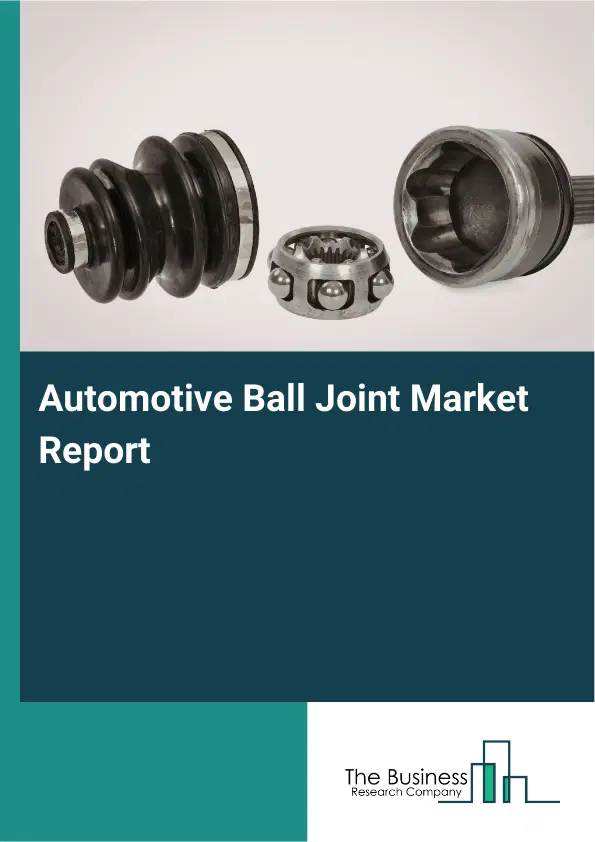
Automotive Ball Joint Market Report 2026
Global Outlook – By Type (Lower Ball Joints, Upper Ball Joints, Female Ball Joints, Male Ball Joints), By Material (Steel, Aluminum, Plastic, Composite), By Chain Configuration (Single Strand Chains, Double Strand Chains, Multi-strand Chains), By Sales Channel (Original Equipment Manufacturers(OEM), Aftermarket, Wholesale) – Market Size, Trends, Strategies, and Forecast to 2030
Automotive Ball Joint Market Overview
• Automotive Ball Joint market size has reached to $3.86 billion in 2025 • Expected to grow to $5.18 billion in 2030 at a compound annual growth rate (CAGR) of 6% • Growth Driver: Surge In Production Of Passenger And Commercial Vehicles Driving Growth Due To Rising Global Vehicle Demand • Market Trend: Technological Innovations In Patented Synthetic Grease Enhancing Ball Joint Performance and Longevity • North America was the largest region in 2025 and Asia-Pacific is the fastest growing region.What Is Covered Under Automotive Ball Joint Market?
An automotive ball joint refers to a crucial component in a vehicle’s suspension system that connects the control arm to the steering knuckle, allowing smooth movement and pivoting of the wheels. It functions as a flexible pivot, enabling the suspension to move vertically while the wheels steer horizontally. Ball joints help maintain proper wheel alignment, absorb road shocks, and ensure stable handling and steering control. They are typically made of hardened steel and enclosed in a protective casing to resist wear and corrosion. Proper functioning of ball joints is essential for vehicle safety and performance. The main types of automotive ball joint are lower ball joints, upper ball joints, female ball joints, male ball joints. Lower ball joints are positioned at the bottom of the steering knuckle where they attach to the control arm, allowing wheels to freely move up and down while preserving correct alignment and absorbing shocks from the road. These are made of various material types such as steel, aluminum, plastic, composite and also in different chain configuration such as single strand chains, double strand chains, multi-strand chains. These are sold through various sales channels such as original equipment manufacturers (OEM), aftermarket, wholesale.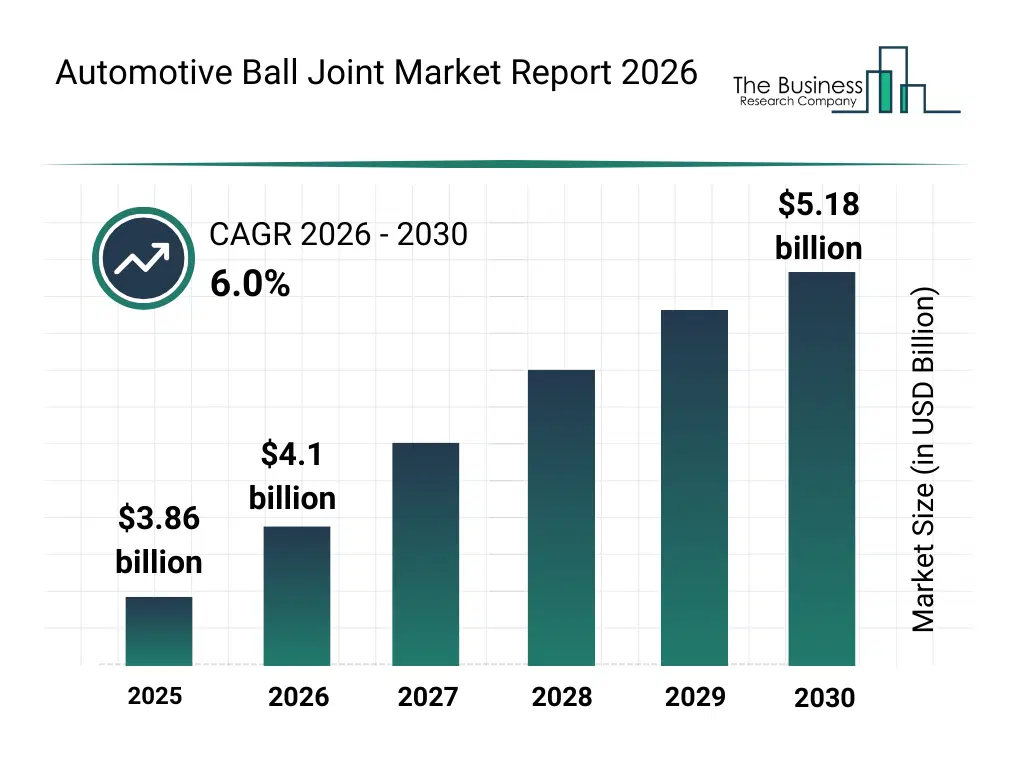
What Is The Automotive Ball Joint Market Size and Share 2026?
The automotive ball joint market size has grown strongly in recent years. It will grow from $3.86 billion in 2025 to $4.1 billion in 2026 at a compound annual growth rate (CAGR) of 6.3%. The growth in the historic period can be attributed to vehicle parc expansion, suspension system standardization, steel component dominance, road infrastructure conditions, automotive production growth.What Is The Automotive Ball Joint Market Growth Forecast?
The automotive ball joint market size is expected to see strong growth in the next few years. It will grow to $5.18 billion in 2030 at a compound annual growth rate (CAGR) of 6.0%. The growth in the forecast period can be attributed to electric vehicle adoption, lightweight material innovation, demand for low-maintenance parts, aftermarket growth, suspension performance optimization. Major trends in the forecast period include use of lightweight ball joint materials, increased demand for durable suspension components, growth of aftermarket replacement demand, focus on extended component life, adoption in electric vehicles.
Global Automotive Ball Joint Market Segmentation
1) By Type: Lower Ball Joints, Upper Ball Joints, Female Ball Joints, Male Ball Joints 2) By Material: Steel, Aluminum, Plastic, Composite 3) By Chain Configuration: Single Strand Chains, Double Strand Chains, Multi-strand Chains 4) By Sales Channel: Original Equipment Manufacturers(OEM), Aftermarket, Wholesale Subsegments: 1) By Lower Ball Joints: Press Fit, Threaded, Welded 2) By Upper Ball Joints: Adjustable Upper Ball Joints, Non-Adjustable Upper Ball Joints, Greasable Upper Ball Joints 3) By Female Ball Joints: Threaded Female Ball Joints, Flanged Female Ball Joints, Weld-On Female Ball Joints 4) By Male Ball Joints: Threaded Male Ball Joints, Stud-Type Male Ball Joints, Weld-On Male Ball JointsWhat Is The Driver Of The Automotive Ball Joint Market?
The increasing production of passenger and commercial vehicles is expected to propel the growth of the automotive ball joint market going forward. Passenger and commercial vehicles refer to types of automobiles designed for different purposes: passenger vehicles are primarily meant for transporting people, while commercial vehicles are intended for transporting goods or performing specialized services. Increasing production of passenger and commercial vehicles is rising primarily due to manufacturers scaling up operations to meet sustained market demand and strengthen supply chain resilience. An automotive ball joint helps passenger and commercial vehicles by providing a pivotal connection between the suspension and wheels, enabling smooth steering, stable handling, and enhanced safety in various road conditions. For instance, in September 2024, according to a report published by the European Automobile Manufacturers’ Association (ACEA), a Belgium-based industry association, 12.2 million passenger cars were produced in the EU in 2023, marking an 11.6% increase compared to 2022. Therefore, an increasing production of passenger and commercial vehicles is expected to drive the growth of the automotive ball joint industry.Key Players In The Global Automotive Ball Joint Market
Major companies operating in the automotive ball joint market report include General Motors LLC, THK Co., Ltd., Hyundai Mobis Co. Ltd., Rane Holdings Limited, ISC Industries Inc., NSK Ltd., Somic Ishikawa Inc., Schaeffler AG, Delphi Technologies PLC, Ferdinand Bilstein GmbH + Co. KG, Specialty Products Company, BENTELER International AG, Dorman Products Inc., Carli Suspension Inc., Dynatrac Products Inc., Mevotech LP, Howe Racing Enterprises Inc., Alinabal Holdings Corporation, GMB, Moog Inc.
This chart is for illustrative purposes; the full report includes a detailed competitor analysis and comprehensive overview of the top 10 companies in the market.
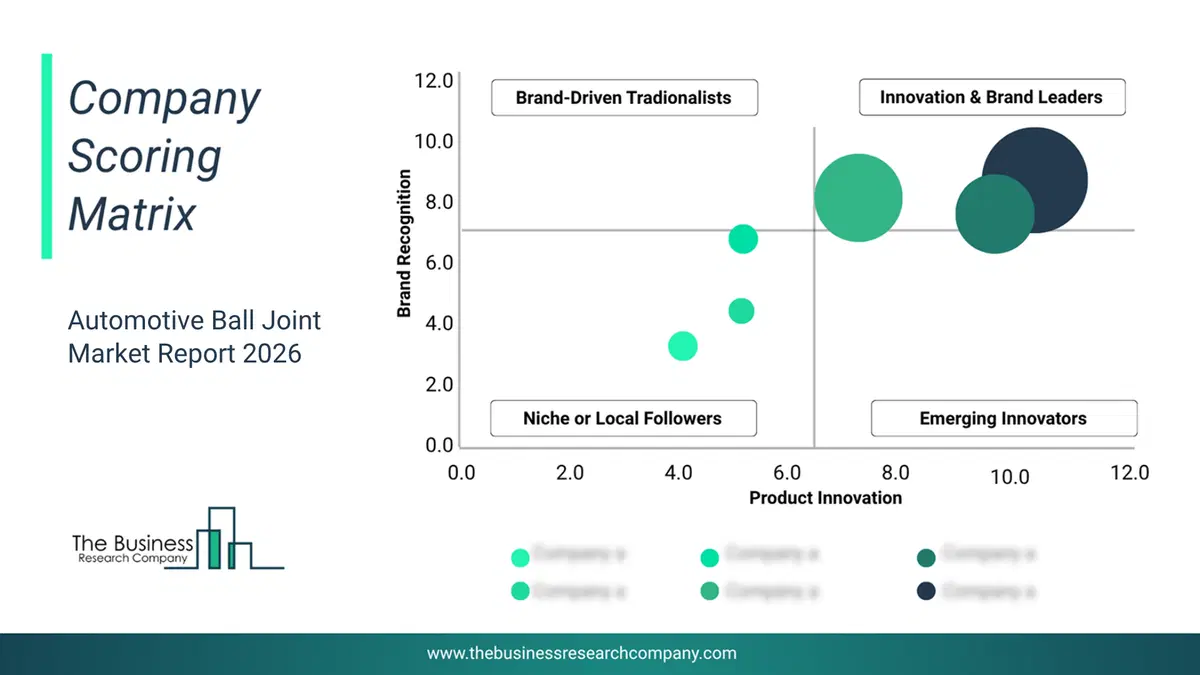
This chart maps companies by product innovation and brand strength, with bubble size indicating relative revenue, helping identify market leaders, challengers, and niche players. This is an illustrative chart; the full report provides a complete and accurate competitive analysis.
Global Automotive Ball Joint Market Trends and Insights
Major companies operating in the automotive ball joint market are focusing on technological development, such as patented synthetic grease, to enhance durability, reduce friction, improve load-bearing capacity, and extend the overall lifespan of ball joints in passenger and commercial vehicles. Patented synthetic grease refers to a specially formulated lubricant designed to reduce friction and wear in mechanical components while offering enhanced performance, longer durability, and better resistance to extreme temperatures compared to conventional greases. For instance, in November 2024, AB SKF, a Sweden-based manufacturing company, introduced a premium steering and suspension line for the U.S. and Canadian markets encompassing ball joint kits, control arms, stabilizer links, and suspension repair kits. These are engineered to OE quality standards to enhance vehicle handling, comfort, and safety with patented synthetic grease reducing friction by up to 35% and packaging featuring QR codes linking to installation guides for efficient repairs.What Are Latest Mergers And Acquisitions In The Automotive Ball Joint Market?
In July 2024, TorQuest Partners Inc., a Canada-based private equity firm, acquired Mevotech L.P. for an undisclosed amount. Through this acquisition, TorQuest Partners Inc. aims to expand its portfolio in the automotive aftermarket sector by integrating Mevotech L.P.'s high-quality steering, suspension, and drivetrain components, thereby enhancing its market presence, strengthening product offerings, and driving long-term growth and operational synergies. Mevotech L.P. is a Canada-based private company that manufactures automotive ball joints.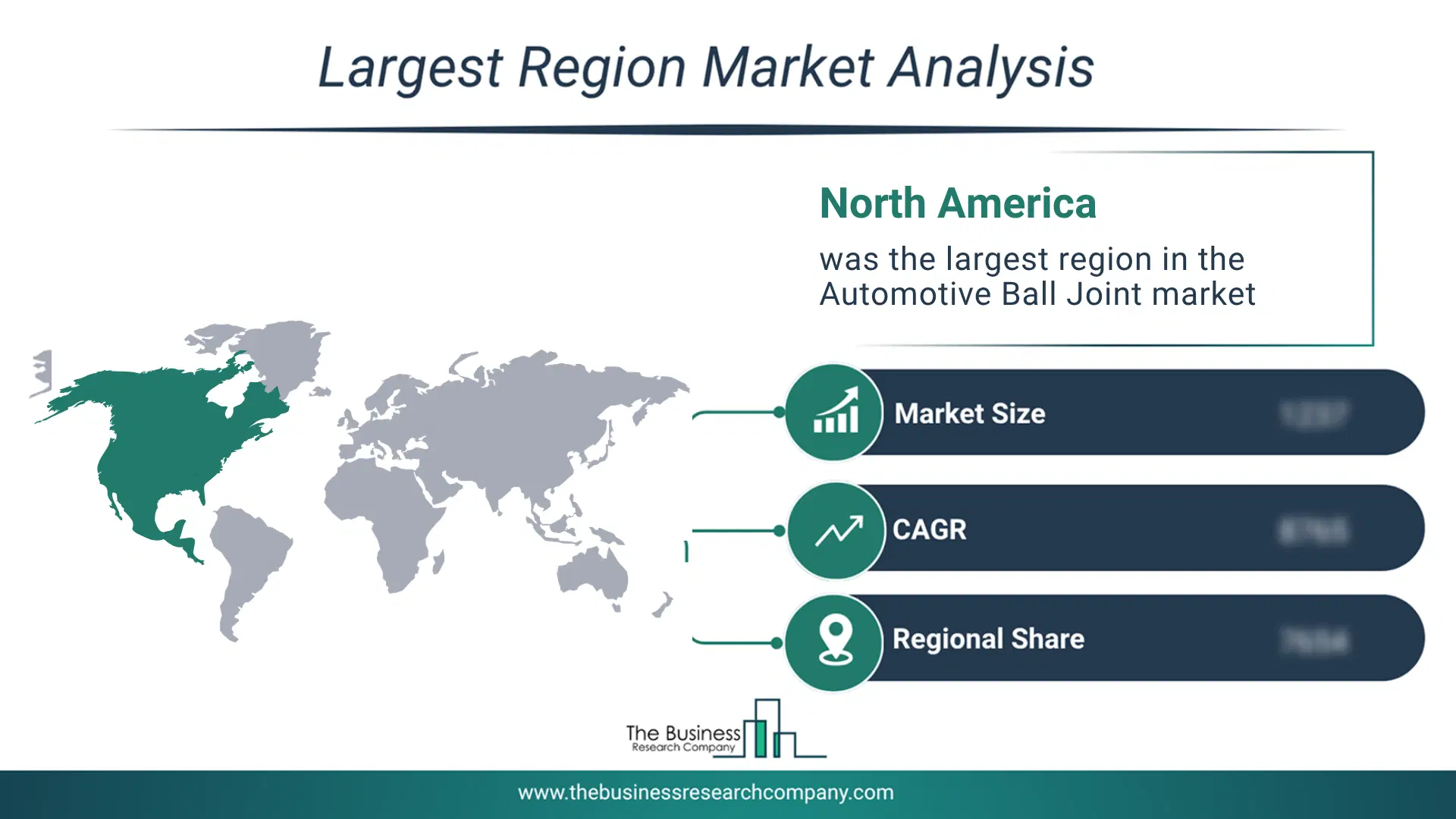
Regional Outlook
North America was the largest region in the automotive ball joint market in 2025. Asia-Pacific is expected to be the fastest-growing region in the forecast period. The regions covered in this market report include Asia-Pacific, South East Asia, Western Europe, Eastern Europe, North America, South America, Middle East, Africa. The countries covered in this market report include Australia, Brazil, China, France, Germany, India, Indonesia, Japan, Taiwan, Russia, South Korea, UK, USA, Canada, Italy, SpainWhat Defines the Automotive Ball Joint Market?
The automotive ball joint market consists of sales of products including dust covers, ball studs, steering knuckles, control arms, and bearings. Values in this market are ‘factory gate’ values, that is, the value of goods sold by the manufacturers or creators of the goods, whether to other entities (including downstream manufacturers, wholesalers, distributors, and retailers) or directly to end customers. The value of goods in this market includes related services sold by the creators of the goods.How is Market Value Defined and Measured?
The market value is defined as the revenues that enterprises gain from the sale of goods and/or services within the specified market and geography through sales, grants, or donations in terms of the currency (in USD unless otherwise specified). The revenues for a specified geography are consumption values that are revenues generated by organizations in the specified geography within the market, irrespective of where they are produced. It does not include revenues from resales along the supply chain, either further along the supply chain or as part of other products.
This chart presents market attractiveness based on a quantitative evaluation of growth, competition, strategic alignment, and risk, offering a clear view of opportunity areas for decision-making. This chart is for illustrative purposes; the full report contains the complete analysis.

This chart highlights the Total Addressable Market (TAM) by estimating the maximum revenue opportunity using an assumption-driven approach, supporting strategic planning and opportunity sizing across markets. The chart is illustrative; the full report provides a more comprehensive analysis.
What Key Data and Analysis Are Included in the Automotive Ball Joint Market Report 2026?
The automotive ball joint market research report is one of a series of new reports from The Business Research Company that provides market statistics, including industry global market size, regional shares, competitors with the market share, detailed market segments, market trends and opportunities, and any further data you may need to thrive in the automotive ball joint industry. The market research report delivers a complete perspective of everything you need, with an in-depth analysis of the current and future state of the industry.Automotive Ball Joint Market Report Forecast Analysis
| Report Attribute | Details |
|---|---|
| Market Size Value In 2026 | $4.1 billion |
| Revenue Forecast In 2030 | $5.18 billion |
| Growth Rate | CAGR of 6.3% from 2026 to 2030 |
| Base Year For Estimation | 2025 |
| Actual Estimates/Historical Data | 2020-2025 |
| Forecast Period | 2026 - 2030 - 2030 |
| Market Representation | Revenue in USD Billion and CAGR from 2026 to 2030 |
| Segments Covered | Type, Material, Chain Configuration, Sales Channel |
| Regional Scope | Asia-Pacific, Western Europe, Eastern Europe, North America, South America, Middle East, Africa |
| Country Scope | The countries covered in the report are Australia, Brazil, China, France, Germany, India, Indonesia, Japan, Taiwan, Russia, South Korea, UK, USA, Canada, Italy, Spain. |
| Key Companies Profiled | General Motors LLC, THK Co., Ltd., Hyundai Mobis Co. Ltd., Rane Holdings Limited, ISC Industries Inc., NSK Ltd., Somic Ishikawa Inc., Schaeffler AG, Delphi Technologies PLC, Ferdinand Bilstein GmbH + Co. KG, Specialty Products Company, BENTELER International AG, Dorman Products Inc., Carli Suspension Inc., Dynatrac Products Inc., Mevotech LP, Howe Racing Enterprises Inc., Alinabal Holdings Corporation, GMB, Moog Inc. |
| Customization Scope | Request for Customization |
| Pricing And Purchase Options | Explore Purchase Options |