
Aviation and Defense Cyber Security Market Report 2026
Global Outlook – By Component (Solution, Service), By Deployment (On-Cloud, On-Premise) – Market Size, Trends, Strategies, and Forecast to 2030
Aviation and Defense Cyber Security Market Overview
• Aviation and Defense Cyber Security market size has reached to $92.62 billion in 2025 • Expected to grow to $162.3 billion in 2030 at a compound annual growth rate (CAGR) of 12% • Growth Driver: Rising Cyber-Attacks Fueling The Growth Of The Market Due To Increasing Need For Protection Of Critical Systems And Data • Market Trend: Real-Time AI Monitoring Boosts Safety In Aviation And Defense Systems • North America was the largest region in 2025 and Asia-Pacific is the fastest growing region.Market Gains By 2030 – Top Opportunities By Segment
Market Gain identifies the most promising market opportunities by highlighting the segments or products expected to generate the highest incremental revenue growth over the next five years.
What Is Covered Under Aviation and Defense Cyber Security Market?
Aviation and defense cyber security refer to highly reliant and progressively interconnected cybersecurity that encompasses the protection of information in the form of digital data and information associated with networks, websites, services, computers, and portals that transport and enable security. The aviation and defense cyber security is used to prevent or mitigate the effects of a cyberattack. Aviation relies heavily on cyber-enabled technologies to improve the safety and efficiency of air travel. The main types of components in aviation and defense cyber security are solutions and services. The solution refers to tools and services that help to protect administrations against cyberattacks, which may result in application downtime, theft of sensitive data, and other hostile consequences. It is deployed in on-cloud and on-premises models.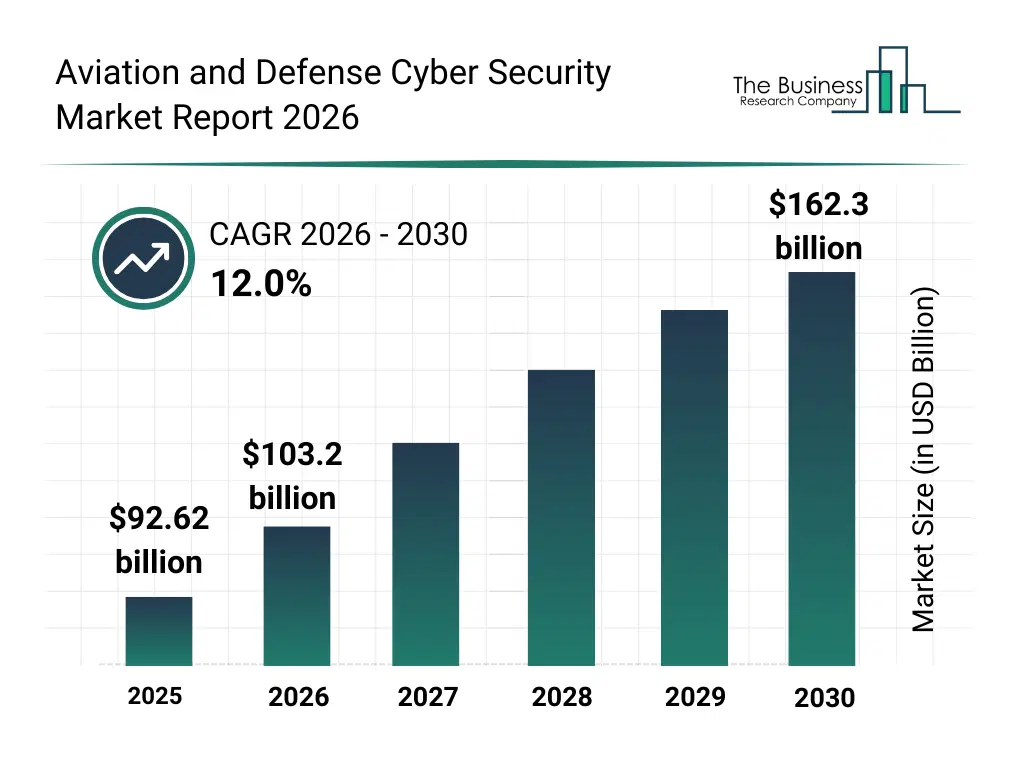
What Is The Aviation and Defense Cyber Security Market Size and Share 2026?
The aviation and defense cyber security market size has grown rapidly in recent years. It will grow from $92.62 billion in 2025 to $103.2 billion in 2026 at a compound annual growth rate (CAGR) of 11.4%. The growth in the historic period can be attributed to increasing cyberattacks targeting aviation networks and defense systems driving early adoption of security tools, rising digitalization of aviation operations requiring stronger logistics and network protection, regulatory enforcement of cybersecurity standards across airlines and defense agencies, growth in interconnected aircraft and airport systems creating vulnerabilities that required mitigation, expanding use of cloud-based platforms in defense logistics accelerating demand for secure network architectures.What Is The Aviation and Defense Cyber Security Market Growth Forecast?
The aviation and defense cyber security market size is expected to see rapid growth in the next few years. It will grow to $162.3 billion in 2030 at a compound annual growth rate (CAGR) of 12.0%. The growth in the forecast period can be attributed to rapid expansion of connected aircraft and next-generation digital avionics increasing cybersecurity needs, growing investment in advanced threat detection and response solutions across defense networks, stricter global cybersecurity compliance frameworks for airlines and defense forces, increasing reliance on ai-driven monitoring and analytics to protect logistics and network infrastructure, rising adoption of zero-trust architectures and encryption solutions in aviation and defense environments. Major trends in the forecast period include growing integration of advanced threat intelligence tools across aviation networks, increasing adoption of multilayered cybersecurity solutions to safeguard mission-critical defense systems, rising implementation of endpoint security for aircraft communication and navigation systems, expansion of cloud-based security platforms for real-time monitoring and anomaly detection, strengthening focus on incident response capabilities to mitigate cyberattacks on aviation and defense operations.
Global Aviation and Defense Cyber Security Market Segmentation
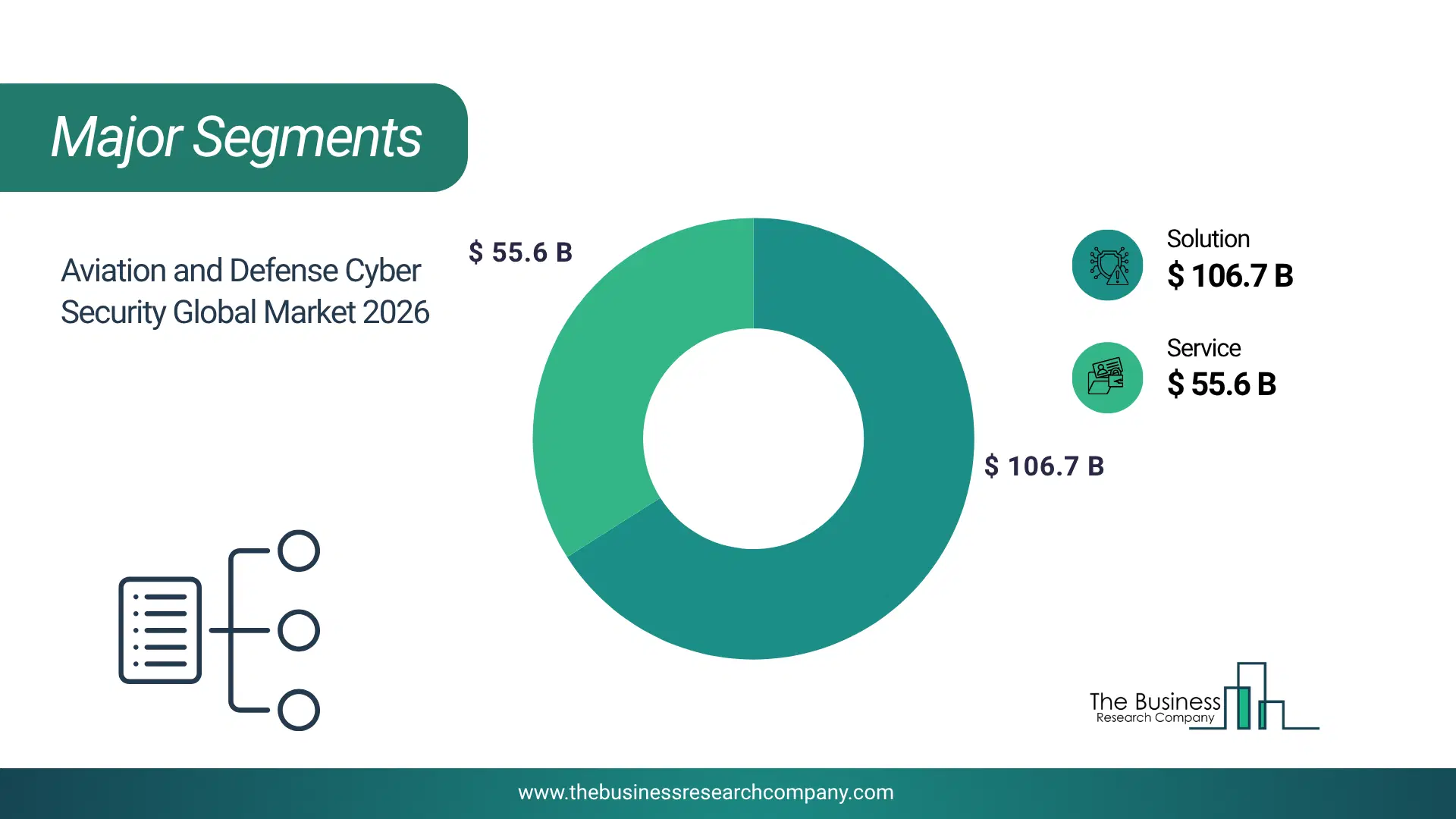
1) By Component: Solution, Service 2) By Deployment: On-Cloud, On-Premise Subsegments: 1) By Solution: Network Security Solutions, Endpoint Security Solutions, Application Security Solutions, Cloud Security Solutions, Data Loss Prevention (DLP) Solutions, Threat Intelligence Solutions 2) By Service: Managed Security Services, Consulting Services, Incident Response Services, Security Training and Awareness Services, Compliance and Risk Management Services The top segments in the aviation and defense cyber security market will be: • Solution will reach $106.71 billion by 2030. • Service will reach $55.59 billion by 2030.What Is Driver Of The Aviation and Defense Cyber Security Market?
The rising cyber-attacks are expected to propel the growth of the aviation and defense cybersecurity market going forward. Cyber-attacks refer to deliberate attempts by individuals, groups, or organizations to breach, disrupt, or damage computer systems, networks, or digital devices. Cyber-attacks are increasing due to the rapid digitization of businesses and government operations, which expands the number of vulnerable targets for malicious actors. Aviation and defense cybersecurity helps mitigate cyber-attacks by protecting critical systems, networks, and data from unauthorized access, ensuring the safety, integrity, and operational continuity of military and aviation operations. For instance, in October 2025, according to the National Cyber Security Centre (NCSC), a UK-based government agency, the UK experienced 204 nationally significant cyberattacks in the 12 months leading up to August 2025, more than double the 89 incidents recorded in the previous year. Therefore, the rising cyber-attacks are driving the growth of the aviation and defense cybersecurity market.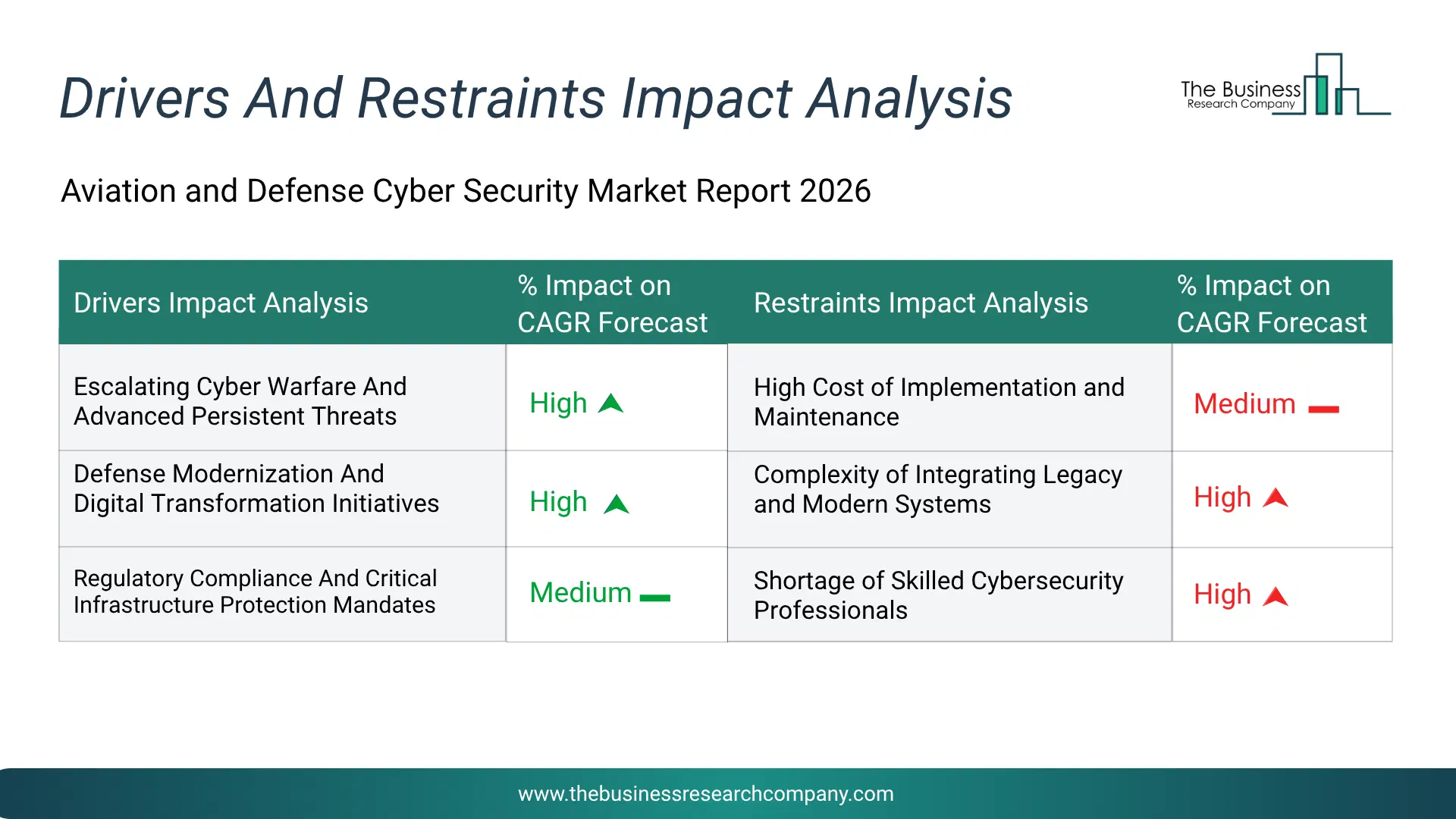
Infographic Chart Showing Key Market Drivers Analysis And Restraints For Aviation And Defense Cyber Security Market
The chart presents an impact analysis of key drivers and restraints, quantifying their relative influence on the market's growth rate and helping assess the balance between growth enablers and limiting factors. This chart offers a high-level perspective; the full report contains more detailed insights.
How Will The Drivers Impact Growth In The Global Aviation and Defense Cyber Security Market?
• Escalating Cyber Warfare And Advanced Persistent Threats (High) – During the forecast period, the escalating cyber warfare and advanced persistent threats is expected to become a key growth driver for the aviation and defense cyber security market by 2030. The increasing frequency and sophistication of state -sponsored cyberattacks targeting military networks, satellite systems, and aviation infrastructure is a primary growth driver. Advanced persistent threats (apts), ransomware campaigns, and electronic warfare integration are compelling defense agencies to strengthen cyber resilience frameworks. The need to secure mission -critical systems, classified data, and interconnected combat platforms is accelerating investments in ai -driven threat intelligence, real -time monitoring, and zero -trust security architectures across aviation and defense ecosystems. • Defense Modernization And Digital Transformation Initiatives (High) – During the forecast period, the defense modernization and digital transformation initiatives is expected to emerge as a major factor driving the expansion of the aviation and defense cyber security market by 2030. Ongoing modernization programs across air forces and defense organizations are driving large-scale upgrades of legacy it and operational technology (ot) systems. The integration of connected aircraft, unmanned aerial systems (uas), cloud-based command centers, and network-centric warfare platforms is expanding the cyber-attack surface. As digital transformation accelerates, cybersecurity solutions are being embedded into next-generation avionics, secure communications, and battlefield management systems to ensure operational continuity and national security compliance. • Regulatory Compliance And Critical Infrastructure Protection Mandates (Medium) – During the forecast period, the regulatory compliance and critical infrastructure protection mandates is expected to act as a key growth catalyst for the aviation and defense cyber security market by 2030. Stringent cybersecurity regulations and defense compliance frameworks are significantly influencing procurement strategies. Government mandates related to classified data protection, supply chain risk management, and secure defense contracting standards are compelling vendors and contractors to adopt certified cybersecurity solutions. Additionally, aviation safety authorities are enforcing stricter cyber risk management requirements to protect air traffic control systems, airport operations, and aerospace manufacturing networks, further driving sustained market demand.How Will The Restraints Impact Growth In The Global Aviation and Defense Cyber Security Market?
• High Cost of Implementation and Maintenance (Medium) – During the forecast period, the deploying comprehensive cybersecurity solutions for aviation and defense requires substantial investment in hardware, software, specialized personnel, and ongoing system updates. Smaller defense contractors and regional aviation operators may face budgetary constraints, limiting adoption of advanced solutions. Additionally, continuous monitoring, compliance management, and threat intelligence integration increase operational expenses. These high implementation and maintenance costs act as a significant restraint, particularly in cost-sensitive programs. • Complexity of Integrating Legacy and Modern Systems (High) – During the forecast period, the defense and aviation organizations often operate a mix of legacy systems and modern digital platforms. Integrating cybersecurity solutions across heterogeneous it and ot networks is challenging and requires specialized expertise. Interoperability issues, risk of system downtime, and compatibility challenges can slow implementation. These technical complexities act as a restraint, particularly for organizations upgrading older aircraft or military infrastructure with new cybersecurity technologies. • Shortage of Skilled Cybersecurity Professionals (High) – During the forecast period, the shortage of skilled cybersecurity professionals acts as a restraint for the aviation and defense cyber security market by limiting the ability of organizations to effectively deploy, manage, and monitor advanced security systems. The rapidly evolving nature of cyber threats requires highly trained experts in threat intelligence, incident response, and secure network architecture, which are in short supply globally. This talent gap increases reliance on external consultants and raises operational costs. It also leads to delayed threat detection and slower response times, increasing vulnerability to cyberattacks.Key Players In The Global Aviation and Defense Cyber Security Market
Major companies operating in the aviation and defense cyber security market are International Business Machines Corporation, Honeywell International Inc., Cisco Systems Inc., Thales Group, Société Internationale de Télécommunications Aéronautiques (SITA), Raytheon Technologies Corporation, BAE Systems plc, Lockheed Martin Corporation, L3Harris Technologies Inc., Northrop Grumman Corporation, The Boeing Company, General Dynamics Corporation, Leonardo S.p.A., Airbus SE, Science Applications International Corporation Inc., CACI International Inc., Booz Allen Hamilton Holding Corporation, Leidos Holdings Inc., Kratos Defense & Security Solutions Inc., Palo Alto Networks Inc., Check Point Software Technologies Ltd., Mandiant Corporation, Fortinet Inc., Intel Corporation, NortonLifeLock Inc., CrowdStrike Holdings Inc., Trend Micro Incorporated, Kaspersky Lab ZAO, F-Secure Corporation, Secureworks Corporation, Darktrace plc, Nozomi Networks Inc., Armis Security Inc., Resilient Systems Inc.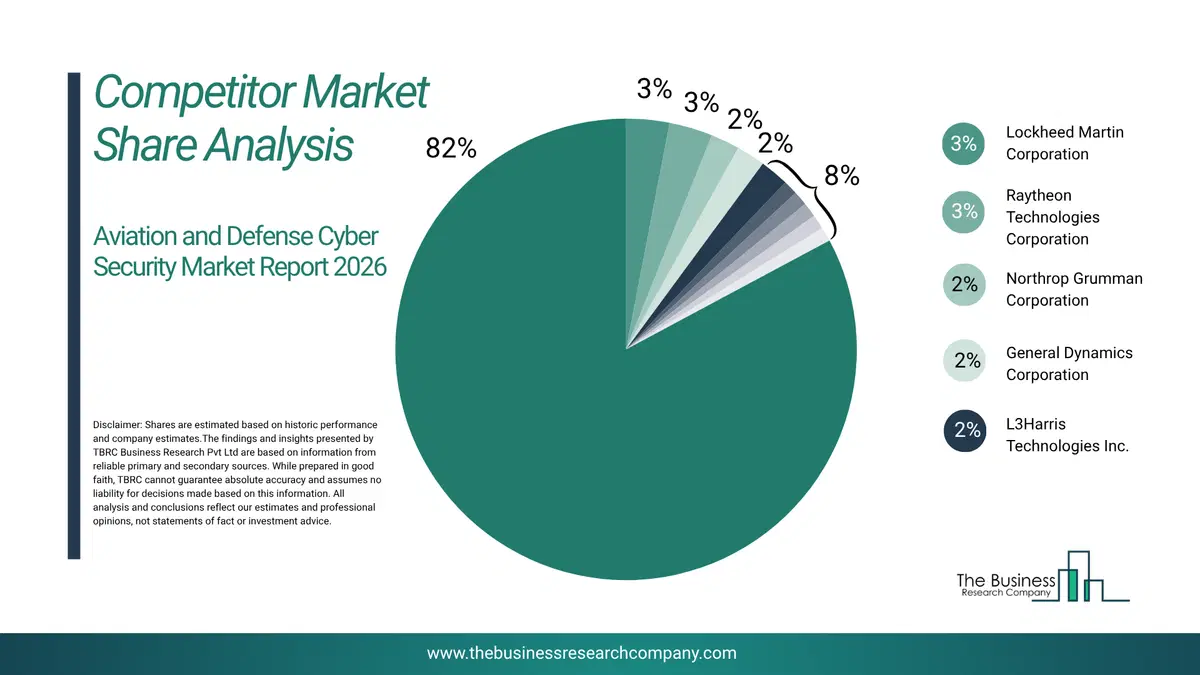
This chart is for illustrative purposes; the full report includes a detailed competitor analysis and comprehensive overview of the top 10 companies in the market.
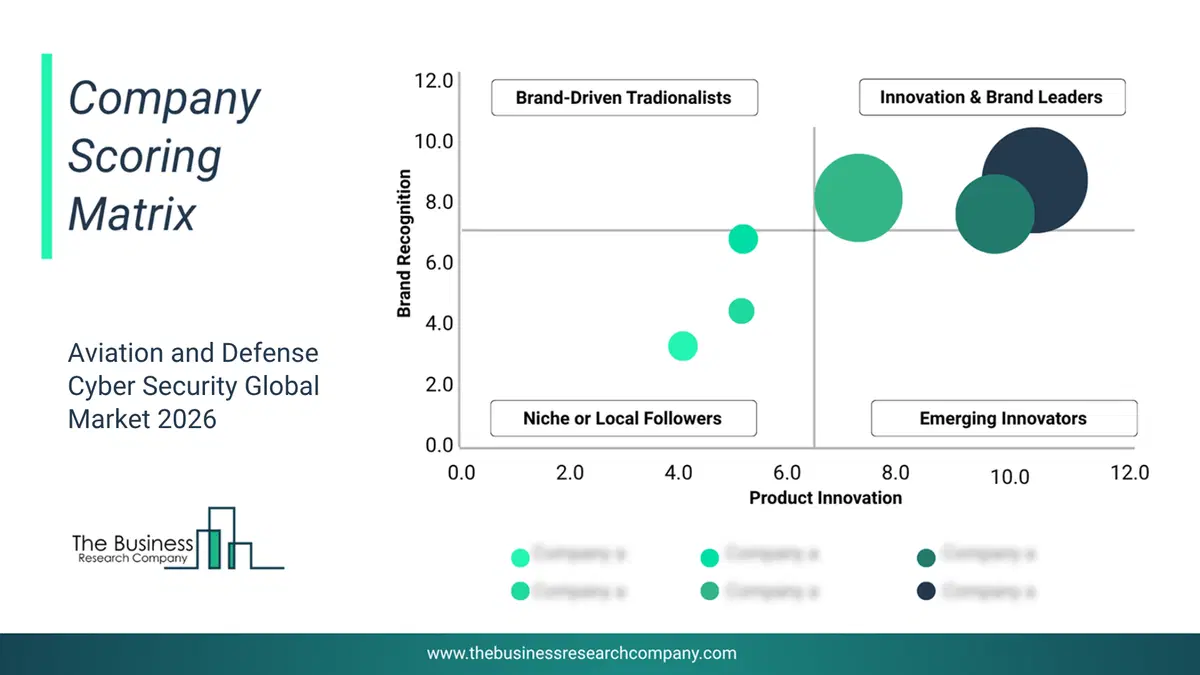
This chart maps companies by product innovation and brand strength, with bubble size indicating relative revenue, helping identify market leaders, challengers, and niche players. This is an illustrative chart; the full report provides a complete and accurate competitive analysis.
Global Aviation and Defense Cyber Security Market Trends and Insights
Major companies operating in the aviation and defense cyber security market are focusing on leveraging innovative technologies such as artificial intelligence (AI)-driven threat detection to enhance real-time monitoring, prevent cyberattacks, and ensure the safety of critical aviation and defense infrastructure. Artificial intelligence (AI)-driven threat detection is a cybersecurity technology that uses machine learning to automatically identify, predict, and respond to cyber threats in real time, helping prevent attacks, reduce response time, and enhance the overall security of aviation and defense systems. For instance, in May 2025, Cochin International Airport Ltd (CIAL), an India-based airport operator, launched the CIAL 2.0 initiative featuring a state-of-the-art CDOC developed with support from CDAC. The facility integrates advanced cybersecurity protocols, AI-driven threat detection, and continuous monitoring to ensure resilient, uninterrupted airport operations. In addition to cybersecurity enhancements, Cial 2.0 also introduces full-body scanners for contactless security checks, an automated tray retrieval system (ATRS) to streamline baggage screening, and an AI-driven surveillance network of over 4,000 intelligent cameras. These upgrades collectively enhance passenger safety, optimize operational efficiency, and set a national benchmark for secure, technology-driven airport management.What Are Latest Mergers And Acquisitions In The Aviation and Defense Cyber Security Market? Sita Acquires Safety Line S.A.S To Enhance Digital Operations
In September 2024, Airbus, a France-based aerospace corporation, acquired Infodas for an undisclosed amount. The acquisition aims to enhance Airbus's defenses against emerging cyber threats by utilizing Infodas's expertise in secure communication and data protection, responding to the growing demand for robust cybersecurity measures in the aviation industry. Infodas is a Germany-based cybersecurity and IT solutions company specializing in cybersecurity for the public sector, including defense and critical infrastructure.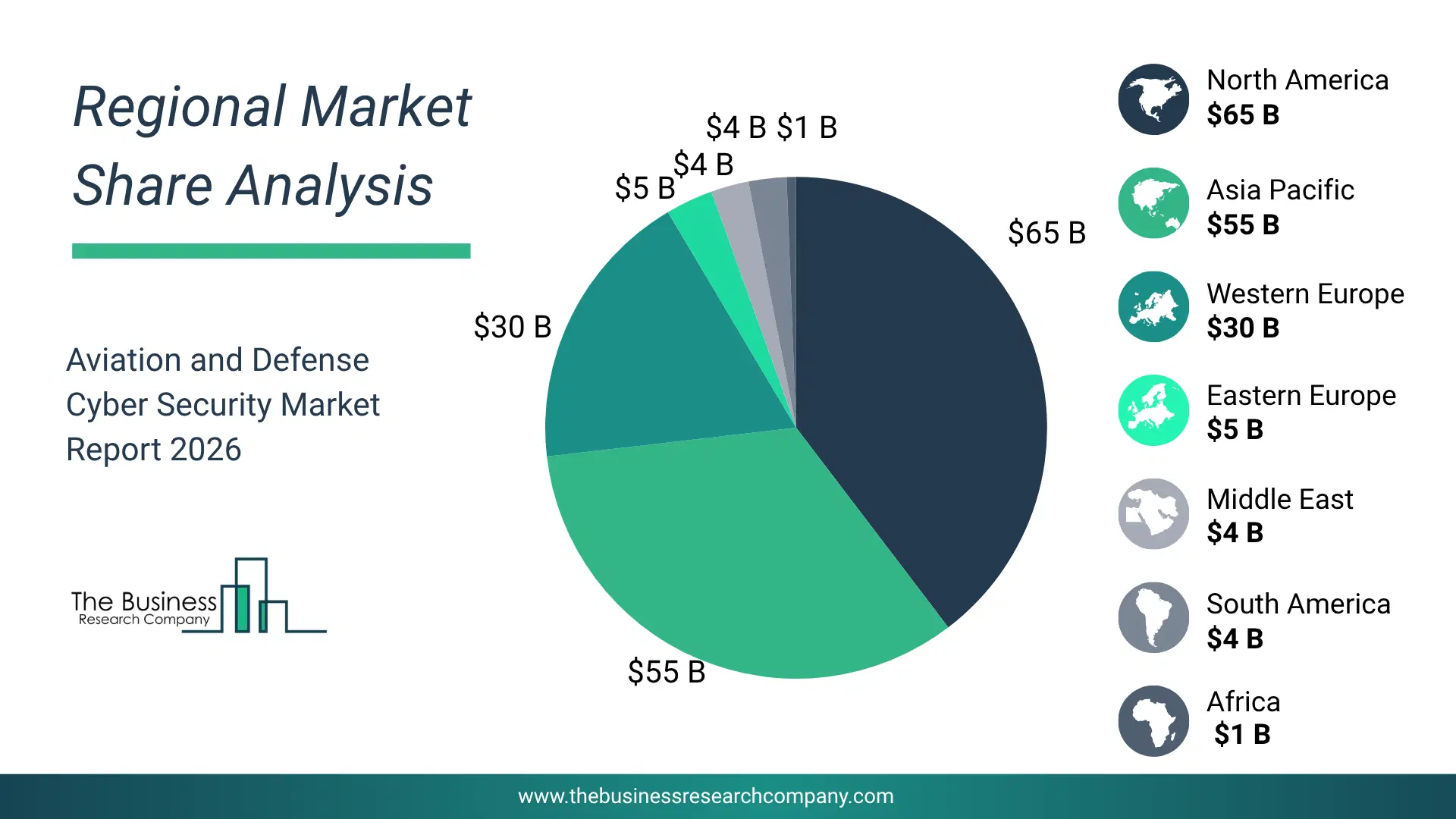
Regional Insights
North America was the largest region in the aviation and defense cyber security market in 2025. Asia-Pacific is expected to be the fastest-growing region in the forecast period. The regions covered in this market report are Asia-Pacific, South East Asia, Western Europe, Eastern Europe, North America, South America, Middle East, Africa. The countries covered in this market report are Australia, Brazil, China, France, Germany, India, Indonesia, Japan, Taiwan, Russia, South Korea, UK, USA, Canada, Italy, SpainWhat Defines the Aviation and Defense Cyber Security Market?
The aviation and defense cyber security market consists of sales of logistics and network security. Values in this market are ‘factory gate’ values, that is the value of goods sold by the manufacturers or creators of the goods, whether to other entities (including downstream manufacturers, wholesalers, distributors, and retailers) or directly to end customers. The value of goods in this market includes related services sold by the creators of the goods.How is Market Value Defined and Measured?
The market value is defined as the revenues that enterprises gain from the sale of goods and/or services within the specified market and geography through sales, grants, or donations in terms of the currency (in USD unless otherwise specified). The revenues for a specified geography are consumption values that are revenues generated by organizations in the specified geography within the market, irrespective of where they are produced. It does not include revenues from resales along the supply chain, either further along the supply chain or as part of other products.
This chart presents market attractiveness based on a quantitative evaluation of growth, competition, strategic alignment, and risk, offering a clear view of opportunity areas for decision-making. This chart is for illustrative purposes; the full report contains the complete analysis.

This chart highlights the Total Addressable Market (TAM) by estimating the maximum revenue opportunity using an assumption-driven approach, supporting strategic planning and opportunity sizing across markets. The chart is illustrative; the full report provides a more comprehensive analysis.
What Key Data and Analysis Are Included in the Aviation and Defense Cyber Security Market Report 2026?
The aviation and defense cyber security market research report is one of a series of new reports from The Business Research Company that provides market statistics, including industry global market size, regional shares, competitors with the market share, detailed market segments, market trends and opportunities, and any further data you may need to thrive in the aviation and defense cyber security industry. The market research report delivers a complete perspective of everything you need, with an in-depth analysis of the current and future state of the industry.Aviation and Defense Cyber Security Market Report Forecast Analysis
| Report Attribute | Details |
|---|---|
| Market Size Value In 2026 | $103.2 billion |
| Revenue Forecast In 2030 | $162.3 billion |
| Growth Rate | CAGR of 11.4% from 2026 to 2030 |
| Base Year For Estimation | 2025 |
| Actual Estimates/Historical Data | 2020-2025 |
| Forecast Period | 2026 - 2030 |
| Market Representation | Revenue in USD Billion and CAGR from 2026 to 2030 |
| Segments Covered | Component, Deployment |
| Regional Scope | Asia-Pacific, Western Europe, Eastern Europe, North America, South America, Middle East, Africa |
| Country Scope | The countries covered in the report are Australia, Brazil, China, France, Germany, India, Indonesia, Japan, Taiwan, Russia, South Korea, UK, USA, Canada, Italy, Spain. |
| Key Companies Profiled | International Business Machines Corporation, Honeywell International Inc., Cisco Systems Inc., Thales Group, Société Internationale de Télécommunications Aéronautiques (SITA), Raytheon Technologies Corporation, BAE Systems plc, Lockheed Martin Corporation, L3Harris Technologies Inc., Northrop Grumman Corporation, The Boeing Company, General Dynamics Corporation, Leonardo S.p.A., Airbus SE, Science Applications International Corporation Inc., CACI International Inc., Booz Allen Hamilton Holding Corporation, Leidos Holdings Inc., Kratos Defense & Security Solutions Inc., Palo Alto Networks Inc., Check Point Software Technologies Ltd., Mandiant Corporation, Fortinet Inc., Intel Corporation, NortonLifeLock Inc., CrowdStrike Holdings Inc., Trend Micro Incorporated, Kaspersky Lab ZAO, F-Secure Corporation, Secureworks Corporation, Darktrace plc, Nozomi Networks Inc., Armis Security Inc., Resilient Systems Inc. |
| Customization Scope | Request for Customization |
| Pricing And Purchase Options | Explore Purchase Options |