
Aviation Cyber Security Market Report 2026
Global Outlook – By Component (Solution, Services), By Security Type (Network Security, Wireless Security, Cloud Security, Content Security, Application Security), By Deployment (Cloud, On-Premises), By Application (Airline Management, Air Cargo Management, Airport Management, Air Traffic Control Management) – Market Size, Trends, Strategies, and Forecast to 2030
Aviation Cyber Security Market Overview
• Aviation Cyber Security market size has reached to $5.28 billion in 2025 • Expected to grow to $7.95 billion in 2030 at a compound annual growth rate (CAGR) of 8.6% • Growth Driver: The Increasing Number Of Cyber-Attacks Fueling The Growth Of The Aviation Cyber Security Market Due To Expanding Digital Connectivity In Aviation • Market Trend: Cyviation And Deloitte Canada Forge Strategic Partnership In Aviation Security • North America was the largest region in 2025 and Asia-Pacific is the fastest growing region.What Is Covered Under Aviation Cyber Security Market?
Aviation cyber security refers to the prevention and protection of the hardware and software infrastructure that also includes data of the aviation sector from unauthorised access, harm, or abuse. Aviation cybersecurity includes the safeguarding of information in the form of digital data, along with the networks, websites, services, computers, and portals that carry and enable data access. The main security types of aviation cybersecurity include network security, wireless security, cloud security, content security and application security. Network security is a segment of cybersecurity that is focused on protecting networks through which various networks are connecting from malicious cyber-attacks. They consist of solutions and service components deployed either on the cloud or on-premises for applications in airline management, air cargo management, airport management, and air traffic control management.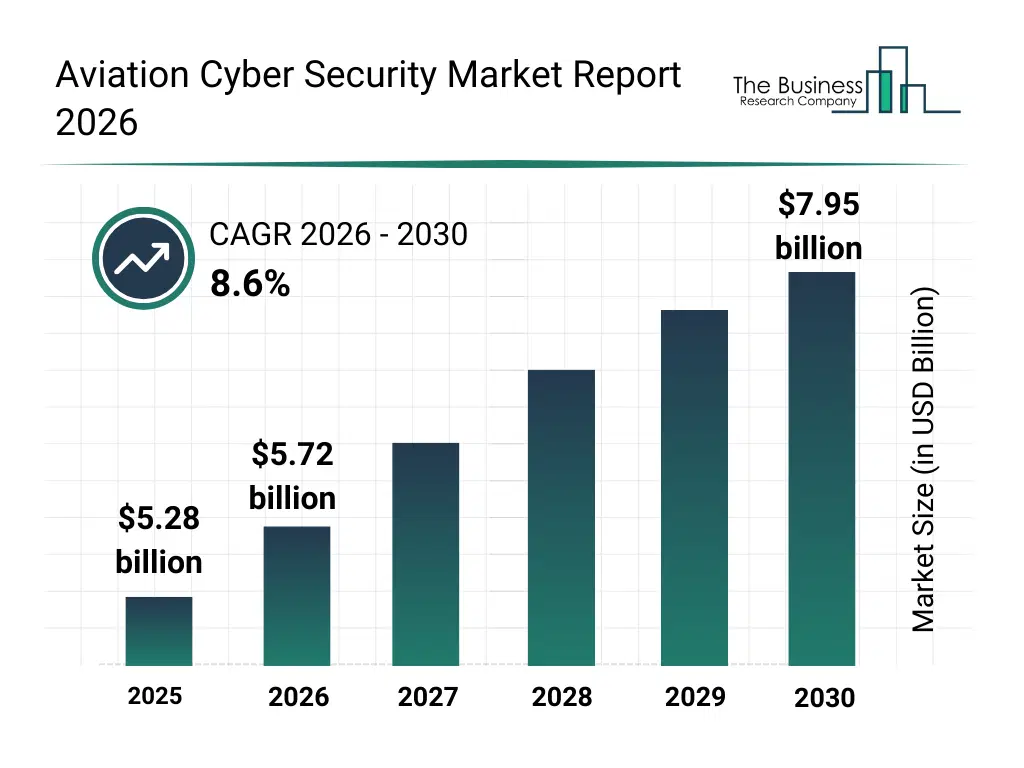
What Is The Aviation Cyber Security Market Size and Share 2026?
The aviation cyber security market size has grown strongly in recent years. It will grow from $5.28 billion in 2025 to $5.72 billion in 2026 at a compound annual growth rate (CAGR) of 8.3%. The growth in the historic period can be attributed to increase in cyber attacks on aviation systems, digitization of airport operations, early adoption of network security tools, expansion of air traffic management systems, regulatory cybersecurity mandates.What Is The Aviation Cyber Security Market Growth Forecast?
The aviation cyber security market size is expected to see strong growth in the next few years. It will grow to $7.95 billion in 2030 at a compound annual growth rate (CAGR) of 8.6%. The growth in the forecast period can be attributed to rising use of cloud aviation platforms, increasing passenger data protection needs, growth of connected aircraft systems, demand for real time threat intelligence, expansion of managed security services. Major trends in the forecast period include advanced threat detection systems, secure aviation network infrastructure, cloud based aviation security platforms, real time incident response solutions, application and data protection tools.
Global Aviation Cyber Security Market Segmentation
1) By Component: Solution, Services 2) By Security Type: Network Security, Wireless Security, Cloud Security, Content Security, Application Security 3) By Deployment: Cloud, On-Premises 4) By Application: Airline Management, Air Cargo Management, Airport Management, Air Traffic Control Management Subsegments: 1) By Solution: Network Security Solutions, Endpoint Security Solutions, Application Security Solutions, Data Security Solutions 2) By Services: Consulting Services, Managed Security Services, Incident Response Services, Training And Awareness ServicesWhat Is The Driver Of The Aviation Cyber Security Market?
The increasing number of cyber-attacks is expected to propel the growth of the aviation cyber security market going forward. Cyber-attacks are intentional incursions by threat actors into aviation networks, systems, or data repositories, and they pose significant risks to safety, operations, and business continuity in the sector. The number of cyber-attacks is increasing because airlines, airports, and air navigation service providers increasingly adopt digital systems and interconnect previously isolated operational technology and information-technology environments, which broadens the available attack surface. The aviation cybersecurity market supports this trend by equipping stakeholders with network security, cloud security, wireless-security and application security solutions designed for airline management, airport operations and air-traffic-control systems. For instance, in June 2025, according to Thales S.A., a France-based aerospace and defence company, ransomware attacks in the aviation sector rose by 600% year-on-year between January 2024 and April 2025, driven by 27 major attacks from 22 ransomware groups. Therefore, the increasing number of cyber-attacks is driving the growth of the aviation cyber security industry.Key Players In The Global Aviation Cyber Security Market
Major companies operating in the aviation cyber security market are Airbus SE; BAE Systems Inc.; BluVector Inc.; F-Secure Corporation; General Dynamics Corporation; Honeywell International Inc.; Lockheed Martin Corporation; Northrop Grumman Corporation; Palo Alto Networks Inc.; Raytheon Intelligence & Space; Thales Group Inc.; Unisys Corporation; Collins Aerospace; International Business Machines Corporation; SITA Information Security Services; Astronautics Corporation of America; Booz Allen Hamilton Holding Corp.; Cisco Systems Inc.; Fortinet Inc.; McAfee Corp.; Israel Aerospace Industries Ltd.; L3Harris Technologies Inc.; Check Point Software Technologies; Computer Sciences Corporation; Accenture plc; T-Systems International GmbH; Capgemini SE; Deloitte Touche Tohmatsu Limited; PricewaterhouseCoopers (PwC); Ernst & Young Global Limited (EY); KPMG International Limited
This chart is for illustrative purposes; the full report includes a detailed competitor analysis and comprehensive overview of the top 10 companies in the market.
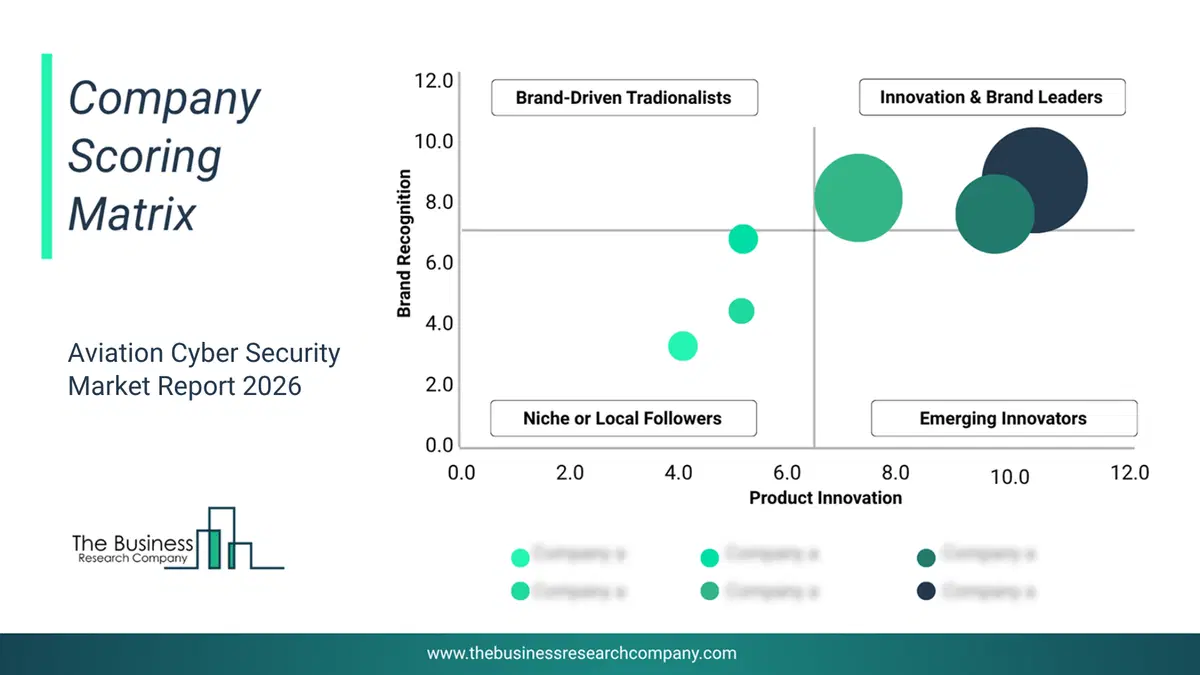
This chart maps companies by product innovation and brand strength, with bubble size indicating relative revenue, helping identify market leaders, challengers, and niche players. This is an illustrative chart; the full report provides a complete and accurate competitive analysis.
Global Aviation Cyber Security Market Trends and Insights
Major companies operating in the aviation cyber security market are focusing on strategic partnerships to sustain their position in the market. A strategic partnership refers to a collaborative arrangement between two or more organisations to achieve mutual benefits, often in pursuit of common goals or objectives. For instance, in April 2023, Cyviation, an Israel-based cybersecurity company that focuses on providing proactive intelligence and monitoring solutions for commercial airlines and private jets, specifically targeting aircraft communication systems, revealed a collaboration with Deloitte Canada, a Canada-based professional services firm, to introduce an integrated solution. This partnership combines Deloitte's comprehensive cybersecurity consulting and professional services with Cyviation's advanced aircraft cybersecurity solutions. It aims to enhance awareness, manage cyber events, and assist airlines in developing cyber resilience while preparing for upcoming regulatory compliance in the ever-evolving landscape of aviation cybersecurity.What Are Latest Mergers And Acquisitions In The Aviation Cyber Security Market?
In February 2023, Accenture PLC, an Ireland-based company specialising in information technology services and consulting, acquired Morphus for an undisclosed amount. Through this acquisition, Accenture aims to expand its portfolio and be able to provide the best cyber defence solutions to its clients. The acquisition will also expand the company's position in growth markets, including aviation. Morpheus is a Brazil-based company that provides cyber defence, risk management, and cyber threat intelligence services in the aviation sector.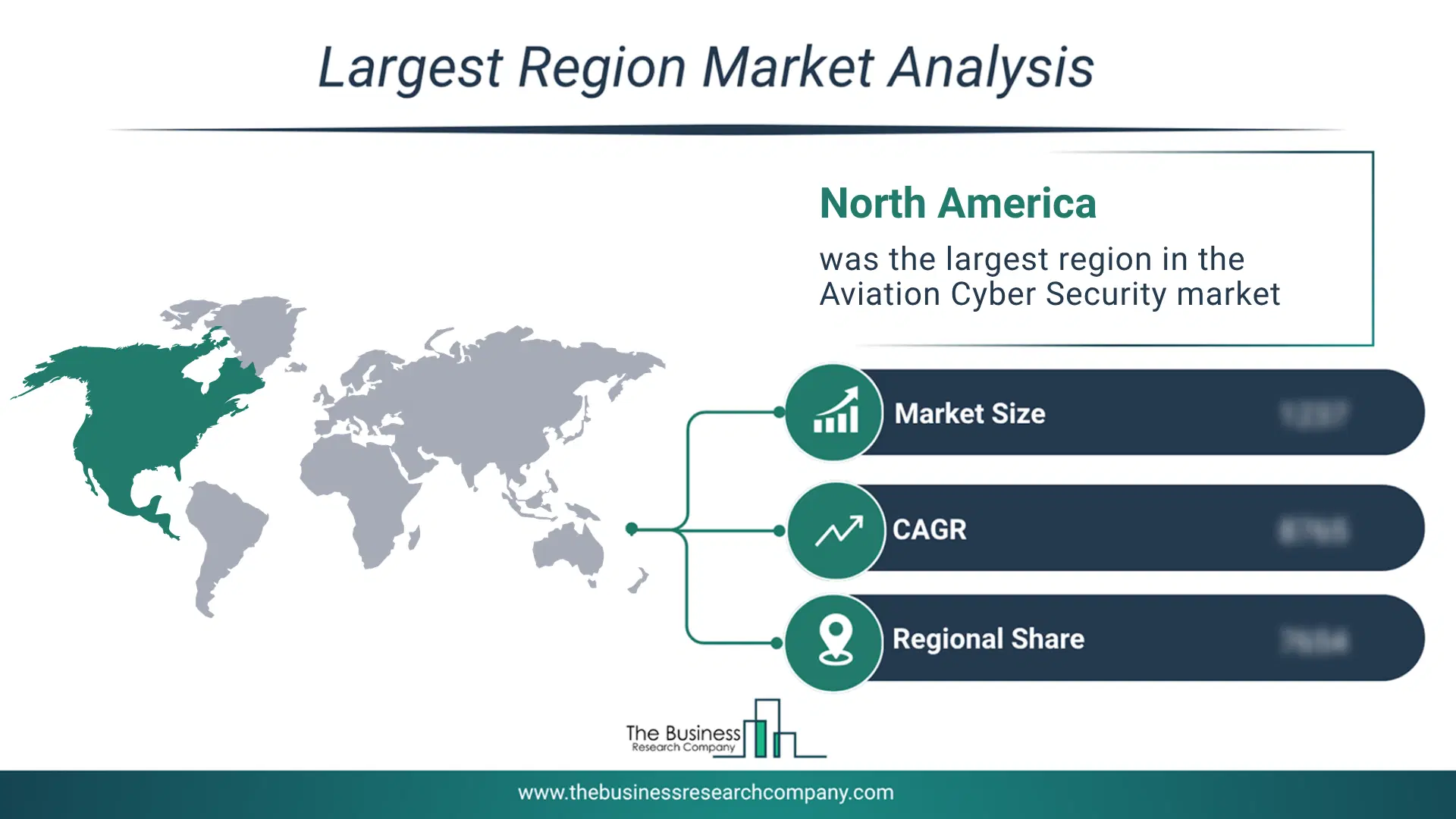
Regional Insights
North America was the largest region in the aviation cybersecurity market in 2025.Asia-Pacific is expected to be the fastest-growing region in the global aviation cybersecurity market report during the forecast period. The regions covered in this market report are Asia-Pacific, South East Asia, Western Europe, Eastern Europe, North America, South America, Middle East, Africa. The countries covered in this market report are Australia, Brazil, China, France, Germany, India, Indonesia, Japan, Taiwan, Russia, South Korea, UK, USA, Canada, Italy, SpainWhat Defines the Aviation Cyber Security Market?
The aviation cyber security market consists of revenues earned by entities by providing services such as risk assessments, compliance audits, training programs, and incident response services. The market value includes the value of related goods sold by the service provider or included within the service offering. The aviation cyber security market also includes sales of hardware and software such as firewalls, intrusion detection and prevention systems, and encryption technologies, that are used in providing aviation cyber security. Values in this market are ‘factory gate’ values, that is, the value of goods sold by the manufacturers or creators of the goods, whether to other entities (including downstream manufacturers, wholesalers, distributors, and retailers) or directly to end customers. The value of goods in this market includes related services sold by the creators of the goods.How is Market Value Defined and Measured?
The market value is defined as the revenues that enterprises gain from the sale of goods and/or services within the specified market and geography through sales, grants, or donations in terms of the currency (in USD unless otherwise specified). The revenues for a specified geography are consumption values that are revenues generated by organizations in the specified geography within the market, irrespective of where they are produced. It does not include revenues from resales along the supply chain, either further along the supply chain or as part of other products.
This chart presents market attractiveness based on a quantitative evaluation of growth, competition, strategic alignment, and risk, offering a clear view of opportunity areas for decision-making. This chart is for illustrative purposes; the full report contains the complete analysis.

This chart highlights the Total Addressable Market (TAM) by estimating the maximum revenue opportunity using an assumption-driven approach, supporting strategic planning and opportunity sizing across markets. The chart is illustrative; the full report provides a more comprehensive analysis.
What Key Data and Analysis Are Included in the Aviation Cyber Security Market Report 2026?
The aviation cyber security market research report is one of a series of new reports from The Business Research Company that provides market statistics, including industry global market size, regional shares, competitors with the market share, detailed market segments, market trends and opportunities, and any further data you may need to thrive in the aviation cyber security industry. The market research report delivers a complete perspective of everything you need, with an in-depth analysis of the current and future state of the industry.Aviation Cyber Security Market Report Forecast Analysis
| Report Attribute | Details |
|---|---|
| Market Size Value In 2026 | $5.72 billion |
| Revenue Forecast In 2030 | $7.95 billion |
| Growth Rate | CAGR of 8.6% from 2026 to 2030 |
| Base Year For Estimation | 2025 |
| Actual Estimates/Historical Data | 2020-2025 |
| Forecast Period | 2026 - 2030 |
| Market Representation | Revenue in USD Billion and CAGR from 2026 to 2030 |
| Segments Covered | Component, Security Type, Deployment, Application |
| Regional Scope | Asia-Pacific, Western Europe, Eastern Europe, North America, South America, Middle East, Africa |
| Country Scope | The Countries Covered In This Market Report Are Australia, Brazil, China, France, Germany, India, Indonesia, Japan, Taiwan, Russia, South Korea, Uk, Usa, Canada, Italy, Spain. |
| Key Companies Profiled | Airbus SE, BAE Systems Inc., BluVector Inc., F-Secure Corporation, General Dynamics Corporation, Honeywell International Inc., Lockheed Martin Corporation, Northrop Grumman Corporation, Palo Alto Networks Inc., Raytheon Intelligence & Space, Thales Group Inc., Unisys Corporation, Collins Aerospace, International Business Machines Corporation, SITA Information Security Services, Astronautics Corporation of America, Booz Allen Hamilton Holding Corp., Cisco Systems Inc., Fortinet Inc., McAfee Corp., Israel Aerospace Industries Ltd., L3Harris Technologies Inc., Check Point Software Technologies, Computer Sciences Corporation, Accenture plc, T-Systems International GmbH, Capgemini SE, Deloitte Touche Tohmatsu Limited, PricewaterhouseCoopers (PwC), Ernst & Young Global Limited (EY), KPMG International Limited |
| Customization Scope | Request for Customization |
| Pricing And Purchase Options | Explore Purchase Options |