
B2C Mobility Sharing Market Report 2026
Global Outlook – By Service Model (Car Sharing; Bike Sharing; Scooter Sharing; Ride-Hailing; Other Service Models), By Vehicle (Cars; Two Wheelers; Other Vehicles), By Level Of Automation (Semi-Automated Vehicle; Fully Automated Vehicle), By Application (Short Trips (5 Km Or Less); Medium And Long Distance (5-15 Km); Long-Distance(More Than 15 Kilometers)) – Market Size, Trends, Strategies, and Forecast to 2030
B2C Mobility Sharing Market Overview
• B2C Mobility Sharing market size has reached to $66.46 billion in 2025 • Expected to grow to $182.89 billion in 2030 at a compound annual growth rate (CAGR) of 22.3% • Growth Driver: Rising Connected Vehicles Drives The B2C Mobility Sharing Market • Market Trend: Digital Platforms Enhancing Coordination And Oversight In Shared Urban Mobility • North America was the largest region in 2025.What Is Covered Under B2C Mobility Sharing Market?
B2C mobility sharing refers to transportation services that are shared among users, such as public transit, car sharing, and bike sharing. It also includes automobile-based modes of sharing, such as car sharing and rides on demand. These are used to provide transportation and ride-sharing services by the service-providing company in the B2C business model delivering directly to consumers. The main types of service models in B2C mobility sharing market are car sharing, bike sharing, scooter sharing, ride-hailing, others. The car-sharing segment consists of sales of B2C mobility sharing that are used to provide public car-sharing services. Car sharing services refer to automobile rental and transportation services that substitute private vehicle ownership and provide automated pick-up and drop-off procedures. The various types of vehicles include cars, two wheelers, other vehicles that have various level of automation including semi-automated vehicle, fully automated vehicle. The different applications include short trips (5 km or less), medium and long distance (5-15 km), long-distance (more than 15 kilometers).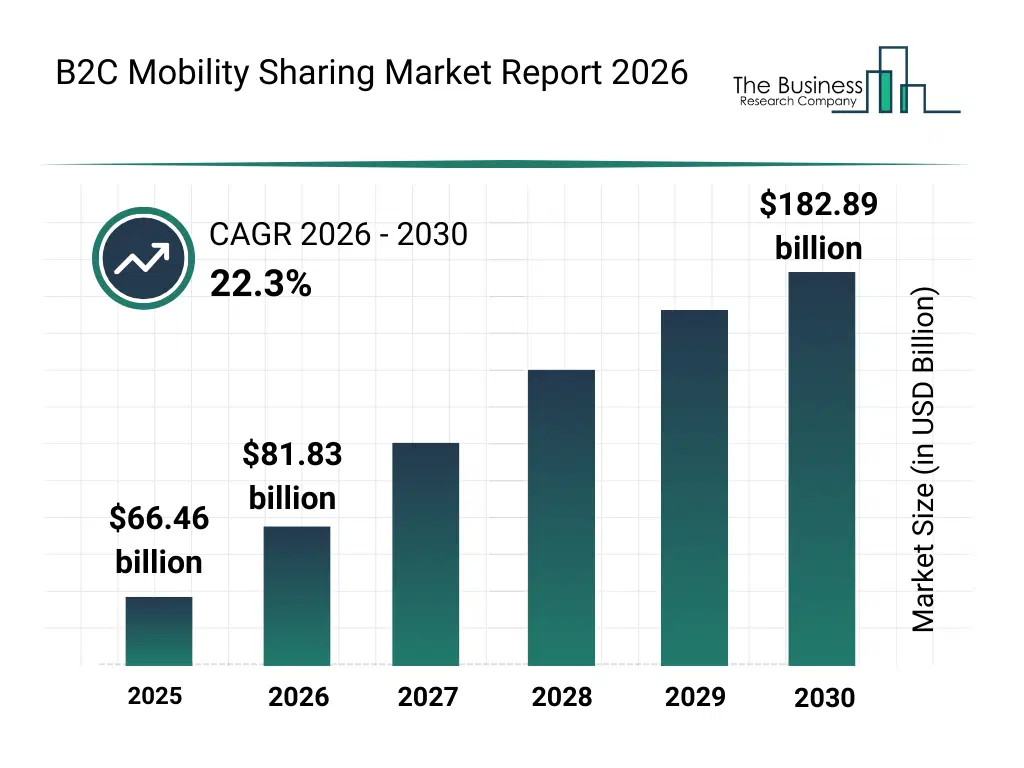
What Is The B2C Mobility Sharing Market Size and Share 2026?
The b2c mobility sharing market size has grown exponentially in recent years. It will grow from $66.46 billion in 2025 to $81.83 billion in 2026 at a compound annual growth rate (CAGR) of 23.1%. The growth in the historic period can be attributed to urban population growth, increased smartphone penetration, expansion of on-demand ride platforms, rising congestion in metropolitan areas, growing acceptance of shared mobility models.What Is The B2C Mobility Sharing Market Growth Forecast?
The b2c mobility sharing market size is expected to see exponential growth in the next few years. It will grow to $182.89 billion in 2030 at a compound annual growth rate (CAGR) of 22.3%. The growth in the forecast period can be attributed to expansion of autonomous ride-sharing pilots, rising focus on low-emission urban transport, integration of shared mobility with public transit, increasing investments in smart city mobility, growing demand for flexible transportation options. Major trends in the forecast period include increasing adoption of app-based ride services, rising demand for electric shared mobility fleets, growing integration of maas platforms, expansion of short-distance urban mobility solutions, enhanced focus on user convenience and pricing flexibility.
Global B2C Mobility Sharing Market Segmentation
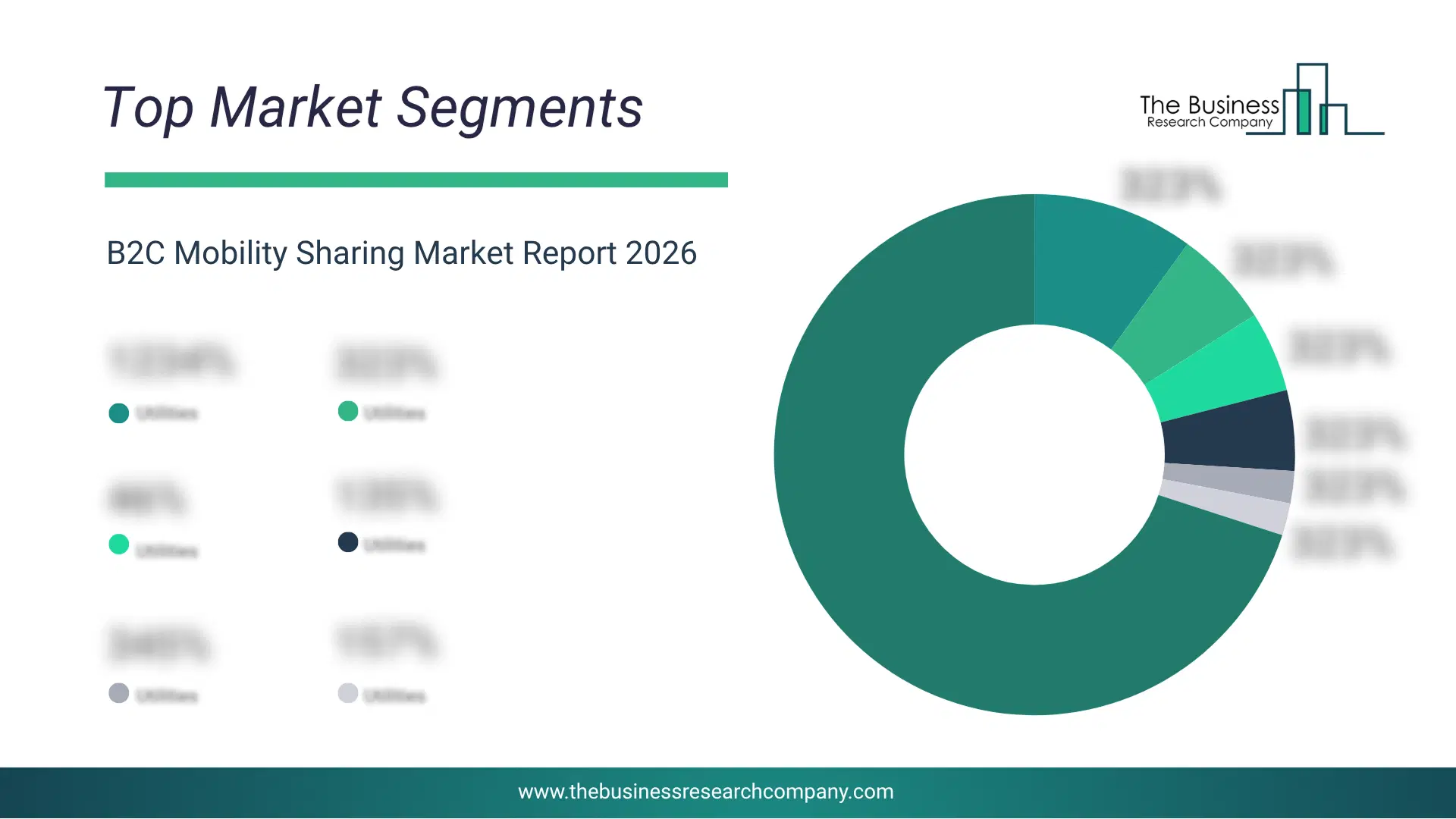
1) By Service Model: Car Sharing, Bike Sharing, Scooter Sharing, Ride-Hailing, Other Service Models 2) By Vehicle: Cars, Two Wheelers, Other Vehicles 3) By Level Of Automation: Semi-Automated Vehicle, Fully Automated Vehicle 4) By Application: Short Trips (5 Km Or Less), Medium And Long Distance (5-15 Km), Long-Distance(More Than 15 Kilometers) Subsegments: 1) By Car Sharing: Peer-To-Peer Car Sharing, Traditional Car Sharing, One-Way Car Sharing 2) By Bike Sharing: Traditional Bike Sharing, Electric Bike Sharing 3) By Scooter Sharing: Electric Scooter Sharing, Manual Scooter Sharing 4) By Ride-Hailing: App-Based Ride-Hailing, Taxi Aggregator Services 5) By Other Service Models: Shuttle Services, Van Pooling, Carpooling ServicesWhat Is The Driver Of The B2C Mobility Sharing Market?
The rising connected vehicles is driving the growth of the B2C mobility sharing market going forward. Connected vehicles refer to motor vehicles empowered with internet access and a local area network that helps to communicate with other vehicles to enhance the consumer experience with the real-time interaction of the vehicles, and can be connected with smartphones to monitor the performance of the car. In B2C mobility sharing, the connected vehicles help with constantly receiving and sending data to increase the vehicle’s security, live tracking of vehicles, and management of fleet to provide drivers and fleet owners seamless mobility service. For instance, in February 2024, according to the Society of Motor Manufacturers and Traders (SMMT) a UK-based trade association, the milestone of Britain's one-millionth battery electric connected car (BEV) being introduced onto the roads was achieved, coinciding with a notable growth of 8.2% in the new car market during January 2024. Specifically, the registration of 20,935 BEVs in January 2024 represented a significant increase of 21.0%, compared to the previous year. Therefore, the rising connected vehicle and smartphone penetration is driving the growth of the B2C mobility sharing industry.Key Players In The Global B2C Mobility Sharing Market
Major companies operating in the b2c mobility sharing market are Avis Budget Group Inc., Beijing Xiaoju Technology Co. Ltd., Bolt Technology OÜ, Cabify SA, Careem Networks LLC, Enterprise Holdings Inc., Europcar Group SA, Grab Holdings Inc., The Hertz Corporation, Lyft Inc., Uber Technologies Inc., Didi Chuxing Technology Co., Car2go NA LLC, DriveNow GmbH & Co. KG, Free2Move Holding AB, Getaround Inc., Modo Co-operative, Mobility Cooperative, Mobility Mixx BV, Our Car Ltd., Poppy Mobility NV, Ridecell Inc., Scoot Networks Inc., Sixt SE, Ford Smart Mobility, TIER Mobility GmbH, Voi Technology AB, Whim by MaaS Global, Zipcar Inc., Zoomcar India Pvt Ltd., Cityhop, Evo Car Share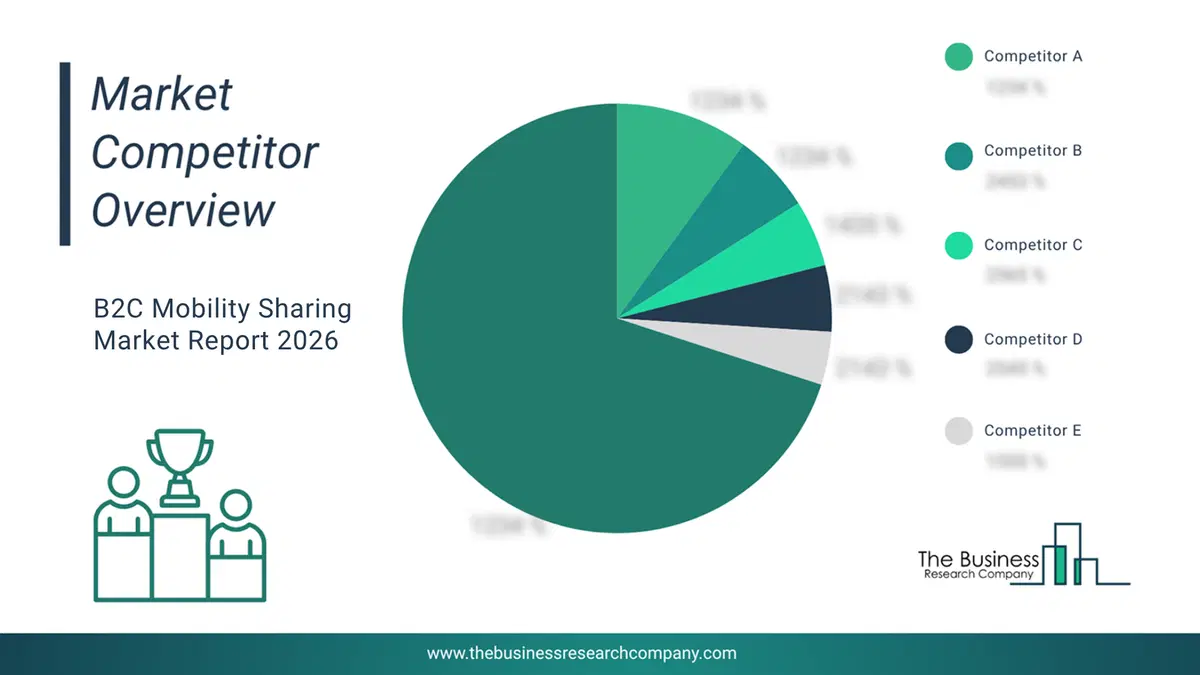
This chart is for illustrative purposes; the full report includes a detailed competitor analysis and comprehensive overview of the top 10 companies in the market.
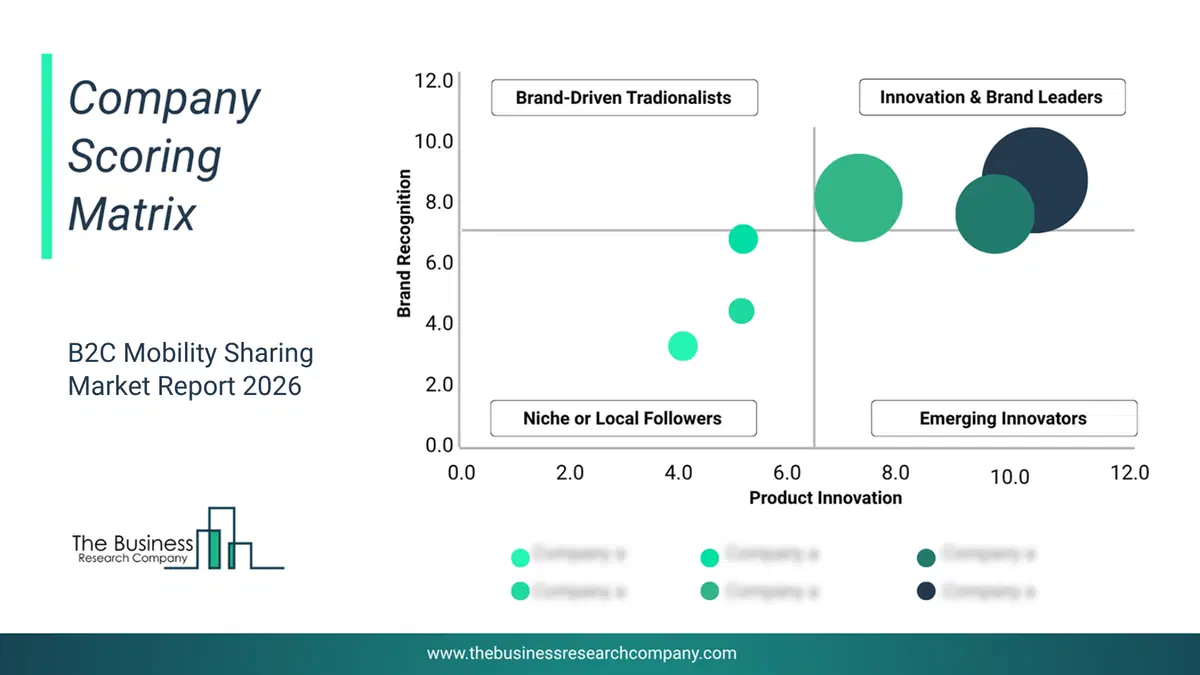
This chart maps companies by product innovation and brand strength, with bubble size indicating relative revenue, helping identify market leaders, challengers, and niche players. This is an illustrative chart; the full report provides a complete and accurate competitive analysis.
Global B2C Mobility Sharing Market Trends and Insights
Major companies operating in the B2C mobility sharing market are focusing on developing innovative solutions, such as integrated soft mobility management platforms, to meet the rising demand for seamless, safe, and efficient urban transportation. An integrated soft mobility management platform is a digital system that connects multiple shared mobility services into a unified interface, allowing real-time monitoring, route optimization, and enhanced user safety, unlike traditional standalone sharing services that operate in isolation. For instance, in May 2023, Dubai's Roads and Transport Authority (RTA), a UAE-based government transport authority, launched an integrated platform under the Enterprise Command and Control Centre (EC3) to manage soft mobility operations. This platform employs AI technologies to monitor and optimize shared mobility usage across the city, linking multiple service providers in real time. The system supports over 2,500 e-scooters and 1,750 shared bikes across more than 28 areas, enabling efficient trip management, safety monitoring, and data-driven planning for future expansions. By integrating these services, the platform provides users with smoother, safer travel experiences while helping Dubai advance its smart city and AI-driven mobility ambitions.What Are Latest Mergers And Acquisitions In The B2C Mobility Sharing Market?
In March 2025, Bolt Technology OÜ, an Estonia based shared mobility and transportation technology company, acquired Viggo ApS for an undisclosed amount. With this acquisition, Bolt aims to enter and rapidly scale its ride hailing operations in the Danish market, complementing its existing e bike rental services and strengthening its multi modal mobility ecosystem in Scandinavia. Viggo ApS is a Denmark-based electric mobility company that specializes in providing fully electric ride hailing services with a fleet of electric vehicles and a substantial user base across Copenhagen and Aarhus.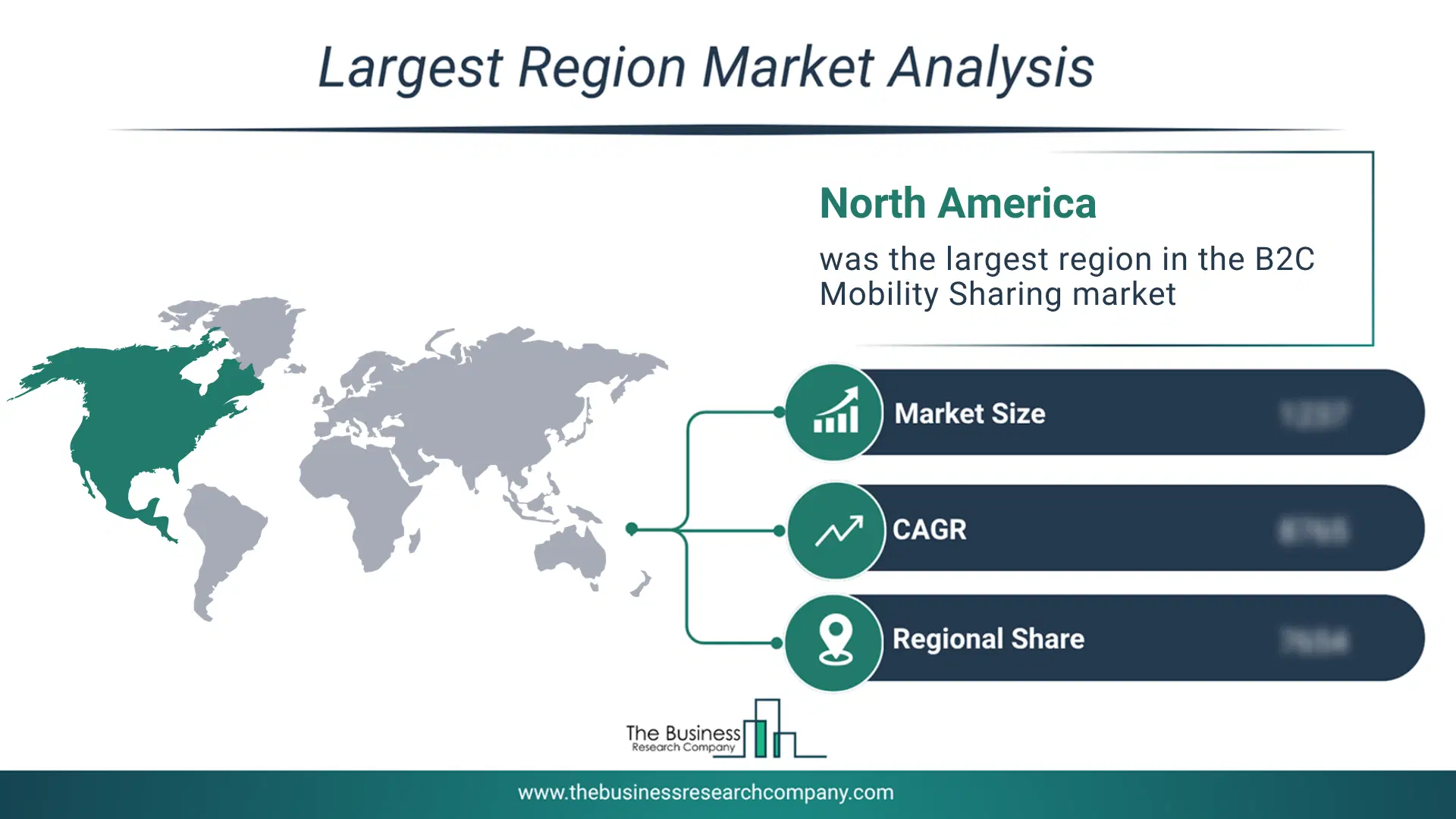
Regional Outlook
North America was the largest region in the B2C mobility sharing market in 2025. The regions covered in this market report are Asia-Pacific, South East Asia, Western Europe, Eastern Europe, North America, South America, Middle East, Africa. The countries covered in this market report are Australia; Brazil; China; France; Germany; India; Indonesia; Japan; Taiwan; Russia; South Korea; UK; USA; Canada; Italy; Spain.What Defines the B2C Mobility Sharing Market?
The B2C mobility sharing market includes revenues earned by entities by providing transportation services such as vehicle-sharing and ride-sourcing. The market value includes the value of related goods sold by the service provider or included within the service offering. Only goods and services traded between entities or sold to end consumers are included.How is Market Value Defined and Measured?
The market value is defined as the revenues that enterprises gain from the sale of goods and/or services within the specified market and geography through sales, grants, or donations in terms of the currency (in USD unless otherwise specified). The revenues for a specified geography are consumption values that are revenues generated by organizations in the specified geography within the market, irrespective of where they are produced. It does not include revenues from resales along the supply chain, either further along the supply chain or as part of other products.
This chart presents market attractiveness based on a quantitative evaluation of growth, competition, strategic alignment, and risk, offering a clear view of opportunity areas for decision-making. This chart is for illustrative purposes; the full report contains the complete analysis.

This chart highlights the Total Addressable Market (TAM) by estimating the maximum revenue opportunity using an assumption-driven approach, supporting strategic planning and opportunity sizing across markets. The chart is illustrative; the full report provides a more comprehensive analysis.
What Key Data and Analysis Are Included in the B2C Mobility Sharing Market Report 2026?
The b2c mobility sharing market research report is one of a series of new reports from The Business Research Company that provides market statistics, including Market Report 2026?global market size, regional shares, competitors with the market share, detailed market segments, market trends and opportunities, and any further data you may need to thrive in the b2c mobility sharing Market Report 2026? The market research report delivers a complete perspective of everything you need, with an in-depth analysis of the current and future state of the Market Report 2026?B2C Mobility Sharing Market Report Forecast Analysis
| Report Attribute | Details |
|---|---|
| Market Size Value In 2026 | $81.83 billion |
| Revenue Forecast In 2030 | $182.89 billion |
| Growth Rate | CAGR of 23.1% from 2026 to 2030 |
| Base Year For Estimation | 2025 |
| Actual Estimates/Historical Data | 2020-2025 |
| Forecast Period | 2026 - 2030 - 2030 |
| Market Representation | Revenue in USD Billion and CAGR from 2026 to 2030 |
| Segments Covered | Service Model, Vehicle, Level Of Automation, Application |
| Regional Scope | Asia-Pacific, Western Europe, Eastern Europe, North America, South America, Middle East, Africa |
| Country Scope | The countries covered in the report are Australia, Brazil, China, France, Germany, India, Indonesia, Japan, Taiwan, Russia, South Korea, UK, USA, Canada, Italy, Spain. |
| Key Companies Profiled | Avis Budget Group Inc., Beijing Xiaoju Technology Co. Ltd., Bolt Technology OÜ, Cabify SA, Careem Networks LLC, Enterprise Holdings Inc., Europcar Group SA, Grab Holdings Inc., The Hertz Corporation, Lyft Inc., Uber Technologies Inc., Didi Chuxing Technology Co., Car2go NA LLC, DriveNow GmbH & Co. KG, Free2Move Holding AB, Getaround Inc., Modo Co-operative, Mobility Cooperative, Mobility Mixx BV, Our Car Ltd., Poppy Mobility NV, Ridecell Inc., Scoot Networks Inc., Sixt SE, Ford Smart Mobility, TIER Mobility GmbH, Voi Technology AB, Whim by MaaS Global, Zipcar Inc., Zoomcar India Pvt Ltd., Cityhop, Evo Car Share |
| Customization Scope | Request for Customization |
| Pricing And Purchase Options | Explore Purchase Options |