
Bluetooth Low Energy (BLE) Technology Market Report 2026
Global Outlook – By Offering (Module, Chipset), By Mode (Single Mode, Dual Mode), By End User (Healthcare, Sports And Fitness, Home Appliances, Consumer Electronics, Wearable Electronics) – Market Size, Trends, Strategies, and Forecast to 2030
Bluetooth Low Energy (BLE) Technology Market Overview
• Bluetooth Low Energy (BLE) Technology market size has reached to $9.95 billion in 2025 • Expected to grow to $12.06 billion in 2030 at a compound annual growth rate (CAGR) of 3.8% • Growth Driver: Impacts Of Smart Home And Iot Adoption On BLE Technology Market • Market Trend: Technological Advancements And Cloud-Connected Solutions In IoT Devices • North America was the largest region in 2025 and Asia-Pacific is the fastest growing region.What Is Covered Under Bluetooth Low Energy (BLE) Technology Market?
Bluetooth Low Energy (BLE) is a wireless personal area network technology designed to provide considerably reduced power consumption and cost while maintaining a similar communication range as classic Bluetooth. The main purpose of BLE technology is to enable devices to operate with very low power requirements, allowing them to run for extended periods on small batteries or even coin cell batteries. The main types of offerings for Bluetooth low energy (BLE) technology include modules and chipsets. A module in Bluetooth low energy (BLE) technology refers to a pre-packaged unit containing essential components such as the BLE chipset, antenna, and other necessary circuitry, designed for easy integration into electronic devices without the need for extensive technical expertise. The modes are categorized into single mode, dual mode, and classic for end users such as healthcare, sports and fitness, home appliances, automotive, consumer electronics, industrial automation, wearable electronics, and gaming.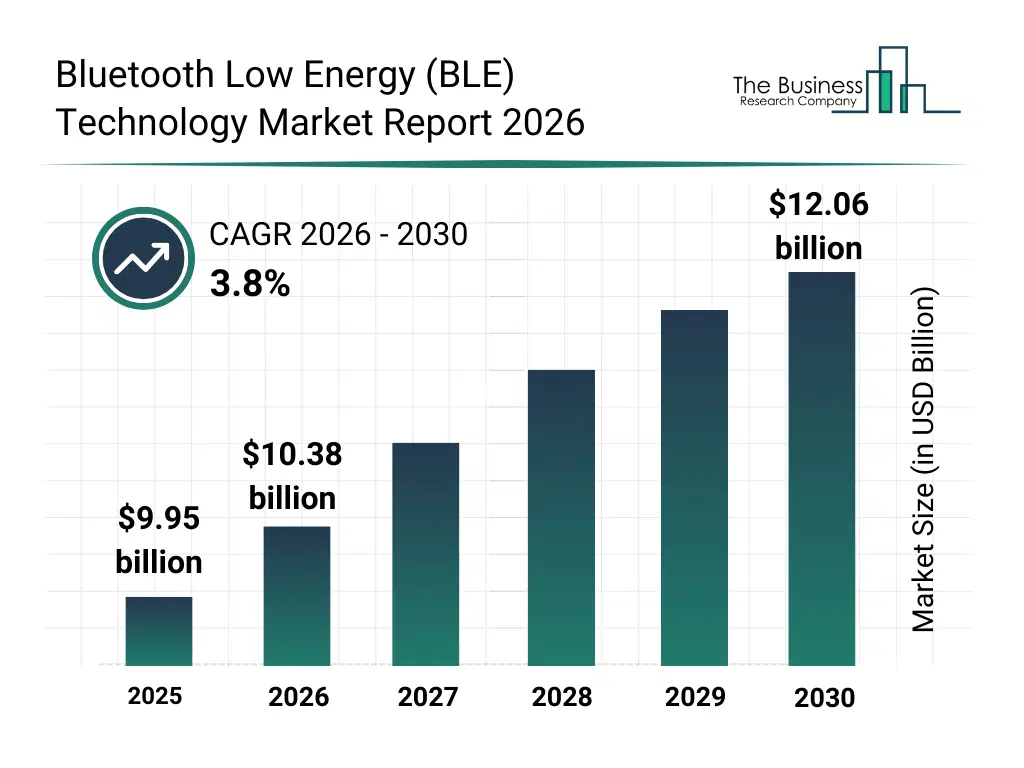
What Is The Bluetooth Low Energy (BLE) Technology Market Size and Share 2026?
The bluetooth low energy (ble) technology market size has grown steadily in recent years. It will grow from $9.95 billion in 2025 to $10.38 billion in 2026 at a compound annual growth rate (CAGR) of 4.4%. The growth in the historic period can be attributed to growth in wireless sensor deployments, expansion of consumer electronics connectivity, adoption of bluetooth standards in smart devices, increasing use of short-range communication technologies, availability of low-cost ble chipsets.What Is The Bluetooth Low Energy (BLE) Technology Market Growth Forecast?
The bluetooth low energy (ble) technology market size is expected to see steady growth in the next few years. It will grow to $12.06 billion in 2030 at a compound annual growth rate (CAGR) of 3.8%. The growth in the forecast period can be attributed to expansion of smart home ecosystems, rising adoption of wearable and medical devices, increasing deployment of iot infrastructure, growth in asset tracking applications, continued innovation in low-energy wireless protocols. Major trends in the forecast period include increasing adoption of ultra-low power wireless connectivity, rising integration of ble in iot devices, growing demand for long-battery-life communication modules, expansion of ble-based proximity and tracking solutions, enhanced focus on compact and cost-efficient chipsets.
Global Bluetooth Low Energy (BLE) Technology Market Segmentation
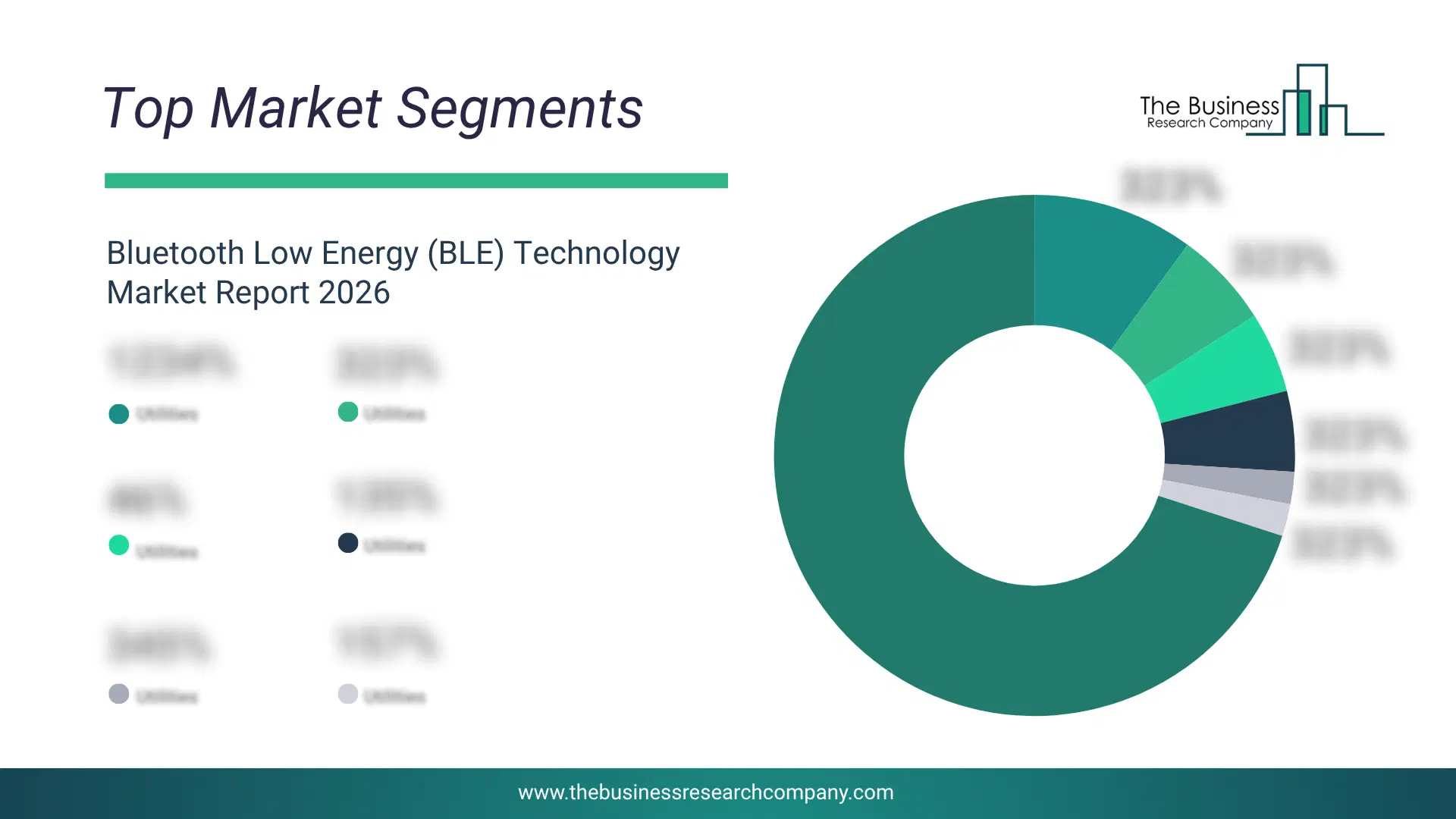
1) By Offering: Module, Chipset 2) By Mode: Single Mode, Dual Mode 3) By End User: Healthcare, Sports And Fitness, Home Appliances, Consumer Electronics, Wearable Electronics Subsegments: 1) By Module: Single-Mode BLE Module, Dual-Mode BLE Module, Multi-Mode BLE Module, System-In-Package (SiP) Modules 2) By Chipset: BLE Transceiver Chipsets, BLE SoC (System On Chip) Chipsets, BLE Processor ChipsetsWhat Is The Driver Of The Bluetooth Low Energy (BLE) Technology Market?
The rising adoption of smart home devices and IoT is expected to propel the growth of the Bluetooth low-energy (BLE) technology market going forward. Smart home IoT (Internet of Things) connected devices refer to a range of household appliances, systems, and gadgets that are designed to be interconnected and controlled remotely or automatically through the internet or a local network. The growing demand for convenience, enhanced security, energy efficiency, and remote control of home functions drive the rising adoption of smart home devices and IoT. Bluetooth low energy (BLE) technology in smart home devices and IoT enables low-power, cost-effective wireless communication for efficient device connectivity and control. For instance, in Auguest 2024, according to the GreenMatch, a UK-based online service, as of 2023, around 5.3 million households in the UK, roughly 19.7% of all homes, utilize smart home products. This figure is projected to increase sharply, with nearly all homes, 98.8%, expected to adopt smart devices by 2027. Therefore, the rising adoption of smart home devices and IoT will drive the growth of the Bluetooth low energy (BLE) technology industry.Key Players In The Global Bluetooth Low Energy (BLE) Technology Market
Major companies operating in the bluetooth low energy (ble) technology market are Apple Inc., Samsung Electronics Co. Ltd., Qualcomm Incorporated, Broadcom Inc., Texas Instruments Incorporated, STMicroelectronics N.V., NXP Semiconductors N.V., Nordic Semiconductor ASA, Microchip Technology Incorporated, Silicon Laboratories Inc., Infineon Technologies AG, Renesas Electronics Corporation, Analog Devices Inc., MediaTek Inc., Realtek Semiconductor Corp., Espressif Systems ShanghAI Co. Ltd., Dialog Semiconductor Plc, Telit Communications PLC, Quectel Wireless Solutions Co. Ltd., Sierra Wireless Inc.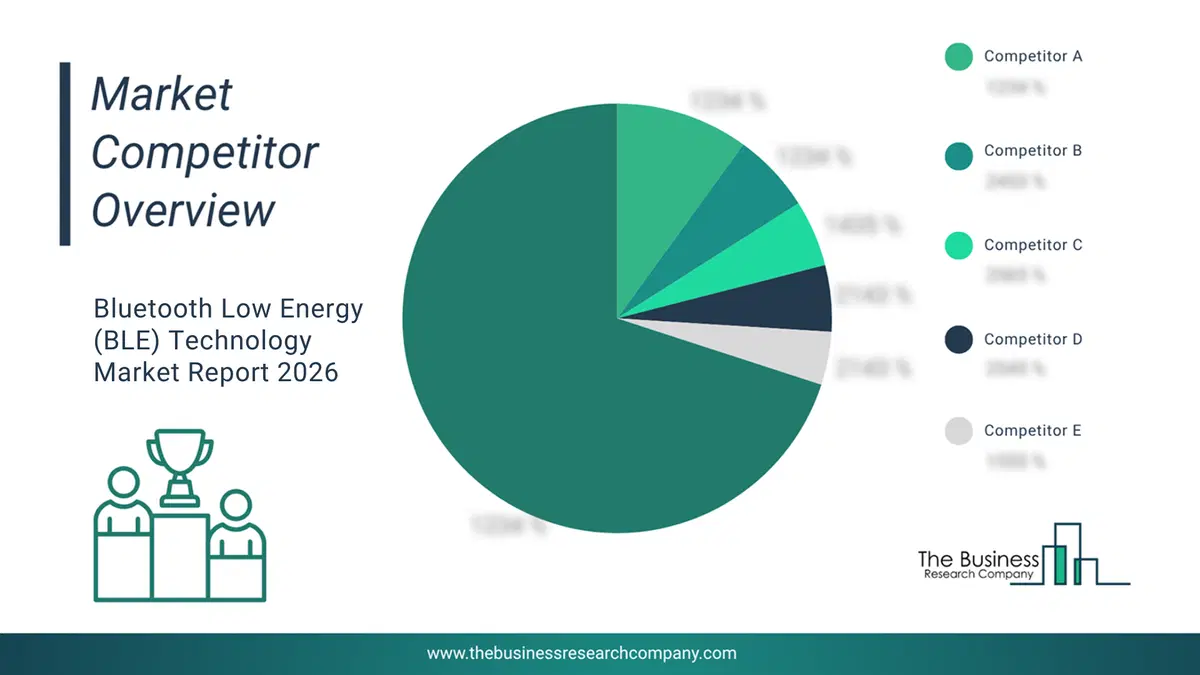
This chart is for illustrative purposes; the full report includes a detailed competitor analysis and comprehensive overview of the top 10 companies in the market.
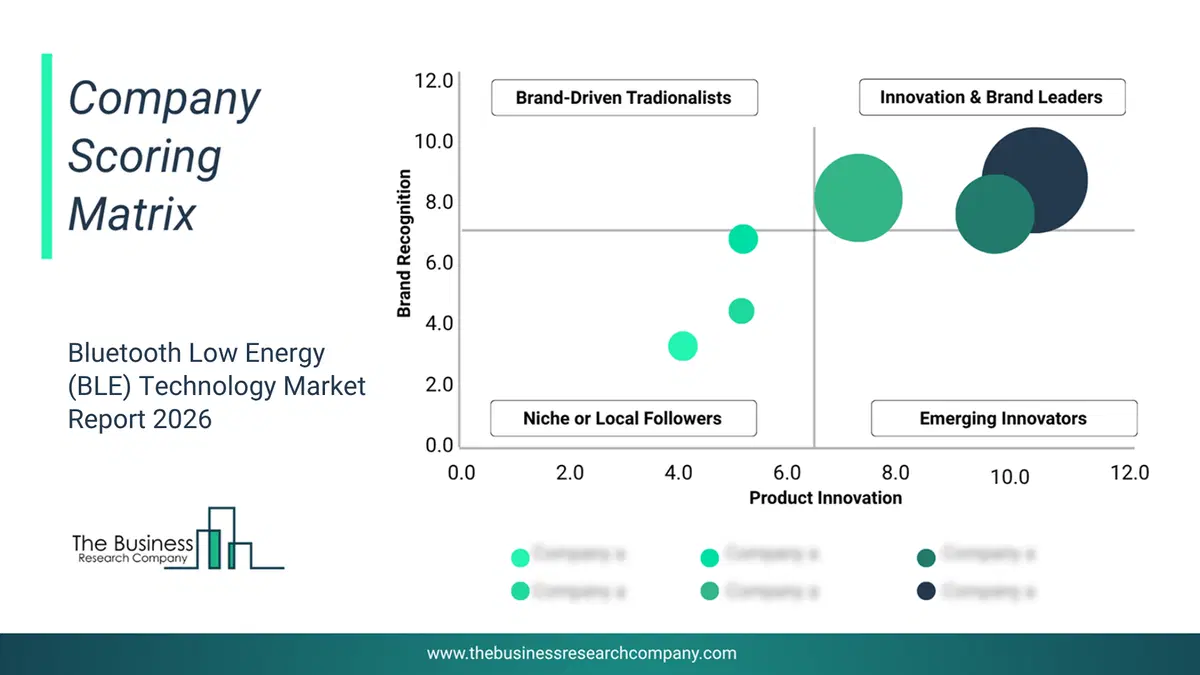
This chart maps companies by product innovation and brand strength, with bubble size indicating relative revenue, helping identify market leaders, challengers, and niche players. This is an illustrative chart; the full report provides a complete and accurate competitive analysis.
Global Bluetooth Low Energy (BLE) Technology Market Trends and Insights
Major companies operating in the bluetooth low energy (BLE) technology market are focusing on developing technological advancements such as over-the-air (OTA) firmware updates to enable seamless remote device upgrades, enhance security, and improve overall performance without requiring physical access. Over-the-air (OTA) firmware update refers to the process of remotely delivering and installing software or firmware updates on a device via a wireless connection, eliminating the need for physical access or manual intervention. For instance, in March 2025, Blecon Ltd., a UK-based IoT solutions provider, launched a range of bluetooth cloud-connected modules designed for industrial, smart home, and wearable applications. These modules support low-power operation, secure cloud integration, and scalable deployment, enabling businesses to accelerate IoT adoption, improve device interoperability, and leverage data-driven insights for enhanced operational efficiencyWhat Are Latest Mergers And Acquisitions In The Bluetooth Low Energy (BLE) Technology Market?
In September 2025, Trackonomy Systems Inc., a US-based provider of smart labeling and digital traceability solutions, acquired InPlay Inc., for an undisclosed amount. With this acquisition, Trackonomy aims to significantly strengthen its smart label ecosystem, enhance real-time product tracking and data analytics capabilities, expand its technological portfolio, and accelerate innovation in connected labeling and supply chain solutions. InPlay Inc. is a US-based technology company, that offers bluetooth low energy (BLE) technologies.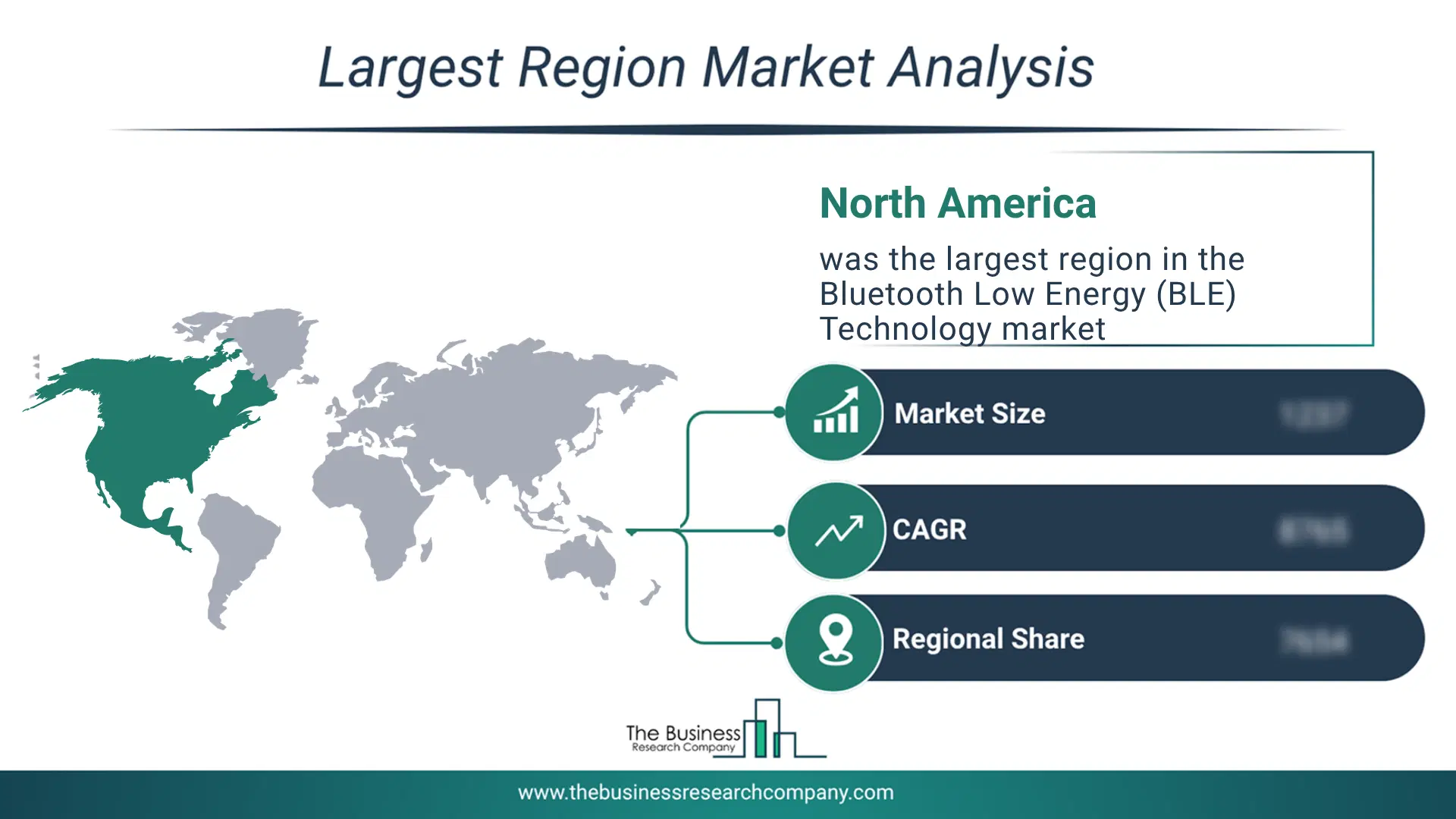
Regional Insights
North America was the largest region in the bluetooth low energy (BLE) technology market in 2025. Asia-Pacific is expected to be the fastest-growing region in the forecast period. The regions covered in this market report are Asia-Pacific, South East Asia, Western Europe, Eastern Europe, North America, South America, Middle East, Africa. The countries covered in this market report are Australia, Brazil, China, France, Germany, India, Indonesia, Japan, Taiwan, Russia, South Korea, UK, USA, Canada, Italy, Spain.What Defines the Bluetooth Low Energy (BLE) Technology Market?
The Bluetooth low energy (BLE) technology market consists of revenues earned by entities by providing services such as application development and integration, consulting and training, and system integration and support. The market value includes the value of related goods sold by the service provider or included within the service offering. The bluetooth low energy (BLE) technology market also includes smart home devices, BLE protocol stacks, sensors, beacons, applications, and firmware. Values in this market are ‘factory gate’ values, that is, the value of goods sold by the manufacturers or creators of the goods, whether to other entities (including downstream manufacturers, wholesalers, distributors, and retailers) or directly to end customers. The value of goods in this market includes related services sold by the creators of the goods.How is Market Value Defined and Measured?
The market value is defined as the revenues that enterprises gain from the sale of goods and/or services within the specified market and geography through sales, grants, or donations in terms of the currency (in USD unless otherwise specified). The revenues for a specified geography are consumption values that are revenues generated by organizations in the specified geography within the market, irrespective of where they are produced. It does not include revenues from resales along the supply chain, either further along the supply chain or as part of other products.
This chart presents market attractiveness based on a quantitative evaluation of growth, competition, strategic alignment, and risk, offering a clear view of opportunity areas for decision-making. This chart is for illustrative purposes; the full report contains the complete analysis.

This chart highlights the Total Addressable Market (TAM) by estimating the maximum revenue opportunity using an assumption-driven approach, supporting strategic planning and opportunity sizing across markets. The chart is illustrative; the full report provides a more comprehensive analysis.
What Key Data and Analysis Are Included in the Bluetooth Low Energy (BLE) Technology Market Report 2026?
The bluetooth low energy (ble) technology market research report is one of a series of new reports from The Business Research Company that provides market statistics, including industry global market size, regional shares, competitors with the market share, detailed market segments, market trends and opportunities, and any further data you may need to thrive in the bluetooth low energy (ble) technology industry. The market research report delivers a complete perspective of everything you need, with an in-depth analysis of the current and future state of the industry.Bluetooth Low Energy (BLE) Technology Market Report Forecast Analysis
| Report Attribute | Details |
|---|---|
| Market Size Value In 2026 | $10.38 billion |
| Revenue Forecast In 2030 | $12.06 billion |
| Growth Rate | CAGR of 3.8% from 2026 to 2030 |
| Base Year For Estimation | 2025 |
| Actual Estimates/Historical Data | 2020-2025 |
| Forecast Period | 2026 - 2030 |
| Market Representation | Revenue in USD Billion and CAGR from 2026 to 2030 |
| Segments Covered | Offering, Mode, End User |
| Regional Scope | Asia-Pacific, Western Europe, Eastern Europe, North America, South America, Middle East, Africa |
| Country Scope | The Countries Covered In This Market Report Are Australia, Brazil, China, France, Germany, India, Indonesia, Japan, Taiwan, Russia, South Korea, Uk, Usa, Canada, Italy, Spain. |
| Key Companies Profiled | Apple Inc., Samsung Electronics Co. Ltd., Qualcomm Incorporated, Broadcom Inc., Texas Instruments Incorporated, STMicroelectronics N.V., NXP Semiconductors N.V., Nordic Semiconductor ASA, Microchip Technology Incorporated, Silicon Laboratories Inc., Infineon Technologies AG, Renesas Electronics Corporation, Analog Devices Inc., MediaTek Inc., Realtek Semiconductor Corp., Espressif Systems ShanghAI Co. Ltd., Dialog Semiconductor Plc, Telit Communications PLC, Quectel Wireless Solutions Co. Ltd., Sierra Wireless Inc. |
| Customization Scope | Request for Customization |
| Pricing And Purchase Options | Explore Purchase Options |