
Breast Ultrasound Market Report 2026
Global Outlook – By Product (Conventional Breast Ultrasound (CBUS), Automated Breast Ultrasound (ABUS)), By Technology (Two-Dimensional (2D) Ultrasound, Three-Dimensional (3D) And Four-Dimensional (4D) Ultrasound, Doppler Ultrasound), By End-Use (Hospital, Diagnostics Imaging Laboratories, Other End-Uses) – Market Size, Trends, Strategies, and Forecast to 2030
Breast Ultrasound Market Overview
• Breast Ultrasound market size has reached to $3.09 billion in 2025 • Expected to grow to $5.58 billion in 2030 at a compound annual growth rate (CAGR) of 12.4% • Growth Driver: The Increasing Breast Cancer Incidence Is Fueling The Growth Of The Market Due To Rising Diagnosis Needs And Demand For Accurate Imaging Solutions • Market Trend: AI-Powered ABUS Systems Enhance Early Detection And Diagnostic Accuracy In Dense Breast Tissue • North America was the largest region in 2025 and Asia-Pacific is the fastest growing region.What Is Covered Under Breast Ultrasound Market?
Breast ultrasound refers to a non-invasive imaging technique that uses high-frequency sound waves to produce real-time images of the internal structures of the breast. It is commonly used to evaluate abnormalities found during a physical exam or mammogram, helping to distinguish between solid masses and fluid-filled cysts. The main product types of breast ultrasound are conventional breast ultrasound (CBUS) and automated breast ultrasound (ABUS). Conventional breast ultrasound (CBUS) is a cost-effective, operator-dependent imaging method using a handheld transducer to detect lumps or cysts, especially in women with dense breasts. It utilizes various technologies, such as two-dimensional (2D) ultrasound, three-dimensional (3D) and four-dimensional (4D) ultrasound, and Doppler ultrasound, and is used by several end-users, such as hospitals, diagnostic imaging laboratories, and others.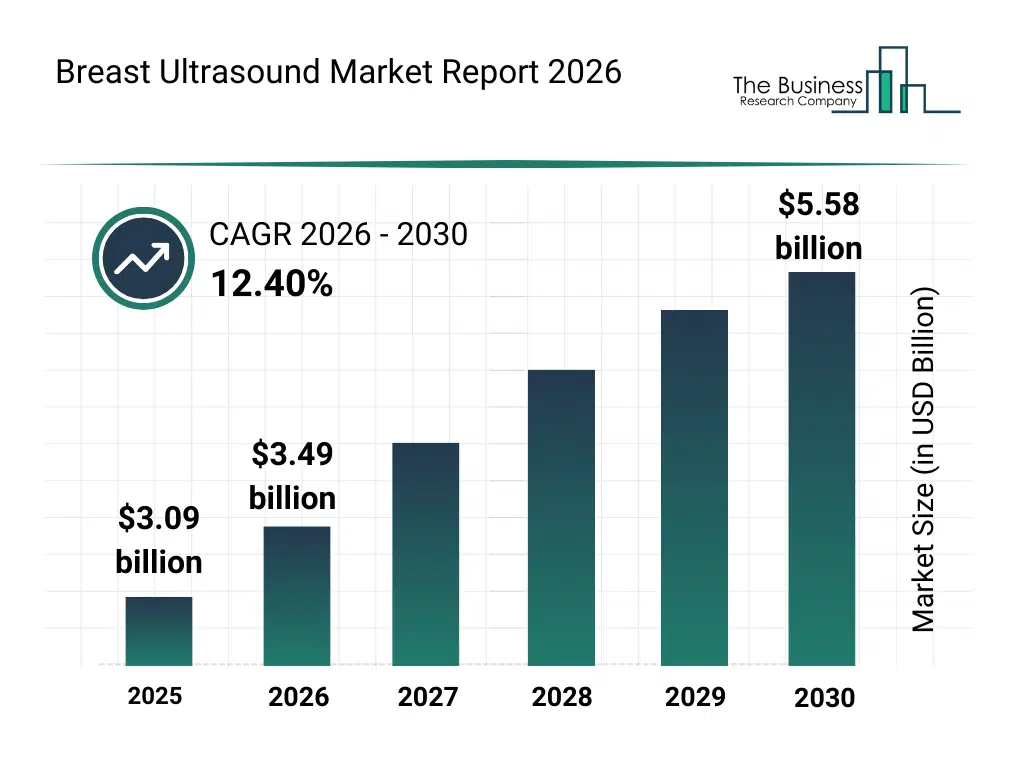
What Is The Breast Ultrasound Market Size and Share 2026?
The breast ultrasound market size has grown rapidly in recent years. It will grow from $3.09 billion in 2025 to $3.49 billion in 2026 at a compound annual growth rate (CAGR) of 12.9%. The growth in the historic period can be attributed to reliance on conventional 2d ultrasound systems, limited access to automated imaging technologies, growing awareness of breast cancer screening, increasing hospital infrastructure for imaging, advancements in doppler ultrasound applications.What Is The Breast Ultrasound Market Growth Forecast?
The breast ultrasound market size is expected to see rapid growth in the next few years. It will grow to $5.58 billion in 2030 at a compound annual growth rate (CAGR) of 12.4%. The growth in the forecast period can be attributed to integration of abUS with full-field digital mammography (ffdm), development of mobile and compact ultrasound units, rising adoption of 3d/4d imaging in hospitals, growth of preventive healthcare and screening programs, increasing investment in diagnostic imaging laboratories. Major trends in the forecast period include rising adoption of automated breast ultrasound (abus) systems, increasing use of portable and handheld ultrasound devices, growth in 3D and 4d ultrasound technologies, expansion of diagnostic imaging laboratories, focus on early breast cancer detection and screening programs.
Global Breast Ultrasound Market Segmentation
1) By Product: Conventional Breast Ultrasound (CBUS), Automated Breast Ultrasound (ABUS) 2) By Technology: Two-Dimensional (2D) Ultrasound, Three-Dimensional (3D) And Four-Dimensional (4D) Ultrasound, Doppler Ultrasound 3) By End-Use: Hospital, Diagnostics Imaging Laboratories, Other End-Uses Subsegments: 1) By Conventional Breast Ultrasound (CBUS): Portable Or Handheld Ultrasound Systems, Cart Or Trolley-Based Ultrasound Systems, Compact Or Notebook Ultrasound Systems 2) By Automated Breast Ultrasound (ABUS): Standalone Automated Breast Ultrasound (ABUS) Systems, Integrated Automated Breast Ultrasound (ABUS) With Full-Field Digital Mammography (FFDM), Mobile Automated Breast Ultrasound (ABUS) UnitsWhat Is The Driver Of The Breast Ultrasound Market?
The increasing breast cancer incidence is expected to propel the growth of the breast ultrasound market going forward. Breast cancer is a type of cancer that originates in the breast tissue and has the potential to invade nearby areas or metastasize to other parts of the body. Breast cancer incidence is rising due to increased exposure to lifestyle-related risk factors such as obesity, which alters hormone levels and promotes cancer development. Breast ultrasound supports the rising incidence of breast cancer by providing a reliable, non-invasive tool for early detection and accurate differentiation of breast abnormalities, especially in dense breast tissue. For instance, in October 2024, according to the American Cancer Society, a US-based cancer organization, in 2022, an estimated 287,850 new cases of invasive breast cancer and 51,400 cases of ductal carcinoma in situ (DCIS) were diagnosed among women in the United States, rising to approximately 310,720 invasive cases and 56,500 DCIS cases by 2024. Therefore, the increasing breast cancer incidence is driving the growth of the breast ultrasound industry.Key Players In The Global Breast Ultrasound Market
Major companies operating in the breast ultrasound market are Samsung Electronics Co Ltd, Hitachi Ltd, Siemens Healthineers, Koninklijke Philips NV, GE Healthcare, Hologic Inc, Mindray Medical International Limited, Canon Medical Systems Corporation, Carestream Health Inc, Fujifilm Sonosite Inc, Esaote SpA, Sonoscape Medical Corp, Shantou Institute of Ultrasonic Instruments, Terason, Delphinus Medical Technologies Inc, SonoCine Inc, Clarius Mobile Health Corp, QT Imaging Inc, QView Medical Inc, BK Medical, Supersonic Imagine, Analogic Corporation
This chart is for illustrative purposes; the full report includes a detailed competitor analysis and comprehensive overview of the top 10 companies in the market.
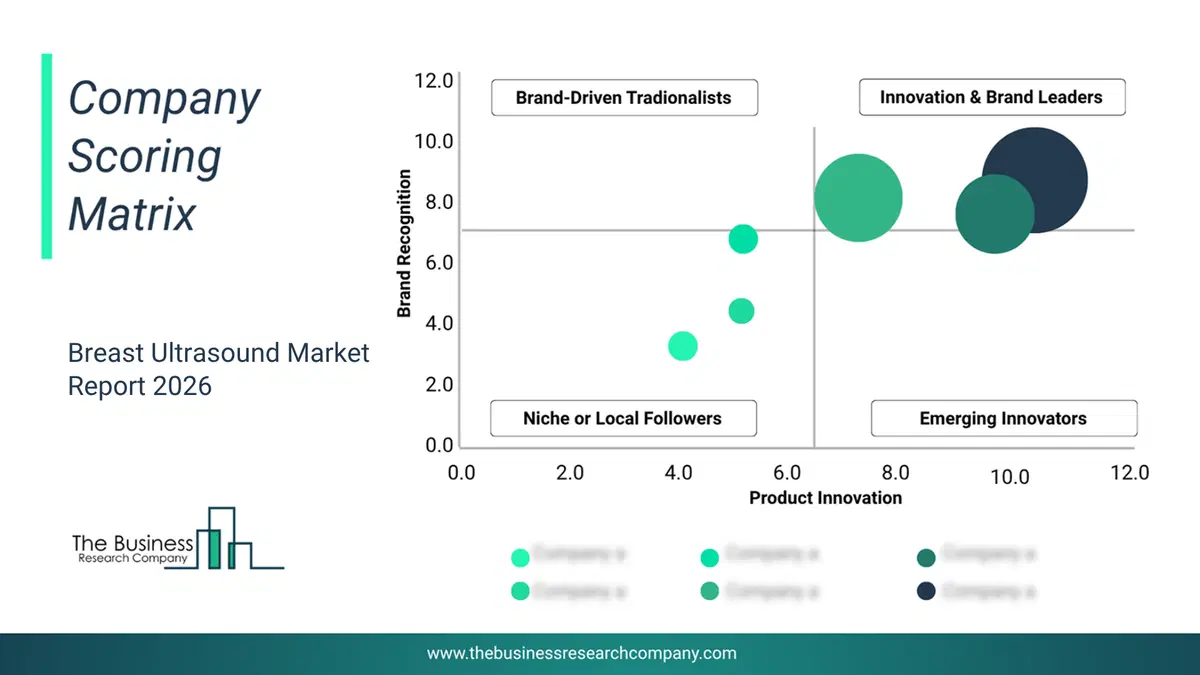
This chart maps companies by product innovation and brand strength, with bubble size indicating relative revenue, helping identify market leaders, challengers, and niche players. This is an illustrative chart; the full report provides a complete and accurate competitive analysis.
Global Breast Ultrasound Market Trends and Insights
Major companies operating in the breast ultrasound market are focusing on developing advanced technology, such as AI-integrated breast ultrasound systems (BUS), to improve diagnostic speed and early detection, particularly in women with dense breast tissue. AI-integrated ABUS refers to ultrasound systems enhanced with artificial intelligence that assist in automated image acquisition, real-time quality checks, and lesion detection, thereby reducing scan variability and operator dependence. For instance, in March 2025, GE HealthCare, a US-based provider of healthcare IT solutions, launched the Invenia ABUS Premium, a patient-friendly 3D automated breast ultrasound system. It has received premarket approval from the U.S. FDA to improve detection sensitivity when used alongside mammography, addressing the challenge that dense breast tissue can mask cancers in traditional screenings. The system features advanced AI tools like Verisound AI for scan quality assessment, auto nipple detection, and a Fast Scan tool that speeds up scanning by up to 40%. Its non-invasive design enhances patient comfort, reduces unnecessary biopsies, and avoids radiation exposure.What Are Latest Mergers And Acquisitions In The Breast Ultrasound Market?
In June 2025, RadNet Inc., a US-based provider of diagnostic imaging services and digital health solutions, acquired See-Mode Technologies for an undisclosed amount. Through this acquisition, RadNet plans to integrate See-Mode’s technology into its DeepHealth population health solutions, positioning itself at the forefront of AI innovation in ultrasound and addressing high demand and capacity constraints in ultrasound imaging services. See-Mode Technologies is a Singapore-based provider of AI for breast ultrasound imaging.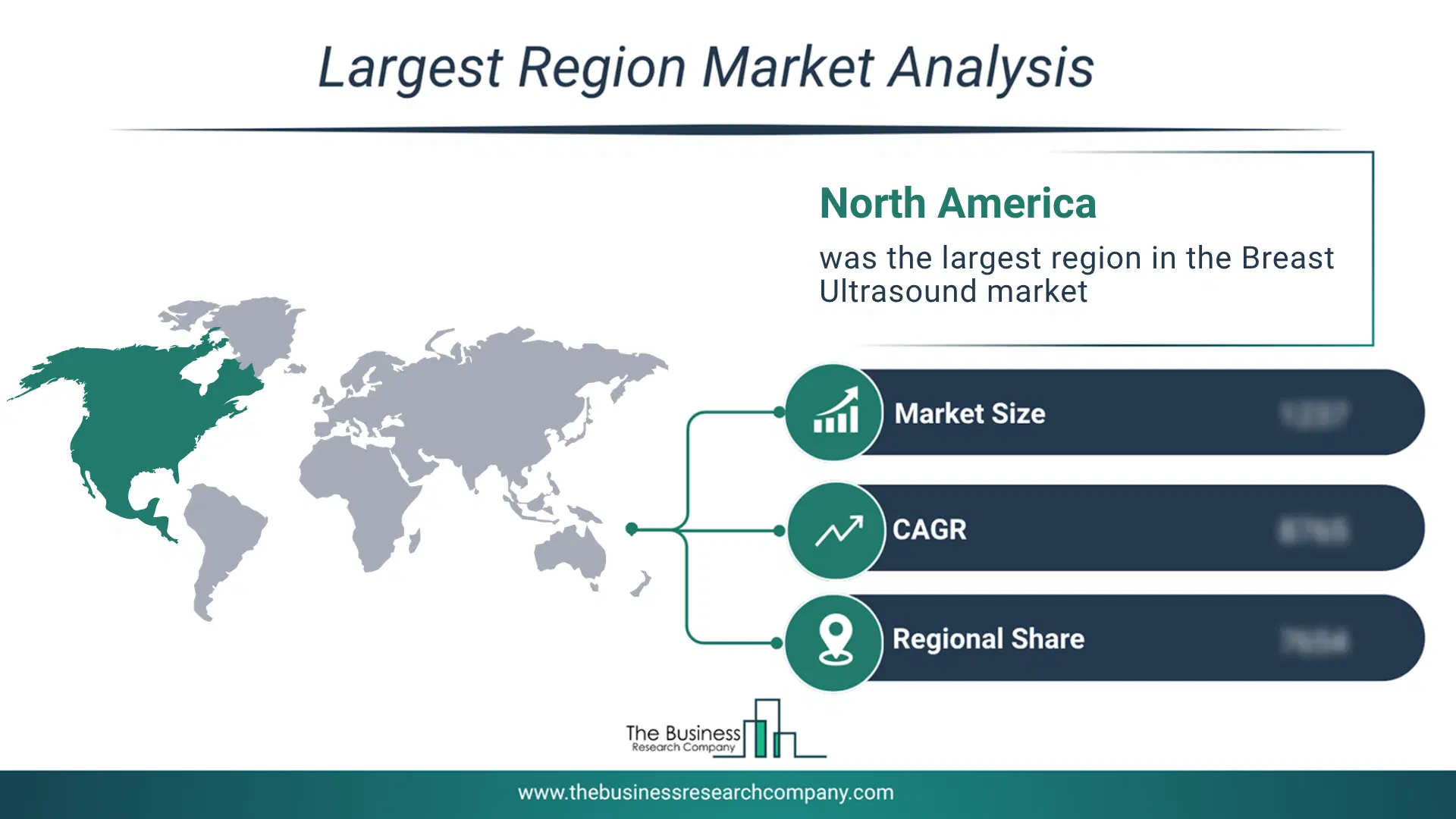
Regional Outlook
North America was the largest region in the breast ultrasound market in 2025. Asia-Pacific is expected to be the fastest-growing region in the forecast period. The regions covered in this market report are Asia-Pacific, South East Asia, Western Europe, Eastern Europe, North America, South America, Middle East, Africa. The countries covered in this market report are Australia, Brazil, China, France, Germany, India, Indonesia, Japan, Taiwan, Russia, South Korea, UK, USA, Canada, Italy, SpainWhat Defines the Breast Ultrasound Market?
The breast ultrasound market consists of revenues earned by entities by providing services such as detection of breast abnormalities, evaluation of dense breast tissue, guidance for biopsies, and assessment of symptoms. The market value includes the value of related goods sold by the service provider or included within the service offering. The breast ultrasound market includes sales of transducers, display screens, data storage systems, gel warmers, and ultrasound consoles. Values in this market are ‘factory gate’ values, that is, the value of goods sold by the manufacturers or creators of the goods, whether to other entities (including downstream manufacturers, wholesalers, distributors, and retailers) or directly to end customers. The value of goods in this market includes related services sold by the creators of the goods.How is Market Value Defined and Measured?
The market value is defined as the revenues that enterprises gain from the sale of goods and/or services within the specified market and geography through sales, grants, or donations in terms of the currency (in USD unless otherwise specified). The revenues for a specified geography are consumption values that are revenues generated by organizations in the specified geography within the market, irrespective of where they are produced. It does not include revenues from resales along the supply chain, either further along the supply chain or as part of other products.
This chart presents market attractiveness based on a quantitative evaluation of growth, competition, strategic alignment, and risk, offering a clear view of opportunity areas for decision-making. This chart is for illustrative purposes; the full report contains the complete analysis.

This chart highlights the Total Addressable Market (TAM) by estimating the maximum revenue opportunity using an assumption-driven approach, supporting strategic planning and opportunity sizing across markets. The chart is illustrative; the full report provides a more comprehensive analysis.
What Key Data and Analysis Are Included in the Breast Ultrasound Market Report 2026?
The breast ultrasound market research report is one of a series of new reports from The Business Research Company that provides market statistics, including industry global market size, regional shares, competitors with the market share, detailed market segments, market trends and opportunities, and any further data you may need to thrive in the breast ultrasound industry. The market research report delivers a complete perspective of everything you need, with an in-depth analysis of the current and future state of the industry.Breast Ultrasound Market Report Forecast Analysis
| Report Attribute | Details |
|---|---|
| Market Size Value In 2026 | $3.49 billion |
| Revenue Forecast In 2030 | $5.58 billion |
| Growth Rate | CAGR of 12.4% from 2026 to 2030 |
| Base Year For Estimation | 2025 |
| Actual Estimates/Historical Data | 2020-2025 |
| Forecast Period | 2026 - 2030 |
| Market Representation | Revenue in USD Billion and CAGR from 2026 to 2030 |
| Segments Covered | Product, Technology, End-Use |
| Regional Scope | Asia-Pacific, Western Europe, Eastern Europe, North America, South America, Middle East, Africa |
| Country Scope | The countries covered in the report are Australia, Brazil, China, France, Germany, India, Indonesia, Japan, Taiwan, Russia, South Korea, UK, USA, Canada, Italy, Spain. |
| Key Companies Profiled | Samsung Electronics Co Ltd, Hitachi Ltd, Siemens Healthineers, Koninklijke Philips NV, GE Healthcare, Hologic Inc, Mindray Medical International Limited, Canon Medical Systems Corporation, Carestream Health Inc, Fujifilm Sonosite Inc, Esaote SpA, Sonoscape Medical Corp, Shantou Institute of Ultrasonic Instruments, Terason, Delphinus Medical Technologies Inc, SonoCine Inc, Clarius Mobile Health Corp, QT Imaging Inc, QView Medical Inc, BK Medical, Supersonic Imagine, Analogic Corporation |
| Customization Scope | Request for Customization |
| Pricing And Purchase Options | Explore Purchase Options |