
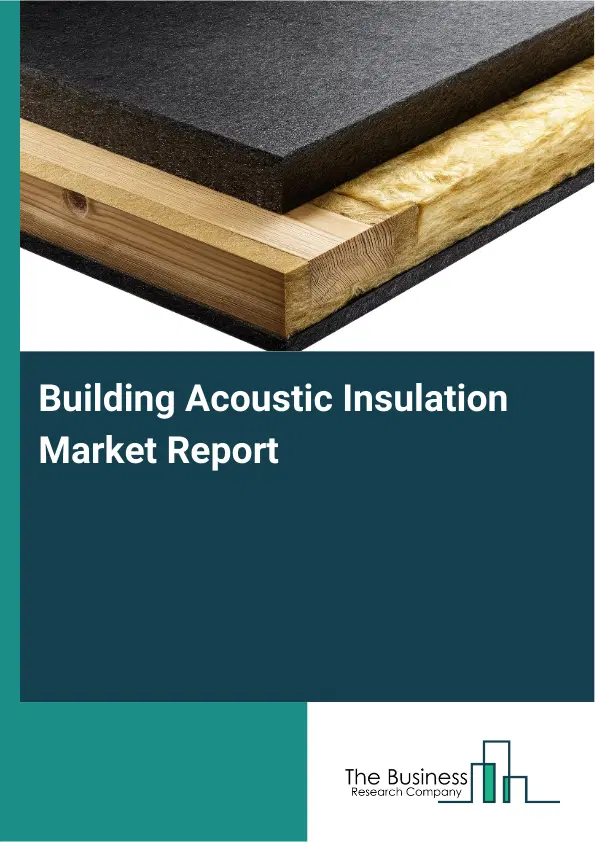
Building Acoustic Insulation Market Report 2026
Global Outlook – By Product (Glass Wool, Rock Wool, Foamed Plastic, Other Products), By Installation Method (Adhesive, Mechanical Fasteners, Spray Foam), By Distribution Channel (Direct, Distributors And Wholesalers, Online, Retail), By Application (Walls, Ceilings, Floors, Doors, Windows), By End User (Commercial, Industrial, Infrastructure, Residential) – Market Size, Trends, Strategies, and Forecast to 2030
Building Acoustic Insulation Market Overview
• Building Acoustic Insulation market size has reached to $10.73 billion in 2025 • Expected to grow to $15.07 billion in 2030 at a compound annual growth rate (CAGR) of 7% • Growth Driver: Rising Green Building Initiatives Driving Growth In The Market Due To Enhanced Energy Efficiency And Sustainable Construction Practices • Market Trend: Technological Advancements In Low-Frequency Acoustic Insulation For Enhanced Indoor Comfort • North America was the largest region in 2025.What Is Covered Under Building Acoustic Insulation Market?
Building acoustic insulation refers to the application of specialized materials and construction techniques aimed at minimizing the transmission of sound between or within different areas of a structure. It plays a crucial role in reducing noise pollution from external sources as well as controlling sound transfer between adjacent rooms or floors. By incorporating sound-absorbing and sound-blocking components in walls, floors, ceilings, windows, and doors, acoustic insulation enhances indoor comfort, privacy, and productivity. The main product types of building acoustic insulation are glass wool, rock wool, foamed plastic, and others. Glass wool is a fibrous material produced from molten glass, offering thermal and acoustic insulation as well as fire resistance for both building and industrial applications. These are installed through adhesive, mechanical fasteners, and spray foam and are distributed through direct distributors and wholesalers, online and retail. It covers applications such as walls, ceilings, floors, doors, and windows, serving end users including commercial, industrial, infrastructure, and residential.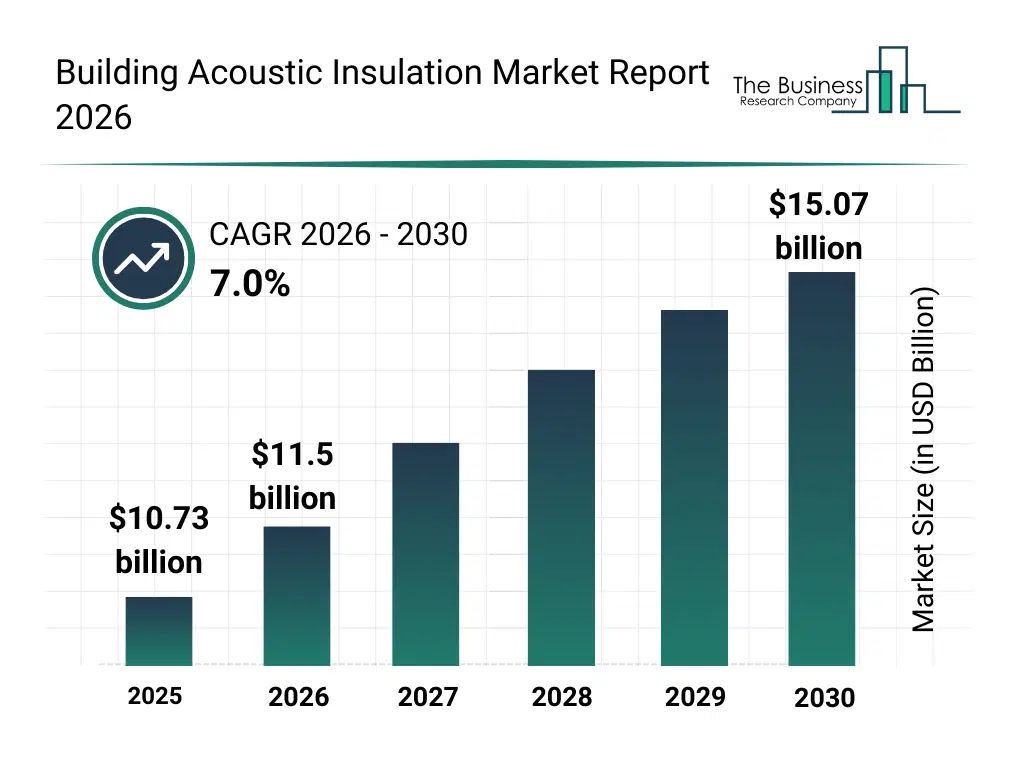
What Is The Building Acoustic Insulation Market Size and Share 2026?
The building acoustic insulation market size has grown strongly in recent years. It will grow from $10.73 billion in 2025 to $11.5 billion in 2026 at a compound annual growth rate (CAGR) of 7.3%. The growth in the historic period can be attributed to rising need for noise mitigation in buildings, increasing adoption of energy-efficient acoustic materials, growth in commercial and residential construction, expanding industrial noise control requirements, increasing use of modular acoustic systems.What Is The Building Acoustic Insulation Market Growth Forecast?
The building acoustic insulation market size is expected to see strong growth in the next few years. It will grow to $15.07 billion in 2030 at a compound annual growth rate (CAGR) of 7.0%. The growth in the forecast period can be attributed to increasing deployment of AI-assisted acoustic analytics, rising integration of connected insulation solutions, adoption of robotics in installation, development of sustainable insulation products, expansion of professional acoustic retrofitting services. Major trends in the forecast period include deployment of automated acoustic insulation installation systems, integration of AI-based acoustic performance analytics, use of smart soundproofing materials, expansion of connected building acoustic networks, adoption of energy-efficient noise control technologies.
Global Building Acoustic Insulation Market Segmentation
1) By Product: Glass Wool, Rock Wool, Foamed Plastic, Other Products 2) By Installation Method: Adhesive, Mechanical Fasteners, Spray Foam 3) By Distribution Channel: Direct, Distributors And Wholesalers, Online, Retail 4) By Application: Walls, Ceilings, Floors, Doors, Windows 5) By End User: Commercial, Industrial, Infrastructure, Residential Subsegments: 1) By Glass Wool: Blanket Rolls, Loose Fill, Rigid Boards 2) By Rock Wool: Slabs Or Boards, Pipe Sections, Loose Fill 3) By Foamed Plastic: Polyurethane Foam, Polystyrene Foam, Polyethylene Foam 4) By Other Products: Mineral Fiber Panels, Cotton Fiber Insulation, Cellulose InsulationWhat Is The Driver Of The Building Acoustic Insulation Market?
The increasing prevalence of green building initiatives and certifications is expected to propel the growth of the building acoustic insulation market going forward. Green building initiatives and certifications refer to programs and standards that promote sustainable, energy-efficient, and environmentally responsible construction and building operations. Increasing green building initiatives and certifications are driven by growing environmental awareness, as stakeholders aim to reduce energy use and carbon emissions and promote sustainable construction. Building acoustic insulation supports green building initiatives and certifications by improving energy efficiency through better thermal and sound insulation, enhancing occupant comfort, and contributing to sustainable, high-performance building standards. For instance, in July 2024, according to the Green Building Council, a US-based non-profit organization, over 46,000 residential projects earned leadership in energy and environmental design (LEED) green building certification, showing 5% rise in new registrations compared to 2023. Therefore, the increasing prevalence of green building initiatives and certifications is driving the growth of the building acoustic insulation industry.Key Players In The Global Building Acoustic Insulation Market
Major companies operating in the building acoustic insulation market are BASF SE, Saint-Gobain S.A., Holcim Ltd., Autex Industries Ltd., Knauf Gips KG, Owens Corning, Kingspan Group plc, Huntsman Corporation, Rockwool International A/S, Trelleborg AB, Aspen Aerogels Inc., L'Isolante K-Flex S.p.A., Fletcher Insulation Ltd., Acoustical Surfaces Inc., Vertisol S.A., Auralex Acoustics Inc., Quietstone UK Ltd., Hush Acoustics Ltd., Acoustics First Corporation., Cellecta Ltd., DDS Acoustical Specialties Inc., Soundproof Cow Inc., TechnoSonus Pvt. Ltd.
This chart is for illustrative purposes; the full report includes a detailed competitor analysis and comprehensive overview of the top 10 companies in the market.
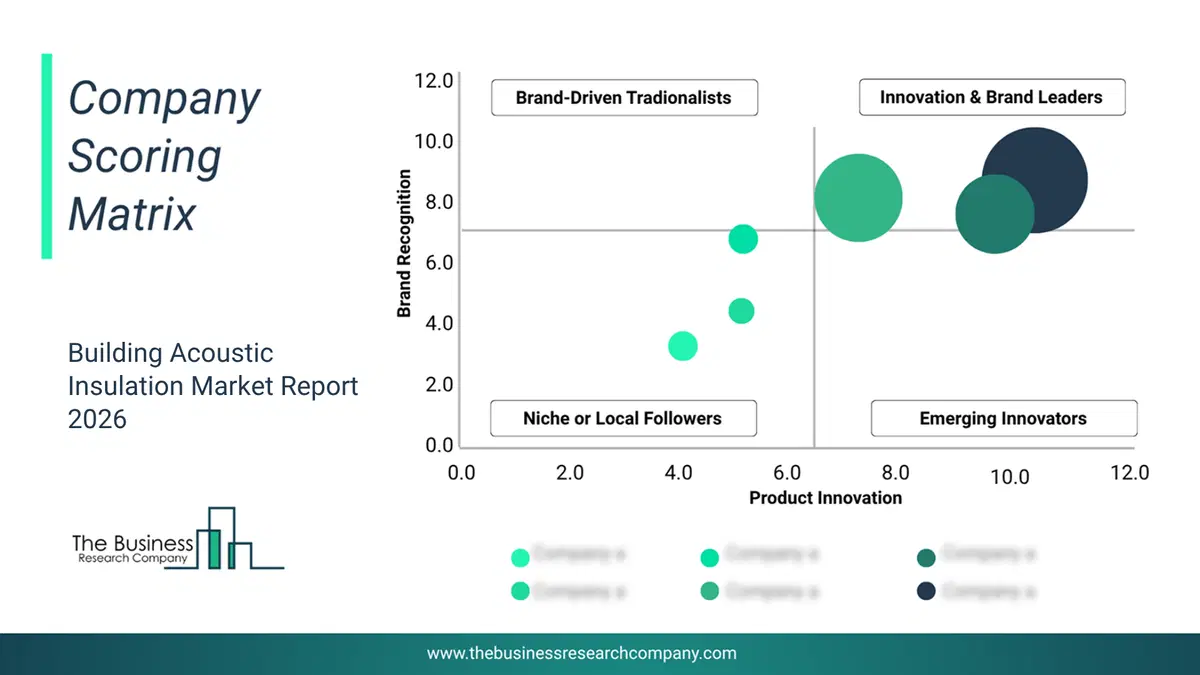
This chart maps companies by product innovation and brand strength, with bubble size indicating relative revenue, helping identify market leaders, challengers, and niche players. This is an illustrative chart; the full report provides a complete and accurate competitive analysis.
Global Building Acoustic Insulation Market Trends and Insights
Major companies operating in the building acoustic insulation market are focusing on developing technological advancements such as low-frequency sound insulation to enhance noise reduction efficiency and meet the growing demand for high-performance, sustainable, and energy-efficient building solutions. Low-frequency sound insulation refers to materials or systems designed to reduce or block sound waves at low frequencies (typically below 250 Hz), which are harder to control and can cause vibrations and structural noise in buildings. For instance, in September 2025, TIKIDAN, an India-based manufacturing company, launched advanced acoustic insulation systems named M.A.D. and Impactodan, aimed at reducing airborne, impact, and footfall noise in various environments such as homes, workplaces, and institutional spaces. These solutions are high-performance, sheet-based systems suitable for installation on floors, walls, and ceilings. They are designed specifically to absorb low-frequency sounds and structural vibrations, which helps in reducing environmental noise and enhances indoor comfort and quality of life.What Are Latest Mergers And Acquisitions In The Building Acoustic Insulation Market?
In February 2024, Compagnie de Saint-Gobain, a France-based construction materials company, acquired International Cellulose Corporation for an undisclosed amount. Through this acquisition, Compagnie de Saint-Gobain aims to reinforce its leadership in light and sustainable construction by broadening its portfolio of eco-friendly insulation and fireproofing solutions, aimed at improving energy efficiency and safety in commercial buildings while advancing its 2050 net-zero carbon emissions target. International Cellulose Corporation is a US-based manufacturer specializing in building acoustic insulation.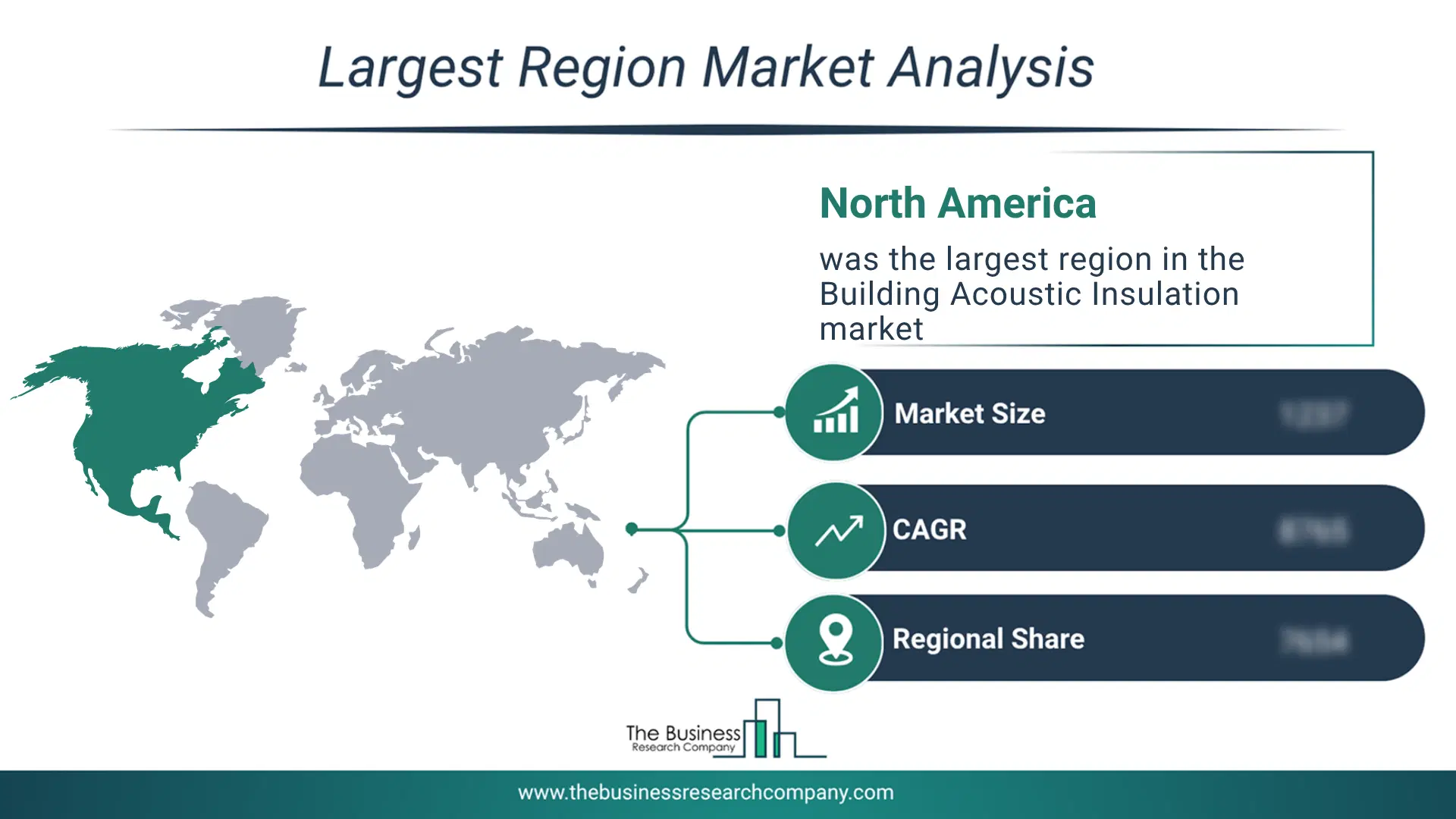
Regional Insights
North America was the largest region in the building acoustic insulation market in 2025. The regions covered in this market report are Asia-Pacific, South East Asia, Western Europe, Eastern Europe, North America, South America, Middle East, Africa. The countries covered in this market report are Australia, Brazil, China, France, Germany, India, Indonesia, Japan, Taiwan, Russia, South Korea, UK, USA, Canada, Italy, Spain.What Defines the Building Acoustic Insulation Market?
The building acoustic insulation market consists of sales of acoustic panels, acoustic curtains and drapes, and soundproof doors and windows. Values in this market are ‘factory gate’ values, that is, the value of goods sold by the manufacturers or creators of the goods, whether to other entities (including downstream manufacturers, wholesalers, distributors, and retailers) or directly to end customers. The value of goods in this market includes related services sold by the creators of the goods.How is Market Value Defined and Measured?
The market value is defined as the revenues that enterprises gain from the sale of goods and/or services within the specified market and geography through sales, grants, or donations in terms of the currency (in USD unless otherwise specified). The revenues for a specified geography are consumption values that are revenues generated by organizations in the specified geography within the market, irrespective of where they are produced. It does not include revenues from resales along the supply chain, either further along the supply chain or as part of other products.
This chart presents market attractiveness based on a quantitative evaluation of growth, competition, strategic alignment, and risk, offering a clear view of opportunity areas for decision-making. This chart is for illustrative purposes; the full report contains the complete analysis.

This chart highlights the Total Addressable Market (TAM) by estimating the maximum revenue opportunity using an assumption-driven approach, supporting strategic planning and opportunity sizing across markets. The chart is illustrative; the full report provides a more comprehensive analysis.
What Key Data and Analysis Are Included in theBuilding Acoustic Insulation Market Report 2026?
The building acoustic insulation market research report is one of a series of new reports from The Business Research Company that provides market statistics, including industry global market size, regional shares, competitors with the market share, detailed market segments, market trends and opportunities, and any further data you may need to thrive in the building acoustic insulation industry. The market research report delivers a complete perspective of everything you need, with an in-depth analysis of the current and future state of the industry.Building Acoustic Insulation Market Report Forecast Analysis
| Report Attribute | Details |
|---|---|
| Market Size Value In 2026 | $11.5 billion |
| Revenue Forecast In 2030 | $15.07 billion |
| Growth Rate | CAGR of 7.3% from 2026 to 2030 |
| Base Year For Estimation | 2025 |
| Actual Estimates/Historical Data | 2020-2025 |
| Forecast Period | 2026 - 2030 |
| Market Representation | Revenue in USD Billion and CAGR from 2026 to 2030 |
| Segments Covered | Product, Installation Method, Distribution Channel, Application, End User |
| Regional Scope | Asia-Pacific, Western Europe, Eastern Europe, North America, South America, Middle East, Africa |
| Country Scope | The countries covered in this market report are Australia, Brazil, China, France, Germany, India, Indonesia, Japan, Taiwan, Russia, South Korea, UK, USA, Canada, Italy, Spain |
| Key Companies Profiled | BASF SE, Saint-Gobain S.A., Holcim Ltd., Autex Industries Ltd., Knauf Gips KG, Owens Corning, Kingspan Group plc, Huntsman Corporation, Rockwool International A/S, Trelleborg AB, Aspen Aerogels Inc., L'Isolante K-Flex S.p.A., Fletcher Insulation Ltd., Acoustical Surfaces Inc., Vertisol S.A., Auralex Acoustics Inc., Quietstone UK Ltd., Hush Acoustics Ltd., Acoustics First Corporation., Cellecta Ltd., DDS Acoustical Specialties Inc., Soundproof Cow Inc., TechnoSonus Pvt. Ltd. |
| Customization Scope | Request for Customization |
| Pricing And Purchase Options | Explore Purchase Options |