
Cancer Tumor Profiling Market Report 2026
Global Outlook – By Cancer Type (Lung Cancer, Breast Cancer, Colorectal Cancer, Prostate Cancer, Melanoma, Ovarian Cancer, Stomach Cancer, Pancreatic Cancer, Thyroid Cancer, Other Cancer Types ), By Technology (Next-Generation Sequencing (NGS), Polymerase Chain Reaction (PCR), Immunohistochemistry (IHC), In Situ Hybridization (ISH), Microarray, Other Technologies), By Process Type (Genomics, Proteomics, Epigenetics, Other Types), By Application (Personalized Medicine, Diagnostics, Biomarker Discovery, Prognostics, Research Applications) - Market Size, Trends, And Global Forecast 2026-2035
Cancer Tumor Profiling Market Overview
• Cancer Tumor Profiling market size has reached to $14.97 billion in 2025 • Expected to grow to $28.27 billion in 2030 at a compound annual growth rate (CAGR) of 13.4% • Growth Driver: Rising Incidences Of Cancer Across Globe • North America was the largest region in 2025 and Asia-Pacific is the fastest growing region.What Is Covered Under Cancer Tumor Profiling Market?
Cancer tumor profiling refers to a laboratory test that examines a sample of tumor tissue for specific genes, gene mutations (changes), proteins, or other biomarkers. Tumor profiling can help with treatment planning as well as predicting if cancer will recur or spread to other parts of the body. The main types of cancer and tumor profiling are lung cancer, breast cancer, colorectal cancer, prostate cancer, melanoma, ovarian cancer, stomach cancer, pancreatic cancer, thyroid cancer, and other cancer types. The different technologies include next-generation sequencing (NGS), polymerase chain reaction (PCR), immunohistochemistry (IHC), in situ hybridization (ISH), microarrays, and others, and involve various types of processes such as genomics, proteomics, epigenetics, metabolomics, and others. It is used in several applications, including personalized medicine, diagnostics, biomarker discovery, prognostics, and research applications.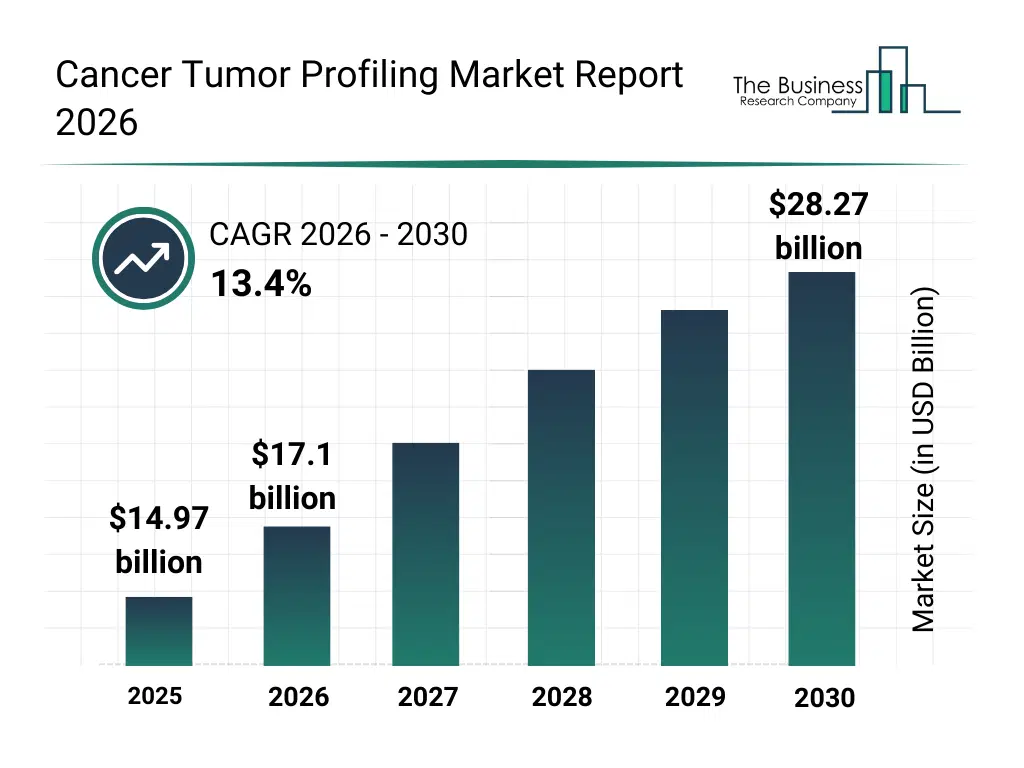
What Is The Cancer Tumor Profiling Market Size and Share 2026?
The cancer tumor profiling market size has grown rapidly in recent years. It will grow from $14.97 billion in 2025 to $17.1 billion in 2026 at a compound annual growth rate (CAGR) of 14.3%. The growth in the historic period can be attributed to increasing utilization of tumor biopsy testing, expansion of oncology research programs, early clinical adoption of molecular stratification, growth of hospital-based profiling services, rising availability of advanced laboratory infrastructure.What Is The Cancer Tumor Profiling Market Growth Forecast?
The cancer tumor profiling market size is expected to see rapid growth in the next few years. It will grow to $28.27 billion in 2030 at a compound annual growth rate (CAGR) of 13.4%. The growth in the forecast period can be attributed to increasing demand for precision oncology decision-making, expansion of personalized cancer therapies, growing investments in translational research, rising adoption of advanced sequencing technologies, increasing focus on predictive oncology diagnostics. Major trends in the forecast period include increasing use of multi-omics tumor profiling, rising adoption of targeted sequencing panels, growing integration of AI-driven biomarker analysis, expansion of personalized treatment planning, enhanced focus on prognostic profiling.
Global Cancer Tumor Profiling Market Segmentation
1) By Cancer Type: Lung Cancer, Breast Cancer, Colorectal Cancer, Prostate Cancer, Melanoma, Ovarian Cancer, Stomach Cancer, Pancreatic Cancer, Thyroid Cancer, Other Cancer Types 2) By Technology: Next-Generation Sequencing (NGS), Polymerase Chain Reaction (PCR), Immunohistochemistry (IHC), In Situ Hybridization (ISH), Microarray, Other Technologies 3) By Process Type: Genomics, Proteomics, Epigenetics, Other Types 4) By Application: Personalized Medicine, Diagnostics, Biomarker Discovery, Prognostics, Research Applications Subsegments: 1) By Lung Cancer: Non-Small Cell Lung Cancer (NSCLC), Small Cell Lung Cancer (SCLC) 2) By Breast Cancer: Hormone Receptor-Positive, Triple-Negative Breast Cancer, HER2-Positive Breast Cancer 3) By Colorectal Cancer: Colon Cancer, Rectal Cancer 4) By Prostate Cancer: Localized Prostate Cancer, Advanced Prostate Cancer 5) By Melanoma: Cutaneous Melanoma, Non-Cutaneous Melanoma 6) By Ovarian Cancer: Epithelial Ovarian Cancer, Non-Epithelial Ovarian Cancer 7) By Stomach Cancer: Gastric Adenocarcinoma, Gastrointestinal Stromal Tumors (GISTs) 8) By Pancreatic Cancer: Exocrine Pancreatic Cancer, Neuroendocrine Tumors 9) By Thyroid Cancer: Papillary Thyroid Cancer, Follicular Thyroid Cancer, Medullary Thyroid Cancer 10) By Other Cancer Types: Kidney Cancer, Bladder Cancer, Liver Cancer, Esophageal CancerWhat Are The Drivers Of The Cancer Tumor Profiling Market?
The increasing incidences of cancer across the globe are expected to propel the growth of the cancer and tumor profiling market going forward. Cancer is a disease in which some cells in the body get uncontrollably large and spread to other parts of the body. As the number of cancer cases rises, so does the demand for cancer tumor profiling, which enables doctors to determine the severity of the disease. For instance, in 2024, the American Cancer Society, a US-based professional organization based, reported that 2 million new cancer cases were diagnosed in the country, up from 1.9 million new cases in 2023. Therefore, the increasing incidences of cancer across the globe drive the growth of the cancer and tumor profiling market. The growing incidence of stomach cancer is expected to propel the growth of the cancer and tumor profiling market going forward. Stomach cancer refers to the uncontrolled growth and multiplication of malignant cells in the lining of the stomach. while gastrointestinal stromal tumors (GISTs) can occur in the stomach, they are distinct from stomach cancer. When two separate tumors collide and merge into one, patients with GISTs have been found to have an increased risk of developing additional cancers, including small bowel adenocarcinoma. Cancer and tumor profiling provides information regarding the cancer development in stomach and help to provide better treatment. For instance, according to Cancer Research UK, a UK-based independent cancer research organization, the incidence of stomach cancer in the UK is projected to fall by 12% between 2023-2025 and 2038-2040, to 8 cases per 100,000 people on average each year. Therefore, the growing incidence of stomach cancer is driving the growth of the cancer and tumor profiling market.Key Players In The Global Cancer Tumor Profiling Market
Major companies operating in the cancer tumor profiling market are F. Hoffmann-La Roche Ltd., Caris Life Sciences, Thermo Fisher Scientific Inc., Illumina Inc., Qiagen, HTG Molecular Diagnostics Inc., NanoString Technologies Inc., NeoGenomics Laboratories Inc., Lucence Health Inc., ACT Genomics Co. LTD, Strand Life Sciences, Exact Sciences Corporation, Guardant Health, Foundation Medicine Inc., Agilent Technologies Inc., Myriad Genetics Inc., Personal Genome Diagnostics Inc., Tempus Labs Inc., ArcherDX Inc., Natera Inc., Bio-Rad Laboratories Inc., Genetron Health, NantHealth Inc., Resolution Bioscience, OncoDNA, Strata Oncology Inc., RareCyte Inc., Inivata Limited, CepheidWhat Are Latest Mergers And Acquisitions In The Cancer Tumor Profiling Market?
In February 2024, AbbVie Inc. acquired a US-based pharmaceutical company, ImmunoGen, Inc., for an undisclosed amount. With this acquisition, AbbVie Inc. aims to strengthen its research and development capabilities, diversify its product offerings, and accelerate growth in key therapeutic areas. ImmunoGen, Inc. is a US-based biotechnology company focused on the development of antibody-drug conjugate therapeutics for the treatment of cancer.Regional Outlook
North America was the largest region in cancer and tumor profiling market in 2025. Asia-Pacific is expected to be the fastest-growing region in the forecast period. The regions covered in this market report are Asia-Pacific, South East Asia, Western Europe, Eastern Europe, North America, South America, Middle East, Africa. The countries covered in this market report are Australia, Brazil, China, France, Germany, India, Indonesia, Japan, Taiwan, Russia, South Korea, UK, USA, Canada, Italy, Spain.What Defines the Cancer Tumor Profiling Market?
The cancer tumor profiling market includes revenues earned by entities by sanger sequencing, pyro sequencing (PyroSeq), chromogenic/ fluorescence in situ hybridization (CISH/FISH) and fragment analysis (FA/Frag. Analysis). The market value includes the value of related goods sold by the service provider or included within the service offering. Only goods and services traded between entities or sold to end consumers are included.How is Market Value Defined and Measured?
The market value is defined as the revenues that enterprises gain from the sale of goods and/or services within the specified market and geography through sales, grants, or donations in terms of the currency (in USD unless otherwise specified). The revenues for a specified geography are consumption values that are revenues generated by organizations in the specified geography within the market, irrespective of where they are produced. It does not include revenues from resales along the supply chain, either further along the supply chain or as part of other products.What Key Data and Analysis Are Included in the Cancer Tumor Profiling Market Report 2026?
The cancer tumor profiling market research report is one of a series of new reports from The Business Research Company that provides market statistics, including industry global market size, regional shares, competitors with the market share, detailed market segments, market trends and opportunities, and any further data you may need to thrive in the cancer tumor profiling industry. The market research report delivers a complete perspective of everything you need, with an in-depth analysis of the current and future state of the industry.Cancer Tumor Profiling Market Report Forecast Analysis
| Report Attribute | Details |
|---|---|
| Market Size Value In 2026 | $17.1 billion |
| Revenue Forecast In 2035 | $28.27 billion |
| Growth Rate | CAGR of 14.3% from 2026 to 2035 |
| Base Year For Estimation | 2025 |
| Actual Estimates/Historical Data | 2020-2025 |
| Forecast Period | 2026 - 2030 - 2035 |
| Market Representation | Revenue in USD Billion and CAGR from 2026 to 2035 |
| Segments Covered | Cancer Type, Technology, Process Type, Application |
| Regional Scope | Asia-Pacific, Western Europe, Eastern Europe, North America, South America, Middle East, Africa |
| Country Scope | The countries covered in the report are Australia, Brazil, China, France, Germany, India, ... |
| Key Companies Profiled | F. Hoffmann-La Roche Ltd., Caris Life Sciences, Thermo Fisher Scientific Inc., Illumina Inc., Qiagen, HTG Molecular Diagnostics Inc., NanoString Technologies Inc., NeoGenomics Laboratories Inc., Lucence Health Inc., ACT Genomics Co. LTD, Strand Life Sciences, Exact Sciences Corporation, Guardant Health, Foundation Medicine Inc., Agilent Technologies Inc., Myriad Genetics Inc., Personal Genome Diagnostics Inc., Tempus Labs Inc., ArcherDX Inc., Natera Inc., Bio-Rad Laboratories Inc., Genetron Health, NantHealth Inc., Resolution Bioscience, OncoDNA, Strata Oncology Inc., RareCyte Inc., Inivata Limited, Cepheid |
| Customization Scope | Request for Customization |
| Pricing And Purchase Options | Explore Purchase Options |