
Cardiovascular Devices Market Report 2026
Global Outlook – By Type (Cardiovascular Surgery Devices And Equipment, Cardiac Rhythm Management (CRM) Devices And Equipment, Interventional Cardiology Devices And Equipment, Defibrillator Devices And Equipment, Peripheral Vascular Devices And Equipment, Prosthetic Heart Valve Devices And Equipment, Electrophysiology Devices And Equipment, Cardiac Assist Devices And Equipment), By Type of Expenditure (Public, Private), By End User (Hospitals And Clinics, Cardiac Care Centers And Specialty Clinics, Other End Users) – Market Size, Trends, Strategies, and Forecast to 2030
Cardiovascular Devices Market Overview
• Cardiovascular Devices market size has reached to $72.22 billion in 2025 • Expected to grow to $100.37 billion in 2030 at a compound annual growth rate (CAGR) of 7% • Growth Driver: Rising Prevalence Of Cardiovascular Disorders Fuels Growth In The Cardiovascular Device Market • Market Trend: Leading Cardiovascular Device Companies Enhance Profitability With Innovative Heliostar Balloon Ablation Catheter • North America was the largest region in 2025 and Western Europe is the fastest growing region.What Is Covered Under Cardiovascular Devices Market?
Cardiovascular devices are used to monitor and control irregular heartbeats and heart rhythm disorders. The main types in the cardiovascular devices market are cardiovascular surgery devices and equipment, cardiac rhythm management (CRM) devices and equipment, interventional cardiology devices and equipment, defibrillator devices and equipment, peripheral vascular devices and equipment, prosthetic heart valve devices and equipment, electrophysiology devices and equipment, and cardiac assist devices and equipment. Defibrillators are devices that restore the normal heartbeat by sending an electric pulse or shock to the heart. They are used to prevent or correct an arrhythmia, a heartbeat that is uneven or slow or fast. The type of expenditure is public, or private. The products used are instruments/equipment, and disposables. The various end-users are hospitals and clinics, diagnostic laboratories, and others.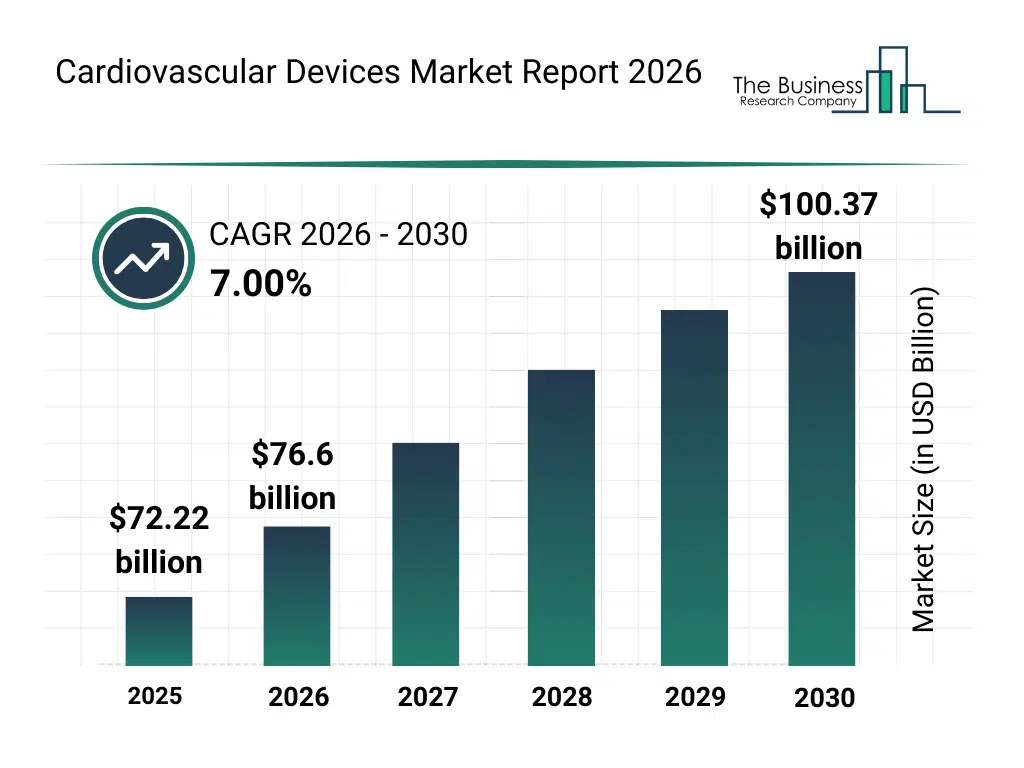
What Is The Cardiovascular Devices Market Size and Share 2026?
The cardiovascular devices market size has grown strongly in recent years. It will grow from $72.22 billion in 2025 to $76.6 billion in 2026 at a compound annual growth rate (CAGR) of 6.1%. The growth in the historic period can be attributed to rising prevalence of cardiovascular diseases, expansion of interventional cardiology procedures, improvements in surgical techniques, growing availability of cardiac care infrastructure, increased use of implantable cardiac devices.What Is The Cardiovascular Devices Market Growth Forecast?
The cardiovascular devices market size is expected to see strong growth in the next few years. It will grow to $100.37 billion in 2030 at a compound annual growth rate (CAGR) of 7.0%. The growth in the forecast period can be attributed to increasing demand for structural heart interventions, rising adoption of AI-assisted cardiac diagnostics, expansion of outpatient cardiovascular procedures, growing investments in next-generation cardiovascular devices, continuous innovation in biocompatible and smart materials. Major trends in the forecast period include increasing adoption of minimally invasive cardiovascular devices, rising use of transcatheter therapies, growing integration of advanced imaging-guided interventions, expansion of remote cardiac monitoring solutions, enhanced focus on device miniaturization and precision.
Global Cardiovascular Devices Market Segmentation
1) By Type: Cardiovascular Surgery Devices And Equipment, Cardiac Rhythm Management (CRM) Devices And Equipment, Interventional Cardiology Devices And Equipment, Defibrillator Devices And Equipment, Peripheral Vascular Devices And Equipment, Prosthetic Heart Valve Devices And Equipment, Electrophysiology Devices And Equipment, Cardiac Assist Devices And Equipment 2) By Type of Expenditure: Public, Private 3) By End User: Hospitals And Clinics, Cardiac Care Centers And Specialty Clinics, Other End Users Subsegments: 1) By Cardiovascular Surgery Devices And Equipment: Coronary Artery Bypass Graft (CABG) Equipment, Heart Valve Repair And Replacement Devices, Aortic Aneurysm Repair Devices, Cardiopulmonary Bypass Equipment, Other Cardiovascular Surgery Devices 2) By Cardiac Rhythm Management (CRM) Devices And Equipment: Pacemakers, Defibrillators, Cardiac Resynchronization Therapy (CRT) Devices 3) By Interventional Cardiology Devices And Equipment: Stents (Drug-Eluting, Bare-Metal), Catheters (Balloon, Diagnostic, Guiding), Angioplasty Equipment, Guidewires, Other Interventional Cardiology Devices 4) By Defibrillator Devices And Equipment: Implantable Cardioverter Defibrillators (ICDs), Automated External Defibrillators (AEDs), Wearable Defibrillators, External Defibrillators 5) By Peripheral Vascular Devices And Equipment: Peripheral Stents, Balloons (Peripheral Angioplasty), Embolic Protection Devices, Endovenous Laser Devices, Other Peripheral Vascular Devices 6) By Prosthetic Heart Valve Devices And Equipment: Mechanical Heart Valves, Biological Heart Valves, Transcatheter Heart Valves (TAVR), Other Prosthetic Heart Valve Devices 7) By Electrophysiology Devices And Equipment: Ablation Catheters, Electrophysiology Mapping Systems, ECG And EKG Systems, Cardiac Mapping And Navigation Systems, Other Electrophysiology Devices 8) By Cardiac Assist Devices And Equipment: Ventricular Assist Devices (LVADs), Intra-Aortic Balloon Pumps, Total Artificial Heart, Extracorporeal Membrane Oxygenation (ECMO), Other Cardiac Assist DevicesWhat Are The Drivers Of The Cardiovascular Devices Market?
The increase in the prevalence of cardiovascular disorders is expected to drive the growth of the cardiovascular device market going forward. Cardiovascular disorders refer to a group of medical conditions that affect the heart and blood vessels, encompassing various diseases and disorders that involve the circulatory system. The growing prevalence is increasing due to aging populations, sedentary lifestyles, poor diet, and rising rates of conditions such as hypertension and diabetes. The cardiovascular device market supports this trend by supplying devices that support heart function and blood flow in people with weak or failing hearts. For instance, in January 2024, according to the American Heart Association, a US-based non-profit organization, the age-adjusted death rate from cardiovascular disease increased to 233.3 per 100,000 in 2024, up 4.0% from 224.4 per 100,000 in 2023. Therefore, the increase in the prevalence of cardiovascular disorders is driving the growth of the cardiovascular device industry. The rising healthcare expenditure is expected to propel the growth of the cardiovascular device market going forward. Healthcare expenditure refers to the total amount of financial resources spent on healthcare services, including medical treatments, hospital care, medications, and public health initiatives, by governments, businesses, and individuals. The increasing demand for healthcare expenditure is due to the rising prevalence of chronic diseases, which require long-term and costly treatments. Rising healthcare expenditure enhances cardiovascular devices by enabling greater adoption of advanced treatment technologies and improving access to life-saving cardiac procedures. It supports better hospital infrastructure, early diagnosis, and high-quality patient care, driving increased utilization of innovative cardiovascular solutions. For instance, in May 2024, according to the Office for National Statistics, a UK-based government department, total healthcare expenditure saw a 5.6% increase in nominal terms in 2023, an increase of 0.9% growth compared to 2022. Therefore, the rising healthcare expenditure is driving the growth of the cardiovascular device industry.Key Players In The Global Cardiovascular Devices Market
Major companies operating in the cardiovascular devices market are Medtronic plc, Boston Scientific Corporation, Abbott Laboratories, Edwards Lifesciences Corporation, Johnson & Johnson, Terumo Corporation, Getinge AB, Teleflex Incorporated, Becton Dickinson and Company, Siemens Healthineers AG, Fresenius SE & Co. KGaA, GE HealthCare Technologies Inc., Stryker Corporation, B. Braun Medical Pvt. Ltd., Baxter International Inc., Fujifilm Holdings Corporation, Canon Medical Systems Corporation, MicroPort Scientific America Inc., W. L. Gore & Associates Inc., AngioDynamics Inc., CryoLife Inc., Endologix LLC, Lombard Medical Limited, Avinger Inc., Abiomed Inc., Biosensors International Group Ltd., Biotronik SE & Co. KG, CeloNova BioSciences Inc., LeMaitre Vascular Inc.
This chart is for illustrative purposes; the full report includes a detailed competitor analysis and comprehensive overview of the top 10 companies in the market.
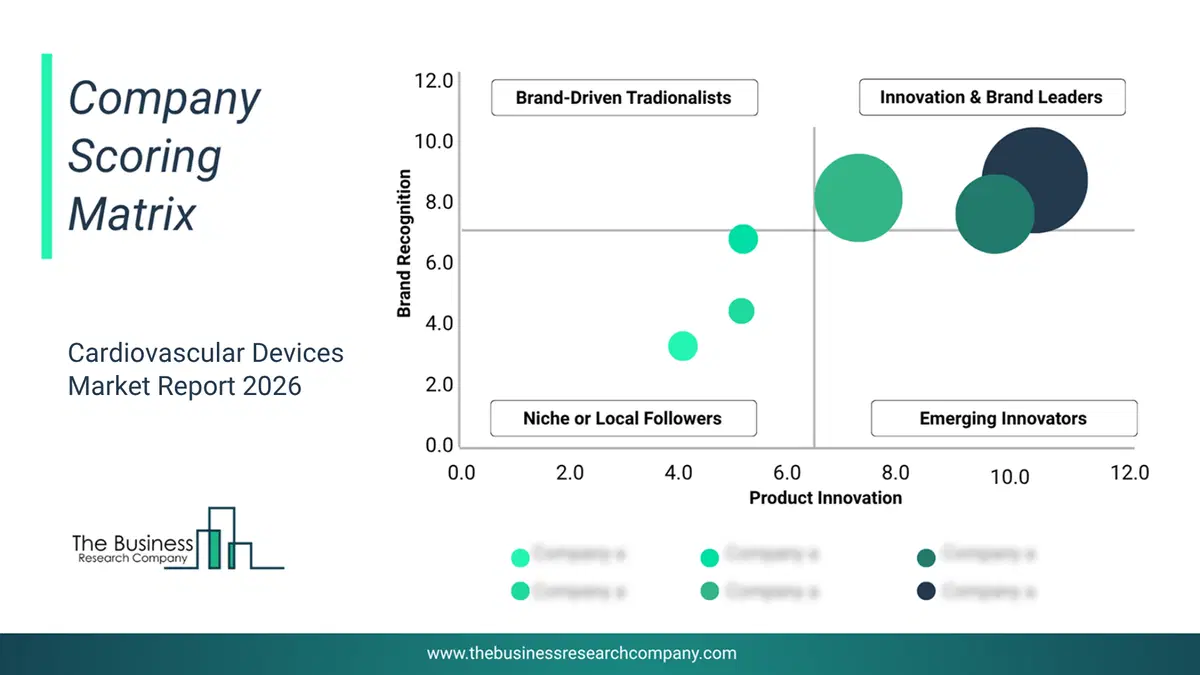
This chart maps companies by product innovation and brand strength, with bubble size indicating relative revenue, helping identify market leaders, challengers, and niche players. This is an illustrative chart; the full report provides a complete and accurate competitive analysis.
Global Cardiovascular Devices Market Trends and Insights
Major companies operating in the cardiovascular devices market are focusing on developing advanced interventional solutions, such as drug-coated balloon catheters, to treat difficult coronary conditions and improve long-term outcomes. A drug-coated balloon catheter is a minimally invasive device that dilates a narrowed coronary artery segment and simultaneously delivers an antiproliferative drug (e.g., paclitaxel) to the arterial wall, helping to prevent restenosis without leaving behind a permanent scaffold. For instance, in March 2024, Boston Scientific, a US-based medical device company, received U.S. FDA approval for its Agent drug-coated balloon catheter, the first of its kind for treating coronary in-stent restenosis (ISR). This device demonstrated significant efficacy in reducing the recurrence of vessel narrowing in a study of 480 patients and provides interventional cardiologists with a non-stent alternative for ISR management.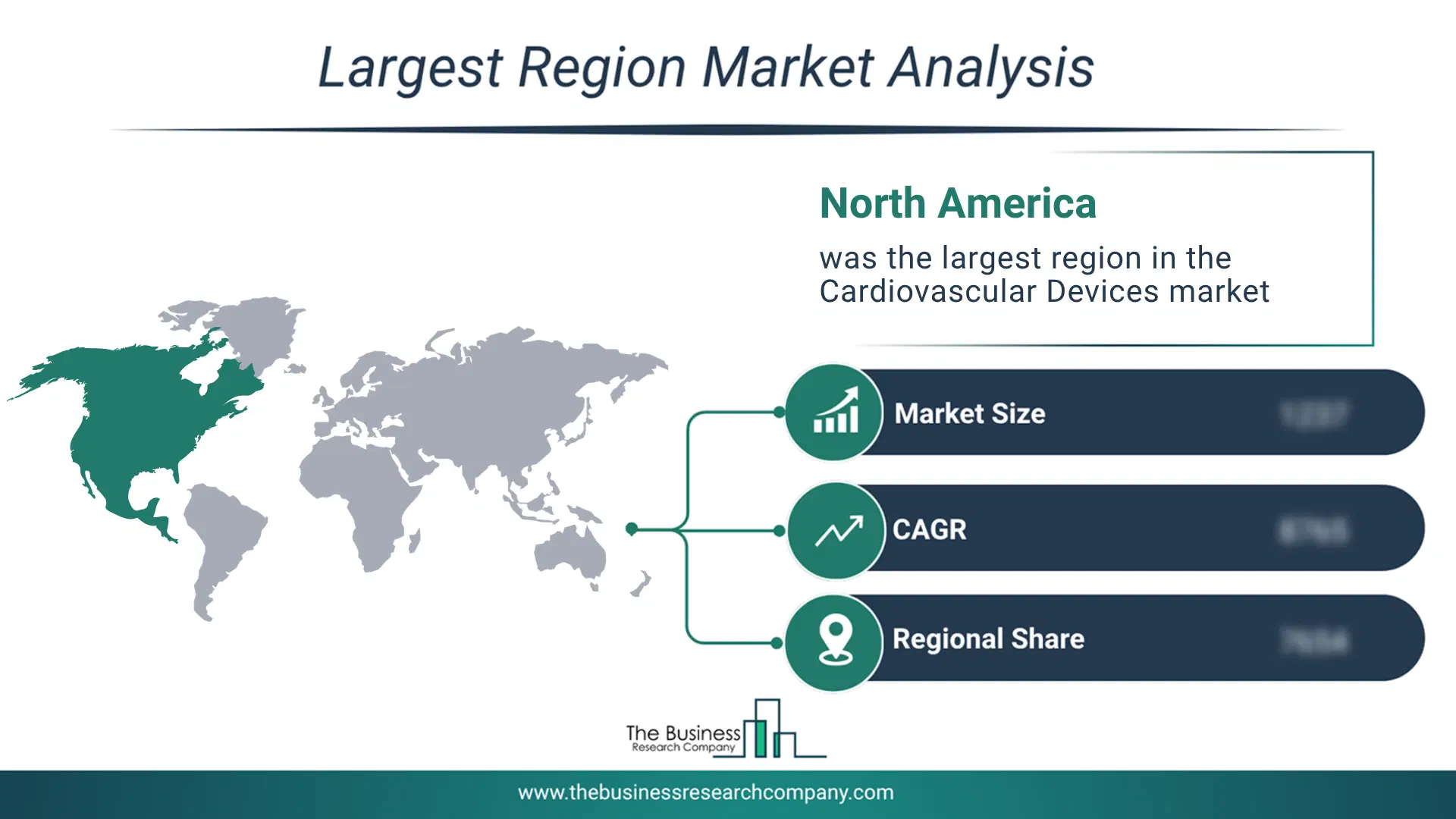
Regional Outlook
North America was the largest region in the global cardiovascular devices market in 2025. Western Europe was the second largest region in the global cardiovascular devices market. Africa. was the smallest region in the global cardiovascular devices market. The regions covered in this market report are Asia-Pacific, South East Asia, Western Europe, Eastern Europe, North America, South America, Middle East, Africa. The countries covered in this market report are China, India, Japan, Australia, Indonesia, South Korea, Bangladesh, Thailand, Vietnam, Malaysia, Singapore, Philippines, Hong Kong, Taiwan, New Zealand, UK, Germany, France, Italy, Spain, Austria, Belgium, Denmark, Finland, Ireland, Netherlands, Norway, Portugal, Sweden, Switzerland, Russia, Czech Republic, Poland, Romania, Ukraine, USA, Canada, Mexico, Brazil, Chile, Argentina, Colombia, Peru, Saudi Arabia, Israel, Iran, Turkey, UAE, Egypt, Nigeria, South Africa.What Defines the Cardiovascular Devices Market?
The cardiovascular devices market consists of sales of biventricular devices, and implantable cardiac loop recorders that are used for monitoring and treatment of cardiovascular disorders. Values in this market are ‘factory gate’ values, that is the value of goods sold by the manufacturers or creators of the goods, whether to other entities (including downstream manufacturers, wholesalers, distributors and retailers) or directly to end customers. The value of goods in this market includes related services sold by the creators of the goods.How is Market Value Defined and Measured?
The market value is defined as the revenues that enterprises gain from the sale of goods and/or services within the specified market and geography through sales, grants, or donations in terms of the currency (in USD unless otherwise specified). The revenues for a specified geography are consumption values that are revenues generated by organizations in the specified geography within the market, irrespective of where they are produced. It does not include revenues from resales along the supply chain, either further along the supply chain or as part of other products.
This chart presents market attractiveness based on a quantitative evaluation of growth, competition, strategic alignment, and risk, offering a clear view of opportunity areas for decision-making. This chart is for illustrative purposes; the full report contains the complete analysis.

This chart highlights the Total Addressable Market (TAM) by estimating the maximum revenue opportunity using an assumption-driven approach, supporting strategic planning and opportunity sizing across markets. The chart is illustrative; the full report provides a more comprehensive analysis.
What Key Data and Analysis Are Included in the Cardiovascular Devices Market Report 2026?
The cardiovascular devices market research report is one of a series of new reports from The Business Research Company that provides market statistics, including industry global market size, regional shares, competitors with the market share, detailed market segments, market trends and opportunities, and any further data you may need to thrive in the cardiovascular devices industry. The market research report delivers a complete perspective of everything you need, with an in-depth analysis of the current and future state of the industry.Cardiovascular Devices Market Report Forecast Analysis
| Report Attribute | Details |
|---|---|
| Market Size Value In 2026 | $76.6 billion |
| Revenue Forecast In 2030 | $100.37 billion |
| Growth Rate | CAGR of 7% from 2026 to 2030 |
| Base Year For Estimation | 2025 |
| Actual Estimates/Historical Data | 2020-2025 |
| Forecast Period | 2026 - 2030 |
| Market Representation | Revenue in USD Billion and CAGR from 2026 to 2030 |
| Segments Covered | Type, Type of Expenditure, End User |
| Regional Scope | Asia-Pacific, Western Europe, Eastern Europe, North America, South America, Middle East, Africa |
| Country Scope | The countries covered in the report are Australia, Brazil, China, France, Germany, India, Indonesia, Japan, Taiwan, Russia, South Korea, UK, USA, Canada, Italy, Spain. |
| Key Companies Profiled | Medtronic plc, Boston Scientific Corporation, Abbott Laboratories, Edwards Lifesciences Corporation, Johnson & Johnson, Terumo Corporation, Getinge AB, Teleflex Incorporated, Becton Dickinson and Company, Siemens Healthineers AG, Fresenius SE & Co. KGaA, GE HealthCare Technologies Inc., Stryker Corporation, B. Braun Medical Pvt. Ltd., Baxter International Inc., Fujifilm Holdings Corporation, Canon Medical Systems Corporation, MicroPort Scientific America Inc., W. L. Gore & Associates Inc., AngioDynamics Inc., CryoLife Inc., Endologix LLC, Lombard Medical Limited, Avinger Inc., Abiomed Inc., Biosensors International Group Ltd., Biotronik SE & Co. KG, CeloNova BioSciences Inc., LeMaitre Vascular Inc. |
| Customization Scope | Request for Customization |
| Pricing And Purchase Options | Explore Purchase Options |